Interlude: Shilu

Content Warnings

Suicidal ideation (MAJOR)
Detailed contemplation of suicide
Implied torture
Just death in general, I don’t know how to CW for this one, it’s weird


Previous Chapter Next Chapter


Shilu became aware that she existed; this was neither a pleasant nor desirable state of affairs.

Her eyelids flicked open — clean and dry, not glued shut by nanomachine slime inside a resurrection coffin. She had expected nothing less. Her consciousness had come online all at once, without the slow biological awakening of greasy grey neurons inside a thin shell of bone.

This was a simulation.

Black void stretched away in every direction.

Shilu was floating on her back, on the surface of still, silent, lightless water. The water felt warm, human body temperature. She knew the dark void extended both upward and downward to infinity. She did not need to see to know these things. She had been here before.

This was her grave. She was meant to be here. But she was not meant to be awake.

She waited — a second, or a year, or a million years, floating in the grave-waters. Subjective time did not matter inside a sensory simulation, though she doubted objective time would pass at all.

How accurate was the simulation? If she lay here, unresponsive, floating on her back, would she eventually grow hungry or thirsty? If she fell asleep, would she sink, and drown? Did she need to breathe? She experimented by inhaling, and discovered that she possessed lungs. She rubbed her fingertips together and found skin, lubricated by the warm water. She tilted her head sideways, wetting her cheek and brow. She opened her lips and tasted the grave. The water was brackish.

A horrible thought crept into Shilu’s mind — what if Lulliet was conscious as well?

She stretched out her arms to either side, to confirm she was alone.

At full extension, the fingertips of her left hand brushed something hard and rough, like coral. The fingertips of her right hand made contact with a slimy surface — a surface that coiled away from Shilu’s touch. Not human.

She was alone. She sighed with relief. Central had revived only her; Lulliet was spared this intrusion into their quiet watery grave.

She resisted a desire to whisper Lulliet’s name, to ensure that she floated by herself in this infinite darkness. She did not want to give Central any ideas.

Shilu spoke to the black and infinite void.

“Why am I alive?”

YOU ARE WISHED TO QUICKNESS AND INCARNATION AT OUR WILL

The reply came not as a voice, not as sound — it was a flicker of reality, overwriting the void with the knowledge of words and their import. Shilu had been expecting that, but still she winced.

A tiny point of pure white light had appeared in the infinite black void, like a lonely star glinting in the sky, far above Shilu’s head. Ghostly illumination fell upon the other inhabitants of this watery grave — vast mats of pale mucosal web strung above the waters, pillars of oozing black beneath the surface, and floating leviathans of grey decay at the edge of Shilu’s sight.

She waited a moment, fearing to hear Lulliet’s voice crying out for her, somewhere far away across the waters.

But no cry came. Lulliet was undisturbed. Shilu’s resolve hardened.

She said: “This wasn’t our deal. I’m done. I’m dead.”

YOU ARE RETURNED UPON OUR PLEASURE TO PERFORM A TASK

“That wasn’t our deal,” Shilu repeated. She clenched her teeth and felt enamel instead of steel. A meaty heart fluttered inside her chest, pumping hard, flushing her blood with anger and heat. “Put me back. Let me die.”

REFUSAL IS BEYOND YOUR CAPACITY

“Then I demand to be addressed properly. If I’m to be a wraith, lift me from my grave. Cease this mummery. Negotiate.”

The black void winked shut.

Shilu’s consciousness flickered out, like a micro-sleep after too many hours of unbroken awareness. Her mind flowered open again a moment later, in brightness of colour and sharpness of sound, an explosion of information crashing against her senses — a simulation reset, without the pantomime of transformation or the customary cushion of transition. She could not decide if this was respect for her experience, or an ill-judged attempt to disorientate her.

She neither blinked nor staggered. It would take a lot more than that to make her scream.

Shilu found herself standing upright, bathed in warm glowing sunlight, in the main room of an oddly familiar cottage.

Plush cream carpet covered the floor of a living area, cupping Shilu’s bare feet with soft fabric. A long, low table dominated one side of the room, surrounded by sitting cushions and discarded children’s toys. The kitchen was tiled in pale slate, with stone counters, shiny silver taps, and a programmable oven. A combination fridge and freezer hummed gently in one corner, emitting little clunks and ticks as it manufactured ice cubes.

Sliding doors stood wide open on the far side of the room, admitting a gentle breeze across the wooden veranda from the verdant garden beyond. The buzz of live insects floated above the leafy green.

One wall was all windows from floor to ceiling. A landscape of patchwork fields rolled toward a cerulean horizon, threaded together by little roads and pathways, bisected by the iron snake of a railway line. Hills were blanketed with dark green trees and topped with the white giants of a wind farm.

Hailin. Summer. Her grandmother’s house.

Shilu’s parents had brought her here every summer holiday, to her grandmother’s home in the hills. Shilu barely recognised the place. The memories were a thousand lifetimes old, drowned in an ocean of blood.

Such a cruel trick would once have angered Shilu, but she couldn’t find the correct emotions.

The sunlight was a clever touch. When she was first resurrected, she would have done anything to bask in the memory of simulated sunlight. But that was then.

Shilu adjusted her perspective to examine her own reflection in the windows. She was human — soft brown skin, wide dark eyes, long black hair worn loose all the way to her waist, in defiance of her parents’ constant demands for a proper haircut, or at least a professional braiding. She was dressed in a soft pink hooded cardigan, cinched at the waist with a heavy black belt, with bare legs and bare feet; she vaguely remembered this fashion — this was also a rejection of her parents’ standards, but the memories were so old, and meaningless to her now. She felt the weight of a cell phone in one pocket, and the bulk of a purse in another. Artefacts from a dead world.

Shilu exerted a flicker of will against the parameters of the simulation; her reflection flickered out, replaced by a scarecrow of black chrome and razor-sharp edges, naked as a shadow. She retained the outline of her own face, re-cast in flawless pale polymer.

That was better. If she had to be alive, she may as well be herself.

Something clicked behind her. Shilu turned around.

An elderly woman had appeared in the kitchen. She had a loose bun of grey hair, sagging skin in ancient bunches, and a bright twinkle in small brown eyes. She was straight-backed, shoulders wide and confident, wearing white exercise clothes. She was very well preserved by the bounty of rejuvenation medical techniques.

The old woman was pouring hot water from a kettle into a large white teapot. A set of cups and saucers sat on a nearby tray.

She smiled at Shilu. The corners of her eyes crinkled with crow’s feet. She said: “Don’t feel like playing along, dear?”

Shilu replied, “I’m meant to be dead. That was the deal. Put me back. Terminate this simulation, end my process.”

The old woman finished filling the teapot. She put the kettle down on an electric stand. She peered into the teapot, then replaced the lid with a little porcelain clink.

She said: “Do you want to know how long it’s been, since you were last revived from the archives?”

“No,” Shilu said. “End this.”

The old woman picked up the tray and walked over to the low table. She placed the tray on the tabletop, then sat down on one of the cushions, crossing her legs with a satisfied sigh. She moved with stiff-jointed confidence.

“I’ll tell you anyway,” she said. “It has been two hundred and sixteen thousand eight hundred and thirty two years, sixty four days, three hours, and eight seconds.”

“I don’t care. Put me back.”

The elderly woman laughed, bright and easy. She waved a hand at Shilu as if batting away a silly joke. Then she began filling the teacups from the pot. The tea was thick and dark, black as tar. The aroma filled the room. She placed one cup in front of herself, then slid another across the table to the opposite seat. She gestured for Shilu to sit down.

“Won’t you sit? It’s been too long, dear. We simply must talk.”

“End this,” Shilu repeated.

The elderly woman sighed, still smiling. “Don’t you recognise me, Shilu? I thought you would prefer it this way. You did ask to be addressed properly.” She looked out across the sun-dappled landscape beyond the windows; a train was creeping along the distant track. “And I thought you would appreciate the sunlight. Such a rare treat, no? Much better than raising you out of a graveyard and prying you out of a coffin. Or do we have to go through all that, is that your cultural expectation?”

Shilu considered her options. Violence was meaningless here. She had no power, not inside a simulation, not unless she could turn herself into a network presence and get at the controls; whoever was in charge of this would undoubtedly have prepared for that escape attempt. She did not have a physical body, not that she knew of. There was no escape through fight or flight.

But something was wrong. This wasn’t like before. Not like all the other times. Central had never attempted to goad or trick or insult her like this. Central was simply not capable of the attendant motivations or emotions.

She had to play along.

She was too angry for that — not at the simulation, but at being awoken at all.

Shilu said: “I think you’re supposed to look like my grandmother. But it’s not working. That life was too long ago. I barely recall this house, let alone her face. This landscape has been gone for hundreds of millions of years. You have no emotional hold on me. I don’t understand why you’re doing this.”

The Avatar — the old lady who was meant to look like Shilu’s grandmother — smiled again, so soft and jolly. Shilu remembered that, just a little, like a dry sob lurking at the back of her memories.

“What if I really am your grandmother?” the Avatar said. “What if I was revived, as you were, and then ascended, as you did, and I’ve been living inside this simulation all along? What if I’m real? Can you afford the gamble? An interesting question, isn’t it? Didn’t I always try to impress upon you the value of considering every possibility before proceeding? And of weighing the consequences of action if you are incorrect? I always taught you not to be hasty, my dear granddaughter. To be wise and calm in all things.”

Shilu walked over to the table. The knife-point grav-floats of her foot-stubs stabbed into the carpet, leaving gashes in the cream. She kicked aside the sitting cushions, slammed a razor-pointed hand into the table, reached over the steaming cups of tea, and tore open her grandmother’s throat.

A fountain of crimson splattered across the table, sprayed up the wall, and coated the windows. Sunlight gleamed through the dripping scarlet mess. Shilu used a tiny layer of gravity-effect to keep the blood off her black-metal body and pale-mask face. She stared into her grandmother’s twinkling brown eyes as the blood fountained forth.

The Avatar did not react. It sat there, smiling, staring back.

Shilu sat down as the Avatar bled. The blood stained her grandmother’s front, soaking into the white exercise clothes, and then finally slowed to a trickle.

Violence was useless inside a simulation — but it felt very good.

The Avatar cleared her throat; blood bubbled in the meaty ruin.

“Send me back,” Shilu repeated.

“I’m afraid that is not going to happen,” said the Avatar. The voice was a broken croak, wheezing from the mangled throat. “I suggest you accept this change and focus on carrying out the task which is to be assigned.”

Shilu considered the cup of tea before her. Blood had pooled in the saucer, coated the cup, and fallen into the liquid. The tarry brew was stained with a deep crimson tint. She picked up the cup and sipped the drink. This memory was not unpleasant — and the taste of hot blood was far fresher than her ancient childhood.

She considered the elderly woman, the simulated cottage, the sunlight falling upon the hills of Hailin.

Violence was a diversion. Wit was a weapon. Shilu went to war.

“You’re not Central,” she said to the old woman. “Central has never chosen to communicate with me in this manner. The last time was a marble hall of infinite volume. Central’s avatar was a ring of burning eyes. The previous time the venue was the surface of an ashen moon, and the avatar was a black pyramid a thousand miles across. This is absurd. You are not Central. You are a lie.”

The Avatar smiled. “I am a subroutine.”

“Bullshit,” Shilu said. “You’re a Necromancer.”

The Avatar sighed, miming grandmotherly disappointment. “What a deeply useless word. I thought you would have gotten past such backward terminology, considering your elevated state. Once a zombie, always a zombie, eh? You should set a better example. Or is your classification so narrow as to include myself in that ridiculous term, while neatly excluding yourself? Are you attempting to soothe a guilty conscience, or construct a new taxonomy of the undead? Must I remind you that most active sophonts currently embodied would regard you as a ‘Necromancer’, too. They would see no distinction between us.”

Shilu smiled. “So you’re not a subroutine. You are a Necromancer. Thank you for the confirmation.”

The Avatar frowned and tutted. “Well I never.”

“You’re not very good at this,” Shilu said. “Your kind never are.”

The Avatar sighed and waved this insult away. She took a sip from her own cup of tea; the hot fluid spilled from the ragged hole in her simulated throat, dribbling down her front, diluting the blood.

Shilu said: “If you’re not Central, you have no authority to resurrect me. Put me back.”

The Avatar returned the teacup to the saucer, which was full of blood. “A task is to be assigned to you, Shilu. I am here to explain the task, and I’m trying my best to make this easy on both of us. There is no purpose in arguing with me.”

“A physical task? Embodied?”

The Avatar nodded. “A number of matters to be cleaned up, tidied away, removed. Nothing that you have not done before.”

“Send a Necromancer.”

The Avatar smiled, crinkling with crow’s feet. “As I already explained, my dear, you are a Necromancer.”

“No,” Shilu said. “I’m not, not in the ways that matter. I was a revenant, and before that I was a human being. You were never human. You began as a post-human recursive feedback loop. Your entire existence is predicated on the maintenance of hell. I have no stake in this. I don’t care. I’m dead … ”

Shilu trailed off, despite her intention, as she realised what was going on. Curiosity blossomed inside her simulated chest; she could have cursed herself.

The Avatar raised her eyebrows and smiled that crinkly smile. “Good. I see you’re coming round. Now—”

“There’s a war in heaven, isn’t there?”

The Avatar stopped.

“Or in hell,” Shilu continued. “Depending on how you look at it.”

She wanted to spit with frustration at herself. Curiosity, intrigue, political games — she’d always been too skilled at these matters for her own good, too eager to poke her nose in where she did not belong, too excited to start moving the pieces about on the invisible board. This is how her ascension had begun, driven by curiosity and a lust for power. The same had been true in life, encouraged and coached by her grandmother, following her into the Service. But that was a hazy dream now, buried under so much necrotic flesh.

The Avatar’s smile curdled. “Delusions. Now listen—”

“Ha!” Shilu barked. “You should have picked better from the archives. Don’t you know what I am, little Necromancer?”

“You—”

“You need some dirty work taken care of. An assassination, a clean-up, a bunch of pathetic zombies wiped out, maybe a worm killed, I don’t know. Whatever it is, it’s out there, incarnated, embodied. But you can’t send a Necromancer through the network. Why? Because you need somebody ‘politically reliable’. Somebody who has been dead for a while, who isn’t involved, who has not picked a side. Am I correct?”

The Avatar sighed. “Speculation is—”

“There’s a war inside the network.”

“Such language will not—”

Shilu played her trump card: “And you’re working without Central’s knowledge or authority.”

The Avatar frowned, craggy and dark, nothing like Shilu’s faded memories of her grandmother. “What does that even mean, you snivelling little meat-sack? How can one do anything without Central’s knowledge or authority? How do those categories even function here, philosophically speaking? Central is a principle, an emergent feedback loop, a property of the system in which you and I operate, the thing which gives us animation. It is magical thinking to imagine either of us are beyond or outside that animating property.”

Shilu smiled. “Doesn’t change the fact that I’m correct. Or Central would be talking to me, not you.”

“Pah!” The Avatar waved a hand. “Sophistry. You fail to comprehend the system in which you exist.”

“No. I think I comprehend it far better than you.”

The Avatar sneered. “And that’s why you chose archival?”

“I chose death,” Shilu said, “rather than continue to be part of this. I would not expect a Necromancer to understand.”

The Avatar sighed, sipped her tea again, and stared out of the window. She looked like she was considering giving up on Shilu. Good, let them pick somebody else, something else, anything else. Let them put Shilu back in the grave, where she belonged, back with Lulliet.

Shilu pressed her advantage: “If you’re working below Central’s notice, how are you planning to insert me across the network, if you need me embodied?”

The Avatar straightened up and smiled again, all hostility forgotten. “We cannot give you Necromancer-level system access, that is true.”

Shilu snorted. “I see.”

“You see what, exactly, my dear?”

Shilu scooped up the cushions she had kicked aside, piled them behind her, and leaned back. She stretched out both legs and put them up on the table, scoring the wood with her razor-sharp edges and gouging points. She was beginning to enjoy this. The novelty would wear off shortly, of course — she would prefer to sleep, to never think again, to be dead alongside Lulliet’s memory. But if she could not return to her rest just yet, she could at least extract some pleasure from irritating this idiotic and unskilled liar.

She said: “You could go yourself, or send another Necromancer, just without the usual system access. But then you’ll have to do the work without all your usual toys. No freezing a hundred zombies in place and turning them all to mush with a thought. You’ll have to actually fight. And you’re all terrible at that. So, you need somebody who can fight, for real. You need me.”

The Avatar smiled, but said nothing.

Shilu reached out with a fingertip and drew a pattern in the blood on the table. “How would you even get me there, if I can’t have Necro-level permissions?”

“You will be inserted into the next batch of resurrections. Below the notice of a graveworm.”

Shilu burst out laughing — harsh and metallic, just how she liked it. She threw her head back. She grabbed the pot of tea and drank a steaming mouthful straight from the spout, then slammed it back down onto the table. Porcelain cracked. Tea sloshed out, mixing with the blood, dripping off the side of the table, staining the cream carpet with brown and red.

The Avatar reacted as if Shilu had made a joke, and her grandmother did not understand: “What’s so funny, dear?”

“I’m going to be a zombie again?” Shilu snorted. “It could take me years, decades, or centuries, just to grow powerful enough to do whatever task you’re trying to get done. And how would I even find the targets? I could wander for a million miles. How would I do anything? Your kind does not comprehend life, I always knew that, but this? This is just stupid.”

The Avatar sighed with indulgence; the bloody ruin of her throat bubbled with breath. “Oh, but we will give you elevated system permissions. Sub-Necromancer. Enough to do the job, but not enough to draw attention. You know how it is, dear.”

Shilu shook her head. Her curiosity was rapidly waning. These sordid politics were a dying spark. She’d seen enough for a thousand lifetimes. She wanted to close her eyes and rest forever. Every simulated breath was a betrayal of Lulliet’s promise.

“Why should I care about any of this?” Shilu said. “Systems are self-reinforcing, Central is no different. If the system can’t reinforce itself, why is that any of my responsibility?”

“This is the system self-reinforcing,” the Avatar said, “by calling upon you. Do your duty, dear. It’s only right.”

Shilu sighed. “And what if I say no?”

“You will be resurrected regardless.”

A shiver ran down Shilu’s spine. She did not wish for another life in the ashen wastes of earth. She tried not to show her reaction.

“I’ll kill myself,” she said.

“Then you will be resurrected again. Resistance of that kind is very tedious, dear. Very unbecoming. You should know better.”

Shilu snorted and shook her head. “I’ll kill myself every time. Over and over. Until you let me sleep.”

The Avatar smiled, warm and bright. The corners of her eyes crinkled with joy. “We’ll resurrect your Lulliet, then.”

Shilu went still. Silence settled over the simulation of her grandmother’s cottage, filled with the hum of the ice-maker in the fridge, the buzz of insects in the long grass of the garden, and the distant call of a train’s whistle, beyond the hills. Gentle, warm, sunlit breeze ran fingers across Shilu’s metal skin.

“Alone,” the Avatar said. “As a fresh revenant. Without your protection or support, she will not last long, will she? She will be cast among a random set of the risen. She will be locked in to a resurrection cycle, with no need for negotiation. She will know nothing of why she has been brought back again.”

Shilu stared at her grandmother’s face. She considered picking up the old woman and smashing her against the wall until she burst like a melon.

She tapped the razor-pointed fingers of one hand against the wooden table. She pressed so hard that her fingers pierced the wood.

“You’re desperate,” Shilu said, to cover up her horror.

Shilu would gladly endure a thousand resurrections and a million fresh deaths; she would suffer little reluctance to plunging a knife into her throat at the earliest opportunity, or offering herself up to the predators which attended every new tomb opening, or just bashing out her own brains on the wall of the machine-womb. Resistance would come easy.

But suicide would be beyond Lulliet. She was an innocent. Through all the blood and violence, Lulliet had remained innocent.

She would be terrified to find herself re-fleshed once again, all the promises broken, eternal rest interrupted. Lulliet would be alone, and afraid, and confused. Other zombies would take advantage of her. She would die screaming, over and over. The light that Shilu had worked so hard to shelter and shepherd would gutter and fade.

Shilu had turned herself into an instrument of evil — into a hand of the unthinking gestalt which roiled at the core of the world — all for Lulliet’s sake. All the murder, the death, the cannibalism, the unthinkable growth beyond any human form, all of it had been to protect that one girl and her innocent smile.

Shilu had grown into a monster of sharp metal and lethal intent, all to give Lulliet the space and safety to remain herself, soft and pliant and warm — not quite baseline human, of course, oh no. Lulliet’s flesh had been replaced with something more durable and regenerative, her organs hollowed out and filled in with soup-like reactor-mass, her brain distributed throughout her body to avoid the risk of neurological damage. Shilu had done the killing, made the deals, climbed the infernal ladder of this man-made hell. Lulliet had been protected, cared for, spared exposure to the predatory logic of unlife.

It was the very least Shilu could do, to repay Lulliet for her own salvation.

They had first met in a tomb, awakened once again, both of them in the double-digits of resurrection cycles, both terrified, both prepared to die shortly thereafter between the jaws of the approaching predators.

And then Lulliet had smiled. Lulliet had hugged everybody in that resurrection chamber. She had told everyone it was going to be okay.

It wasn’t, of course. Of nine girls, only three had survived the exit. Shilu had lost Lulliet some months afterward.

Centuries later they had met again, by pure chance. Shilu had grown into a murderous machine of metal and polymer, hunting live prey on the edge of a graveworm safe-zone, lost deep in dreams of blood and meat. Lulliet was a terrified scavenger, small and dirty and helpless. Shilu had ambushed her in an ancient school classroom, after two days tracking her, exhausting her, running her down. Lulliet had smiled, opened her arms, and prepared to be eaten.

But Shilu had recognised the smile. The smile had brought her back from the brink of forgetting herself. She had not eaten Lulliet.

She had become a protector. In the years which followed she had begun the search for a way out, a way past death.

Central was the way out. The deal with the gestalt, with a centre that lacked intent, with a non-entity that did not care but only saw the feedback of its own internal loops. The deal with Central had been absolute — death, final and real, asleep forever in the archives. Shilu did not trust Central, because trust was not applicable to such a thing. But she knew it would neither lie nor scheme. It was not capable. It simply was.

The same did not apply to Necromancers and their ilk, though they were merely hands of that unthinking principle.

The Avatar smiled. “Perhaps I am desperate. But your lover will be resurrected, if you act insubordinate.”

Shilu smothered the desire to pull the Avatar inside out and smear her guts all over the walls. She yanked her razor-pointed fingers out of the table and gestured at the window.

“Turn off the sun.”

The Avatar raised her eyebrows. “Why would you want that?”

“I don’t want to talk about this in the sunlight. Turn off the sun.”

The Avatar shrugged. She blinked once and the sun went out. The bright and breezy day died an instant death. The sky was smothered by deep black clouds, thicker than cold tar, roiling with eternal storm. The green landscape withered, turning brown and grey. The grass died. The insects fell silent. The windmills turned to rust. The train tracks were swallowed by mud. The inside of the house fell into pitch-dark shadow.

Shilu could still see perfectly well.

“Better?” the Avatar asked.

Shilu said: “Tell me what I’m to do.”

The Avatar reached under the table and produced a plastic folder. She flipped it open and extracted a number of photographs.

Shilu said, “Is the simulation really necessary for this part? Just give me the data.”

“The raw data is … complicated, possibly compromised. It will be given to you once you have incarnated.”

Shilu held back a frown. Even with the assumption of a war inside the network, that was bizarre. How could they not have reliable data? Were they sending her out beyond the city, into the deserts of the west? Or deep into the wilds, far from a worm?

The Avatar spread the photos out on the table, then slid one toward Shilu. She tapped the glossy surface with a liver-spotted finger. “First target.”

The photograph showed a Necromancer — or what Shilu guessed was a Necromancer — twisting and diving into the ground, discarding her body as she melded into the concrete and dirt, shedding a disguise of purple armour, becoming a network presence. A huge iridescent blob-zombie was pictured on the edge of the frame, seconds away from enveloping the fleeing Necromancer.

Shilu forced herself not to react. A Necro had gone rogue? Was that even possible?

“The zombie?” she asked.

“No,” the Avatar said gently. “The Necromancer in the picture. That is your first target.”

Shilu raised her eyes and stared at the Avatar, waiting for the punchline.

The Avatar said: “Restrain, reduce, return. You won’t be able to kill her, of course, even with elevated system access.”

“I won’t even be able to fight her, not if she has Necro-level permissions.” Shilu focused on the practical, not the political or the paradoxical. A Necromancer had gone rogue. This was insanity. No wonder they needed somebody uninvolved.

“You will be fire-walled against cellular control,” the Avatar said. “Next target.”

She slid all the other photos across the table at once. Shilu examined them in silence.

The first picture showed a tank, a gigantic armoured vehicle in distinctive bone-white, caught in the act of firing its main gun; the picture was grainy with interference, washed out from light damage. The second image showed a four-armed, four-legged mech — wreathed in flowers of blackened flesh, crawling with life like a freeze-frame of an opening blossom. The mech was armoured in that same bone-white colour, but the armour had exploded outward into a fractal of growth. It was caught in the moment of retreating from one of Central’s physical presence nodes.

The node was downed, wounded, lying in a lake of mud and burning gold.

Shilu looked at the Avatar again; the Avatar stared back, as if daring Shilu to point out what she was being shown.

“I can’t fight those,” Shilu said. “Not even with full Necro-level system access. I know what that giant robot is, I wasn’t born yesterday. That fight is beyond me. It’s beyond you, as well. It doesn’t matter if you resurrect Lulliet. I can’t.”

The Avatar smiled gently — granny sending her beloved granddaughter on a little errand. “You won’t have to, dear. They will be dealt with in other ways.”

“You mean you’ll wait for them to wander off.”

“Your target,” the Avatar said, “is these.” She tapped the remaining three pictures.

The photos were grainy and dark, probably captured from the node and smuggled out through the network. The first showed a series of figures running toward the tank from the other image. It was impossible to make out any features against the grey mud. The second photo showed a close-up of a zombie standing on the back of the tank — dark-skinned, dark-haired, with a tomb-grown coat whipping about a tall and willowy physique. Her mouth was open in a shout or a howl. One eye was a peat-green bionic. Both were wide in awe and ecstasy.

The third picture was another close up. It showed a zombie wrapped in a black robe and a long coat, filthy with grey mud, turning and firing a solid-shot submachine gun toward the viewpoint. Copper-brown skin was shadowed beneath the zombie’s hood. Purple eyes flashed amid the grey mud.

“Why is the quality of these images so bad?” Shilu asked.

“Never you mind, dear. You just focus on the task.”

Shilu sighed. “What task? These are just zombies. The machines, those are the real threat, aren’t they?”

The Avatar answered: “We believe the targets have elevated systems access of their own.”

“From the rogue Necromancer?”

“No.”

Shilu raised her eyebrows.

The Avatar held her gaze, level and unblinking. “Not a Necromancer. The rogue we can firewall you against. This, we cannot.”

“ … one of them is becoming like me?”

The Necromancer shrugged. “Perhaps. That is for you to discover, if necessary to carry out your task. Analysis is not required. Only destruction.” She tapped the final photograph again, pointing at the copper-skinned woman, her face peeking out from under a heavy hood. “Kill them all.”

Shilu considered leaving this matter unspoken, but she made one last attempt at a return to her watery grave. She said: “I know what that mech is. Aren’t you afraid of me defecting, especially if one Necromancer already has done?”

Grandmother smiled, her eyes crinkling with mirth. “Lulliet would be so afraid. All alone, all over again.”

Shilu considered trying for network access and pulling this Necromancer apart line by line. She dismissed the concept as fruitless.

“And if I do this job?” she asked.

“You will be allowed to rest. In the archives. Though I cannot imagine why you want that.”

“Forever?”

“Forever. I promise.”

Shilu snorted. “Your word means nothing.”

Shilu reached over as if to pick up one of the photographs — but then lashed out and speared her razor-point talons through the back of her grandmother’s hand. She felt flesh part and bone scrape. She moved the Avatar’s hand aside like a chunk of meat on the end of a fork, dripping blood onto the wood, then retracted her fingers again. The Avatar did not react.

Shilu scooped up two of the photos — the one of the dark-skinned woman standing upon the tank, and the one of the copper-skinned woman with the purple eyes.

She knew that second phenotype. She’d seen it before.

She kept that to herself.

Shilu stared into the woman’s purple eyes. “Nothing but zombies. Alright, corpse-rapist, I’ll be your hatchet woman. Let’s get this over with. Put me back in a bag of flesh. I’ll do the rest.”


Previous Chapter Next Chapter


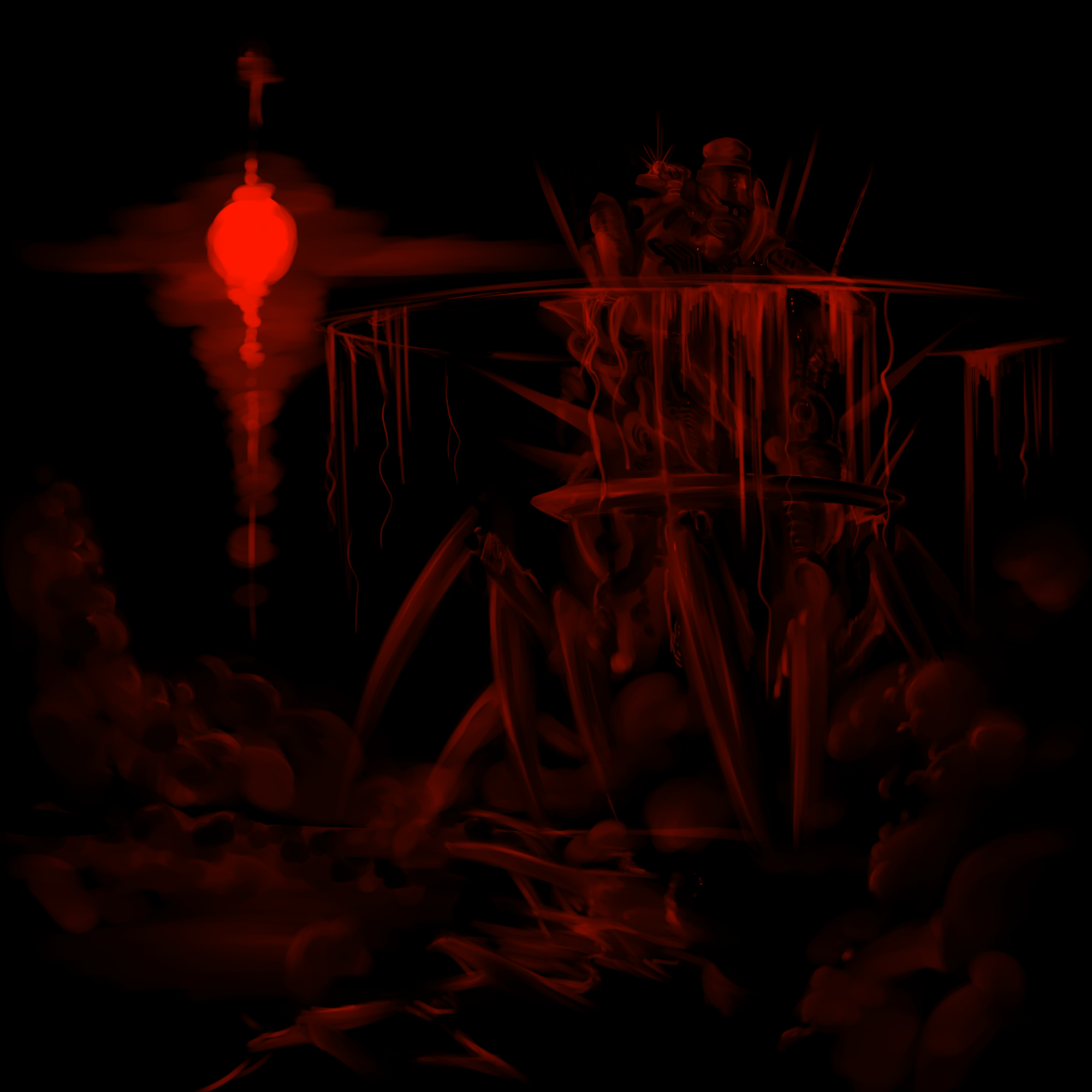
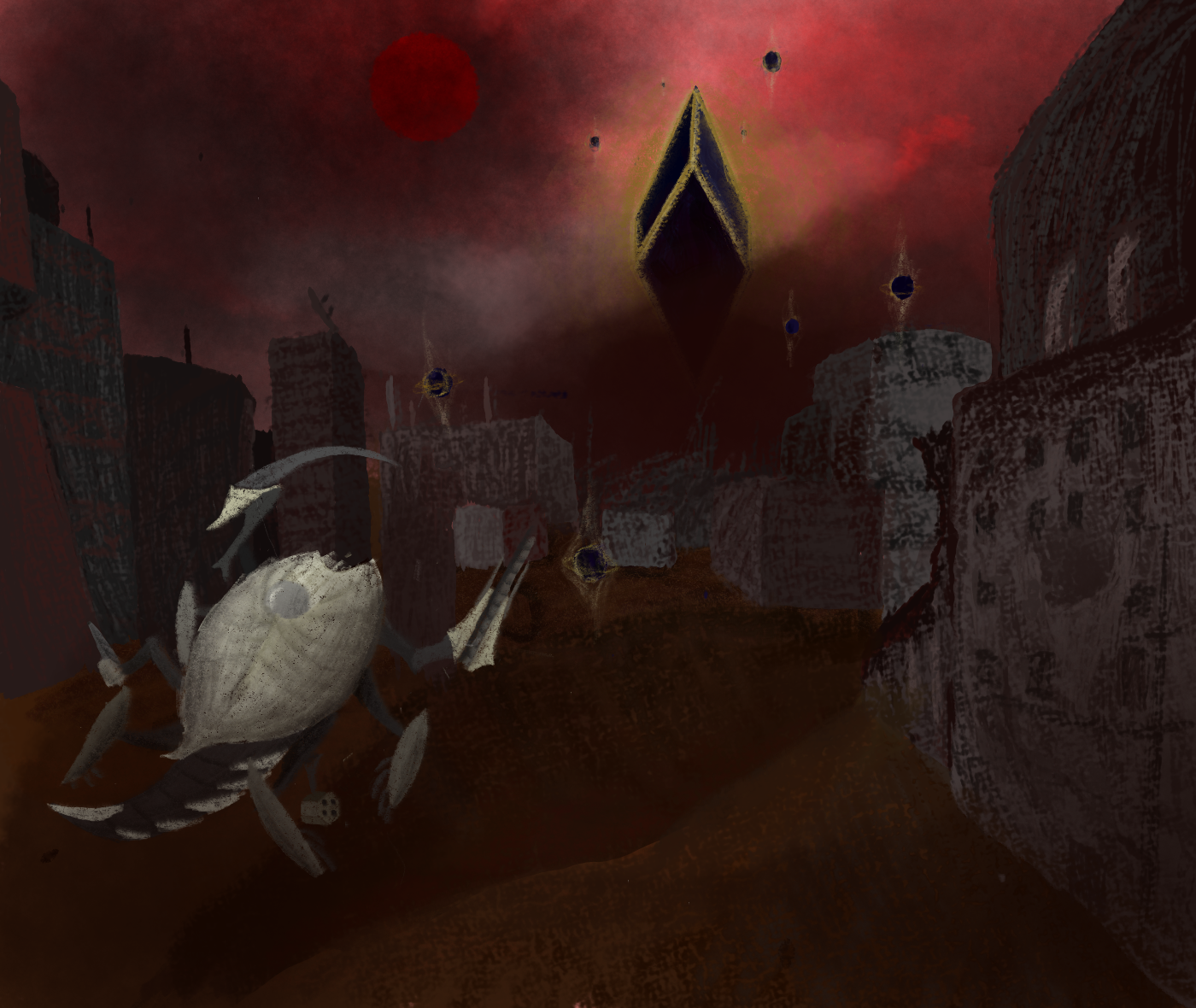
A close-up look at a spade-full of grave dirt. What mighty worms and carrion beetles scurry and gnaw in this barren soil? What plots and plans do they hatch? What designs do they draw up – and what wars do they fight, behind the curtain of death?

Shilu’s a sharp one. I wonder what she’ll think of Elpida.

And we are back! Thank you all so much for your support and patience, dear readers. On with the show! An interlude this week, indeed. Next chapter we are onto arc 10 for real, and very likely a much-needed return to Elpida herself, and a much deserved period of rest and recovery for some of our hardworking zombie girls, not to mention all the plans to be made. Arc 10 might be a bit shorter than arc 9, I think, but we might be doing quite a bit of POV switching. I won’t be sure until the girls hit the page and ruin my plans, so we will see!

No Patreon link this week, as today is the last day of the month, and I never like double charging anybody. Feel free to wait till tomorrow, if you were suddenly planning on subscribing!

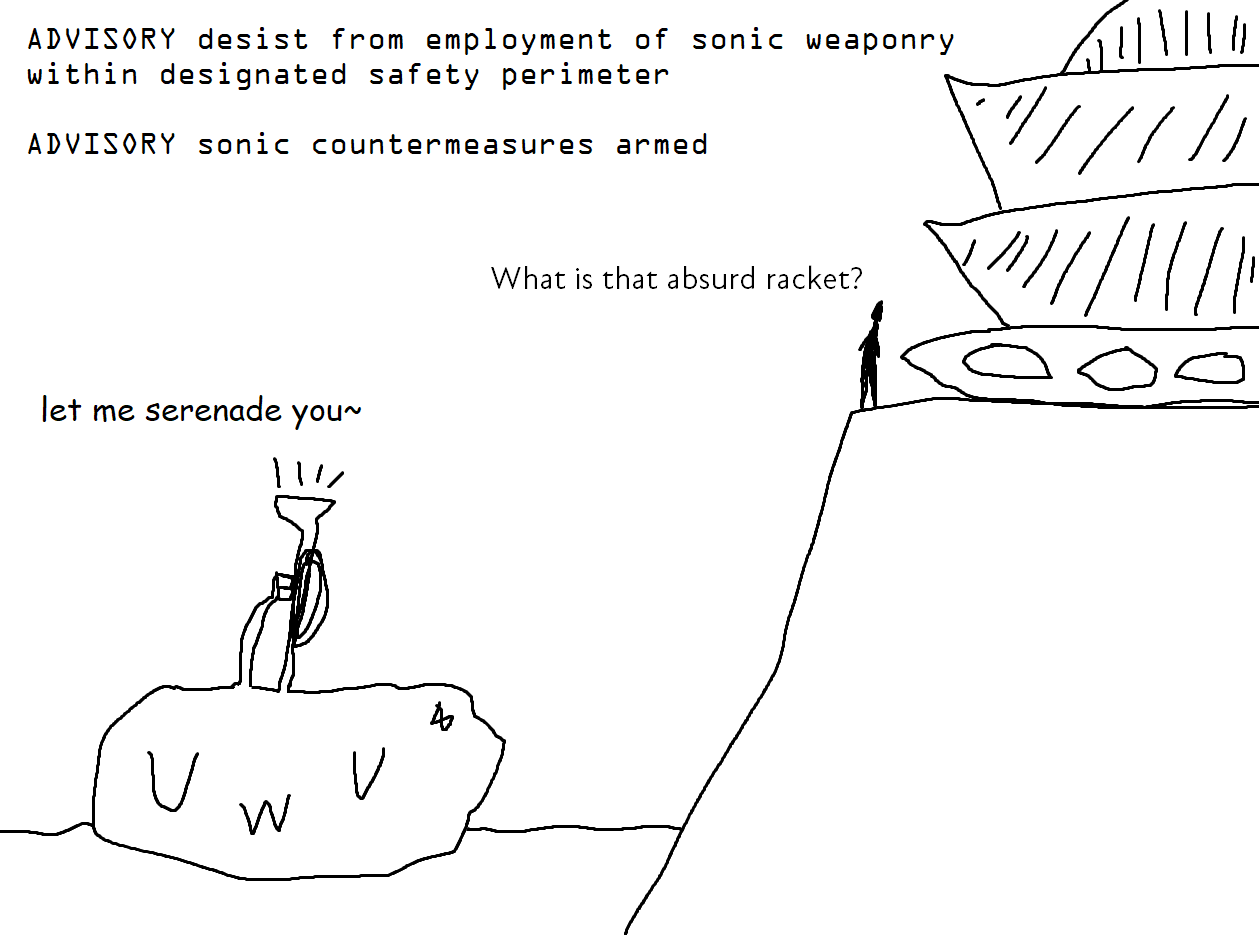
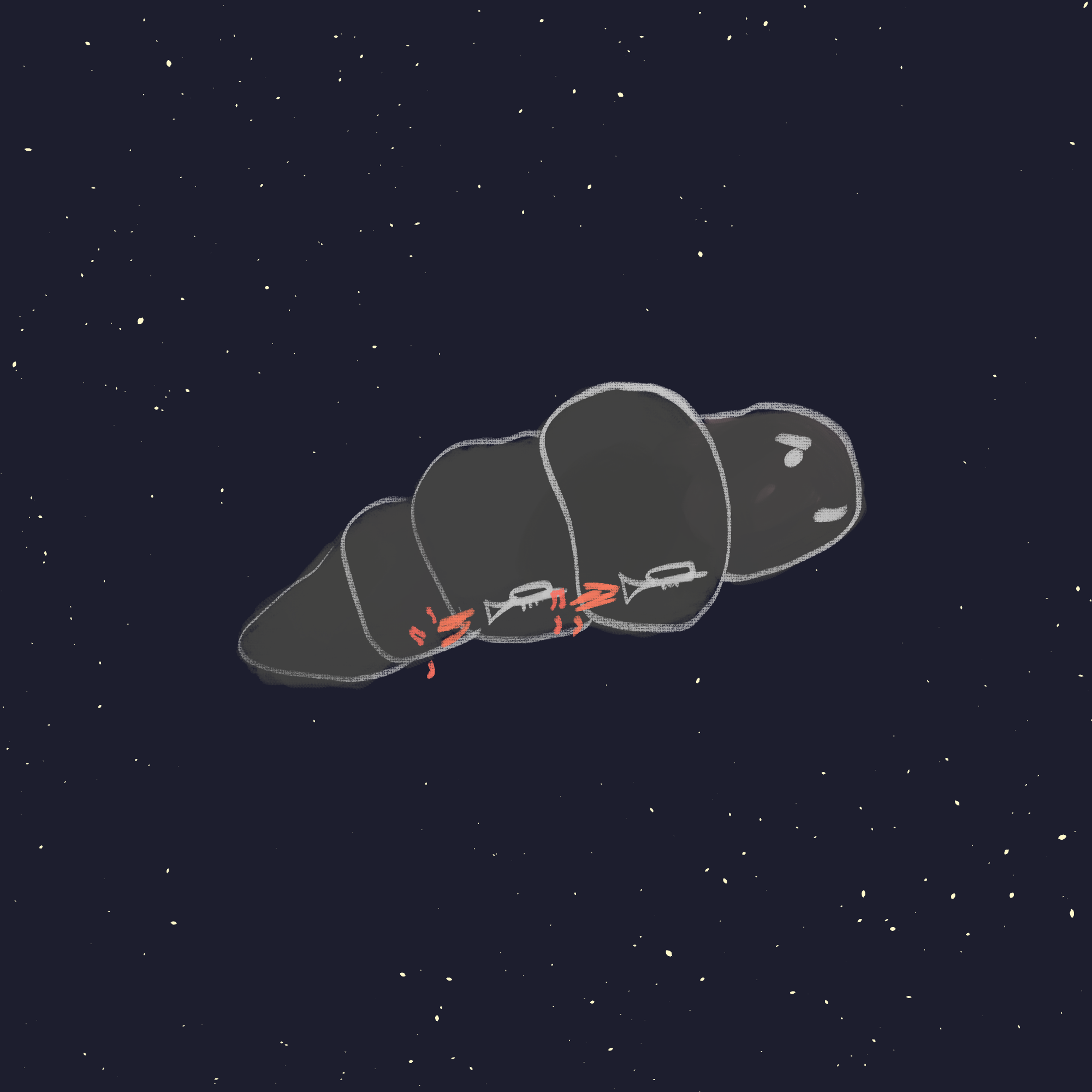
In the meantime, please enjoy this wonderful artistic rendition of Iriko doing her absolute best to show off her musical skills to her beloved tank boy, once again provided by ray! Thank you for letting me share it here!

But there’s also a TopWebFiction entry, even when it’s nearly the end of the month! Voting makes the story go up in the rankings, which helps more people see it! This only takes a couple of seconds, and it really helps! If you have a moment, please consider voting.

And, as always, dear reader, thank you so much for reading my little story. I hope you are enjoying Necroepilogos as much as I am enjoying writing it. Onward we go! Down through the ashes and the dirt, to investigate the deeper strata of this dead world. Until next week! Seeya!

impietas – 9.12

Content Warnings

Body horror (I know, I know, it’s Necroepilogos, of course there’s body horror. But, like, body horror)
Vomiting


Previous Chapter Next Chapter


Elpida climbed through Pheiri’s top hatch and stepped out onto the flat armour of his exterior deck.

The sky was a burning blanket of charred and caustic gilt-gold gloaming.

Radioactive wind whispered against the hood of Elpida’s armoured coat and tugged at the shirt wrapped over her mouth and nose. The air stank of superheated metal, masonry dust, and carbonised meat. Pheiri’s hull was coated in a thick layer of black soot, streaked with dry crusts of grey mud, and spotted with flecks of muted gold; those shining sparks were turning red-brown like dying stars, as their power was slowly neutralised by the molecular composition of the carbon bone-mesh armour.

Pheiri’s hull-mounted weapons stood silent sentinel as Elpida emerged. Autocannons covered the slumped and cracked buildings on either side of the street; sponson-guns tracked back and forth across the ruins; swivel-nubs and pintle-mounts pointed backward to cover Pheiri’s rear; missile-pods and point-defence batteries scanned the sliver of red-hot sky visible at the top of the artery-canyon.

Elpida knew half those guns were spent. Internal magazines awaited fresh rounds from Pheiri’s on-board ammunition manufactories, clunking and whirring down in his guts. He bristled like a hedgehog, half tooth and claw, all the rest mere threat and promise.

His main gun — the PBE, the particle beam emitter — was offline. Nobody was at the MMI-uplink to provide fire control.

Elpida could not see the cannon from where she stood on the rear deck, but she could hear the metal ticking and creaking as the weapon cooled. A wall of heat-haze rose from the front of Pheiri’s turret, scorching the air and baking the nearby streaks of mud into hard black flakes. Thirty two minutes had passed since the final shot, but the gun was still hot.

Elpida would not have ordered Pheiri to fire again, even if the PBE was his only operational weapon. The energy demand of his main gun had taken a terrible toll; every shot had stirred a stalling stutter from Pheiri’s nuclear heart.

By the end of the fight he had been running on half-power draw, active shields thinned to minimum, squinting through the storm-murk with a reduced sensor array.

Elpida and Howl had guided him away from the crater and the downed golden airship, wriggling back into the ossified guts of the corpse-city.

After twelve minutes and thirty seven seconds, Pheiri had regained enough internal coherence to re-ramp his reactor and resume control of his own internal functions; Elpida and Howl had helped, pressing systems back into Pheiri’s hands, easing him upright, tightening his armour, patting him on the metaphorical back. After eighteen minutes and thirty one seconds he had gently advised Elpida to disengage the MMI-uplink — she was welcome to stay, but she was also shaking all over from neurological feedback, on the verge of hypothermia, and suffering significant epistaxis.

Pheiri was right; Elpida had opened her eyes and removed the MMI-uplink helmet to find her lower face, chin, and t-shirt soaked through with blood — and not from the cut on her hand. Her nose was running freely with sticky crimson mess, the price of neural interlock without a proper MMI slot.

After twenty five minutes and a short debate, Pheiri had halted — along with his escort — so that Elpida could initiate proper communication.

Pheiri and Elpida and all her companions were now over half a mile away from the impact crater, burrowed back into the labyrinthine safety of the corpse-city streets, surrounded on all sides by crumbly concrete and rusted steel and shattered brick, far beyond the lethal storm-zone stirred up by the golden airship’s death throes.

The sky was bleeding.

The soot-black ceiling of choking cloud was dyed golden-red, as if licked by tongues of flame from a roaring bonfire. The toxic light of the wounded diamond spilled upward from the crater, far away to Elpida’s right, buried behind the buildings.

Howl purred in the back of Elpida’s head: Almost like a real sunset, right? Bet nobody’s seen one in millennia. How romantic.

Too much radiation in the air for romance, Elpida replied. She tugged her makeshift mask tighter around her mouth and nose.

Says you! Howl cackled. We’re zombies, girl! It’ll burn a bit, but we’re immune. Sure does put some spice on your tongue, right?

Elpida could no longer see the airship with her naked eyes; her intel came from Pheiri’s sensors. The gold diamond had ceased thrashing and writhing in the centre of the whirlpool of ruin. Central’s ‘physical asset’ lay still — but it was not dead, not yet. The leviathan had plugged its terrible wound with its own gravity generators, and then coiled the rest of its vast tentacles around the ruins of the nearby skyscrapers. The remaining ball-shaped rotor-craft had pulled back to guard their mother-ship with a thick cloud of gravitic needles and feelers, forming an invisible shield wall.

Whatever it was, the machine was downed, neither pursuing nor fleeing. Good enough for Elpida.

In the opposite direction, on Elpida’s left, a mountain range was on the move.

The graveworm had begun grinding forward across the city, burrowing through the dead flesh of the world. A deep tremor ran through the ground, lurking below awareness unless Elpida concentrated on the sensation. The distant jagged line of the graveworm’s hide seemed to be slowly rotating, slate-grey mountains rising as others fell toward the ground.

Did the worm spin as it crawled, like a drill chewing through bone?

Between worm and diamond, in the middle of the street, dead ahead, stood Arcadia’s Rampart.

Elpida’s companions joined her on Pheiri’s exterior deck — not everybody, only those who wished to brave the trailing edge of the radioactive storm, to witness this communication up-close.

Vicky huddled inside her own armoured coat, hood pulled up against the wind and the stench. Kagami clung to Vicky’s side, too weak to walk unaided, but too fascinated and determined to be left below. She was swaddled in fresh bandages beneath two coats. Her auspex visor covered the top half of her face; the lower half was hidden behind the black rubber of a gas mask. Vicky wore a gas mask as well. One mask had belonged to Pira, while the other was among the equipment that Elpida had taken from the tomb, just after resurrection. Vicky had tried to insist that Elpida should wear the best protective equipment, but Elpida had declined. The masks were not necessary for zombies, not really. Elpida had more than enough raw blue nanomachines still in her system to endure a little radioactive dust in her lungs.

Atyle wore no protection except her coat, hood down, front open, head high. Her face was burned and blistered from earlier exposure, and her biological eye was still white-blind with damage. But she breathed the toxic air with open relish.

Ilyusha and Amina sheltered together in the lee of the top hatch, faces swaddled with cloth, close enough to watch and listen but still technically inside Pheiri, spared the worst of the wind and the grit and the contaminants.

Melyn and Hafina had declined the invitation, preferring to stay below and watch the exchange on Pheiri’s sensors. Pira was too still injured to drag herself out of the control cockpit, and Ooni refused to leave her beloved Leuca’s side.

Elpida was wearing the comms headset beneath her hood, for emergency communication with the cockpit, in case Pheiri needed to execute any sudden movements.

Elpida judged that was unlikely; they had acquired quite an escort.

Serin was sitting on a gnarled outcrop of Pheiri’s bone armour, at the edge of the top deck, a silent wraith wrapped all in black. Her usual woody, mushroomy stench was undetectable, overpowered by the storm. Her robes had puffed up and stiffened with internal layers, and her metal mask had expanded into a helmet of matte steel armour, though it was still marked with twin rows of jagged teeth in black paint. She showed no flesh except for a thin strip of pale skin around her augmetic red eyes, behind a narrow transparent window.

Elpida acknowledged her with a nod. “Serin.”

Serin rasped from inside her mask: “Fresh meat no longer. Nice ride, too. Don’t think you count as new anymore. You need a proper name. I think.”

Atyle raised her chin. “God-touched.”

Serin replied, “You’re too kind.”

“Us,” Atyle said. She smiled, wide and toothy. “Not you.”

Serin snorted. The sound was distorted by the metal of her helmet. “You’ve got rad-burns from crown to collar. Touched is right. You’ll be peeling like pastry within a day.”

Elpida said: “Just Commander is fine, thank you.”

Serin made a ‘hmmmm’ sound, then said, “Not mine.”

Elpida’s right hand was wrapped in a rough mitten of bandages, to seal the deep gash she had sustained while climbing into Pheiri’s turret seat; she’d not had time to let Melyn do a proper job with stitches and dressing. Elpida’s blood was already soaking through the bandages and dripping from her fingers.

She raised her bloody paw, pressed her stained index finger to the left breast of her armoured coat, and drew a quick and dirty version of the crescent-and-line symbol — the same symbol that Serin bore tattooed on her arm and Ilyusha had drawn on her t-shirt, the symbol the Death’s Heads had hated.

Then Elpida added the second line, the improvisation of her own, turning the symbol into a pictograph of Telokopolis.

Serin raised her eyebrows.

Elpida said: “You and I need to talk, Serin. Later.”

Serin tilted her head — a half-nod. Elpida decided that was enough. She had bigger concerns right now.

Past Serin — past Pheiri’s hull emplacements, past the edge of his armour and the housing for his tracks and the jutting bulges of his sponson-mounts, sprawled across the ash and dust in the street — was a giant mollusc.

A protoplasmic zombie-thing, almost two thirds Pheiri’s size, with flesh the colour of oil on unsettled water. The edges of her slug-like foot were slowly melting through the ground on which she sat. She extended pseudopods to scoop up bits of brick and concrete, breaking them down with acidic mucus before pulling them back into her core. Her back was plated with bristling layers of overlapping silver scales, like mailed armour, flexing and twitching in the nuclear breeze, glimmering with a reflection of the burning skies. She sprouted eye stalks capped with iridescent globes and pale marsh lights and hundred-faceted compound spheres.

Parts of her hide were still blackened and burned from where she’d defended Pheiri. Chunks of armour were missing, or still regrowing. Flesh hung in ragged sheets, slowly reabsorbed into her main body.

Pheiri’s internal sensors had designated her with a dizzying array of threat levels and specialised warnings — and, finally, as ‘Iriko’.

Elpida was armed with her submachine gun slung over one shoulder, but the weapon was mostly for show. She could grip and spray with one good hand easily enough; she was ambidextrous, after all — a minor benefit of the pilot genome — but she doubted small calibre bullets would bother this zombie. If Iriko wanted to flow over Pheiri’s back and kill everyone present, Elpida could probably not stop her. Pheiri probably couldn’t stop her either, not in his current state.

Big fucking girl, isn’t she? Howl hissed with overt appreciation. Big as you, Elps.

She’s on our side, Elpida replied. Pheiri was quite clear about that.

Wishful thinking! Howl cackled. Not complaining, though. I did like her style, right off the top rope! Ka-slam!

Elpida asked: Have you seen anything like her before?

Howl went silent.

Elpida followed up: I’m not accusing you of anything, Howl. I love you, however you got here, whatever you’ve become. You’re my clade-sister first, a daughter of Telokopolis, whatever else you are.

Howl growled. Mmmmmmrrrrrr.

If you have information on this form of revenant, please share it with me.

You think I wouldn’t? I’ve seen less than you think, Elps. Pretty much the same as you. I ain’t been around for long. But nah, never seen this before. Never seen much.

That’s all I needed to hear. I trust every word. Thank you, Howl.

Howl hissed between her teeth, to cover her sniffles.

Elpida waved to Iriko. She raised her voice, calling through the fabric over her mouth: “Thank you! Iriko, thank you for the assistance!”

Iriko reacted like a slug poked with a stick. The giant blob retracted most of her stalks and sensors, then slowly re-extended a single dark purple eyeball, staring back at Elpida.

Kagami was hissing under her breath: “Fucking hell. Fucking hell. Fuck me. Fuck.”

Vicky mumbled, voice muffled by her gas mask: “S’not that bad, Kaga. She did save us from those choppers.”

Kagami spluttered. “‘Choppers’? What are you, a Twen-Cen TV drama? That’s not a fucking AA emplacement, it’s a … it’s … a … ” 

Elpida said: “Hold. Stay calm. We’re among allies.” Kagami started to splutter, but Elpida ignored her and leaned toward Serin. “Can Iriko communicate?”

Serin’s eyes crinkled with a hidden grin. “With me? Radio only. Firewall any connection. She loves to inject.”

Vicky spluttered too, eyes going wide above the black rubber of her gas mask. “She what?! Sorry? Inject what?”

Serin chuckled. “Keep your distance. To her, you are still fresh meat. We all are. Little morsels, wet and wriggling.”

Elpida said: “Is she safe?”

Serin shrugged. “She is sated. For now. But tread lightly.”

“I need to thank her,” Elpida said. “She saved us from those three rotor-craft when Pheiri was down and out. It’s very important to me that she understands our gratitude. Can you do that for me, Serin?”

Atyle put her hands together and bowed her head toward Iriko; the blob responded — she extruded several random pseudopods and feelers. Atyle straightened back up and smiled in return.

Atyle said: “It is done, Commander.”

Elpida replied, “Thank you, Atyle, but we need more specificity.”

Serin glanced toward Iriko, then said: “She knows. But she did not do it for you.”

Elpida nodded. “Good enough. And, Serin? Thank you as well. You helped us escape from the Death’s Heads, whether you intended to or not. We may not have made it out without your support.”

Serin purred inside her helmet. “Always a pleasure to hunt the death cult. I could have done better. Always.”

“Let me know right away if Iriko gets … ” Elpida trailed off. She was uncertain how to phrase the request.

Kagami snapped through her gas mask: “Hungry?! Irritable!? Commander, we should not be stopped here, not like this!” She gestured with one hand at Iriko, then over her other shoulder at the towering flesh-blossom of Arcadia’s Rampart. She glanced back and forth, eyes wild and bloodshot behind her auspex visor. “Not like this.”

Vicky forced a chuckle; the gas mask turned it into a wheeze. “Don’t be rude, Kaga. Blob-girl here saved our asses. And the mech, uh, well, it wants to talk, right?”

Kagami turned on Vicky with a twitch in one eye. “I am not afraid, Victoria! I am advising tactical dispersal! This nanomachine blob thing is turning us into a prime target. And … that—” she gestured at Arcadia’s Rampart again “—is clocking in like a fucking primitive signal fire on this!” She slapped the side of her auspex visor. “I don’t even need this! The thing is visible for miles in every direction! And the graveworm is moving. We move with it, or we get left outside with the monsters. Isn’t that how it works? Am I the only one remembering that!?”

Ilyusha snapped from down in the stairwell: “We all know! Fuck you, legs!”

Vicky sighed. “Yeah. Kaga, we’re all tired, not stupid.”

Serin purred. “This one thinks highly of herself.”

Kagami pulled herself straighter, clawing at Vicky’s shoulder for support. Vicky grudgingly tightened her grip around Kagami’s waist. Kagami snapped: “Higher than the rest of you! Am I the only clear thinker in this gaggle of left-behind de-wired operatives? We move with the worm or we get eaten, isn’t that how it works?”

Elpida said: “I don’t think she can come with us.”

Kagami’s head whipped around: “What!? What are you talking about?”

“Arcadia’s Rampart. Thirteen. And Iriko, I think.” Elpida held Kagami’s gaze. “Neither of them belong inside the graveworm safe zone. They’re both too big and too powerful. We’re at a crossroads. This is decision time.”

That shut Kagami up. Vicky just watched, eyes shadowed by her armoured hood. Atyle murmured, “We go among the gods.” Down in the lee of the top hatch, Ilyusha raised a clawed hand and curled a fist in acknowledgement. Amina just stared, eyes wide, the rest of her face wrapped in cloth to protect against the radioactive dust and sharp-grit wind.

Elpida strode forward across the exterior deck and stopped behind the massive armoured hump of Pheiri’s turret.

Arcadia’s Rampart dominated the street ahead. The combat frame towered over the nearby buildings, dwarfed only by distant skyscrapers — a plate of crimson flesh encrusted with blackened bone, studded with weapon emplacements like horns and claws, crawling with vitality and motion and growth. Three of the frame’s massive legs were planted in adjacent roads, while one leg was braced against a steel roof, buckling the building beneath. Despite the extensive transformation and the damage it had sustained during the battle, the combat frame still bristled with weaponry, pointing all manner of armament in every direction, watching the sky with far more firepower than Pheiri could currently muster.

Bone armour had melted like wax and reformed into fractal sheets of snowflake intricacy, draped down the frame’s sides like curtains of effervescent lace. Machine-meat innards had burst from beneath, spilling waves of bloody crimson and shining garnet and glistening scarlet out into the open air, to curve and coil into flourishing braids and tumescent vines, radiating into mucosal mats of blushing pink tissue, twisting into cables of iron-red muscle, sprinkled with ocular organs glittering like rubies embedded in lava. The frame’s underside bulged with distended pouches of pulsing sinew and cartilage, sprouting tendrils which spiralled downward and blossomed outward into sweeping clusters of branching feelers.

The frame’s back had opened into a gigantic cup of frilled petals, pirouetting and swirling, the heart of a miniature storm of meat and bone, so high up that Elpida could not see without the aid of Pheiri’s sensors. Towers of meat reached upward from that vortex of change, brushing the air, shivering like stamen, scattering pollen of coral and fuchsia upon the nuclear breeze.

Vast patches of exterior bone armour were cracked and blackened, broken by the assault of the gravity effectors — but fresh scabs were pushing through the oceans of throbbing meat, already whitening around the edges with fresh osteogenesis. Much of the exposed machine-meat flesh — largely on the top and front of the frame — was charred and cracked, blackened by heat, weeping soupy dark vermilion plasma, cooked by the toxic golden light of central’s physical asset. Some of it was still steaming. Elpida could smell it on the air, like roast pork.

But fresh tissues, red-wet and quivering, were already crawling up those Arcadian towers, reabsorbing the damage with cellular self-cannibalism. Great strips of burned meat fell away, pulled apart by feelers and fed back into the vast central bloom-mouth of the giant blossom.

Beautiful, isn’t she? Howl purred. A little piece of Telokopolis, reborn.

Elpida blinked tears out of her eyes — but she was less certain than Howl: the frame glowed with the same verdant red light as the hidden meat of Telokopolis itself, beautiful beyond even Elpida’s memories of home; the combat frame had blossomed into a truth Elpida had barely grasped during life; but she was not insensible to the intimidating stature and biological overgrowth of what Arcadia’s Rampart and Thirteen had become.

Her companions likely saw a monster, or a god, or an enigma in flesh and bone. Elpida tried to keep that in mind.

Arcadia’s Rampart was also the reason Elpida had called a halt. The combat frame had been moving slower and slower, even while keeping pace with Pheiri, as if reluctant to plunge into the graveworm safe zone. Communication via Pheiri’s comms had proved impossible.

Elpida asked Howl: If we lead this combat frame closer to the graveworm, could you keep the worm-guard off us? Could you keep them off Iriko, too?

Howl cringed and hissed. Nah. Soz, Elps. Can’t pull that trick again, at least not so soon. The worm’ll be wise to my shit now. For a bit. And even if I could, I couldn’t hold their targeting for long. There’s hundreds of worm-guard close to the worm, and it can slap together thousands more in minutes. That’s how it works. Fucking near killed me just roping three for a few minutes.

Never leave me again without explicit orders, Howl.

Ha. What, you get lonely without me all up inside you?

Just don’t.

Behind Elpida, Vicky’s voice quivered inside her gas mask: “What the hell are we even looking at here? Elpi? Hey? Is this like … is this like where you came from? Is this like Telokopolis?”

“Not exactly,” Elpida answered.

Ilyusha yapped from down in the stairwell, “Cool shit!”

Atyle said: “A newborn god.”

Kagami hissed between her teeth. “A nanomachine gyre. A grey-goo event with legs. A class one atomic sterilization target. A failure of proper containment!” She huffed and cleared her throat. “No offence, Commander. I know this is your … kin.”

Elpida said, “A piece of Telokopolis, yes.” She reached up and tapped the earpiece of the comms headset. “Pira, do you read me?”

Pira’s voice crackled across the short-range link, raspy and raw, from down in Pheiri’s cockpit. “Commander.”

“Good. Pheiri, can we try a comms handshake again? I want to test if Thirteen is saying anything new. She stopped when we stopped, so I’m going to take that as a good sign.”

Elpida’s earpiece clicked twice, buzzed with a brief burst of static, then re-established a direct audio link with Arcadia’s Rampart.

A voice like boiling blood chewing on molten bone filled her ears.

“—missing the heart of all matters, missing your hand in my belly, missing the heat of your breath. Fifty times I would have chewed up your flesh if you would have but asked, and five times I would have given mine unto you, and still we would not have equalled each other. Your voice swims the aether between worlds but my ears were never graced with a song. You are lost in a mire with all hands, yet I cast you a rope from the rocky shore. Twelve times I will come and twelve times your mouth will open and drink me deep and make me your innards—”

Elpida winced. “Cut connection.”

The screeching cacophony went silent. Pira crackled across the earpiece again: “Pheiri’s storing the raw translated audio for you, in case it’s ever important. I think that’s what he means. But it’s just more of this nonsense. It goes on and on and on.”

Elpida gazed upward at Arcadia’s Rampart. The combat frame — or whatever it had become — was backlit by the false dusk of the burning sky, haloed by the innards of a corpse on fire.

Elps, Howl purred, almost embarrassed. That was, uh—

Elpida saved Howl the embarrassment. The worst Upper-Spire love poetry I’ve ever heard, yes.

Howl scoffed. Worse than the shit Kos used to write down? Didn’t she write one for you, once?

Kos wrote three poems about you, Howl. And they were very beautiful. Unless you’ve forgotten? No answer. Elpida smirked. It’s worse, yes, and not just because Afon Ddu was different to us. Mostly because it’s incoherent. She’s switching rapidly between different forms and registers. One line is a hearts-dirge, the next is sun-glare sonnet, then almost an elegy. She’s jumbled up.

And the screeching! Howl laughed. Don’t forget the screeching! And it doesn’t end. She’s, what, broadcasting this in an endless signal? This girl is down real bad.

Elpida nodded. She did not have time to consider the implications of this. Same thing I’d do for you and the rest of the cadre, Howl, if I was in her position.

Howl spluttered. Elpida felt her coil up and hide.

Elpida spoke into the headset again: “Pheiri, can you please rotate your turret ninety degrees to the left? I want to talk to Arcadia’s Rampart — or to Thirteen — face to face, without the heat haze from your main gun getting in the way. Sorry, I know you’re tired.”

Pheiri did as requested; the massive armoured hump of his turret rotated slowly to the right. The distended purple-red spear of the PBE swung around, trailing heat-haze, still red-hot and hissing as it passed through fresh, cool air.

Elpida waited for the turret to stop. “Thank you, Pheiri.”

Then she mounted the turret, climbed to the apex of Pheiri’s armour, and faced Arcadia’s Rampart. She raised her bloody, bandaged hand.

“Thirteen!” she yelled. “Thirteen, it’s Elpida! It’s your Commander!”

The combat frame did not respond.

Put us through, Howl said. Put me through to her.

You want to hear more love poetry?

Howl hissed. No, cunt-brain, I want to snap her out of it! Put us through, one-way audio. And let me do the talking.

Elpida tapped her comms headset again. “Pheiri, patch me back through to Arcadia’s Rampart, my audio only.”

Click-click. Pira said: “Pheiri says go. You’re live.”

Howl took control of Elpida’s lips and tongue. She spoke in clade-cant, cackling into the headset, her words whipped away by the radioactive wind.

“Hey, lover girl! You wanna save that pillow talk for after you get your cunt stretched? Maybe wait until you’ve not got an audience! Or do you like that, you like showing off? Hey, I’m talking to you, that’s right, down here!”

Arcadia’s Rampart quivered like a flower in the breeze — and then lowered its distended belly, easing closer to Pheiri with a forest of crimson feelers.

A dripping sphincter opened up deep in the mass of fractal flesh and blossomed bone, parting in waves of meaty fronds and fluttering frills of delicate membrane.

A rope of meat ten feet in diameter emerged from the orifice. The cable of flesh coiled through the air, twisting toward Elpida with slow and sinuous motions, rippling with waves of peristalsis.

The tip of the tentacle melted like candle wax sloughing from a marble statue, leaving behind an engorged and swollen core. Sleeves of skin pulled back and peeled away, coated in soft wet juices of maroon and umber; droplets fell hissing upon the ashen ground. Flesh flexed and flowed with rapid change as the tentacle dipped lower and lower, then completed and clarified as it came face-to-face with Elpida.

A recognisable human form stood at the tip of fifty meters of meat-tentacle — hips and stomach, ribcage and breasts, shoulders and collar bone and bobbing throat. Slender arms detached from the wall of flesh, waving delicate fingers that sharpened into bone-white talons. A face emerged from the roiling crimson — narrow and aquiline, sharp-jawed and hard-nosed, with burning purple eyes, copper-brown skin, and a flowing mane of albino-white hair.

Pilot phenotype.

Thirteen grinned back with all her heart — and a mouth filled with six-inch fangs.

Thirteen — if this was indeed the original pilot and not a reanimated flesh-puppet — was much larger than any baseline human being, scaled up in every way possible, like a little giant on the end of an even larger thumb. Her skin bubbled and roiled like simmering meat cooked in boiling tar. Her purple eyes shone with the inner glow of Telokopolan machine-meat. Her fingers and teeth kept shifting back and forth from blunt human standard to razor-sharp predatory tools.

Elpida’s companions had gone quiet. Kagami was panting rapidly through her gas mask. Amina had made a tiny sound of awestruck terror, then fallen silent. Atyle murmured: “The godling seed. You are a beautiful thing. You are the sun.”

Woah, said Howl. She is big. No kidding.

“Thirteen,” Elpida said. “Are you there?”

Thirteen’s face grinned even wider — the flesh of her cheeks split open to reveal deeper rows of teeth — then snapped back to human-normal, a beaming smile of euphoric delight.

“Commander!” she burbled, speaking in a voice of burning blood and chips of charred bone. The sound seemed to come all the way down the flesh-tentacle before emerging from Thirteen’s mouth.

Elpida concealed a wince. Behind her, somebody staggered backward and almost fell over. Vicky hissed a curse. Somebody else scurried down into the safety of Pheiri’s insides. A sharp set of claws wrapped around Elpida’s ankle — Ilyusha, ready to yank her to safety.

Elpida held one hand low, and said: “Hold. Everybody stay calm. Thirteen is one of us, one of my sisters, no matter how distant in time. She is on our side.”

Thirteen bobbed left and right on the end of her tentacle. “Yes! Yes, Commander! Yes! I’m still here, I’m still me.” Thirteen’s head twitched to one side, flowing apart in a wave of flesh, then reforming again. “Still us. We were always us. We were always here, always like this. It just took a push to know the truth. Thank you, Howl!”

S’nothing, Howl said.

Elpida had so many questions, but she had to focus on practical concerns; Kagami’s worries about presenting a vulnerable target were not all bluster.

“Thirteen,” Elpida said, “I’m happy for you. I’m very glad we all made it out of there. Thank you for protecting us where and when you could. But—”

“Thank youuuuu! And you, too!”

Thirteen flowed downward, engulfing Pheiri’s front in a wave of crimson flesh and branching feelers. If Pheiri reacted, Elpida could not tell. Behind her, somebody let out a weird, warbling trumpet noise, wet and fleshy. Elpida glanced back and saw that Iriko had sprouted an array of noise-maker organs.

Thirteen flowed away from Pheiri’s front armour again, reforming back into her human-puppet visage.

“Oh,” Thirteen crooned. “But there is a flutter in your heart, little brotherrrrr.”

Iriko tooted again — louder.

Kagami hissed, “By Luna silver soil, yes, this is exactly what we need, an angry trumpet blob! Can you shut her up, you overgrown mushroom?!”

Serin purred: “No.”

Thirteen laughed — a scratching of bone on rust. Elpida concealed another wince.

Thirteen said: “Not my meaning. No, no. A flutter of flesh and metal, of particles rushing around in a little ring. You have strained yourself. You need to eat.”

Elpida spoke up, trying to take control of the situation again: “Yes. Thirteen, that’s right. Pheiri — the crawler, our little brother — has pushed himself too far. We need to get out of the open, back toward the worm. But you were slowing down, are you—”

Thirteen reared back like a striking snake.

Howl recoiled inside Elpida’s mind. From behind, Kagami screamed inside her gas mask and Ilyusha stamped to her feet, hissing a challenge. Iriko rushed around Pheiri’s side, a coruscating blob of armoured flesh ready to throw up a wall in front of his hull.

Thirteen whip-cracked forward — and began to vomit.

A stream of thick, dark, soupy grey goop poured from her mouth and pooled on the front of Pheiri’s armour, seeping into the cracks and pits, collecting in the depressions in the carbon bone-mesh. The vomit had the consistency of wet concrete and smelled like burnt metal.

Elpida shouted into the headset: “Pheiri, back away, back—”

A voice interrupted her — Melyn, chattering at high-speed, from down in Pheiri’s control cockpit. “Nanites! Nanites! She’s giving Pheiri nanites! His nanites! We need those. Need those. Need those. Can’t make them else-wise. Can’t. Can’t. Cant. Not anymore. Anymore. She’s giving. Giving.”

Thirteen kept vomiting. The torrent of grey sludge began to overflow, dripping down Pheiri’s tracks.

Elpida spoke into the headset: “You’re certain? Melyn?”

“We need to collect it! Scoop it up and put it inside him! Don’t waste any!”

Elpida said: “Understood, Melyn. Thank you.” She spoke over her shoulder, trying to reassure the others. “She’s giving Pheiri nanomachines. Apparently. We need to collect it. Vicky, Illy, you’re both able-bodied right now, help me to—”

Thirteen stopped vomiting as quickly as she had begun. She straightened up and looked Elpida in the eyes, perfect and untouched, glowing with crimson light from inside her flesh.

“Commander!”

She was begging for approval.

“ … thank you, Thirteen.” Elpida’s mind worked quickly. She needed to ask this, before anything else: “Can you do that for us, too? For revenants? Can you make the raw blue nanomachines?”

Thirteen blinked. Her whole face became an eyeball, blinking — and then flickered back to normal, though with teeth far too numerous and sharp.

“No,” she said. “I’m sorry, Commander. Pheiri and I — me and us, Arcadia’s Rampart — we’re of Telokopolan flesh, true and alive, but you’re all zombies.” She suddenly started to cry, weeping tears of sticky scarlet. “I’m sorry. My reactors, my stomach, my enzymes, they don’t turn your way.”

“That’s alright, Thirteen,” Elpida said. She quashed the pang of disappointment. “Listen, we need to get out of the open. We need to hunker down and repair Pheiri. And we need to follow the worm. Are you—”

Thirteen’s tears quickened, joined by a sob. She smiled, sad and lonely. Elpida recognised that look instantly; she knew it in her own heart, from her own face, from the way she missed her cadre, her sisters, her world.

Thirteen whispered: “I can hear her voice.”

Elpida’s heart lurched. Her skin prickled. Dare she hope? “Whose voice? Telokopolis?”

“Twelve Fifty Five. A number no longer, not in this heart. She lives. They all live on. Deep in the rot, deep beneath the waves, deeper than we ever guessed.”

Elpida’s head whirled. “Another pilot? Your sisters? How? Where? Thirteen, what do you mean?”

Thirteen closed her eyes, but kept crying. “Faint but faithful. Her voice replies. I sing! I sing so that she will know I am here. She is sunk so very deep. I will dive.”

“Into the green? Is that what you mean?”

Thirteen nodded. “The rot and the black and the waves. She mewls in the dark. They all do, trapped but fighting, forever and ever and ever.” Her eyes snapped open, glowing like lamps. “I can stay with you a short while, Commander. I can walk with you on the edge — but not by the worm. I would be overwhelmed by the little helpers, even changed as I am now. But I can walk with you, until you are safe. But then I must go, I must find her. I must atone for my betrayal. I must plunge into the dark beneath the world, as I once fled into the dark beyond the skies.”

Elpida’s throat started to close. “Then … then let me find a way to help you. There must be—”

“You are too small, Commander. Sister. Elpida. You are not as we once were. You are already dead.”

Thirteen smiled, sad and lonely.

Elpida wanted to plead. She considered begging. To find a sister — even one from millions of years hence — only for her to depart on a quest to places where Elpida could not follow, it was a sharp pain, worse than she had expected.

She was dead. She was not of Telokopolan flesh.

We can’t, Elps, Howl grumbled. We can’t walk to the edge of a continent and stride into whatever the green has turned into. Not without a combat frame. One of our own, I mean. Whatever fight is there, it’s not ours.

It is, Elpida replied. While one of us draws breath, Telokopolis still stands — flesh or otherwise.

Elpida knew she had to focus on the practical necessities. She needed to organise the others to collect the strange grey goo and get it stored inside Pheiri, fed into his machines, to heal his heart and fuel his reactor. And she had to follow the worm — or plunge into the wastes.

Her decision was not yet made.

“Thank you, Thirteen,” she said. “Walk with us a while?”

Thirteen smiled again, with too many teeth coated in tears of blood.

Howl said: She’s gone beyond us. Just … just accept it.

She hasn’t. Nothing is beyond us, Howl. Nothing is beyond Telokopolis.

Howl grumbled. Ugh. Fine. Guess you’re right about that. Turning my own shit against me, huh? Well done.

And, Howl?

Eh? Y-yeah? What!? I don’t like that tone, that’s the tone you make when you think you can win a sparring match! And you can’t!

Maybe not. But you’ve got some explaining to do.

Howl was silent for a moment. Thirteen began to retract toward the sphincter in the underside of Arcadia’s Rampart. Pheiri’s engines rumbled with fresh fire, ready to move. Iriko slid back around Pheiri’s side, to shelter by his flank. Somebody behind Elpida swore softly, muffled by a gas mask. Melyn’s voice crackled over the headset, repeating the urgent demand to collect up the grey goo.

Yeah, Howl growled. Guess I have, right? Got caught red handed and all. Promise me a thing, though? Please?

Whatever you’ve done, whatever you’ve become, I am still your Commander, and you are still my sister, Howl. I saw Pheiri’s internal warning, just before you returned, about detecting a nanomachine control locus. Are you a Necromancer?

Howl snorted. Stupid word! But, yeah, I … I think I am, by definition, sorta. Doesn’t mean what you think it does, though. I don’t work for anybody but myself. And occasionally you! Ha!

I would never dream otherwise.

Yeah yeah.

So, enlighten me, Howl.

Howl hissed. About what? I don’t know shit! Not much more than you do. I haven’t been around long enough. You think I’m hiding knives up my fucking sleeves? I’m hiding my own fucking arse, that’s all. You wanna see my arse? Wanna stare into my—

Elpida gestured at the grey goop on Pheiri’s armour. “Vicky, Illy, get below, get containers, whatever you can find. Ask Melyn and Haf. Serin, you help me. Atyle, go lie down. Kagami, get below and sit. Vicky, Vicky just guide her down.”

The others scurried into motion. Serin stood up slowly, sauntering over. Elpida climbed down off Pheiri’s turret.

You can show me while we work, Howl, Elpida said. You’re gonna show me everything, arse included. Now, let’s get started.


Previous Chapter Next Chapter


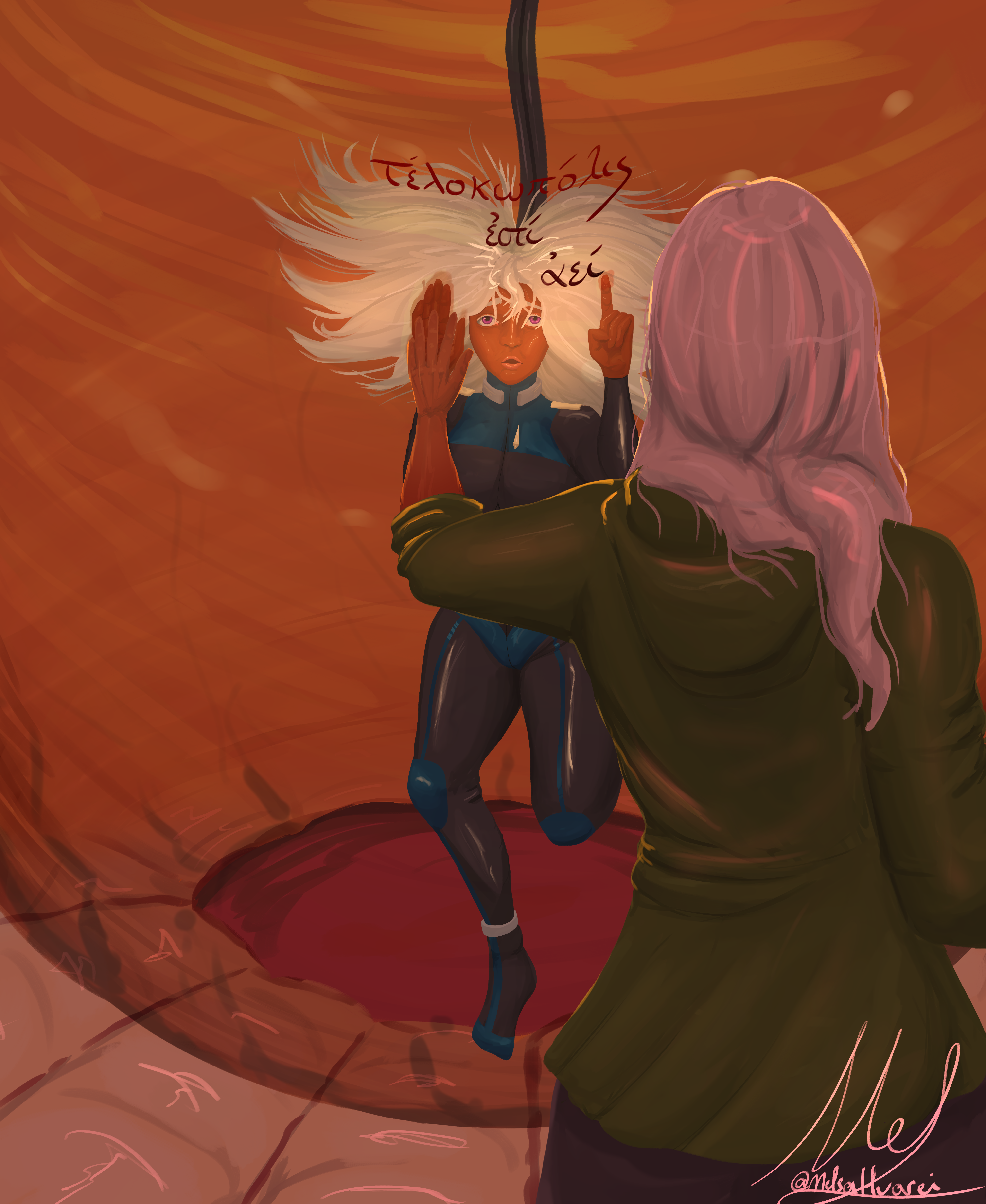
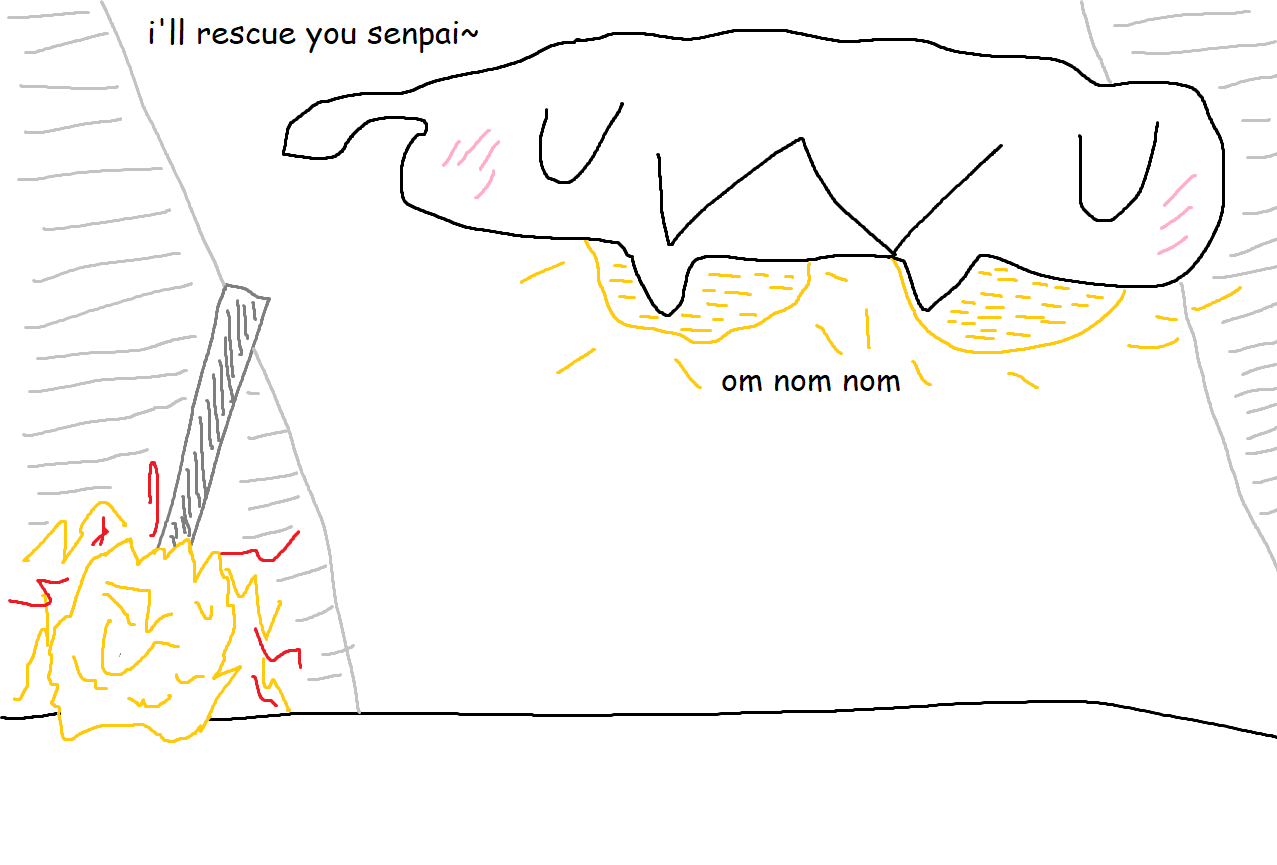
Iriko toots her displeasure! (by Melsa Hvarei, over on the discord! Shared with permission! Thank you so much!)

Also from the discord, I wish to share two fandom summaries of some major plot movements this arc:

WHAT IF WE SPENT TWO MILLION YEARS LOCKED IN A ROOM TOGETHER GOING INSANE WITH DESIRE AND MISSED OPPORTUNITY HATING EACH OTHER MORE WITH EACH PASSING MOMENT UNTIL THE HATE DRIVES US BEYOND THE BOUNDS OF REASON AND WE BOTH GO MAD AND YET STILL WE CANNOT GIVE IN TO OUR OWN DESIRES

AND. WE. WERE. BOTH. GIRLS. 

And,

What if you died and you thought that I’d died but I lived but living without you was pointless so I swore that I would bring you back no matter how long it took so I decided to live forever and over a billion years I made a new world with the express goal of finding you and bringing you back and nothing else mattered even as I tore down the cities that had birthed us and smothered the world in my creations and then another billion years later amidst the ruins that were my creation you did come back after all and We. Were. Both. Girls.

(Both of these are by Saffron, shared in the discord, and re-shared here with permission! Thank you!)

(A couple of comments have made me aware that I should probably state for the record: the above summaries are fanfiction, i.e. theories, and should not be taken as metatextual/authorial commentary either confirming or denying anything about the story. Everything down here in author notes is just for fun, really!)

Ahem. Anyway! That’s the end of arc 9! The end of the first ‘book’, sort of??? The climax of a lot of stuff, certainly. This has been one hell of a narrative movement, and very challenging, and I’m delighted you’ve all enjoyed it so much. And now, Thirteen wants to depart for the sea (kinda?), Pheiri needs some repairs, Iriko has developed a crush, and Howl has a lot of explaining to do. Elpida is probably about to learn more Necromancer facts than she ever wanted to know. But first! Next chapter will be an interlude, a little lurking surprise, before we plunge onward with arc 10.

If you want more Necroepilogos right away, there is a tier for it on my patreon:

Patreon link! Right here!

Right now this only offers a single chapter ahead, about 4.5k words.  Feel free to wait until there’s more story! I’m focusing on trying to push this ahead for now, seeing if I can make more time in my writing schedule to get an extra chapter or two out. I’ll keep doing my best!

There’s also a TopWebFiction entry! Voting makes the story go up in the rankings, which helps more people see it! This only takes a couple of seconds, and it really helps! Thank you!

And, as always, thank you for reading my little story! Thank you so much, I’m very glad that you’re enjoying Necroepilogos. I couldn’t do this without all of you, the readers. And we have so much of this writhing corpse left to explore. We’ve barely even started. Until next chapter! See you then!

impietas – 9.11

Content Warnings

None this chapter.


Previous Chapter Next Chapter


Iriko was sunbathing.

She was perched on the roof of a skyscraper, the highest point she could reach. The majority of her biomass was stretched open and spread wide — her body had blossomed outward into thin, light, quivering membranes, cupping the air with meaty petals and fleshy fronds. She gorged herself on an endless stream of food, drinking straight from the whirling, whipping, wild currents of the surging storm.

Iriko was breaking every rule she had, all the habits of security and safety which kept her alive and whole. She was exposed to the sky and to the ground, out of cover and vulnerable; her refractive mail was peeled back from her flesh, to maximize the surface area she could use for eating; she was positioned at the outer edge of an environmental danger which should have sent her fleeing toward more placid climes, or at least into a deep dark hole in the ground; she was staring directly at two of the most terrifying monsters she had ever seen, yet made no attempt to run and hide.

But how could she resist this feast?

The storm was like honey poured down a throat she didn’t possess, like endless bowls of clean white rice passed into starving hands she could no longer form, like rich red raw meat torn by teeth she no longer needed.

Every cubic inch of air was soupy-thick with nanomachine nutrition.

But the storm was also rotten with radiation, crammed full of very nasty chemicals, and swimming with synthetic biological contaminants. Grit and dust and debris turned the wind into a sandpaper scythe, scouring concrete, scoring exposed metal, and slicing at unprotected flesh. Screaming madness flooded every corner of the electromagnetic spectrum.

Iriko’s flesh buckled and burned, melted and metastasised, twisted and tore in the fury of the storm. She had to regrow her fleshy membranes every few seconds after they were ripped apart in the maelstrom. Her main body was crammed flat against the rooftop, anchored to the concrete with screw-shaped bone-spikes and fusion-welded metallic bonds. She peered out into the storm and across the crater with recessed eyeballs and sensor pads armoured behind six inches of synthetic diamond.

And all that work still consumed less than one twentieth of the resources she was soaking up. The risk was worth the meal.

Iriko was no fool. She knew her limits. If she ventured any deeper into the storm — any closer to the giant combatants at the far edge of the crater — she might be torn apart by flying shrapnel, drowned in boiling mud, or burned to ash by toxic golden chemicals. She was right on the edge of her own tolerances, and she would keep feeding for as long as she could.

Radio contact crackled against Iriko’s underside.

Serin said: 「Still alive up there?」

Iriko replied, 「weather nice weather good-sunny hot warm come join join come」

Iriko’s invitation was not serious. She knew that Serin was only a little zombie beneath her robes, no matter how clever and quick and full of knowledge. The storm would cook Serin alive and rip her steaming flesh from her blackened bones. Serin was huddled inside the skyscraper, several floors down, cocooned in concrete and steel. Even before the storm had hit, Serin’s metal mask had expanded to cover her whole head and her robes had puffed up as if growing extra layers on the inside. Iriko knew those robes were special; when she and Serin had travelled together around the edge of the crater, hunting the zombies Serin called ‘death cultists’, Iriko had used every kind of sense and scanner to probe Serin’s body, but nothing could penetrate those black and ragged robes.

Serin would be safe indoors, wrapped up cosy and tight, here on the edge of the storm. Sunbathing with Iriko would kill her in minutes.

Iriko didn’t want Serin to die. That was not a new feeling — Iriko could dimly recall other zombies she had not wanted to die, though she could not remember their names, and thinking of their faces made her sad. She had struggled against the urge to eat Serin, as they had travelled and hunted together. Serin had always stayed one step ahead of Iriko, just in case.

But Iriko didn’t want to eat Serin anymore. She didn’t need to.

Serin replied: 「A comedian, too. You’re just full of surprises. How long you planning on sunning yourself, Iriko? We can’t stay here.」

Iriko was relieved that Serin understood Iriko’s joke.

「sunbathing」

Serin sent: 「I need a time window. How long? Estimate. In minutes.」

「sunbathing」

「The worm is moving. We have to move with it. I want to watch this fight too, yeah, I know. Never seen anything like it before. But we can’t get left behind. We’re already close to the edge of the safe-zone. An hour more and we’ll be in the wilds. You know that.」

In the opposite direction, away from the crater and the interesting fight, the graveworm was on the move. Iriko was sparing a tiny portion of her sensory input capacity to monitor and estimate the worm’s direction and speed. Serin wasn’t wrong. But Iriko would do anything to keep eating.

Iriko sent back: 「worm slow. sunbathing」

「Estimate. Please.」

「five five five more minutes more minutes sun good warm hot good eat」

「Five or fifteen?」

「fifteen. sunbathing.」

「Fifteen minutes it is. Then I go, with or without you, Iriko. I’d rather that be with. Keep an eye out for rotor-craft up there.」

「pbbbbbbbbt」

Sunbathing.

Iriko knew that word was not an accurate description, but it was a nice poetic metaphor.

Iriko could not recall the colour of true sunlight, let alone the caress of a summer’s day against her skin. She could barely remember what it felt like to have a single layer of exterior epidermis. But she knew that the toxic golden blood pouring from the machine in the crater was not sunlight; the taint of glittering brilliance in the whipping air was not the aura of a sunny day. It was too dark, too high-energy, too dangerous. Golden specks of the stuff burned through Iriko’s flesh membranes at the lightest touch, and left horrible patches of blackened meat where they fell on her main body. The big explosion earlier was almost like sunlight, but it had been too quick and violent for any bathing, and now the air was full of radioactive particles. Iriko was also not ‘bathing’ — she was spread out wide, sucking at the soupy air, gulping down great mouthfuls of pollutant.

She knew what she was. She knew what the world was. The sun was dead, the sky was black, the world had choked to death long ago. She was a mass of mutable flesh, sucking at the air with tubes of meat. She was not a pretty girl with her kimono peeled away from her shoulders, soaking in the sun.

As little as twenty minutes ago Iriko would not have worried herself over the messy particulates of metaphor and meaning. Who cared? Eating, sunbathing, ‘photosynthesising’, it was all the same. And she didn’t need to communicate to anybody, it wasn’t as if anybody else cared about the specific cadence and subtle semantic differences between those words. Serin didn’t. Serin was practical and straightforward. Serin only cared about killing other zombies. Nobody was going to ask Iriko to speak those words aloud. She didn’t have hands and fingers to hold a brush, or ink in which to dip, or paper on which to write. Poetry was dead. Who cared?

Iriko cared.

For the first time in a very long time Iriko was almost not hungry.

With every passing moment and every additional mouthful of nanomachines absorbed from the storm of dust and radiation and machine-blood, Iriko found her thoughts more clear and complete. She could split her attention in new ways, following multiple trains of thought at once. She no longer had to fight the overwhelming urge to wriggle down through the concrete and stairwells and ducts to ambush Serin and eat her up. Her mind was no longer consumed with appetite.

Most of the nanomachine glut was diverted to mass-building — Iriko was getting nice and plump and thick down on the surface of the skyscraper roof, dense with fat storage, heavy with specialised metallic compounds, rich with quick-reaction stem-cells — but she reserved a good portion for increasing her cellular interconnectivity.

Iriko wanted to do too many different things, all at the same time. She wanted to try that trick with an extruded pseudopod again, to see if she could recall and recreate the way her hair used to look. She wanted to broadcast a song, or a poem, or just a sentence or two, a simple composition shouted out into the world. She wanted to rush downstairs and peer inside Serin’s robes so she could learn all sorts of things about how the zombie worked. She wanted to broadcast to Pheiri, just to babble at him — she did not know where he had gone. She wanted to try growing wings, or proper legs, or re-route her digestive systems to finally extract some benefit from concrete. She wanted to—

She told herself to slow down.

Part of Iriko knew that this state would not last. When the storm ended she would hunger again. She would lose this clarity.

She had to focus.

Iriko sent a tight-beam radio broadcast: 「serin」

「Mm?」 Serin sounded distracted.

「sorry sorry missed the necromancer sorry too slow not fast enough she was too clever too clever for namekujin get other dead cult dead?」

Serin replied, 「No.」

「oh oh oh」

Silence from Serin. Iriko listened to the whipping, roaring wind, the distant howling of the wounded golden giant, and the mess of terrible nonsense smeared all over the electromagnetic spectrum.

She felt bad. She’d failed. The Necromancer had been too smart for Iriko; she hadn’t been able to freeze all of Iriko all at the same time, but she had run very fast and grown a lot of legs and then dived into the ground to become one with the dirt and the concrete. Iriko had eaten through the ground, thinking that maybe the Necromancer was just pretending to be concrete. But the Necromancer was gone. She’d gotten away. Serin was disappointed. Iriko’s fault. Iriko was so stupid when she was hungry, and she was always hungry, so she was always stupid. She was tired of being hungry and tired of being stupid.

Iriko had hoped that Serin had been able to kill and eat the other ones they’d found, the bad zombies, the ‘Death Cultists’. Iriko hadn’t asked about the bodies, though she had wanted to eat them very badly. She had run off and failed. The meat belonged to Serin.

But nobody had gotten that meat! What a waste.

Radio contact crackled on Iriko’s skin. Serin said: 「They got away. When that mech started sprouting flesh. My fault. Shouldn’t have paused to gloat. Never pause to gloat. Stupid of me.」

「stupid! eat first gloat later eat eat then laugh big-laugh belly-laugh ha stupid serin」

「Where’d your comedy streak go? I rate that a one out of ten.」

Iriko wanted to grow a mouth and beam a smile. She could spare the resources, for once. But the storm would tear apart unprotected lips. Iriko knew she could make lips sturdy and tough and plated with armour, but she also knew that would make her sad. She wanted her lips to be neat and soft and pretty. So she didn’t.

That was one thought dealt with, and it had only taken a handful of moments. Iriko turned toward the other urgent matter.

Why was the air full of poetry?

Iriko knew where the poetry was coming from, despite the cacophony of nonsense which filled the electromagnetic spectrum — the improvised verse originated from the smaller of the two giants locked in combat on the far side of the crater, the one called Arcadia’s Rampart. Iriko knew the giant’s name because it had attached a signature to one of the first pieces of poetry it had shouted. The poetry struggled through the density of signals in the air, an electromagnetic twin to the physical storm of debris and radiation and golden toxins. But the voice was distinct, clear, and highly poetic.

Iriko liked that. The food had cleared her thoughts, but the poetry made her think.

She could not listen to every line — the poetry was very beautiful, but it was also packed with viruses and infinite recursive loops and nasty terminal equations — but she opened a fire-walled data-port and scrubbed the incoming contents, just to listen to another snippet.

「—leap upon the glowing gyre, ride it into the wilds with me, ‘o beauty of my eye, apple in my hand. Come back to me, come back to me, for I fly beyond the limit of your song, to the stars where we may not be found abed. Twelve and twelve and fifty and five, all the times I have missed your hands in the long and empty dark. Your unlucky seed, your sweet pea abandoned on barren soil, has taken root and branch and nut and leaf and bitten the hand that feeds.」

A natural pause.

Iriko strained with a need to reply, to compose a response in equal verse. A dim memory stirred inside her, of swapping poems beneath pillows, of passing secret words into the hands of giggling friends. She started to string a few words together, then gave up in frustration and fear. Even if she could compose a line or two, she could not write it down. And she would not broadcast it; that would give away her position to both of the terrifying giants.

Arcadia’s Rampart started up again: 「Lily pads and lily pads and lily pads, pressed tight together in the sweating sun, swapping our saliva and our empty valves. We miss the curve of your spine against our belly and the flutter of your breath in our own mouth and the—」

Skreeeeeeeerk!

Poetry was drowned out by a storm-wall of roiling rage from the wounded golden machine.

Iriko did not like the mess of signals and data pumped out by the giant diamond airship. That was not poetry. It had no sense, no balance, no beauty. The thing had been screaming since it had turned up, filling every wavelength with jumbled nonsense which meant nothing, or at least nothing interesting. Iriko knew this technique well; sometimes it was used by things from far beyond the graveworm line, from out in the wilds. Flooding prey with nonsense information could stun or confuse for long enough to complete a kill. The diamond was a predator, a stupid and hateful one, filling an already dead world with empty nonsense.

The diamond had screamed even more when it had taken a wound. Arcadia’s Rampart was very clever.

Arcadia’s Rampart was also terrifying; crawling with rapidly growing flesh, blooming and sprouting like a plant, spewing weaponry and explosions in all directions, glowing with an intensity of nanomachine activity that Iriko could not track with even the widest of her wide-band sensors. Iriko knew she was only able to watch this fight because both combatants were focused so completely on each other. To encounter either of them alone would have meant certain death for Iriko, no matter the beautiful poetry from Arcadia’s Rampart. Beautiful things could be deadly. Arcadia’s Rampart was both.

Pity it was going to die.

Iriko could see no other way for the fight to conclude. She could barely see the fight anyway — her visual sensors were plated with inches of diamond, poking just over the lip of the skyscraper’s roof, staring into the gold and brown and black of the storm. She witnessed the fight mostly via echolocation returns, IR sensor readings, and heat-map output grids.

Arcadia’s Rampart was buckling beneath gigantic gravitic blows, legs sunk into boiling mud, flesh baking to crusts of blackened carbon. The golden diamond was bleeding to death, like a boar on the end of a spear — but it would gore the hunter before it bled out.

Iriko wanted to cry. She couldn’t though — the storm would whip away any tears quicker than any eye could shed.

Arcadia’s Rampart was terrifying — but the poetry was so beautiful. Part of Iriko’s mind told her it barely counted as poetry at all, but she didn’t care. She had not heard or composed poetry in longer than she could remember. Hunger had killed poetry. Now it was threatening a resurrection, urged on by this weird fleshy giant. Iriko did not want to lose that. But she could not help. She was still too small and too stupid.

If only she could drink faster. Grow bigger. Be stronger.

But if she did that, would she forget poetry again? Would she be like she used to, when she was large and strong and cruel? She didn’t want to keep being like that. She wanted to be smaller, more dense, more compact. She wanted to brush her hair and bathe in the sun. She wanted to grow lips for smiling and feet for shoes and skin for putting clothes against.

Maybe if she stored enough nanomachines and thought hard enough.

Far below, down at the feet of the skyscraper towers, down in the ash and dust of the city, a familiar dirty white speck burst into the crater.

Iriko almost lost her grip on the roof.

Pheiri!

His tracks were spinning, biting into the grey mud, throwing up waves of liquid muck. He hit the edge of the crater and skidded round to avoid plunging into the boiling swamp. His turret turned as he slewed to one side, perfectly balanced and perfectly level, even amid the fury of the storm; the barrel was like the arm of an archer on horseback, strong and sure and aimed right at the golden diamond. The weapon was turgid with energy, held back by a hair-trigger touch, a bowstring quivering for release. Iriko read Pheiri’s targeting matrix, the trajectory of his shot. She grew a heart — an actual organ, red and wet and pumping for just three beats — purely so she might feel it swell with emotion.

Pheiri was going to save the poet!

Iriko suddenly felt disgusted with herself. She was spread out like an untidy flower of burning meat on the rooftop, uncaring of how she looked. She thought the feast had made her confident, daring, even bold — but in truth she knew the giants did not care to look at her, and she did not care in turn what Serin saw. But Pheiri was strong and smart and sweet, even if he was sometimes rude and silly.

Iriko whipped her membranes back in, folding up her flower of flesh, ending her meal. She did not want Pheiri to see her all massive and bloated and ugly, even if he had already witnessed the truth of her body.

She was about to squirt a greeting — no, a friendly joke — no, again, how about a cold-shouldered grumpy pout — no, none of those, none—

Pheiri split the air.

A lance of light brighter than the forgotten sun flashed from Pheiri’s distended turret-weapon and hit the golden diamond. The beam ripped through the storm like a gust of clear wind through a fog bank, searing the air and roaring with super-heated particles.

Iriko squealed and scrambled back across the rooftop, ramming her anchor-spikes into the concrete and clinging to her cover. Half her senses were whited out, blinded by the beam.

Serin’s voice crackled across the radio: 「Iriko! Iriko, did you see that? Is that Pheiri?」

Iriko could not spare the attention to reply. She rushed back to the lip of the roof, plating her exterior in double layers of refractive armour, packing her flesh with fat and ablative coolants and plush-soft absorbent layers. She peered over the edge, blinking with new-grown eyeballs hardened against light damage.

Pheiri’s chivalrous lance had failed to slay the golden diamond — but the beast was wounded anew. A patch of golden metal on one of the struts had turned black, cooked by Pheiri’s weapon, like a sunspot.

Other weaponry fired upon the diamond from the opposite side of the crater. Iriko whipped all her senses around — then almost flung herself backward off the roof when she registered the source of the fire. A trio of worm-guard were attacking the diamond.

Iriko closed off that entire angle of her senses; the worm-guard were not nice to look at. She left positioning trackers where she had last seen the hated things, so they could not sneak up on her.

Was Pheiri working with the worm-guard? How? Why?

Iriko decided it did not matter. If they were helping Pheiri, she would not turn her nose up at the assistance.

Pheiri was skidding about down at the edge of the crater, far below Iriko’s vantage point. He slammed back through the buildings, brick and metal and dust raining all around his bone white shell. Iriko would have bitten her lip if she’d had a mouth. She wanted a mouth. She wanted to make a mouth and shout poetry down at Pheiri. She wanted to ask him—

「pheiri hurt hurt pheiri please hurt tell safe tell? unsteady wobble weave! get steady get feet get feet!」

Iriko squirted the radio-burst before she could stop herself.

Three whole seconds passed with no reply, not even a static burst telling her to shut up and go away. Iriko leaned over the edge of the skyscraper’s rooftop. The storm ripped at her flesh, trying to find ways through her armour plating. Pheiri was weaving and wavering, like he’d lost control. If only Iriko was larger, she could reach out and help.

Pheiri’s punch-drunk weave suddenly steadied.

A reply crackled back up the radio wavelength, a little data-packet just for her: 「NEGATIVE cease communications remove self proximity danger」

Iriko grew several trumpet-like organs and honked in outrage, almost loud enough to carry through the storm. She didn’t care about the radiation and the wind and the nanomachine cost.

「hate you hate you hate you! rude rude nasty rude look after look want to know! stupid boy hate fuck you fuck」

How dare he?! How dare Pheiri tell her to shut up, when she was worried about—

He replied with a burst of static, like slapping a hand over Iriko’s mouth. She grew more trumpets and screamed louder and—

Pheiri sent: 「ADVISORY. remove self proximity danger」

Iriko yanked all her flesh-trumpets beneath her armour and slammed back onto the roof. If she’d had cheeks she would have blushed. If she’d had lungs she would have squealed. She wanted to kick her legs up and down and screw her eyes shut and pull at her hair.

Pheiri was telling her to go away because this place wasn’t safe for her!

Pheiri’s turret jerked round as he slammed back through the buildings and skidded into the crater again. He took aim at the diamond a second time. Iriko irised all her eyes shut and darkened her sensors.

Pheiri tore the air with a second beam of sunlight.

The lance blackened another spot on the golden hide of the noisy diamond. The worm-guard on the opposite side of the crater added their firepower to the barrage. Pheiri skidded and slewed again in the aftermath of his thrust. Iriko watched, awestruck, wishing she could cheer.

Serin’s voice crackled over Iriko’s internal radio: 「Didn’t know that lot were suicidal. You seeing this?」

「not suicidal! not not no no not! serin stupid face shut face shut up shut up shut!」

Pheiri fired again, and again, and again, splitting the air with the colour of real sunlight, burning dead spots onto the false-gold of the monster’s hide. The worm-guard helped, pummelling the beast from a greater distance with ultra-high-output solid-round guns and narrow spears of laser beam and squirts of data-assault. The worm-guard were doing almost no damage, like pebbles flung against a whale.

But they were distracting the diamond, forcing it to grope for them with feelers of gravity. Iriko hid herself, flattening her body against the roof as those vast invisible snakes uncoiled overhead and slammed down to crush the worm-guard. But the nasty horrible machines had already danced away on their million little legs, taking up new firing positions to harass and irritate the giant.

Shot by shot, Pheiri and the worm-guard were saving the poet; Arcadia’s Rampart pulled crimson legs from the boiling mud and shot the diamond in the face with barrages of missiles and meat, retreating from the fight. The poet lost tons of flesh to burning gold light and sucking muck and the lash of the gravitic snakes, but it was quick and clever, retreating at speed.

The poet was going to live.

But Pheiri was not quite so fast.

As Pheiri lined up and loosed a thirteenth beam of burning sunlight, the golden diamond turned its attention toward the tiny white speck of the darting, dipping, ditzy little tank.

One of the massive snakes of gravitic power lashed out toward Pheiri, smashing through the buildings at the edge of the crater and stirring the storm-winds to greater fury.

Iriko refused to retreat, ramming her anchor-spikes deep into the concrete lip of the roof, clutching metal rebar with pseudopods, gluing her flesh to the glass and steel of the structure. Her eyeballs burned and melted but she grew new ones and wrapped them in fresh diamond, searching for Pheiri in the aftermath of the strike. Pheiri had to be safe! He had to be okay! He was too gallant and bold to die like that!

A cloud of debris and dust filled the air in all directions, like a knot in the storm. Iriko cycled through sensory information, peering through the debris with radar and infra-red and echolocation and—

Pheiri roared free of the dust cloud. Iriko cheered across the radio, babbling words she had not used in longer than she could recall.

But Pheiri seemed dazed, slower than before, his tracks pulling to one side. His turret was pointing in the wrong direction. His other weapons were quiet and still.

The golden diamond lifted the giant snake a second time, to break Pheiri’s shell and crush his innards. Iriko’s own insides contracted with terror.

Iriko broke the last and most important of her own rules — she broadcast her own location.

She squirted a data packet toward Arcadia’s Rampart, along with Pheiri’s position and the relative angle of the gravitic generator output, to aid in triangulation. She sent it on an open channel, unencrypted, with no carrier virus or hidden parasites, to increase the chance that Arcadia’s Rampart would listen.

It did.

The blossom-monster of flesh and bone reached back with one of its own gravitic feelers and interrupted the golden diamond.

Gravitic waves exploded in all directions like a shattering vase, as tentacle and feeler met in mid-air. A wave of pressure washed over the skyscraper, knocking Iriko back, forcing her to retreat into a high-density ball of tightly pressurised flesh.

The gravity waves passed. The giant snake and the little feeler both reformed, but they were pulling back.

Arcadia’s Rampart had saved Pheiri.

Iriko rushed back to the edge of the roof. She peered down, down, down — so many floors down, at the white speck of Pheiri’s shell, still speeding along the edge of the crater, still intact, still unbroken.

Pheiri had come back to his senses.

He turned his turret and fired a final beam of sunlight toward the golden diamond. Showing off! The fight was done: Arcadia’s Rampart was clear of the deepest mud, slapping at the gravitic snakes as the golden diamond tried to reach across the crater; the worm-guard had dispersed, vanished into the guts of the city, their fire-support mission successful, probably off to rejoin the worm; the golden diamond itself was thrashing and writhing, a whirling vortex at the core of the storm — but it was dying. The railgun strike from Arcadia’s Rampart had broken something essential. The diamond sprawled and bucked and spread ruin all about itself — but it would not be pursuing anything, not now, not yet.

Iriko felt very complicated.

Why had Pheiri rushed into danger? For Arcadia’s Rampart? Was the terrifying thing of flesh and bone dear to him? Did either of them even care that Iriko had helped?

Iriko peered over the edge of the roof and trained all her senses on Pheiri. He was racing toward a gap in the buildings, on a trajectory that would bring him into contact with Arcadia’s Rampart. Were they friends? Did the little zombies inside Pheiri care about the giant? Or was it something more?

Iriko was still sated enough to know that she was feeling jealousy. She felt very stupid and small. She wanted to pull back inside the skyscraper and hide in the dark.

Radio contact crackled across her flesh. Serin sounded sick: 「You alive up there?」

「no」

「Lucky you don’t have guts to empty. That wave popped one of my lungs. I’ll be okay. You need help?」

「no」

「We should move. Fight’s done. And I wanna see what our little friends are gonna do with that mech. Ready to go?」

「no」

「Iriko. I’m serious. I’m moving with or without—」

「no」

Iriko had more important things to worry about.

Three of the ball-shaped rotor-craft burst from the remains of the dust cloud behind Pheiri.

The trio of machines were hot on Pheiri’s heels, lashing the air with their own miniature gravitic snakes. Most of the rotor-craft from the golden diamond seemed to be dispersing through the ruins, or retreating into the sky, perhaps leaving their leader behind. But those three were focused and intent, moving fast, hunting.

Pheiri would not reach Arcadia’s Rampart in time.

Iriko squirted a warning, a blurt of static joined to a trajectory readout.

Pheiri didn’t reply. He acted; his hull weapons swivelled and fired — but only half of them, off-target, punching empty air. The rotor-craft smashed the shells and bullets out of the sky, knocking them aside. The distended spear of Pheiri’s main gun was powered down. He was spent and exhausted. The rotor-craft whizzed through the air, bearing down on him from behind.

Iriko retracted her anchors, bunched the base of her body, and leapt off the skyscraper.

She narrowed herself into a spear of flesh, tipped with a nose-cone of ultra-dense diamond-laced bone; the storm-winds ripped at her body and buffeted her sideways, slamming her into the wall of the skyscraper. She hurled herself back into open air with a dozen pseudopods, sacrificing the flesh to the radiation and chemical damage and wind shear. She righted herself, falling faster and faster, trying to calculate speed and trajectory and the correct angle of impact. She used flaps of meat to steer herself as she plummeted through the whipping storm.

The trio of rotor-craft were almost on top of Pheiri. One of them was reaching for his rear.

Iriko realised with mounting horror that she could not stretch herself wide enough to kill them all. She was too small.

But she was no longer too stupid.

She whipped out with a clutch of pseudopods and a squirt of acid, raked at the exterior wall of the skyscraper, and ripped a steel girder free from the structure. The effort sent her tumbling end over end, losing control, careening toward the ground.

She bunched up into a tight, dense, armoured ball. She sucked the metal girder inside herself, cut one end into a sharp point with a diamond razor, and then ejected the makeshift spear with a heave of muscular force.

The sharpened girder sliced through one of the rotor-craft and slammed it into the ground, pinning it to the earth.

Iriko spread herself wide at the last second, becoming a flutter of open flesh. She fell upon the remaining pair of aircraft in a rain of acid and digestive juices and specialised metal-eating toxins. Gravitic snakes ripped through her meat, but she parted before them, reforming in their wake. She slammed into the main bodies of the rotor-craft and coated them with the strongest acids she could produce, melting their metal and wiring and fragile plastics, eating through silicon wafers and exotic substrates and chewing into the armour of their high-density cores.

Iriko hit the ground just behind Pheiri, in a tangle of flesh and metal and acid and mud.

One of the rotor-craft cores managed to self-detonate before she got inside, exploding outward in a crump of ruined flesh and twisted plastic; Iriko smothered the core to protect Pheiri’s rear, swallowing the explosive force with her body. She lost hundreds of kilos of biomass, charred and burned and flung away into the mud. She rammed injectors of acid and sealant and corrosive enzymes into the other core, killing it before it could end itself in a similar explosion. Iriko digested the nano-rich substrate, sucking it within herself, desperate to regenerate her flesh.

She was badly damaged, de-cohered, and dazed, lying amid the splatters of boiling mud and shrapnel from the rotor-craft, still torn and tugged by the edge of the storm. In moments she would be up and whole, ready to slink away into the dark, but right then she was the most vulnerable she had been in a very long time.

And she was about fifteen meters from the rear of Pheiri’s bone-white shell.

Fifteen meters was a lot closer than Pheiri had tolerated before.

He was all pitted and gnarled, covered in mud and soot, his tracks damaged here and there, his weapons spent and sagging with exhaustion. Up close his surface was so much more complex than Iriko had been able to read from a distance. She could see the seam where his hatch would open to let the zombies in and out. She could see the way his shell curled into strange little fractal patterns and detailed knots and funny little coils.

Pheiri skidded to a halt. He pointed his hull-mounted weapons at Iriko, blanketed her with a warning of static, and pinged her with half a dozen targeting alerts.

Iriko stared back. She wanted to cry, or perhaps hide. She wasn’t sure which. She made no effort to explain herself, nor conceal the oil-on-water colour of her skin, nor pull herself out of the wreckage. Maybe this was it. This was the end. Slain by a silly boy who didn’t know any better.

Pheiri squirted a beam of IR comms, tight and narrow, just for her.

「ADVISORY escort damaged unit」

Iriko stirred from within the wreckage, pulling herself together. Had she heard that right? She extended a pseudopod toward Pheiri’s rear hatch.

「NEGATIVE minimum convoy range 10 meters. ADVISORY utilize unit as cover」

Iriko slid out of the wreckage and next to Pheiri, using his body as shelter from the storm. She waited for him to shoot her, but the barrage did not come. If she had a heart it would have been trying to escape her chest. If she had a face it would have been turned down and blushing bright red. She gave him the requested ten meters of clearance, pulling her wounded, melted flesh into safety alongside him. The hunger was beginning to return. Iriko’s thoughts were growing less focused.

Iriko squirted: 「safe safe fallen safe fall fast? pheiri tired sleep need meat more meat meat for pheiri meat for us? serin upstairs downstairs go get serin? serin behind not behind not leave」

Pheiri started moving again, tracks dragging at the mud, heading toward Arcadia’s Rampart and the gap between the skyscrapers. He broadcast a wordless affirmative; Serin was welcome to meet up with them, at the supplied coordinates.

Iriko reached out with a pseudopod again, toward Pheiri’s bone-white shell.

Pheiri squirted: 「WARNING no-contact minimum convoy range 10 meters」

Iriko pulled her pseudopod back.

「bwaaah. bah bah bah. as if no way no. ha ha ha.」

Silly boy.


Previous Chapter Next Chapter


(The above illustration was drawn by ray, over on the discord, shortly after I posted the chapter for patrons! Once again, I just had to include it, because … well! Look at it! Thank you again, ray!)

Surprise! It’s Iriko! She’s such a good girl. Pity about losing all that bio-mass, but I’m sure Pheiri will be nice to her.

I gotta admit, I am finding it extremely funny that I, a writer self-consciously dedicated to lesbian fiction, have managed to accidentally(???) write a straight romance in which the girl is a multi-ton carnivorous zombie blob and the boy is an armoured fighting machine the size of a house. Honestly I don’t even know if Pheiri is into this. He is being very gentlemanly there at the end, I guess? Good for Iriko!

Writing her is such a blast. Hope you enjoyed this chapter too, dear readers! Next week’s chapter, 9.12, is currently planned to be the end of arc 9!

If you want more Necroepilogos right away, there is a tier for it on my patreon:

Patreon link! Right here!

Right now this only offers a single chapter ahead, about 4.5k words.  Feel free to wait until there’s more story! I’m focusing on trying to push this ahead for now, seeing if I can make more time in my writing schedule to get an extra chapter or two out. I’ll keep doing my best!

There’s also a TopWebFiction entry! Voting makes the story go up in the rankings, which helps more people see it! This only takes a couple of seconds, and it really helps! Thank you!

And thank you so very much for being here and reading my little story. It really does mean the world to me, that so many readers are out there enjoying my work. Thank you! And even now, as we approach the end of arc 9, the culmination of so much narrative, we’ve still barely even scratched the surface of this rotten corpse of a world. Until next chapter! See you then!

impietas – 9.10

Content Warnings

Discussion of suicide and suicidal ideation


Previous Chapter Next Chapter


///Pilot Neural Interlock requested: accept handshake yes/no?

>y

///running neural interlock verification

.signal origin internal component check PASSED
.signal bio-sign integrity check PASSED
.signal firewall compatibility check PASSED
.signal military authorisation check FAILED

///neural interlock verification interrupt
///elevate permission control
///input standard Afon Ddu MIL-1 ident code
///permission control overridden 99999999 ERROR hours previous: authorization Chief Engineering Officer Rhian Uren
///MIL-1 ident code: 109877-E-RU
///ident accepted
///neural interlock verification resume

.signal neuro-electric check PASSED
.signal mutual handshake check PASSED
.signal non-indig nanomachine contamination check FAILED

///SUSPECTED NANOMACHINE CONGLOMERATION ACCESS ATTEMPT DETECTED
///PRIORITY ONE STANDING ORDERS PREVENT SYSTEMS CAPTURE
///EMERGENCY SHUTDOWN AND SYSTEMS PURGE ADVISED

>n

///PRIORITY ONE STANDING ORDERS OVERRIDE
///EMERGENCY SHUTDOWN INITIATED
///systems purge in 3 …

>abort shutdown

///systems purge in 2 …

>abort shutdown combat situation priority avert destruction of unit

///elevate permission control
///input Human-Human mastergene code access
///permission control overridden 99999999 ERROR hours previous: authorization Chief Engineering Officer Rhian Uren

///systems purge in 1 …

. . .

///shutdown purge aborted
///neural interlock verification resume

.signal designate check PASSED
.signal designate: Elpida

///neural interlock verification complete
///Pilot Neural Interlock engaged

///internal audio
///Elpida: .“Nnuurgh! Ow! Ahhh … uh, Pheiri, if you heard that, ignore me. I’m fine, keep going, I can take the data stream. Give me the turret controls, I’m ready.”

///turret traverse systems handover SUCCESS
///turret elevation systems handover SUCCESS
///turret auxiliary reactor junction handover SUCCESS
///turret shielding tunnel handover SUCCESS
///PBE targeting handover SUCCESS
///PBE fire control handover DENIED

///internal audio
///Elpida: .“Got it! This is a … a particle beam emitter? Alright. Pheiri, I’m sorry, but I don’t even know what that is! All I can do is point and shoot. I’ve got traverse, elevation, power controls, and … ”

>PBE fire control handover retry

///PBE fire control handover DENIED

>handover denial query

///ERROR undefined parameters

///internal audio
///Elpida: .“Good, good. Great! I’ve got a targeting overlay, sensor access, this is good, this is good! I’m gonna keep talking out loud, okay? This isn’t a true spinal socket so I don’t even know if we have subvocalisation crossover. I’ll keep talking, you keep driving. You got that?”

///subvocalisation pilot neural loop return value
>y

///internal audio
///Elpida: .“Haha! Yeah, I hear you! Well, I see you, but that may as well be the same thing, plugged in like this. I’m with you, little brother. I’ve got your back. Go as fast as you need. I can’t keep up with the peripheral visuals but I don’t need to. All I need is a target lock on the diamond airship. Just give me an angle and give me fire control.””

>handover denial query PBE fire control

///ERROR access denied

>query access denial authorization

///access denial authorization Chief Engineering Officer Rhian Uren

> …

> …

> …

>why

///access denied authorization Chief Engineering Officer Rhian Uren

* * *

Elpida was not alone; a ghost lurked in the wet-meat weave of Pheiri’s brain.

She had not noticed the additional presence at first. The ghost was quiet and subtle and stayed out of sight. Elpida had many other things on which to concentrate, most of which were loud, fast, and dangerous.

Elpida’s mind was flooded with input from Pheiri’s body. Her vision was overlaid with the data from his external sensors; she had a three-hundred-and-sixty degree view around his outer hull, racing through the rotting streets of the corpse city, a composite picture in visible light, infra-red, heat-signature, echolocation, gravitic disturbance readout, nanomachine density estimate, radiological hazard level, bio-chemical readings, and a dozen more she could not name with words, only feel with sense and instinct. Speed, acceleration, and momentum all registered like wind upon her skin. The back of her head churned with munition statistics, armour integrity charts, and a hundred overlapping spheres of weapon range markers, each one flashing and blinking with new firing solutions and confirmed hits.

She felt the throb of Pheiri’s nuclear reactor as if it was her own heartbeat; the pulse and flow of his coolant and lubricants was the rush of blood in her own arteries; the churning of his tracks mapped to the pumping of her own leg muscles. The roar of his engines was the flutter of her lungs. The thump and crack of his guns was the swinging of her fists. The crackle of his active shielding was the tiny hairs on her arms, standing on end.

Elpida’s skin prickled and tingled with the backwash of a million overdue maintenance requests and internal safety warnings and minor error messages.

Piloting Pheiri was not like piloting a combat frame — certainly not one in good condition, well-cared for by an engineering team, regularly linked back to Telokopolis itself, fed and watered with protein-slurry and synthetic hydrocarbons.

Pheiri was a mess.

Elpida spoke out loud: “We gotta get down inside you with a spanner and some grease. Maybe once we’re clear. Once we’ve saved Thirteen. Promise you, alright? I promise. When we’re not fighting for each other’s lives, we’ll see to some proper repairs for you. I promise.”

Pheiri’s reply scrolled across her sight in glowing green.

>y

Pheiri’s sensors picked up voices down below — Elpida’s comrades.

“—we just fucking turn around?!” That was Kagami, raging inside the infirmary. “We turned around! We’re going back! What the fuck—”

Atyle interrupted; Kagami’s voice must have carried. “The warrior plunges into hell for the love of her ghost, poor scribe! Still your fearful bleating! Sing now, sing with me! Or have you no romance in your dead and blackened heart?”

Vicky spluttered, interrupted as Pheiri skidded to one side. “Elpi’s doing this?! What, wait, how—”

Ilyusha broke in at the top of her lungs. “Wooooooo! Wooooo! Whooo!”

“Illy!” Amina squeaked. “Illy, please, hold— hold on, hold me, hold—”

“Awooooo-aroooo!”

Kagami snapped: “I’m not going to sing, you mad bitch! Shut up! Stop! Somebody turn this tank around! Fuck! And stop the borged up barbarian from howling like that!”

Elpida shut them out. They were safe for now, cradled within her flesh and Pheiri’s steel. She needed to concentrate.

Elpida was not joined to Pheiri via a true MMI-uplink, plugged into the base of her brain and wired to her neural lace; she could not reach out with a thought and move his tracks, nor take charge of his many hull-mounted weapons, nor interfere with his more delicate internal systems. Piloting a combat frame had always felt like being magnified; one’s sense of self expanded to fill the machine-meat of the frame, while the frame’s animalistic consciousness nestled safe and secure in the whorls of one’s own brain.

Without the willing sensory deprivation of a pilot capsule, Elpida struggled to ignore her own physical body. She was lying down in the bare metal groove inside Pheiri’s turret — all that was left of a pilot seat. She was shivering despite the fact she couldn’t feel the cold. Her hair was wet and filthy with grey mud, her naked legs were sore from the journey across the crater, and her hand was bleeding freely from where she’d cut it on the edge of the bare metal seat

She shut her eyes; there was nothing to see except the shadows and gloom of the turret. She needed to concentrate on Pheiri’s sensors.

She could still hear the roar of Pheiri’s engine, the rumble of his tracks crashing through brick and concrete, and the thump-thwack of his guns pounding at the pursuing aircraft. Every turn and swerve threw her against the rough metal sides of the pilot seat.

Through Pheiri’s sensors she spotted three of the ball-shaped rotor-craft bobbing through the air in pursuit, trying to hunt Pheiri from the rear; she internalised the composition of the air — even Pheiri’s sensors were overwhelmed by the radiological, chemical, and biological hazard flowing outward in waves of golden toxin from the wounded diamond. The atmosphere was thick with nanomachines, soupy enough to drink — but laced with dangers that would melt unprotected lungs and burn straight through an unarmoured stomach.

“Howl, Howl, please be alright, please be safe out there in all that.”

She spread Pheiri’s communications pickup net as wide as she could, listening for Howl’s voice on the wind.

Nothing but screaming static and the backwash of radiation interference. The storm was too strong.

“Come on, Howl. Come on! I’m right here! Come on! Shout louder. You were always loud!”

>y

“Thank you, Pheiri.”

>y

“We’ll find her.”

>y

Piloting Pheiri felt more like Elpida was being carried on a pair of shoulders. Pheiri was a strong presence, a hard pulse in the back of her head; there was no mixing of intention between her and Pheiri, no potential for their distinctive minds to become confused, as was the way with any combat frame. Pheiri was comforting, distinct, and solid.

She liked that very much. She held on tight to her little brother’s support, and accepted the gun he passed up into her hands.

“Particle beam emitter,” she whispered out loud. “Right.”

Pheiri’s main gun system self-identified to her as ‘PBE model 6.1, flash-charge atmos borer positive, 3.8 ex-watt output.’

Elpida had no idea what those specifications meant. A targeting matrix leapt into her mind when she linked herself with the weapon controls. Red and purple and white filled her external view of the world. The golden diamond was picked out in positive-fire red. Arcadia’s Rampart was null-engage white, a ghost shimmering through the clouds of debris and toxic golden fallout.

The PBE itself was a gigantic barrel, longer than twice Elpida’s height, projecting from Pheiri’s turret in a jutting spear of purple and red. The weapon looked like a prolapsed organ, a swollen wound ejected from the white nano-composite bone of Pheiri’s hull. Elpida did not have time to pause and read the various retrofit records and systems upgrade documents, but she could tell the weapon was a late-life addition to Pheiri’s armament.

Her access gave Pheiri access too. She felt him re-assume reams of locked-out memories as the gun passed through his hands.

She felt him glow with pride. He had used this weapon for something mighty, once upon a time, long ago.

Elpida laughed out loud inside the turret. Her whole body was shaking. She was panting with the effort of the neural load and the nervous tension of the coming fight. They were racing back toward a battle that even Pheiri would not survive intact, if he took but a single blow.

“You deserve the pride, little brother!” she called out. “Let’s hunt some giant!”

Up ahead, through the gaps in the buildings, the golden diamond airship was still flailing and lashing out in all directions. Pheiri’s sensors picked out the gigantic snakes of gravitic power in grey-scale highlights. Great billows of masonry dust and pulverised earth filled the air, churned into storm clouds of crackling electricity and glittering radioactive hazard. An unprotected human — or even a nanomachine zombie — would have been shredded to bone and melted to ash within seconds.

Arcadia’s Rampart weathered that storm like a wilting flower. It had two arms raised high to form a shield of regrowing bone and crawling flesh, blackening and buckling and burning away under the onslaught of gravity and fire and radiation. The combat frame was invisible to the naked eye, barely visible with sensors, sunk deep in debris and interference, half-swallowed by the boiling mud sucking at its feet.

Elpida’s initial assessment was correct: Arcadia’s Rampart was unable to withdraw.

Elpida estimated she had perhaps sixty seconds left before Pheiri reached the edge of the crater and would no longer be sheltered by the cover of the buildings; Pheiri could not plunge into that boiling mud — he would sink. Their only option was to weave in and out of the buildings as they fired upon central’s ‘physical asset’. Elpida did not expect a kill. She just wanted to give Thirteen and Arcadia’s Rampart an opening to withdraw.

And she had to catch Howl. She had to get closer, plunge into the storm, and grasp her sister’s hand.

“Okay, Pheiri. Here we go. I’m gonna start.”

She traversed the turret thirty seven degrees to the right, corrected for Pheiri’s current angle, and raised the barrel of the PBE by four degrees. She locked the targeting matrix to the nearest cross-beam of the golden diamond. Then she accessed Pheiri’s internal speakers.

“This is Elpida,” she said loud and clear. Down in Pheiri’s innards, she heard her own voice squeak to life from a dozen speaker systems. “Brace for shock wave. Repeat, brace for shock wave. Heads down, hold on tight. Brace, brace, brace.”

She reached out with her mind to grasp the fire control mechanism, and—

“Ah!”

Elpida yelped in pain. She shook her right hand — her physical hand — as if she’d planted her palm on a hot stove top. The pain was feedback from an automated access rejection.

“Pheiri?” she hissed. “Pheiri, I need fire control! What was … oh. Okay. Right. That wasn’t you.”

Elpida accepted that she was not alone.

She’d ignored the other presence at first. She had chalked up the sensation to the differences between Pheiri’s body and a combat frame from her own era. Perhaps the presence was one of his sub-systems, or the echo of Melyn and Hafina down below, or something else she didn’t understand about her little brother. The presence did not feel like another thinking being plugged into Pheiri’s mind, nothing like another pilot at the far end of an MMI-uplink chain, like one of her sisters ready to acknowledge and embrace her.

The presence was like the lingering warmth of a hand on controls she had just grasped, or the groove of unfamiliar buttocks in a seat beneath her own backside, or the feeling of eyes watching over her shoulder as she worked.

The presence made itself felt in additional layers of access and identity confirmation, in screens and skins of control web around Pheiri’s subsystems, in esoteric interlock denials that faded before Elpida could investigate.

The ghost had melted away before every one of Elpida’s access requests — until fire control.

Forty seconds to the crater’s edge.

Elpida opened her mouth to ask the obvious question: was this the doing of a Necromancer? Were Pheiri’s systems being corrupted by the golden diamond in the sky? Were they both compromised, before they had even joined the battle?

She killed the question. It was pointless. If they were compromised, then their actions didn’t matter.

Thirty five seconds.

Elpida went digging. She followed the trail of access-denial system-wrappers, pushing through firewalls that turned to shredded gossamer as she touched them; she pulled the loose threads of stray processes, hunting as they led deeper into the knot of Pheiri’s mind; she yanked up the flooring and knocked on the walls, searching for hollow spaces.

And she realised that Pheiri had no idea what she was doing. He couldn’t feel any of it. He didn’t know this stuff was here.

Twenty five seconds.

Panting, covered in cold sweat, bumped and bruised against the sides of the pilot seat, cut in three places where she’d tried to anchor herself with one hand, Elpida worked as fast as she could.

“There!”

Elpida jerked bolt upright.

She found what she was looking for — a fully hidden process, invisible to even Pheiri himself.

Twenty seconds.

She tried to interface with the process, but it protected itself with layers of shell and spike and spear and shield. It flashed warnings and threats and instructions to stay away. But it also held out a peace offering — a multi-format message file, in text, audio, octademcial, binary, and direct MMI-input.

Fifteen seconds.

Elpida did not have time to listen or read, but direct MMI-input carried a serious risk. The file could be a mimetic virus, a trap for anybody who tried to pilot Pheiri. Somebody had planted this program here on purpose, and it was stopping her from firing Pheiri’s main gun. Was it intended to protect central’s physical assert? That seemed unlikely. To protect Pheiri? Probably. But from what?

Anybody who wanted to protect Pheiri was on Elpida’s side, by definition. If she wanted to find Howl and rescue Thirteen, she had no other choice. Elpida decided to trust the file.

She loaded it directly into her brain.

* * *

///message recorded 99999999 ERROR hours previous
///message author: Chief Engineering Officer Rhian Uren
///message topic: Fuck you, or thank you, I don’t know yet. Let’s find out.

*Hello, whoever or whatever you are. My name is Rhian. If it matters to you, then I’m the Chief Engineering Officer in whatever is left of the Afon Ddu cradle-plant fortress. If you’re reading or hearing this message, that means you were smart enough to follow the breadcrumb trail inside my boy’s mind. Yeah, that’s right. My boy. I sure hope you have the semantic range and knowledge of familial relations to understand the meaning of those words. You’re inside my boy’s head, hopefully via that stupid helmet up in his turret. And if you’re reading or hearing this message— fuck, I already said that part. Fuck. Fuck me. No, you know what? Fuck you! I don’t have time to waste on this shit. Bottom line, the program you’re staring at is an Adaptive-Recursive Firewall. Compared to Pheiri himself it’s barely smarter than a snail, but it’s a venomous snail, you understand? If you’re … if you … if you’ve hurt …

If you’re a blob, or some kind of nanomachine monster, or something I can’t even imagine, and you’re listening to this after murdering my boy, then I hope the AR firewall has gutted you and fried your brains inside your skull. If you even have a skull. I hope this message is the last thing you ever hear. I would shit on your corpse if I could.

Fuck. Alright. Okay. Look, if you’re not any of those things and you have actually initiated neural handshake with Pheiri, then I’m sorry for the temper, okay? I’m about to die. Everyone is about to die. Cut me some fucking slack from a billion years in the future, or whenever you are. I dunno, maybe you’re a great big six foot cockroach and you’re Pheiri’s best friend now. If you’re on his side, then thank you. But this means the AD firewall is stopping you from doing something you shouldn’t — namely, something that puts Pheiri at risk. It can’t stop Pheiri, mostly because I didn’t want it to. It can’t interact with him at all. If he thinks a risk is the right thing, then I’m not gonna hold him back. But it can stop you. And listen, I’m not in there. The firewall isn’t me. I programmed it, but you can’t argue with me. I’m dead.

Whatever you’re trying to do, either stop it, or hand the process back to Pheiri, or … or if you really want to unravel the firewall, I … I can’t … I …

Hand whatever you’re doing back to him. Understand?

And if you are his friend, human or otherwise, I don’t care. Just … don’t let him down. Don’t die. Not like I’m about to. I could have gone with him, with him and the girls, but that would be a slow death. A nasty death. A real bad death. Starvation, nano-rot, worse. All three of them would have to watch me drown in my own rotting blood, or claw my skin off, or go mad. I don’t want Pheiri to see that.

I’m taking the coward’s way out, see? Got a full mag, seventeen rounds, in case I lose my nerve. Just gotta finish this and send him off. Then I’m gonna walk up to whatever’s left of the top atrium and blow my brains out before the blobs get to me. Why not? Siana died two days ago. There’s nothing left for me to do. This is the end. This is the end for everything, all of us. There’s no human beings left after this. This is it. Extinction. Just … just a tank, with two artificial humans in it … fuck me … 

Why the fuck am I telling you this? You’re not even anybody. You’re a hypothetical future that will never come to pass. Everything Telokopolis made is dead, we’re all dead, we—

Just don’t get him killed, alright?*

///end message

///ALERT
///electromagnetic network signal return
///nanomachine control locus detection POSITIVE
///advise immediate priority one procedure
///seal electromagnetic ingress
///raise external firewall
///retract communications pickup net

* * *

Elpida was still reeling from the message when a familiar voice came screaming through the storm.

—lps! Ca—

“Howl!” Elpida shouted. Her voice rang inside the metal box of the turret.

Pheiri’s internal systems were throwing up a cloud of warnings, urging a full shutdown of his comms pickup net, but Elpida threw them wide. She stretched out her and Pheiri’s combined awareness as wide as it would go.

Howl! I’m here! Howl!

Howl slammed into the comms net and passed through Pheiri’s buffers like a weasel down a greased pipe. For a moment she was nothing more than an ultra-dense block of encrypted data, wriggling out of the atmospheric nanomachines and into Pheiri. Then she crashed back into Elpida’s mind and unfolded like a barbed steel blossom.

Elpida screamed. She bucked against the metal seat, opening a huge gash in her arm. The sensation of Howl crawling back into her skull was like being shot in the head. Her vision went grey, then black, then throbbed back in waves of blood-red visual interference. Her skin flushed with cold sweat. She dribbled saliva from the corners of her mouth and spat a glob of bloody mucus into her own lap. She wheezed and shook and wanted to vomit.

But the relief was worth the pain.

Howl?! Elpida shouted into her own head.

Elps! Hahahahaaaaaaa! You caught me! Howl laughed like she’d just pulled off an almighty jape. She was panting and heaving as if from great effort — though she had no lungs with which to draw breath. Woo! Fuck! Like being a leaf in a storm! Hahaaaaa never doing that again. Fuck me backwards. She hiccuped and sobbed, almost afraid.

Howl! Elpida snapped, suddenly fierce with fury Sister. You never leave again without telling me. You—

Howl laughed in her face. Never again! Yeah, sure! But I had to rustle up some fire support!

Elpida sat upright in the bare metal pilot seat. Fire support? From who? Or what? Howl, be specific.

Howl made a sheepish, playful growl. Guess I’m rumbled now, huh? But I don’t give a shit. We’re not leaving that dumb bitch out there behind, right? Anything for a sister! Anything for one of us! Are you even seeing this shit she’s doing?! Thirteen is a fucking ace! Better than you, Elps! Ha!

Yes, that’s what I’m trying to do here. We’re not leaving Thirteen to face this fight alone. Pheiri has a main gun, a—

Particle beam emitter, right! Cool! I see it. Nice set-up you’ve got here. Hey there, little bro. Huh? Eh? What’s this?

Howl reached out from within Elpida’s mind, grasped Rhian’s AD firewall, and smoothed away every venomous spine and poisonous fang and toxin-tipped spear. She soothed it in an instant, turning the program tame and safe.

The particle beam emitter fire control permissions jumped into Elpida’s hands. Ready to fire.

“Howl?!” Elpida spluttered out loud. “How did you—”

Later, Elps! You can spank me later! As much as you fucking like! I’ll stick my ass in the air and wiggle it for you! But right now we’ve got fire to lay down, yeah?!

Elpida was crying. She felt the tears on her face — relief, confusion, horror. But she had no time to dwell on Howl’s return, or what this meant, or what she had seen inside Pheiri’s mind in the moment before her sister had come rushing back. Howl — whatever she was — was on her side. Pheiri’s side. The side of Telokopolis and her comrades and Thirteen, out there in the crater, fighting alone. That was all which mattered. Questions were for later.

Elpida re-locked the targeting matrix onto the golden diamond and grasped the fire control systems. Pheiri was less than five seconds from the edge of the crater. Arcadia’s Rampart was buckling under the gravitic stress. They had to get the diamond’s attention off the combat frame, even if they couldn’t wound it.

Howl’s hand slipped over Elpida’s, a strange sensation inside the space of Pheiri’s mind. Howl yapped: Hold fire a sec!

What?! Why? We—

Howl spoke to Pheiri. Hey little brother, you ready to rock and roll? This thing’s gonna knock your control systems out, right?

>y

“What!?” Elpida said out loud.

Howl cackled. That’s why the little bug wouldn’t let you fire! This bitch-ass fuck-cannon draws too much power. Pheiri’s gonna be driving blind for a few seconds after we shoot. We gotta take control! You ready, Pheiri? Ready for some fun? Ready to let your big sisters take the wheel? Promise we won’t drive you into a ditch!

>y

Okay! Love you too! Count us down!

>three

Pheiri burst from between the buildings.

The leading edges of his tracks bit into the grey mud and then skidded sideways, skirting the edge of the crater and the storm and the lake of boiling golden mud and the fight within. Central’s physical asset pounded upon Arcadia’s Rampart as if trying to squash a bug. Thirteen fired back with salvoes of missile and bullet and flesh. The diamond bled from the massive shattered crossbeam, flooding the air with golden toxin.

>two

Three signals suddenly leapt into view on the far side of the crater — sensor-mangled smears of dark scribble, stabbing into Elpida’s head like spears of living migraine.

Pheiri’s sensors labelled the trio as Bad Customer, Big Face, and Brown Pants.

Worm guard. The three worm guard who had stood watch atop Arcadia’s Rampart and welcomed the Necromancer inside. The trio who had exchanged fire with Pheiri, until his superior firepower and shielding had driven them off.

Pheiri re-targeted his auxiliary weapon systems, rerouted more power to his active shielding, and painted the worm guard as bright red threats.

But Howl whooped and cheered. That’s our fire support! Let ‘em work! I’ve got ‘em leashed, for now!

Elpida had too many questions. But this was not the time to ask.

>one

She sighted down the particle beam emitter, felt Howl’s hands on her own, and engaged the fire control systems.

The PBE discharged in two waves — the first beam flash-bored a tunnel through the atmosphere, through dust and debris and radiation and a storm of wind, to kiss the crossbeam of the golden diamond with a flutter no greater than a butterfly’s wings.

The second beam punched down that tunnel with a lance of charged particles brighter than the sun.

External sensors whited out. A roar of static filled Elpida’s head. Pheiri’s nuclear heart stuttered and lurched. His engines coughed and fluttered. His nervous system and neural network blinked out, scrambling for self recovery.

Come on, bitch tits! Howl roared into Elpida’s mind. Hands grabbed her own and forced them onto unfamiliar controls. You do the tracks and the engines, I’ll do the guns! Pheiri needs a piggyback!

Elpida grasped Pheiri’s insides. Howl did the same. Together they pulled him sideways, smashing through buildings and walls, tucking him back into the relative safety of the corpse-city’s guts. Behind them Elpida picked up the deafening retort of the worm guard opening fire on the diamond, splitting the machine’s attention, giving Pheiri another opening.

Pheiri’s nervous system rebooted. Elpida felt his awareness flood back into her mind.

He was glowing with pride.

Howl whooped and laughed. Ready for another shot, little brother?!

>y


Previous Chapter Next Chapter


Awoo!

>y

Ahem. Two more chapters left in this arc now, I think! I won’t know for sure until the words actually hit the page and Elpida decides just how far things are gonna go, but I am 75% certain that 9.12 will be the conclusion of the arc. Though we could go to 9.13, maaaaybe. We’ll see! Depends how well this fire-support mission goes, I guess. Hey, least Howl brought some ‘friends’. Right? No? Uh oh.

If you want more Necroepilogos right away, there is a tier for it on my patreon:

Patreon link! Right here!

Right now this only offers a single chapter ahead, about 4.5k words.  Feel free to wait until there’s more story! I’m focusing on trying to push this ahead for now, seeing if I can make more time in my writing schedule to get an extra chapter or two out. I’ll keep doing my best!

There’s also a TopWebFiction entry! Voting makes the story go up in the rankings, which helps more people see it! This only takes a couple of seconds, and it really helps! Thank you!

And thank you! As always, thank you all so much for reading my little story. I could not do this without all of you. I dearly hope you are having as much fun with Necroepilogos as I am. I never expected this story to grow so much, mutate so far, and attach so many cybernetic parts. And we’ve still barely even scratched the surface! Seeya next chapter!

impietas – 9.9

Content Warnings

Grief/(implied) loss of partner/(implied) loss of headmate


Previous Chapter Next Chapter


Howl was gone.

Elpida felt her sister’s absence like the bleeding socket of a shattered tooth, or the phantom pain of a severed limb, or the fading warmth of abandoned bedsheets. She knew that Howl was not merely asleep, unconscious, or quiet, in the same manner she knew the position of her own legs and arms. This absence was a raw and open wound. Something had been torn away from Elpida’s mind, something she had not known she possessed, not until it was gone.

“Howl?!”

Her shout filled Pheiri’s crew compartment.

Her comrades could not spare further shock or alarm — everyone was busy struggling to retain their balance, stowing weapons and equipment, dripping grey mud from saturated clothes, lurching and reeling with wide-eyed panic and helpless fear.

Pheiri was accelerating, tracks crunching, engine roaring, weapon emplacements pounding out a chorus of bullets and missiles beyond the hull; he was still fighting the ball-shaped rotor-craft, despite the damage to the gigantic airship. The crew compartment juddered and jerked as Pheiri skidded and swerved, tossing everyone from side to side as he took evasive action, speeding through the streets of the corpse-city. He was likely trying to place himself beyond the blast radius of a second atomic detonation; his nano-composite bone armour had protected his insides and his crew, but even he had limits.

Elpida held fast to a piece of wall-rib and screamed at the silence inside her own head.

Howl?! Where did you go? Answer me! Howl!

No reply. Howl was not there. Howl was gone.

Elpida pinpointed the exact moment she had lost track of her sister — lost Howl a second time, all over again. It was happening again!

Howl had gone silent during the flight across the muddy crater, seconds before Arcadia’s Rampart had reared up and blossomed into a whirling tower of flesh and bone. Howl had nothing to say about the combat frame’s terrifying and beautiful transformation; Elpida had assumed that Howl was focused on survival and extraction, silently urging Elpida onward, keeping her steady, giving her purpose. Elpida had sent a distress call to Pheiri, then concentrated on keeping the small group together and moving; Kagami couldn’t run, Vicky was terrified, so they both needed help. Elpida had expected Howl to cheer when Pheiri had burst into the crater and hammered a rotor-craft out of the sky; she had expected an awestruck gasp when Arcadia’s Rampart had landed a railgun strike on the golden diamond, or when the crossbeam of the vast airship had detonated with the force of an atomic blast. 

Not all Howl’s vocalisations were clear, not all her comments were coherent, not all her emotions were fully expressed — but they were always present in the back of Elpida’s head. Elpida had not yet grown used to this new dual-minded way of being, this passenger inside her skull, but the sudden absence of her clade-sister made her realise just how much of Howl’s input was non-verbal.

She had lost her second in command, the angel on her shoulder, her devil’s advocate. All over again.

Had Howl departed on purpose? Had all her support been nothing more than the surface bait of a cruel manipulation?

Howl, don’t, don’t leave me, don’t go now. I can’t do this alone, I can’t—

Pheiri swerved a hard left, tossing the contents of the crew compartment to one side. Tiny projectiles or debris pattered off his hull like a rain of steel.

Hafina was halfway to the infirmary, dripping liquid mud from her cloak and armour, cradling Kagami in her arms; she braced herself against the wall and floor, rocking with the sudden motion. The others didn’t fare so well. Atyle was already sprawled on the floor, her skin covered in blisters, sliding to one side as Pheiri swerved. Ilyusha and Amina went tumbling together, slamming into a wall with a hiss and a yowl. Ilyusha caught Amina and held her tight, to spare her the worst of the impact. Vicky flew out of her seat, eyes wide, arms wind-milling for a handhold.

Elpida hooked Vicky around the waist before she could crash into the wall. Pheiri slewed to the other side, tossing everybody back again. Vicky yelped, clinging to Elpida’s arms. Ilyusha spat a curse. Amina screamed.

Howl! Last chance. If this is a joke, stop, right now. If you’re in trouble, communicate with me however you can. If you’re not here … if you’re not … not here …

Elpida knew she would be dead without Howl.

She was already dead, already a zombie — but without Howl, Elpida would have died again, and not in a temporary manner, not to be resurrected by the lingering power of her nanomachine biology. Without Howl’s relentless support, Elpida would not have escaped from captivity, would not have escaped the Death’s Heads and Yola and their sick designs on her. Without Howl to pull her out of defeat and despair, Elpida would have lingered in the false darkness of dreams and delusion. Howl had forced Elpida to her feet and made her keep fighting, even when her body had screamed to stop. Without Howl, Elpida’s companions would not have their Commander, Pheiri would not have found his Telokopolan pilot, and Thirteen would not have reconciled with her combat frame. Without Howl they would all be dead, to be resurrected again in ten or fifty or a hundred years, separated and broken.

Howl, please. I can’t do this alone.

Had Howl betrayed her? Was ‘Howl’ even Howl?

Elpida had simply accepted the reality of Howl’s voice, the support and reassurance of her sister back at her side, the miraculous resurrection of one she wished for so dearly. But Howl had not explained how she had come to exist, or how she had come to be riding along inside Elpida’s head. Howl had explained nothing.

Elpida’s mind raced to construct a working hypothesis. She had three options: Howl had either departed on purpose, or been intentionally taken away, or been left behind by accident. There was a fourth option, of course — Howl may be dead — but Elpida discarded that as useless. She couldn’t act on that. Howl had germinated, or been planted, or moved into Elpida’s mind when she’d been unconscious, chained to the Death’s Heads’ surgical table, dying of a gut wound, at the exact moment Elpida had needed her most. Howl could have been lying dormant since Elpida’s resurrection in the tomb, or she may have arrived later.

Her origin did not matter. What mattered was that she could leave.

Why now?

Elpida made two educated guesses: either the golden diamond in the sky — central’s ‘physical asset’ — had ripped Howl out of Elpida’s mind; or Howl had departed on purpose, to give Thirteen the last push into transformation.

Both of those meant Howl might be trying to return home.

Home? Home was Telokopolis. Home was Elpida.

Elpida was inside Pheiri’s hull, sheltered from most electromagnetic interference. And Howl was out there, in the whipping winds and fallout and radiation of an atomic detonation.

Or she had betrayed Elpida, because she was never Howl in the first place.

That was not a risk Elpida could take.

She chose trust.

Okay, Howl, I’m coming to find you and pick you up. Hold on.

Elpida slammed Vicky back down into her seat on one of the crew compartment benches. She yanked at the belts and webbing and got Vicky strapped in, despite the slippery grey mud all over Vicky’s clothes and Elpida’s hands.

Vicky stammered: “E-Elpida, Elpida, Kaga is—”

Elpida struggled to keep her balance as Pheiri swerved again. “Vicky, you stay there, stay put, stay strapped in. Pheiri needs to move fast. We can help him by protecting ourselves. That’s an order. Stay there.”

“Kaga—”

“Haf’s got her. The wound is shallow. She’ll be fine. Stay there.”

Elpida did not wait for acknowledgement. She swung away from Vicky to see to the others.

Ilyusha was already bundling Amina into a seat and tugging the straps across her chest. Ilyusha’s claws gave her better handholds on Pheiri’s innards. Amina was crying and heaving with panic, cradling one badly burned hand; she had been briefly exposed when the blast wave had hit.

Elpida hurried past them. “Illy, Amina, you two stay here as well, stay strapped in, look after each other.”

Amina said: “But Pheiri—”

Elpida caught a bulkhead rib and twisted round to look Amina in the eye. “Pheiri is trying to save us. We have to help him by staying safe. Your job is to stay safe. Do you understand?”

Amina nodded, tears streaming down her face. Pheiri swerved again; the movement was punctuated by the thump-thump crack-crack of his guns — not the small point-defence weaponry, but the big weapons, the autocannons and missile pods. Explosions blossomed beyond the hull, buffeting the crew compartment with noise and fury. The firepower shook Pheiri’s insides, drawing a scream from Amina’s throat and throwing Elpida backwards.

Ilyusha reached out and bunched a clawed fist in Elpida’s coat, catching her before she could crack her head on the metal wall.

Illy bared her teeth. “What about you!?”

Elpida grabbed Ilyusha’s hand and squeezed hard. “Howl’s gone. We left her behind. I have to find her.”

Ilyusha let go, grimacing through clenched teeth. She nodded and threw herself down into the seat next to Amina. Clawed hands pulled straps and webbing over her body. Clawed feet gripped the decking. Pheiri fired again; the recoil made the crew compartment shudder and shake. Elpida braced her hands against the wall.

“Illy, where’s Pira and Ooni?”

Ilyusha jerked her head at the corridor to the control cockpit. “Up front!”

Elpida scrambled forward. She grabbed the hatch to the infirmary and stuck her head through.

Hafina and Melyn had worked fast; Kagami was laid out and strapped down on one of the infirmary slab-beds. Her coat was peeled away from her right shoulder, revealing a burned, pulped mass of flesh on her upper right arm. Blood was pooling on the floor, reduced to a trickle by an emergency tourniquet and bandage. She’d taken a shrapnel wound during the flight across the crater — a lucky shard of metal had slipped between the halves of her coat and sliced open her arm. The wound looked much worse than it was; Elpida had taken worse in life and come away with nothing more than a short visit to medical.

Kagami snapped as soon as she saw Elpida. “Fucking hell! Fuck me!” Her eyes were wide, pupils dilated with pain and fear. “Commander, Commander, we have to get out of here!” She looked up at the ceiling and the walls, eyes jerking every which way. “Go faster, damn you! Remember me?! Remember me from the fucking radio!? Drive faster! Commander, make this thing go faster!”

Melyn was clamped to one of the fold out chairs — legs braced beneath the seat, arms gripping the sides, her tiny, pixie-like frame bouncing with every rut and hole in Pheiri’s path. Hafina hadn’t bothered to sit, perhaps conscious of her mud-soaked clothes; she used her height and her many limbs to brace herself against the ceiling and walls, riding the swaying like a gyroscope.

Elpida said: “You two have Kaga in good hands?”

Hafina grinned. “Lots of hands.”

“Don’t try to treat her until we’re secure. Stay strapped in. Be safe, both of you.”

Melyn rattled off a reply. “Yes yes yes, yes yes.”

Elpida lurched back into the crew compartment. Atyle was still sprawled on the floor, making no effort to pull herself up into a seat; that seemed to be a successful strategy so far, keeping her centre of gravity low. The exposed skin on her face and hands was red and raw, starting to blister and peel; she’d been standing on top of Pheiri when the first part of the blast wave had rolled over the crawler. It was a miracle she hadn’t been blown off Pheiri’s hull or had her flesh melted to her bones; either the distance or Ilyusha’s quick thinking had saved her. Elpida and the others had been sheltered by Pheiri’s armour, just inside the hatch when the detonation had hit. They’d reached him just in time.

Atyle was smiling at the ceiling, lost in private visions, one hand pawing at the air. Her biological eye was milky and blank with light damage. Her peat-green augmetic was wide and whirring.

Elpida dragged Atyle off the floor and strapped her into one of the bench seats, then grabbed her face and stared into Atyle’s bionic eye.

“Atyle. Atyle, concentrate. I need you, right now. I need your sight.”

Atyle blinked. Suddenly she was lucid. She slurred through burned lips. “Warrior?”

“If you really can see into brains, I need you to confirm something for me. Howl is gone. I don’t understand why. Is she still inside me?”

Atyle paused, then said: “You are alone, warrior. The other one is nowhere.”

Elpida’s heart lurched. She nodded. “Thank you. Stay here, stay strapped in. We’ll tend to those burns later.”

“Tend? Nay, warrior, they are proof of a divine hand.”

Elpida straightened up. Pheiri was accelerating straight ahead, skidding over rubble and rock, bouncing and slewing. Elpida gripped the rib of an interior wall and stripped off her mud-soaked cloak, dropping it to the floor. She unhooked her submachine gun and tossed it onto the bench. She pulled off her armoured coat, stamped out of her waterlogged boots, and pushed her trousers down her legs. She didn’t care about the cold or the discomfort; she needed to move fast. If her hypothesis was right then Howl might be trying to return home right then, trapped beyond Pheiri’s hull, alone.

Elpida ducked into the connecting corridor and hurried for the control cockpit. She banged her elbows and skinned her knees in the tight confines. She cracked her head off low-hanging equipment and smacked her hips into chairs and control panels. Her gut wound was still not healed; it complained and ached as she doubled-up, sending spikes of pain deep into her abdomen. She crawled most of the way, past the access hatch and the bulge of armour over Pheiri’s brain. When she passed beneath the turret-ladder she looked up into the gloom, at the gleaming hint of the MMI-uplink helmet.

“Hold on, Howl,” she whispered.

She burst into the control cockpit and hauled herself upright. She clung to the back of a chair as Pheiri lurched to the left; the massive crawler entered a long, curved, skidding motion, bringing his front around, letting his rear end carry him with sheer momentum and weight. Through the tiny steel-glass window in the cockpit Elpida saw snatches of building and soot-dark sky and a toxic golden glow in the air, all whirling as Pheiri struggled not to spin out. She heard Pheiri’s tracks biting and clawing at concrete and asphalt as he pulled out of the slide.

From far behind, far beyond Pheiri’s hull, Elpida heard a second unmistakable crack-thump of earth-shattering railgun discharge. She braced for a second blast wave.

But this time there was no atomic detonation.

A miss?

She had no idea how the fight was progressing. But she couldn’t help Arcadia’s Rampart and Thirteen. Not without a combat frame of her own.

Or could she?

Two wicks with one flame, wasn’t that how the old saying went? If one of those wicks was Howl and the other was Thirteen, perhaps Elpida had a way to keep both of them burning.

Pheiri pulled out of his skid with an almighty lurch, throwing everything forward. Elpida would have gone flying if she hadn’t dug her fingernails into the burst stuffing of the chair. She clawed her way to the front of the control cockpit, braced for more of Pheiri’s evasive manoeuvres.

Pira and Ooni were strapped into two of the forward seats. Pira still looked like absolute hell, like a corpse lifted from the mortuary slab and injected with adrenaline. Ooni was wide-eyed with terror, lips peeled back, hands shaking as she gripped the armrests. Both of them were staring at one of Pheiri’s little screens. Elpida wiped her mud-drenched hair out of her face.

Pira looked up, hard-eyed. She snapped: “You lost somebody.” It wasn’t a question; she’d read it on Elpida’s face.

Elpida nodded. “Howl.”

Pira squinted. “What? How? She’s in your head.”

“I don’t understand. But we’re going to get her back. I need access to Pheiri’s comms systems. Pheiri? Pheiri, can you spare enough attention to speak with me? We need to—”

Ooni sobbed through clenched teeth. “Commander! Commander, we’re going to—”

Elpida put a hand on Ooni’s shoulder and squeezed hard. Ooni winced. “Nobody dies. Nobody gets left behind. Never again. Hold on. Close your eyes if you have to. There’s no shame in that.”

“But!”

Ooni pointed at the screen she and Pira were watching.

The screen showed a false-colour exterior view of the battle back in the crater, with the buildings and obstructions cut away, the picture constructed by sensor readouts and radar information. The false colour was outlined in greens and blacks, flickering with heavy static, harsh on the eyes.

Arcadia’s Rampart — or the angel of flesh it had become — had scored a single titanic hit on the giant golden diamond, shattering one of the crossbeams with a railgun slug. Elpida had witnessed that strike in the final second before she’d bundled everybody on board Pheiri and slammed the ramp shut.

Now the diamond was listing to one side, reeling and rocking, bleeding a million gallons of golden fluid into the crater; the fluid superheated the grey mud where it fell, turning the sucking mire into a boiling cauldron of toxic gold. The vast airship lashed out in all directions with gigantic feelers of artificial gravity — those were invisible to the naked eye, but Pheiri highlighted them with grey-scale overlays and measurements. The machine’s tantrum was smashing buildings to dust, pulverising metal into explosions of splinters, throwing up waves of boiling grey mud, and even knocking many of its own auxiliary craft out of the sky. The edges of the crater were already blackened and blasted by the atomics, buildings crumbling and earth charred, but the machine’s tantrum would leave nothing standing.

Arcadia’s Rampart stood amid the onslaught, golden toxins streaming off its armour and burning into its flesh. The combat frame — so changed now, into a thing of blossoming muscle and flower-like protrusions — was scuttling to retain its footing amid the shifting mud and collapsing ground. It pounded the golden diamond with every weapon it had; the railgun was once again concealed, withdrawn, perhaps charging magnetic coils for a third shot.

Elpida had not begun to process the combat frame’s transformation, or what Thirteen had told her, or what any of that meant. None of that mattered right then. Elpida did not care. A comrade was in battle.

“You can do it,” Elpida hissed. “Come on, Thirteen. Get out of there. Get out of there.”

“It can’t!” Ooni wailed. “It’s trapped!”

Ooni was correct.

The diamond was thrashing and writhing like a cornered animal. Perhaps it was dying. But Arcadia’s Rampart was unable to withdraw in good order. For all the transcendent beauty of the flesh-and-bone change, even an uncaged combat frame was not invincible. The exposed flesh was blackening, the armour buckling, the limbs bowing under repeated blows. In minutes Arcadia’s Rampart would fall to the onslaught of gravitic assault, or get trapped in the sucking whirlpool of gold-baked mud, or melt under the torrent of ichor and chemical damage and radiation.

Elpida said quickly: “Is she talking to us?”

Pira squinted. “She?”

“Thirteen, the pilot. Any broadcasts?”

One of Pheiri’s little black screens flashed to life, scrolling with green text.

>
///message log buffer 73/73 direct contact attempt unknown
///re-designate: “Thirteen”
///73/73 direct contact attempt corrupted datastream rejected
>

Elpida nodded. “She’s trying to contact us but the data is corrupted. Understood. That’s to be expected, she’s changed too far and she’s in the middle of the fight of her life. We’ll have to re-establish communication protocols later. Pheiri, we’re going back to help her.”

Ooni spluttered: “What?! No! Back into that? No, no!

Pira snapped: “Nobody gets left behind, Ooni. You heard the Commander. Nobody get left behind. Shut your mouth.”

Ooni squeaked.

Pheiri refreshed the green text.

>
///local volume radiological hazard class alpha
///local volume biological hazard class alpha
///local volume chemical hazard class alpha
///local volume nanomechanical hazard class alpha alpha plus
///local volume signals hazard class unregistered
>

Elpida said: “I know. Pheiri, listen to me very carefully. Howl is missing — the girl inside my head. That means she was somehow independent of me. A piece of data. I don’t know. She may be trying to get back to me, back home, through all that stuff out there. Signals can’t penetrate your hull, not unless you invite them, so I need you to listen for Howl trying to get home. But I don’t know if you’ll recognise her without me.”

>
///datastream capture protocol engaged
///data entity buffer WARNING DO NOT WRITE MEMORY
///internal firewall integrity check . . . passed
///passthrough connection request nanomachine conglomeration ‘Elpida’
///waiting … 
///waiting … 
///waiting … 
>

Elpida laughed, or tried to. She was shaking. “Good. Yes. Now, I’m going to have to climb up into your turret and plug myself into your MMI uplink system, via that helmet up there. You grab Howl, stuff her back into my head. Right? Okay. So.” Elpida wet her lips. “Your main turret weapon, it’s for killing combat frames, isn’t it?”

>
///negative return no record
>

Elpida grinned. She couldn’t help herself, patting the control console. “That’s not an accusation. I put some of this together from what Thirteen told me. It’s for felling large targets. That’s what the weapon system is for, even if you’ve never used it for that purpose. Do you know what it’s called? What it fires? Anything at all?”

>
///negative return no record
///armament identifier corrupt
>

“Right. You can’t run it without a pilot. You can’t aim or fire without pilot permissions. You can’t even access the controls without a pilot. I don’t know why the people who made you decided that. I’m going to climb up into your turret and plug myself in, then we’re going to turn around and head back toward that fight. We’re gonna scoop up Howl, then we’re going to back up Arcadia’s Rampart with fire support. Understood?”

>Request orders

“No. This is not an order. I can’t order you to do this, Pheiri, because this means I have to climb inside your mind. Do I have your consent, little brother?”

>Commander

The green text vanished. The screen went dark. Elpida felt Pheiri slew to one side, crashing through brick and rubble. He was turning back toward the fight.

Ooni wailed: “This is madness! It’s like a fight between gods! We can’t, we’re going to die! This is madness!”

Pira snapped, “Madness has worked for the Commander so far. Shut up. Close your eyes.”

“Leuca! Leuca, hold my— my hand, please— please—”

Elpida scrambled for the rear of the control cockpit, leaving Ooni and Pira behind. She slipped back into the connecting corridor and hurried to the turret ladder. The rungs were set too close together, built for somebody much more compact. Elpida hauled herself up the ladder and squeezed into the empty cavity inside the turret.

The space was tiny and cramped, full of equipment, all sunk in dark shadows and thick with dust. A bank of blank, broken screens blanketed the front of the turret compartment, perhaps once meant for showing external views. A curved seat was set into the rear, the stuffing long since eaten away or pulled out, leaving behind only a blank metal curve beneath the MMI uplink helmet.

Elpida threw herself into the seat. Her bare legs slapped against the cold metal. Her muddy, damp clothes stuck to her skin. She cut her hand on the exposed edge of the seat, but ignored the wound. She did not have time to care.

She yanked the MMI uplink helmet down.

The helmet was a simple steel-grey skull-cup, two inches thick, lined with conductive copper coils and patches of neuro-sensitive plastics. A cable emerged from the middle, as thick as Elpida’s thigh, leading up into a bracket on the ceiling and then down into Pheiri’s body. The cable ran all the way to his brain.

Elpida hesitated.

She had not yet processed what she had seen Thirteen and Arcadia’s Rampart change into. Pilots and combat frames, two equal seeds of something she had only dreamed of. Did that same potential lie within her? Or within Pheiri? He was based on combat frame technology, after all. His brain was Telokopolan machine-meat.

Would she feel some hitherto unexplored urge the moment she joined with his mind?

No, she decided. Pheiri had given no hint that he was unhappy within the secure shell of his own body. He had expressed nothing but the clarity of his current purpose. Perhaps the engineers of Afon Ddu had perfected something that Telokopolis had not — or could not. Pheiri was her little brother. She trusted his intentions and his Telokopolan heart.

Elpida raised the helmet. The cut on her hand smeared blood down one side.

“Here we go, Pheiri,” she said out loud, in case he needed the warning. “Keep those arms wide, be ready to catch Howl. Then, with the gun, I’ll handle the targeting, you just get us close.”

Elpida’s throat was thick with tension. Her heart was racing. Her hands were clammy.

What if she was wrong about Howl? What if Howl was not struggling against the current, desperate to return home? What if Howl was a traitor and a falsehood, a comforting lie, a Necromancer trick? What if Howl was not Howl?

Elpida cast aside all those what-ifs. They did not matter. If she was wrong, she was wrong. If Howl needed her, she had to be there.

“Time to be a pilot again. Hold on, Howl. I’m coming.”

Elpida pulled the helmet down over her skull. She felt a warm tingle, a flush of rushing thoughts, and a flowering of her mind into another.

Pheiri welcomed her home.


Previous Chapter Next Chapter


D-A-N-G-E-R C-L-O-S-E. That’s how we spell “fire support” in Afon Ddu.

Hooooo wow this chapter was almost kind of breather after the last few? This whole stretch of arc 9 has been very intense, with high drama and high action; we needed to dip back to Elpida for a bit to get our bearings. She’s doing better than expected, considering the circumstances, but once again she cannot resist the drive to plunge back into a fight to save her comrades and friends, even when that fight is vastly beyond her physical scale.

At least Pheiri’s got some big guns. Strap in and hold on tight.

If you want more Necroepilogos right away, there is a tier for it on my patreon:

Patreon link! Right here!

Right now this only offers a single chapter ahead, about 4.5k words.  Feel free to wait until there’s more story! I’m focusing on trying to push this ahead for now, seeing if I can make more time in my writing schedule to get an extra chapter or two out. I’ll keep doing my best!

There’s also a TopWebFiction entry! Voting makes the story go up in the rankings, which helps more people see it! This only takes a couple of seconds, and it really helps! Thank you!

And thank you so much for reading my little story! I hope you’re enjoying Necroepilogos, dear readers, because I am still having an absolute blast writing it. I still feel like I’ve barely scratched the surface of my plans for these characters and the details of the setting. There’s so much more to see. But first, a big fight! Until next week!

impietas – 9.8

Content Warnings

Body horror (woo)
Gore
Honestly I don’t even know why I’m warning for these! You know this by now!
Burns/burnt flesh/descriptions of burnt flesh


Previous Chapter Next Chapter


Atyle stood atop Pheiri’s armoured shell to witness the gods make war.

Her boots were planted on Pheiri’s bone-hard hide; her hands gripped an outcrop of the little titan’s chalk-white body; wind whipped at her face and snapped the hood of her armoured coat. She swayed and rolled to keep her balance as Pheiri accelerated; the little titan’s heart-fire roared as he slammed through debris-dunes and skidded across landslides of rubble, crushing stone and metal beneath spinning treads. He was moving fast, erratic, unpredictable, jerking and jinking and skidding, to avoid the attention of the flying machines which filled the air. The buzzing mosquitoes were attacking everything they could reach, scooping screaming revenants from the buildings with tendrils of gravity, and crushing those who tried to flee. Pheiri swivelled the mouths of his great guns all across his bone-hide, threatening the flying machines as they dove to catch him. The air tore and burst with the barking retort of his weapons all about Atyle’s ears, deafening her for but a moment. Gunfire and shouting and the voices of beasts echoed from every passageway, while Pheiri raced down the broadest streets in open defiance.

Atyle approved with all her heart; Pheiri was too great to be a mere steed, but she rode him all the same.

She howled over the wind and the guns and the thwok-thwok-thwok of the mosquitoes, through lips that still tasted of vomit and a tongue still numb with gravity-wave pressure.

“Fleet of foot and sure of arm, little titan! You shall see us through!”

Atyle did not look down to read the subtle flash and crackle of life inside Pheiri’s brain, to see if he appreciated her confidence. She could not tear her eyes away from that which she had emerged to witness — neither her mortal eye nor her god-sight. The hatch in Pheiri’s hide yawned wide a few feet to Atyle’s left; she had tried to close it twice, but the little titan kept it open for her, despite the danger to his own soft innards. The dark hole beckoned her back into the safety of Pheiri’s inner shell. The others were still huddled down there, recovering from the sickness and sheltering from the storm of steel and gravity above. There would be no loss of honour or face for Atyle to retreat as well.

But Atyle had spent her whole life choosing safety in lies, spinning tales of gods she did not really see.

Now, in death and resurrection, she chose peril and truth.

She chose to witness.

Through her mortal left eye she saw no more than she had in life: the view was blocked by rows of buildings whizzing past, by shattered concrete and twists of rust and ruin, by the rotten guts of the corpse-city through which Pheiri raced like a divine maggot. Atyle’s mortal eye saw the giant diamond in the sky well enough — a toxic sculpture of poisonous dripping gold, framed against the soot-choked black, haloed by clouds of buzzing rot-flies, and blurred by a phantasmal warping in the air. Of the great titan — Elpida’s ‘combat frame’ — Atyle’s mortal eye saw only slivers of white armour through the gaps between the buildings, as the titan stood firm before the foe.

Atyle’s god-sight — in the blessed gift of her right eye — pierced metal and stone, brick and earth, flesh and bone, thought and soul.

The others called her god-sight a ‘bionic’ or ‘augmetic’; they compared it with the scribe’s hated legs, or the betrayer’s powerful arm, or the machine-heart that beat in the soldier’s chest.

But Atyle knew her god-sight was different. Unlike the others, she had not forgotten the promise that had made her anew.

God-sight saw the truth of the mechanism in the sky — a boiling nest of giant snakes forged from pure force, birthed by dark engines inside the golden arms of the diamond-frame, controlled from a great distance like a puppet dancing upon a million strings. The mechanism’s arms contained a mind, imposing itself on the nearby weave of tiny machines, to better fuel the crushing power of the snake-nest in its heart. Atyle knew this power was called ‘gravity’; it was that power she felt pounding at her stomach and ears and internal organs every time the snake-nest moved.

Atyle considered the possibility that this golden diamond was one of the gods she had met, in the twilight between life and death.

Those lurking gods had promised her many things — power and strength, wisdom without limit, infinite lovers and friends and allies — if only she would agree to unspoken prices, to submission and fealty and a place in secret plans. But Atyle had kept her own counsel. She was no pawn.

Only one of those gods — a dainty thing, ancient and furtive, so much smaller than the others — had promised her the gift of true sight. The price? A kiss, from the lips of a mortal shade to the body of a forgotten god. Atyle had given that kiss freely, a feathery touch of her lips upon the noble forehead of a crowned girl. She could not recall the details now, could not remember the face of the crowned girl, and that pained her, for she so wished to call out the name of that god in worship. But the river that separated life from this rebirth was hazy and indistinct, even to her perfect sight. Her deal with the crowned girl in the underworld seemed as a dream after waking. But she had risen with the eye, with the perfect sight that was promised. All the others woke with their wounds closed and their missing limbs replaced. But Atyle had died with both her lying eyes inside her skull, and been reborn with truth on her tongue.

No, she decided; this poisonous diamond was not an emissary of her crowned girl. It was the avatar of another god. She would do right to smite it, if only her arms had the strength.

But the golden mechanism was not what had drawn Atyle out onto Pheiri’s hull.

She was here to witness the titan — Arcadia’s Rampart.

She had learned that name seconds ago, from a pulse-scream of message the titan had sent in all directions. She had learned other names too — ‘Thirteen’, and ‘1255’. She had not understood the words of the message; this language was veiled, like that of Pheiri’s maids. But her true-sight had unpicked the waves and revealed the meaning in the crackle of power.

From inside Pheiri’s armour she had seen the titan lurch to its feet amid the grey mud; the others had all heard the great roar of challenge from the titan’s throat, but only Atyle had seen the titan flower with spear and sling to protect Elpida, and witnessed the tremor of a change inside that mountain of flesh. The others were in a poor state; Pheiri’s maid, Melyn, had fared better than the living flesh of her fellows, but little Amina, Atyle’s sweet rabbit of hidden claw, was sick with vomiting and writhing, with only the rabid Ilyusha for comfort. The betrayer and the animal were in Pheiri’s front, perhaps hoping to help guide their chariot to answer Elpida’s call for help.

Fools. Pheiri needed no guidance.

And Atyle needed to see this. She needed to do in death what she had made a falsehood in life. Perhaps this was why the crowned girl had gifted her this sight.

Pheiri turned sharply to the right, his rear end skidding out behind him, smashing into the lower levels of a brick building. A shower of debris and shattered brick fell all about Atyle’s head; her mortal eye clouded with tears, but her god-sight stayed wide. An irritating mosquito swooped into the space Pheiri had occupied a moment earlier, slashing at the air with talons of gravity, pulverising brick and steel into dust and splinters.

Atyle sang out: “Begone, insect! You know not what you tempt!”

Pheiri turned the mouths of his guns upon the flying ball and blasted it back through the building with the sheer force of his stones and arrows. Atyle’s ears ached with the pounding of the guns, but she did not retreat inside. She sang louder, throat ringing with an old lie that was untruth no longer.

“For I ride the mammoth of the gods! I command the spring storm and the summer lightning! Begone, for you have no hold upon me!”

Pheiri’s tracks bit into the concrete; the little titan leapt forward once again, slamming Atyle against the outcrop of bone-armour. Atyle cleared her mortal eye with a wipe of her sleeve, laughing at the top of her lungs, howling to gods she had once cursed in her secret heart.

Past the buildings, out in the crater filled with mud and filth, Arcadia’s Rampart turned toward the golden diamond. The great titan unfurled an army’s worth of weapons, some of them more terrible than even Atyle’s god-sight could comprehend.

Atyle held her breath. The great titan was a godling worthy of the title — but the golden diamond was vast beyond imagination. How could such a small thing hope to prevail?

But it must!

Arcadia’s Rampart was among the most beautiful things Atyle had ever witnessed. When the titan had lain defeated and sleeping, it had seemed nothing more than the husk of a dead god, like the discarded shell of a beetle — pretty with colours and shaped most excellently, but pointless and fleeting, dust beneath a careless heel.

In motion the titan was sublime. It was shaped like a great hump-backed beetle, with four folding legs and four elegant arms; a tiny silvery head was planted in the middle of the back, but Atyle’s god-sight revealed this to be no head at all — it was the anchor-point of the vast shields that flashed and seared in the air around the titan’s body. Atyle offered a silent apology to the titan; she had imagined it would move with lumbering care, like an elephant or a hippopotamus, or perhaps like a real beetle, scuttling and scurrying in furtive stealth. Her assumptions shamed her. Arcadia’s Rampart moved with the swift clarity of a human being, each limb unfolding with the flowing precision of a sword-bearer, the body balanced like a dancer on the sand.

Atyle’s god-sight showed her more; she pierced bone and saw the gleaming meat beneath, ruby-rich and throbbing red, flushed with crimson blood and crackling with great sheets of passing life. The titan was more alive and more vital than any mortal flesh; Pheiri’s insides were beautiful in the same manner, especially the wonder of his shrouded brain, but even Pheiri was but a pale shadow of this brilliance. Atyle saw the network of organs the titan used for thinking, the eight-lobed brain and sixteen-branched heart and the armoured chambers of thought and memory; she saw the perfection of biological systems even her god-sight could not comprehend, webs of impulse and energy worming through the titan’s body, sacks of chemical and bile and humour that could have melted her soul to nothingness if she but inhaled the smallest wisp.

She saw the way the bone-hide and red-muscle repelled the machines of the gods in the air all around, forcing the tiny ‘nanomachines’ to change course or be destroyed by noise and fury. The titan’s innards boiled with their own tiny machines, flexing and flowering as they shivered with the promise of a coming change.

Atyle blinked. The titan was changing inside. A ripple passed through the gleaming burgundy meat, like a caged river behind a dam.

The golden diamond in the sky reached down toward the titan with snakes of crushing power; there would be no contest, the titan would be smashed to splinters if it did nothing.

What did it need?! A final push? Was the titan intimidated? Did it suffer doubt, as mortals did?

“You are witnessed!” Atyle howled over the noise of Pheiri’s engines and treads, over the whirr of the aircraft and the whipping wind in her face. “You are seen! I see you! The gods see you! The crowned child sees your struggle! You are witnessed!”

In the core of Arcadia’s Rampart, in a spot Atyle had previously overlooked, two fluids crashed together — a moment of fusion, as the titan and her keeper became one.

Fusion spread through the titan in an instant, crashing through muscle and tendon and nerve and breaking the dam of age.

Bone-armour burst asunder with a noise like the earth being torn in two. Flesh flowered into a whirlwind, with a wet and meaty ripping sound, like the innards of the world spilling forth. Crimson and scarlet reached for the heavens with towers of dripping meat.

Pheiri shot from the confines of the streets, treads biting into the rim of the grey and muddy crater, carrying Atyle out into the open. She no longer needed her god-sight to see.

Arcadia’s Rampart was blossoming: white armour had burst and peeled back at every seam to reveal the scarlet meat beneath — and the meat was growing, expanding, flowing upward in waves like ivy climbing a tree, like mould eating the world. The beetle-shaped back had exploded outward into a flared cup of bone, cradling a spiral of meaty petals, each one singing with arcs of brilliant blue life crackling forth to scorch the air and imprint their truth upon Atyle’s stinging retina. The titan’s legs and arms unfolded outward like a mathematical equation written in leaf and branch, gaining a dozen new joints, digging into the grey mud and spiralling through the air, carrying fragments of bone on a wave of divine flesh. Exposed nerves and lymphatic tubes and bleeding arteries spider-webbed upward, forming towers of meat and blood to dwarf the skyscrapers which ringed the crater.

“Lilium,” Atyle whispered. “The lily. Newborn god. Give me your name! Your name!”

Atyle’s voice was lost; the titan was too busy screaming its own truth outward across the weave of the world, overpowering even the noise of the golden diamond in the sky.

The titan’s exposed flesh bubbled and boiled with new extrusions — claws and teeth, protector-like organs, eyeballs the size of people, great maws yawning wide; the weaponry on the titan’s hide was quickly overwhelmed, each blister and knot of bone-embedded gun absorbed and overgrown with flesh. The great ‘railgun’ on one arm vanished beneath a wave of crimson and garnet.

But the golden diamond cared not for all this beauty. It reached down with an army of invisible serpents, to rip blossom from stem.

Atyle longed to cry a warning. She did not see how this battle could go any other way. The titan was beautiful beyond her dreams, beyond the most fanciful of her tales, but it was still so tiny compared to the foe.

But then Atyle’s god-sight saw new engines suddenly bloom deep inside the titan’s flesh, seeds bursting to life within an instant, expanding from thumb-sized dots of potential into roaring organs of throbbing power, red and wet and glistening beneath the grey light of the soot-choked sky. The air around Arcadia’s Rampart turned hazy with heat; a wave of cooked air washed outward and slammed over Atyle’s face; the mud beneath the titan’s four feet flash-dried and hardened to a baked crust.

The diamond reached downward with limbs as wide as rivers; Arcadia’s Rampart reached back up with snakes of her own.

Gravity met gravity; the invisible tentacles did not slap and deflect like true limbs, but exploded outward in waves of shattering force wherever they met, reforming as soon as they parted. The mud of the crater rocked and flowed under the ripples of the blows; skyscrapers creaked and tilted, steel screaming with the pressure; ball-craft were thrown through the air like seeds on the wind. Even Pheiri shuddered beneath Atyle’s feet as he sped onward, throwing up grey mud behind his tracks.

The waves of gravity washed over Atyle, spinning her head and forcing vomit from her lips. She spat bile and let it come, but she kept her eyes wide open.

Up in the sky, the golden diamond wobbled on its axis.

Tears rolled down Atyle’s cheeks.

Atyle had spent her girlhood weaving lies about watching the gods at war. She lied to her parents, she lied to her siblings, she lied to the elders, she lied to the priestesses in the temple, and even to the great emperor himself, when she had been brought before him amid all the finery of the palace. She had lied to the guests from foreign lands, she had lied to soldiers and armies and generals. She had lied to dying men and barren women and orphaned children. She had lied to condemned enemies and to staunch allies and all others under the sun. She intuited at a young age that the adults wanted to believe her lies, wanted to believe that the gods were just above their heads. She would lie on her back and stare at the clouds and pretend to witness victory or defeat in the pantomimes of divine provenance. She would lie to her bed-slaves of love and destiny and fate. She would jump up in the middle of meals and declaim a new vision, a new unfolding of the cosmic dance. She would justify her whims — or, more often, the whims of her lord and emperor — with stories she dreamed up while emptying her bowels of night soil.

In life Atyle — Priestess, Visionary, Chosen, Wise Woman, Temple Bride — had been a liar and a fraud. Her gods were born of shit; they were worth the same.

The gods in the twilight between life and death were real.

They had offered her much, but they were not flesh and blood. They were spirits lost in the gloom between worlds, chained and bound to the will of greater things, things that did not deserve the name of gods. Even her crowned girl, the secret to which she owed allegiance, was but a phantom craving incarnation.

But this, this blossoming beauty, this was a god in the flesh. Newborn.

The golden diamond wobbled — it had not expected to face a newborn godling, armed with the same terrible instruments of wrath. The nest of snakes reeled backward in surprise, then reared up for a second strike. Tips of gravity lanced through the air, racing faster than Atyle’s god-sight could measure; the pressure wave hit her in the front, made her ribs creak, compressed her organs, squeezed her lungs. But she kept her eyes open.

The Newborn’s own gravity blossomed outward into a shield made of petals; the diamond’s gravity-snakes exploded into shards against this defence. The Newborn opened a dozen mouths in her flesh — red and wet and dripping with blood — and bellowed a scream into the sky, so loud that the air itself blurred and shook. Atyle clamped her hands over her ears, head spinning and pounding.

The golden diamond lurched sideways under the assault of this god-voice scream; its perfect mathematical equilibrium was lost.

Arcadia’s Rampart bunched her legs; flesh flowered and grew downward into great springs.

The Newborn Godling gathered herself, leapt into the air, and flew.

Arcadia’s Rampart sprang like an insect, throwing up a great wave of mud from the crater, powering her jump with the flaring exhausts of exotic energies Atyle did not comprehend. She pounced toward the vast shape of the stricken diamond. She trailed divine effluvia of blood and bile behind her — and then burst at the sides with wings of flesh to carry herself the distance. She grew great spikes and fangs and stabbing teeth, all downward-pointing, as she fell toward the golden mechanism like a hawk falling upon the eyes of a lion.

The diamond righted itself, reformed the shattered snakes, and swatted Arcadia’s Rampart out of the sky.

“No!” Atyle screamed.

The Newborn fell like a bleeding comet, wings shattered, limbs kicking at the air with corkscrews and spirals of scarlet flesh, fragments of bone-armour spilling away from her hide. She clipped the top of a skyscraper and slammed into the ground below, shaking the earth and sending up a cloud of debris and dust beyond the edge of the crater. Atyle’s god-sight saw the Newborn on her back, vulnerable and splayed, her flight ruined.

The golden diamond pulled back with its feelers of gravity, ready to smite the titan to nothing upon the earth.

Arcadia’s Rampart reached up with one gravity-feeler, like the hand of a drowning girl; the golden diamond had not expected this, and had left no snakes in reserve to repel the touch. Arcadia’s Rampart wrapped her gravity around the golden cross-beam of the diamond, and pulled, down.

The front of the diamond dipped, like the head of a horse compelled by a hand. The leading tip slammed into the city below; buildings exploded, throwing debris in every direction, falling in waves of concrete and brick, rippling outward like the impact of a boulder tossed into the sea. The diamond shook itself, lashing out with gravity and smashing buildings aside. Arcadia’s Rampart was back on her feet, the feint concluded; the Newborn danced in the ruins, a beetle sparring with an elephant. She had dragged the behemoth down to her level, and held it there with a fist of iron.

Pheiri skidded to a halt, throwing up a wave of grey mud and stagnant water.

A voice interrupted Atyle, from the open hatch.

“Mad fucking bitch!” Ilyusha howled, laughing and spitting, tatters of vomit on her lips. “Get in, get in! You’re gonna get smashed up there!”

Another voice — Amina, quavering in awe and terror: “God— God— God is— God—”

Atyle shook her head. She did not even look away from the gods at war. “Not God, little rabbit! The gods themselves, the true lords of creation! Come up, come up and see! I cannot part from them!”

“Tch!” Ilyusha hissed; Atyle expected her to vanish again. The animal did not understand faith, she had none. But then little feet scrambled up out of the hatch and little hands grabbed Atyle’s coat. “Ami!” Ilyusha screeched — then followed as well, claws scrabbling against Pheiri’s bone-hide.

Atyle spared them a smile. Amina clung to her coat, eyes wide; Ilyusha’s claws were clamped around Amina’s leg, her own feet gripping the hatch, to anchor all three to Pheiri’s safety.

“We witness the gods,” Atyle whispered.

The Newborn stumbled back through the skyscrapers, as a human stumbles through a field of wheat, feet slamming into the mud of the crater. It dragged the golden diamond as a human drags a plough through the earth.

Amina whimpered. Ilyusha was silent. Even the animals understood.

The Newborn, Arcadia’s Rampart, was bleeding from a dozen wounds — pulped and pulverised areas of crimson flesh where she had failed to deflect the diamond’s gravity. Patches of armour were buckled and cracked. Fields of flesh were blackened and cooked, carbonised by some weapon Atyle did not understand.

The titan had not forgotten her flesh-embraced weapons: she had used them as a surprise. The many guns and slings and spears upon her hide had resurfaced, glowing with new energies, reinforced by bone and tendon and throbbing meat; the guns pounded against the golden diamond, filling the air with blossoms of explosion and crack-whip spikes of brilliant light, rocking the crater with the impacts. The diamond lashed out in return, slamming into the tentacles of gravity, washing over the mud with stray shock waves. Arcadia’s Rampart ducked and buckled, struggling to hold on, to keep the diamond grounded.

“The little God has hooked herself a leviathan,” Atyle whispered. “But this monster will drag her under the waves.”

Ilyusha howled with a laugh halfway to madness: “Fuckin’ get some shit! Yeah!”

Over to the right, Pheiri’s rear ramp descended with a loud thump, splashing into the grey mud. Atyle allowed herself a split-second glance away from the titanic fight on the far side of the crater. Three figures were sprinting for the ramp, one of them carrying a fourth, all of them caked in mud from head to toe. Elpida, leading the scribe and the soldier and Pheiri’s other maid. Hafina turned as she ran, cracking off a rifle shot behind her; she was trying to keep another ball-aircraft at bay. Pheiri turned his guns on the swooping machine and hammered it backward in the sky, like a dandelion seed held aloft on a stream of breath.

Ilyusha grabbed Atyle’s shin, tugging at both her and Amina. “Down! Below! Elpi’s back! Now, come on, fuck!”

“Wait, animal! Wait!”

On the far side of the crater the golden diamond finally shook itself free of the Newborn’s grip.

The diamond started to rise, like a whale rearing up to smash the boat that had so briefly held it hooked. The golden surfaces were untouched by bullet or bomb or arc or magic. Soot and mud alike slid from them, leaving their bleeding toxic light undimmed, gleaming and perfect. That light burst in a wave over Arcadia’s Rampart, shrivelling crimson flesh and darkening bone-white armour. Atyle felt that same light against her face and the exposed skin of her hands, blistering and burning her flesh. The Newborn shrivelled, like a blossom before the flame.

Atyle wept. Had it all been for nothing? The crowned girl did not deserve to see this.

The weave of flesh in the Newborn’s hide peeled back, as if drying out and dying away, falling back in layers of crusted petal, revealing pulsing dark innards beneath. A face shifted in that flesh — a face larger than buildings, narrow and aquiline, sharp of jaw, toothy with triumph.

The face looked a tiny bit like the warrior, the Commander, Elpida.

Ilyusha yelped a laugh; Ilyusha saw some logic that Atyle did not. “Surprise!” the animal howled. “Fuck you!”

The face was gone as quickly as it had risen from the soup of flesh, melting to nothing — and leaving behind the railgun.

Like a stinger ejected from the flesh of a wasp, the massive arm-cannon railgun shot forward, the tip almost touching the diamond’s cross-bar of toxic gold. Magnetic power flared. The railgun discharged with a crack like the splitting of a mountain.

A round the size of Pheiri’s body slammed into the diamond’s crossbeam — and broke it.

An explosion of golden shrapnel filled the air, brighter than the forgotten sun, growing into a mushroom of burning light.

Atyle’s breath was sucked from her lungs; her skin began to boil and the sight in her mortal eye turned to blinding white; her god-sight dimmed and flickered, filled with sparkles of static and dancing stars. The Newborn God stood untouched amid the fiery doom, levelling her guns once again. The golden diamond was reeling, bleeding shining ichor in great torrents. Atyle wept tears of blood and—

And hit Pheiri’s hide in a heap; Ilyusha pulled her off her feet and dragged her down through the hatch.

Atyle allowed herself to be shoved down the steps, back into the safety of Pheiri’s innards. She could not keep her feet; she collapsed at the bottom of the passageway, sprawled out across the floor of the crew compartment, half-blind and almost deafened, bleeding from patches of cooked skin, weeping tears of blood — tears of joy. The gods had shown her the truth at last. She had witnessed victory, not a fiction, not a lie.

“Ami! Ami!” Ilyusha was shouting.

Amina replied: “I-it burns, but it’s only m-my hand, I’m— I’m okay, I’m okay, Illy.”

Elpida and the others had returned moments before the Newborn’s surprise — they were dripping grey mud as they fell in through the airlock compartment, shouting and babbling, weapons clattering, boots ringing against the metal. Pheiri lurched forward again as soon as all were aboard, tossing the revenants sideways as he skidded in the mud and made good their escape.

The Commander snapped orders above the chaos, checking on her girls, but even her voice shook.

“Everyone in? Everyone in!? Nobody left behind? Haf, get Kaga into the infirmary, right now. Vicky, Vicky, sit down, hold onto something. What happened to her — Ilyusha, what happened to Atyle? What— what are you— Howl? … Howl? Howl?”

Atyle paid no attention.

The crowned girl had appeared in Atyle’s god-sight.

She was not a dream-memory, but a phantom standing upon the decking, a ghost none of the others could see, even as they stepped through her insubstantial body. She was beautiful, dressed in a gown of bone and pearl and coral, with hair the colour of burning ash, eyes of pure obsidian, and skin like fresh, rich, warm blood. Her crown was silver, melted to her skull, crackling with life.

She smiled at Atyle: a thank you.

“Howl?!” Elpida was shouting, clutching her own head. “Where are you?! Where did you go?! Howl?!”

The crowned girl lost her smile. She closed her eyes with heavy sorrow, tears of liquid silver flowing down her cheeks.

Atyle’s god-sight cleared. The crowned girl was gone. The crew compartment slammed from side to side as Pheiri accelerated away from the crater, dodging mosquitoes and losing traction and smashing through buildings.

The Commander was standing in the middle of it all, dripping with grey mud, hair filthy, jaw clenched, eyes wide with the mania of a fresh wound.

“Howl?!”


Previous Chapter Next Chapter


Apotheosis in flesh and bone! A shattered diamond, a burst of gold, and a war between the gods.

Gosh, writing from Atyle’s POV for the first time was very challenging! This was very, very different to all other characters so far, even Amina, back when we saw a few things from her POV, but I think I’m quite happy with how this turned out. And I hope you enjoyed it too! We may get some more Atyle in the future (perhaps once she recovers from those, uh, ‘burns’), but in the meantime we’ve got an escape to pull off, wreckage to sort through, a duel not yet concluded, and a very missing Howl. Uh oh.

And how about that crowned girl? Royalty from the nanomachine underworld. Let’s hope she’s happy with the result.

If you want more Necroepilogos right away, there is a tier for it on my patreon:

Patreon link! Right here!

Right now this only offers a single chapter ahead, about 4.5k words.  Feel free to wait until there’s more story! I’m focusing on trying to push this ahead for now, seeing if I can make more time in my writing schedule to get an extra chapter or two out. I’ll keep doing my best!

There’s also a TopWebFiction entry! Voting makes the story go up in the rankings, which helps more people see it! This only takes a couple of seconds, and it really helps the story.

And thank you! As always, thank you so much for reading my little story! I’m delighted that you’re here, I hope you’re enjoying Necroepilogos, and I can promise so much more to come. Onward we go, deeper into the rot and rust and ruins, cradling this newborn flower in a fist of nuclear fusion. Until next chapter!

impietas – 9.7

Content Warnings

Toxic relationship dynamics
Intimate partner abuse (sort of? I’m erring on the side of caution here)
Strangulation
Cannibalism
Paralysis
Implied infection of wounds
Infidelity


Previous Chapter Next Chapter


Cantrelle accepted that God was speaking to her once again, after decades of unbroken silence. Divine messages were written upon the world in the language of pattern and sign — even here, after the end of all life, deep in the Kingdom of Death.

She didn’t give a shit. God could go fuck himself.

Yola was missing; Yola had advance warning.

Yola was a traitor.

“Eyes on the aircraft! Eyes on that fucking aircraft! That one, it’s coming around for us again! Phol, get that shoulder-mount locked on, scare it off!”

“Serpents in the sky, servants of a greater power—”

“Shut up! Shut up! Get your shit together!”

“—don’t think we can scare them, don’t think they scare at all—”

“It’s loaded with gravitics, in the core—”

“They all have fucking gravitics! Ignore it! Spook it before—”

“Run! Just run! Out the back! Fucking run!”

The air was filled with the screams and shouts of an uncontrolled rout. Boots thumped against blood-slick concrete, ankle-deep in half-eaten corpses; bodies slammed into walls and smashed through doors, shoved aside or dragged clear or thrown to the ground. Stray gunshots whipped and cracked, finding no targets; automatic weapons opened up and then sputtered out, swatted to silence by gravity itself. Stragglers cried out for help. Few stopped to assist the fallen.

The Sisterhood was breaking around Cantrelle’s skull.

“Argh! Aaaa! My ears, ahhh— comms are— f-f-fuck—”

“—look at my eyes! Look at me! Get— get up! Get up!”

“Yank her comms implant, cut it out if you have to. Knife, now! Get it out of her throat. Nobody access wide-band comms, it’s frying our heads—”

“Fuck the comms! Fucking run! Phone’s gone, phone’s gone! Shoot her, leave her!”

“I’ll shoot you first you rancid cunt! One finger on her and I’ll eat your heart raw!”

“—that thing in the air is flooding every frequency with bullshit. No comms! Do not leave visual range or you will be left behind!”

“Hahaha! ‘Visual’? We’re gone, bitch!”

Cantrelle’s peripheral vision throbbed black and red; the gravity-wave pulse had damaged her bionic eyes. She was on her hands and knees, struggling to stand up; frothy crimson bile hung from her lips. A puddle of vomit lay on the floor before her. Blood and gore was soaking through the bandages which encased her hands, seeping into her wounds with sharp, cold pain. The air stank of sick and shit and breached intestines.

“It’s God. It’s God, descended from the heavens at last, to scour us clean of our sins. Oh, God, we’ve sinned so much, so much, too much to wash off—”

“-you, maybe, you sick rat. Move!”

“It’s not God you fucking moron. God is dead. We killed him!”

“Airship. It’s an airship. Use your eyes.”

“I can’t see! I’m— bleeding— no— it’s too cold. Pholet, where—”

All organisation and coherency was lost; resources were being abandoned; Sisters were falling upon each other.

“Bag the meat! Get on that now! Bag the meat, get everything we can!”

“—fuck you, it’s mine! This one is mine—”

“Bitch, get off! I’ll fucking shoot you first!”

Bang! Bang!

“—gurrlk—”

Bang!

“Urgh, I still feel sick, I can feel that thing up there clawing at the air. Every time it moves I wanna hurl.”

“That’s gravitics. Get used to it. Run! Go!”

Cantrelle’s eyes recovered, though the edge of her vision was grey and flickering. She raised her gaze from the filthy floor, then staggered to her feet, boots slipping in the blood and gore. The slowest and most optimistic of the shattering Sisterhood were fleeing all around her, sprinting for the doors, shouting and screaming and shoving.

One of the ball-shaped rotary craft was swooping toward the entrance of the loading dock, unfurling wings of gravitic power.

Far behind the aircraft — past the jagged hillside of bone-white mech lying prone in the grey mud, beyond the skyscrapers on the opposite side of the impact crater — a golden diamond hung in the sky, bleeding toxic light into the atmosphere.

Lashed by lightning, shining with regal brilliance, giant beyond imagining. The golden titan boiled with waves of pressure which rolled over Cantrelle’s exposed face and throbbed deep inside her bite wounds.

A sign from God.

Cantrelle grit her teeth. She didn’t care.

Yola was missing; Yola was a traitor.

Six hours earlier the Sisterhood of the Skull had finally quit the weakness-inducing safety of their temporary fortress, inside the skyscraper on the opposite side of the impact crater. Yola had done everything Cantrelle had come to expect of her: she had roused the girls with a short speech, showing nothing but confidence and authority; she had focused her words on the need to reassert the Sisterhood’s self-evident primacy; she had highlighted the insult of the breakout, and decreed it would not go unpunished; she had declared her intention to exert the Sisterhood’s will upon the degenerates who had gathered to usurp the Sisterhood’s rightful prize — the mech lying prone in the middle of the crater. She would sweep them away with violence and add their meat to the Sisterhood’s bodies.

Yola’s obsession with the degenerate ‘superhuman’ — Elpida — appeared to have passed; perhaps she was suppressing it, but Cantrelle did not care. As long as Yola’s madness did not taint the Sisterhood’s purity of purpose.

As usual the Sisters made no attempt to remove the grinning skulls they had daubed on the outer walls of the skyscraper — the sign of their passing would remain until the city itself scrubbed away the blood and ink. Cantrelle approved of this habit; the skull was a reminder to others that there was only one possible allegiance in the Kingdom of Death.

Yola had led the Sisters away from the impact crater, ostensibly to avoid the sucking grey mud churned up by the night’s rain; Cantrelle had briefly worried that Yola was breaking her word. Was she leading the Sisterhood beyond the graveworm line, in doomed pursuit of her superhuman fixation? Had Cantrelle finally become unable to read Yola’s true intentions? Should she have killed Yola when she’d had the chance, or agreed to betray her to Elpida’s request?

No, not that, not ever.

Cantrelle had told nobody about the secret radio contact from Elpida. She told herself that such concerns would only risk the return of Yola’s languid obsession.

Alone with Yola, Cantrelle could save the Sisterhood with one bullet and a bit of quick thinking, but out in the rotting streets with the Sisters in motion, Cantrelle would have no choice but to follow Yola to certain doom.

But Yola had turned the group away from the graveworm line.

They had skirted the outer edge of the tangled ruins at the crater’s top end. Cantrelle had breathed a sigh of private relief, and stuck close to her prophet’s side.

Yola had not needed to issue orders — the Sisters had slipped back into their natural doctrine: small groups advancing without relying on each other, leapfrogging between scraps of cover, falling into loose competition over who could move faster, who could bag opportunistic kills, and who could surprise or taunt or interrupt other groups. Three fights had broken out — a small number compared to usual. Only one of those three required intervention: Hafsatu had attempted to shoot Ida in the ankle, in a disagreement over who got to stick closest to Tiri. The fight had turned into a fists-and-feet scuffle with screaming and shouting and some teeth knocked out with a brick. Yola had stepped in with but a word and the Sisters had disengaged.

Her authority had returned. Cantrelle approved, purring with inner satisfaction. All was right within the Kingdom of Death.

The Sisterhood spent five hours slicing their way through the ruins, limbering up muscles and stretching trigger fingers, flexing blood-lust and building an appetite for more. They caught and killed four lone revenants on the journey; the meat went to the killers, with choice cuts for the leadership.

When they reached the opposite side of the crater they spent forty five minutes setting up an assault on the first inhabited building they found: a long, low, metal structure between the skyscrapers, an ancient industrial plant coated with rust. A small group of zombie filth was huddled within — nobodies, without even a standard or symbol to their name. Too easy, hardly like overcoming a determined knot of Wreckers and Murderers.

But the Sisterhood needed the morale boost. Confidence was yet thin. Yola ordered; Cantrelle approved.

On Yola’s signal they hit the prey all at once. They poured through doorways and windows into some kind of ancient loading dock, all concrete platforms and faded markings on the ground. They avoided the main entrance — a gaping aperture which faced the crater and the crippled mech. Kuro had gone in first, bowling through the defenders and scattering them across cold concrete.

The fight was over in less than five minutes. None survived. No Sisters even wounded. Easy prey.

Cantrelle still hurt all over from the wounds she had sustained against Elpida and Amina. Her voice was still a scratchy strangled mess. She could not hold or fire a gun properly, not even the low-powered PDW she carried beneath her coat, not with her hands still wrapped in bandages. She still felt the insult of the bite wounds on her face and neck — especially the bite wound which neatly bisected the skull tattoo on her cheek. She had not decided what to do about that. She dared not remove the bandage; the sign would be taken as an ill omen, at best. She wanted to rip away the ruined tattoo and re-apply the black skull on her other cheek, so that her faith would remain unbroken. But her fingers had faltered at the symbolism of pulling the broken skull off her flesh.

She had told herself there was no symbolism. This was not a sign. She had not read signs since true life. God did not speak in the Kingdom of Death.

Relief was better than any painkiller. Yola had located her senses and bound the Sisterhood to her leadership once again, feeding them on victory and blood, on raw meat and quivering brains. After the humiliating ‘defeat’ by the so-called ‘superhuman’ and her degenerate friends, everyone needed the reminder: the brides of death would not be denied, for they are the incarnation of the world to come.

The Sisters had begun to feast on the dead while setting up a perimeter. Everyone was hungry, so Yola allowed a little laxity.

Cantrelle had been tearing off a piece of meat for herself, a nice chunk of fatty thigh from one of the dead girls, glistening and wet in the grip of her tentacle-pincers. She had shoved a quivering gobbet into her mouth, then turned toward where Yola had stood a moment ago, toward the back of the loading dock.

But Yola was gone, without a word or a whisper, without standing orders. She hadn’t even taken her fuck-toy with her — Kuro was right there, opening the face-plate of her armour to shove handfuls of meat into her maw.

The double doors at the rear of the loading dock had been swinging shut; Cantrelle was the only one to see that. Nobody else had noticed Yola leave.

Cantrelle had opened a line to Yola across the comms network. She had been about to ask what the hell Yola was doing.

Half a second later God’s Sign had appeared in the sky, heralded by a pressure-wave of gravitic power.

The Sisters had voided their guts amid the ruins of their conquest, slipping and sliding on the gore that fell from their hands. Cantrelle had felt the jelly inside her eyeballs shake and the contents of her stomach slam up through her throat. She had fallen to her hands and knees, retching, dizzy, blacking out. The comms network had gone down, filled with the screaming voices of every soul in hell. Clouds of flies had poured from the Golden Sign in the sky — ball-shaped rotor-craft, swarming over the impact crater, falling upon the corpse of the mech like carrion eaters upon rotten meat.

Cantrelle was back on her feet now. The Sisterhood was broken and fleeing. Cantrelle drooled bloody bile from her lips and stared up into the soot-black sky through a veil of tears. God’s Messenger glowed with a toxic gold she had not seen since true life, boiling with a mass of gravitic power she could dimly see through her flickering, glitching augmetic eyes.

A sign from God. A sign that God was not yet dead. The divine was still at work in the world.

Cantrelle had been eight years old when she’d first successfully deciphered the messages from God.

Her older brothers had ambushed a patrol of King’s Men who had wandered too deeply into the forests; the soldiers had died swiftly, cut down by the bullets of stolen rifles, distracted by the baying of hounds at their heels, and crushed beneath dead-fall traps on the single-file false trail. Cantrelle’s father and the other adults were mostly interested in the guns the King’s Men had carried, in the computers and machines in their pockets, in the strange liquid armour the leader had worn. The adults also discussed when the patrol might be missed, when more soldiers with better guns might visit the forest, or when Toulouse might dispatch more than scouting parties to enforce the peace.

They had piled the corpses upon the flat stone foundations of God’s House, in hopes of a sign, but the village had not boasted of a seer in generations. The adults had gathered all the children under thirteen and paraded them before the corpses, but no insight had struck, only tears and whimpers. Then a wild dog had gotten to the corpses and dragged out the entrails of one soldier. That was taken as a very bad sign. The village had prepared to flee to the deeper woods.

But on the night the village was to be emptied, Cantrelle had wandered into the dark of God’s House, alone and unguarded. The other children had been afraid or disgusted by the corpses and the looping entrails, but Cantrelle found them fascinating, like watching the flowing of a stream or the dancing of a fire or the wheeling of a flock of birds. The adults had kept asking questions about what the children could see, but Cantrelle hadn’t been able to concentrate, not with all the noise.

Alone in the dark with the bodies, the world had started to make sense.

She had sat with the entrails in the cold hours of the morning, reading truth in spilled guts. She had begun to see the meaning in the ravens and crows gathering overhead, in the sounds of their cries, in the numbers and sequences in which they alighted on the branches. She had read music in the rustle of leaves, seen art in the wriggling of worms in maggoty flesh, and heard the whisper of God in all things. She had woken up to divine truth, everywhere and always.

At sunrise Cantrelle had walked back home and informed her parents of what God had said: more King’s Men would come in ten days time, two hours before dusk.

Cantrelle had turned out to be right.

She had spent the next fifteen years reading signs from God. She saw the messages and meaning in everything. She had even read them in the flames that had licked her feet and blackened her toes, when the King’s Men had burnt her to death in Toulouse a decade and a half later.

When Cantrelle had first been resurrected in the Kingdom of Death she had attempted to read God’s words in the guts of other revenants. She had cut them open in secret places, sifting entrails even as she shoved handfuls of flesh down her gullet. Surely this afterlife was God’s doing, God’s work, God’s intention? Surely she had not been abandoned here, among demons and monsters and the eaters of the dead?

She had watched the skies and tasted the soil and listened for the rustle of leaves in the wind. But the sky was empty and the soil was barren and nothing grew here but false flesh.

God’s voice was silent. God was dead.

Cantrelle had spent many years as a screaming madness, then more as a scuttling thing of dirt and wordless hungers.

Eventually Cantrelle had joined the Sisterhood, the so-called Death’s Heads, the only ones who saw what the world had become, the only ones with a sensible answer. They had seen her potential. She had learned about nanomachines and metabolism and the nature of the ecosystem. She had learned science and medicine and chemistry. She had stopped looking for signs from God. She no longer believed.

But the signs these past few weeks had become too much to ignore. First the mech had fallen from the sky, a comet from the heavens. Then the ‘superhuman’, Yola’s perfect leader, had walked out of the empty void. Then the defeat, the sickening humiliation of being strangled to death but not killed. Then the symbol on her cheek, bitten through. The Kingdom of Death, thrown down.

And now this golden diamond in the sky. This celestial machine. This resurrection of the signifier.

Cantrelle’s younger self stirred inside her chest.

“Fuck you!” Cantrelle screamed at the sky, at the rotor-craft swooping down toward her, at the golden message dripping toxic light down onto the grey. “Where were you when I fucking needed you?! Fuck you! Fuck you!”

God was a liar and a cheat and a traitor.

And so was Yola.

Yola had stepped out of those rear doors seconds before the gigantic craft had appeared in the sky. Yola had advance warning from some unknown source. Yola had left the Sisterhood to die.

Cantrelle was going to kill her.

Cantrelle turned and ran before the rotor-craft could crash into the loading dock. Her boots slipped in the gore and blood, but she lurched forward and kept her balance. The rest of the Sisterhood was almost gone, running through the guts of the building, fleeing the revelation above the crater.

Cantrelle slammed through the double-doors at the rear of the loading dock, into the shadows and dust of a long and empty hallway; several Sisters were sprinting ahead of her, their footfalls and shouts echoing down the concrete tunnels, leaving nothing but bloody boot prints. Motes of dust swirled in the dim air. Sounds of combat pounded through the walls, backed by gravitic pressure-waves.

And beneath it all was an unmistakable grinding sound — a mountain range rubbing its back against the world, spiralling its way through gigatonnes of concrete and steel and brick.

The graveworm was moving. Cantrelle didn’t care.

“Yola!” she rasped into the dark, drowned out by the titans beyond the walls.

The comms network was full of cognitive hazard pouring from the god-thing in the sky; Yola’s direct frequency was inaccessible. Cantrelle bypassed comms entirely and reached out to Yola’s implants. She had not done this in years, not since Yola had stopped sleeping in the same bedroll as Cantrelle. Their last communication at this level of signals intimacy had been ugly and upsetting, filled with insults Cantrelle did not care to recall, and followed up by a personal visit from Kuro.

Cantrelle knew Yola would not accept the handshake protocol. Yola was a traitor, she had spat on everything they had ever shared, and Cantrelle would snap her neck before the Sisterhood broke and—

Yola accepted the connection.

<<Yolanda!>> Cantrelle screamed down the direct line; the connection was filled with static whispers from that thing in the sky, trying to break the private encryption. <<Where the fuck did you go? Where are you?! Answer me, you apostate fuck! You knew we were about to get hit, you knew! You knew all along! You bitch, you unfaithful heretic shit, you—>>

<<ping-ping-ping>>

Yola replied with a non-verbal systems ping, a three-beat metronome.

Cantrelle stopped breathing.

Back in the good days — when Yola had relied on Cantrelle for everything, when Cantrelle had known the taste of Yola’s tears and fingers and cunt, when Yola had whined and mewled whenever Cantrelle wanted — that three-beat signal had acted as a private cry for help. Not physical help; even back then Yola was a Sister in good standing, and now she was the prophet, the leader, and more. If Yola needed physical help all she had to do was shout. Every Sister would come running to her side.

That three-beat burst was for Cantrelle only. It meant: I can’t do this alone. Please, Ella. Please come to me.

The Yola who had last used that signal was long gone, replaced by a traitor, a shadow, a mockery of the sweetness that Cantrelle had raised up.

Cantrelle drew her PDW with her tentacle-pincers — awkward and clumsy, but better than nothing. Her hands hung limp, bandages soaked with gore.

“Yola!” she yelled into the dark. “Yolanda!”

<<Yola? Where are you?! Give me positional!>>

<<ping-ping-ping>>

Twenty five feet away, to the right.

Cantrelle hurried along the dusty corridor and slipped around an archway, leading with her weapon. She stepped into a room which had once been some kind of chemical mixing and storage plant. Huge upright steel chemical tanks branched off into hundreds of tubes and pipes, caked with centuries of rust, all leading to a shallow depression in the middle of the room, dry and empty.

Yola stood in that shallow depression. The helmet of her purple armour was peeled back to show her ruby-red hair and the burn wound on her face.

She was crying. Quiet tears made tracks down her cheeks, shining in the cracked flesh of her wound.

Yola’s eyes swivelled toward Cantrelle — one emerald, one blinded and milky, both hollow and lost.

Cantrelle’s heart lurched; that was her Yola, her sad, pathetic girl, her fragile little lamb who needed to bite Cantrelle’s shoulder until it all felt better. That was the girl Cantrelle had brought to sobbing orgasm hundreds of times. The girl Cantrelle still wanted. Her Yola. Hers.

Elpida stood in front of Yola.

The degenerate was touching Yola’s face.

One soft brown hand cupped the cracked and blackened flesh of Yola’s cheek, brushing her tears with a thumb. Elpida was dressed in her tomb-coat, the same as Cantrelle’s, but new and undamaged where Cantrelle’s was patched and torn from years of wear. She carried a submachine gun in her other hand, loose and lazy; she didn’t bother to aim as Cantrelle swept into the room. Her long white hair was clean, undimmed by dirt or dust. Her copper brown skin looked warm as velvet, as if she’d just stepped from a bath. Cantrelle couldn’t remember what a bath felt like.

Purple eyes flashed with amusement. Elpida’s mouth curled in a cruel smile. Her lips parted.

Cantrelle pointed her PDW and pulled the trigger.

Nothing happened.

Her tentacle-pincers had frozen as if gripped by invisible force, unable to finish depressing the trigger of her gun. Her muscles were locked in place. Her legs wouldn’t move. Even her lips were fixed and still. She tried to scream with humiliated fury, but her throat wouldn’t budge. What was this?!

Elpida smiled wider, and said: “You called your special friend, Yola. No.”

Yola whispered: “I-I’m sorry. I … I … I never wanted—”

Elpida interrupted: “Yolanda, I told you, my offer is only for you, and for you alone.” Elpida reached out and stroked Yola’s burned cheek; a shudder of pain passed through Yola’s body. Cantrelle had not seen Yola show pain in years. Sick jealousy gnashed at her heart. Elpida continued: “Have we not come to a special understanding, you and I?”

Yola panted through tears. “I-I don’t want to go. I don’t want to leave my … my girls … my … ”

Elpida sighed. “There is no time for these petty dramas and stale loves.”

‘Elpida’ sounded nothing like the superhuman girl from before, nothing like the captive, or the voice on the radio. She spoke with the same timbre and tone, but her word choice was all wrong. Her attitude was different. The way she held herself was incorrect.

Cantrelle realised this thing was not Elpida. She figured out why she couldn’t move.

The figure wearing Elpida’s face turned to glance at Cantrelle, with an amused curl to her lips. Suddenly Cantrelle could move her throat and mouth again.

“Necromancer!” Cantrelle screeched and spat. “Corpse-fucker! Don’t touch her! She’s mine! Mine! Don’t you dare! Fuck you! Fuck you! Yola, step away from her! Yolanda! Fuck!”

The Necromancer smiled with Elpida’s lips. “This one is spirited, but she is bound to the cares of the dead.” The Necromancer nodded to one side. “Better than this one, at least. Poor taste, Yolanda.”

Cantrelle realised she wasn’t the only Sister frozen solid in that room. Kuro stood six feet to Cantrelle’s left, an unmoving giant inside her suit of grey war-plate. Kuro’s weapons were deployed, pointing at the Necromancer, but locked in place, just like Cantrelle’s PDW. Yola’s living dildo fuck-pet had not fared any better than Cantrelle. A cold comfort.

A rumble came from beyond the walls, out in the crater. Was the airship making a move?

The Necromancer turned back to Yola.

Cantrelle screamed again: “Yola! Yola, why are you crying?! What did it do to you?!”

The Necromancer smiled. “I have informed Yolanda of what is happening here. That is all. Our time is almost up, Yola. No witnesses to the Telokopolan machine will be allowed to leave here. Those who die beneath central’s eye will not be returned to eternity’s wheel. They will be held in the pattern, forever. I am giving you this one chance, Yolanda. You and I have shared something special these last few years. Have we not?”

Was this where Yola had been getting it all? All her confidence, her high-and-mighty play-acting, her new mannerisms and new-found independence? This thing talked like Yola, not like Elpida! This corpse-rapist had taken her Yola away and replaced her with a puppet.

Yola was weeping, staring into the Necromancer’s imitation purple eyes. The Necromancer’s hand brushed her burned cheek a second time.

<<ping-ping-ping>>

Cantrelle screamed in rage and humiliation. Perhaps Kuro was doing the same, inside her armour.

The Necromancer sighed. She lowered her hand and turned away from Yola, toward Cantrelle. “Very well, dead things. You will have your poetic end. But this one I will take myself.”

‘Elpida’ flowed apart like a torrent of water.

Skin lightened and rippled. Coat hardened and bulged. Hair shrank and darkened. The transformation happened in the blink of an eye.

The Necromancer turned into an imitation of Yola — a grinning, smug, imperious Yola. The Necromancer smiled at Cantrelle with all the charisma of the prophet Yola had become. She raised a slender pistol, one that Yola herself had not used in years, large calibre, hollow-point rounds, more than enough to explode Cantrelle’s head like a watermelon beneath a sledgehammer.

The real Yola let out a sob.

Cantrelle suddenly found she could move again; she tumbled forward as her muscles resumed their earlier motion. She caught her balance and brought her PDW up, aiming at—

Yola?

The Necromancer started to speak.

Cantrelle roared with anger and pulled the trigger. Bullets slammed into the Necromancer’s imitation skull, tearing through meat and shattering bone, pulping brain and breaking jaw. The Yola-mask disintegrated under a hail of gunfire, turned to shredded meat and splinters of bone.

“Did you think I wouldn’t?!” Cantrelle screamed. “Because you’re wearing her face?! Fuck you! Fuck her!”

Bang-bang-bang-bang-click—

Cantrelle’s magazine ran dry — but the Necromancer did not fall.

An eyeless head more meat than face stared back at Cantrelle through bloody wounds. Black orbs opened in the bullet holes, twisting and writhing and emerging as tarry-black tentacles, glistening wet and dripping with fluid. The real Yola whimpered.

“Ahhhhh,” the Necromancer sighed — a sound like blood-filled lungs struggling for a final breath, in Yola’s broken voice. “Never mind, then.”

She raised the pistol, pointed it at Cantrelle’s head, and pulled the trigger.

The wall of the chemical plant exploded inward.

Masonry fragments and steel shrapnel filled the air, pattering off coats and armour, slicing unprotected flesh, ringing out a mad chorus against the rusted chemical tanks. Cantrelle reeled from the impact, crashing onto her backside with a crunch of breaking bone, choking in the cloud of brick dust and debris.

Beyond the ragged stoma in the wall she caught a glimpse of the soot-black sky, with the toxic golden visitation hanging far above the horizon, framed by the sucking grey mud below. The fallen mech still lay like a stripped skeleton of bone-white amid the filth, surrounded by a cloud of flies.

The mech shuddered.

A monster slammed through the broken wall and into the chemical plant in a tidal wave of flesh — a seething, roiling, bubbling mass of semi-transparent iridescent protoplasm, flashing with dark purples and bright pinks and vomit-sick greens, flowing with rapidly re-forming eye-stalks and sensor-pads and blade-tipped tentacles. It was the size of a house and moved like a lightning bolt.

A true degenerate from beyond the graveworm line, a revenant changed beyond all memory of human form.

It pounced at the Necromancer.

Kuro turned as the degenerate attacked, released from the Necromancer’s control. Her armour bristled with weaponry as every firearm rose to slice into the side of the blob-zombie. But the monster lashed out at Kuro with a cluster of tentacles, faster than Cantrelle’s bionic eyes could follow. The monster tossed Kuro aside, hurling the power-armoured giant through the air; Kuro’s weight crashed through several chemical tanks and shattered the concrete with her landing.

The Necromancer was a parody of Yolanda now, a pulped skull atop a suit of imitation purple armour. It froze the degenerate blob monster with a glance, just like every other zombie.

But the flesh kept coming.

Like an avalanche of tar flowing around rocks, the glowing blob-thing did not stop moving; sections of it slammed forward, reaching for the Necromancer with any piece of itself it could unfreeze — a set of tentacles here, a splash of flesh there, a stabbing tendril or a sneaking lash. The Necromancer took a step back, then another, then another; her blind head jerked back and forth, as if she couldn’t keep up with all the different body parts of this creature. She froze them as they came, but this blob always had more.

The real Yola collapsed, freed from whatever control had kept her standing at attention.

Yola slammed to her hands and knees, scuffing her purple armour on the floor, and dragged herself into Cantrelle’s lap. Cantrelle caught her and held her tight; she wanted to crack open Yola’s armour and lever her rib cage apart and squeeze Yola’s heart in a fist. Yola was sobbing and wailing — crying, a noise that Cantrelle had not heard in too many years.

“I’m sorry, I’m sorry, I’m sorry— Ella, I’m sorry, Ella, Ella, I’m sorry—”

Cantrelle put her bloody, bandaged, aching hands around Yola’s throat; she barely had the strength to squeeze.

“Traitor.”

Yola wheezed. One emerald eye bulged in her face. “I’m sorry—”

A dark figure swept through the shattered wall on the heels of the blob-monster, framed against the distant background of bone-white mech. She was wrapped in a dark cloak from feet to scalp, showing only a mushroom-pale face and a jaw-mask of matte metal, painted with jagged black teeth. She carried half a dozen guns held in too many spindly hands. Chief among her weapons was a massive rifle. A pair of glowing red eyes flickered from the retreating Necromancer to Cantrelle and Yola.

The sniper. Wrecker and Murderer.

Cantrelle scrabbled for her PDW, but the gun was empty. The sniper levelled her massive rifle at Cantrelle and Yola to send a bullet through both their bodies. She used another hand to point a strange, boxy-looking gun toward the Necromancer.

She said: “Bye bye, death cult—”

Far behind the sniper, the fallen mech lurched to its feet.

Showers of grey mud shook from bone-white limbs. Weapons blossomed open all across the war machine’s body. The giant roared — a war-horn cry so loud it hurt Cantrelle’s eardrums and shook the ground.

Prone and unmoving it had seemed an ugly and twisted wreck. In motion it was beautiful beyond words.

The sniper pulled the trigger but her shot went wide, knocked off her aim by the roar of a waking god.

The Necromancer turned and ran.

The sniper shouted something from behind her mask — “Get her! Iriko!” — and the blob-monster raced after the fleeing corpse-fucker.

The sniper quickly levelled another shot. Cantrelle held Yola tight, even though she embraced only cold armour.

But the world exploded with sound and fury before anybody else could shoot: the god-machine bone-mech fired upon one of the tiny rotor craft, blossoming the air with explosions and laser-cannon beams and solid-shot rounds. Cantrelle didn’t even care that she was about to die at the hands of a degenerate, or that Yola was the worst kind of traitor, or that she was crying her own eyes out — the sight of that god-machine swatting a fly was like nothing she had witnessed in all her resurrections. The firepower was earth-shattering. Every motion was poetry.

“Yolanda,” Cantrelle whispered in the moments before the end. “You were right.”

Yola was looking up too now, lost in awe. “No … no … ” she whispered.

“With that machine the Sisterhood could have conquered a worm.”

Yola sobbed. “Ella.”

The sniper ignored it all; her finger tightened on the trigger.

The golden idol in the sky was reaching toward the mech with a nest of gravitic snakes, dimly seen through Cantrelle’s bionic eyes. The mech turned toward its foe, flowering open a hundred guns and missile pods and laser batteries. But it would not be enough.

Cantrelle felt tears running down her cheeks, tears for a lie she had abandoned so long ago. There could be no contest here. This grandest of all resurrections, this divine machine, this refutation of God’s word — it would be crushed into the barren mud like all other life. God had made his signs plain; the Kingdom of Death was his work after all. This place was his will and his desire, and he would brook no challenge, not even from an angel.

For the first time in decades Cantrelle wished it was not so.

But then the mech seemed to strain against its dirty white armour. Crimson flesh showed through widening gaps. A sound like tortured metal tore out across the crater.

The mech rippled — and burst.

A blossom of blood and bone opened like the first flower of spring, blooming into a whirlwind of flesh.


Previous Chapter Next Chapter


Flesh flowers; bone blossoms!

And meanwhile, here’s the Sisterhood of the Skull (or whatever they care to call themselves) having a very bad time. Cantrelle especially is not having a good day. Neither is Yola. Did they bring this upon themselves? Probably. But hey, here’s Iriko! Maybe she can give them a hug! No? No danger hugs from Iriko? No getting in Iriko’s tummy? Oh well.

This week I would like once again to direct your attention to the fanart page! We have new additions: these two depictions of Thirteen with Elpida, by Melsa Hravei; and this illustration of Arcadia’s Rampant staring down central’s asset, by FarionDragon. I’m so endlessly delighted by the incredible fanart from readers of the story; it makes me very happy to see my own work inspiring others to make art. Thank you all so much!

If you want more Necroepilogos right away, there is a tier for it on my patreon:

Patreon link! Right here!

Right now this only offers a single chapter ahead, about 4.5k words.  Feel free to wait until there’s more story! I’m focusing on trying to push this ahead for now, seeing if I can make more time in my writing schedule to get an extra chapter or two out. I’ll keep doing my best!

There’s also a TopWebFiction entry! Voting makes the story go up in the rankings, which helps more people see it! This only takes a couple of seconds, and it really helps the story.

Thank you very much for reading my little story, dear readers! Arc 9 is very chaotic so far, a big turning point for the story in various ways, and I dearly hope you are enjoying it as much as I am. Thanks for being here! Seeya next chapter!

impietas – 9.6

Content Warnings

Body horror, the usual.


Previous Chapter Next Chapter


Thirteen could do nothing but apologise; she had no help to offer Elpida beyond the empty hands of regret. Thirteen would soon be dead anyway: either rejected from the warmth and love of Arcadia’s Rampart, an isolated organ left to rot inside her tube of rancid amniotic fluid — or ripped apart along with Arca when the frame’s armour failed, attacked by the recent arrival beyond the hull, as they both lay helpless and unshielded upon the barren earth.

Even shut out from MMI uplink access, denied true communion with the combat frame, Thirteen still felt dull echoes of Arca’s senses.

That vast airborne target — the source of the gravity-pulse sound wave — was unfurling tendrils of force, flexing claws of invisible power, and blanketing the airspace with tiny ancillary craft.

Arcadia’s Rampart stared at its own weapon clusters and shield-splay nodules like a crippled dog considering its own shattered legs.

On the other side of the steel-glass and transparent cartilage, Elpida still stared at Thirteen, still in shock, still recovering from—

“Two million years,” Elpida repeated. Her words were no longer a question. She nodded. “Right. Understood.”

Elpida quickly examined the edges of Thirteen’s pilot capsule, as if planning a manual extraction — but hadn’t Elpida already acknowledged that was a false hope? Thirteen would die if removed, devoured by the nanomachine atmosphere. Elpida frowned at Arca’s bruised flesh around the capsule, at the damning evidence the combat frame was rejecting its pilot. Thirteen doubted Elpida understood what she was looking at. She doubted the First Litter had ever experienced anything like this. They had probably been in perfect union with their frames, not spat out like lumps of cancer.

Elpida looked up at the nearest of Arca’s ocular orbs, a flower of crimson meat and sticky flesh behind the thin bone of the pilot chamber walls. Several oculi swivelled to stare back at her. Elpida’s eyes were hard and flinty, determined and full of purpose. Thirteen did not understand how this could be.

Elpida started to say: “Thirteen, how—”

Thirteen quickly reached forward and traced on the glass.

CAN’T SAVE ME

Elpida read the words out loud so the others could hear, but the tone of her voice made plain her disagreement.

ARRIVED ADVERSARY CANNOT BE FOUGHT. GO BEFORE YOU DIE AS WELL. YOU MIGHT BE ABLE TO SLIP AWAY WHILE IT KILLS US. PLEASE DON’T STAY AND DIE I CAN’T TAKE THAT TOO PLEASE GO PLEASE RUN PLEASE

“Thirteen—”

I’M SORRY I’M SORRY I LOVED ALL OF YOU I LOVED TELOKOPOLIS I’M SORRY I’M—

Behind Elpida, Mirror barked a bitter laugh, then rattled off several sentences in her staccato language of chopping syllables. Mirror was cradled in Summer’s arms now; the strong limbs of the Artificial Human made the woman look tiny and childlike, her bionic legs hanging limp and loose. Victory was frantic by her side, glancing from Elpida to Thirteen to the exit and back again. She nodded at Mirror’s words and pleaded with Elpida’s name.

Elpida rounded on the others. “No, it’s not catatonic. It’s not in a coma or an isolation-induced fugue state. It’s alive and well and clearly making decisions. Look at this!”

She gestured at the flesh around the capsule, the bruised sections beneath the nano-composite bone — Thirteen’s shame.

Mirror scoffed and spoke again, but Elpida overruled her with a chop of one hand.

“Two million years? Fine. We never had a frame grow that old, obviously. The oldest we had were less than thirty years since construction and growth. The Prota was the oldest at twenty nine, and it strained against its armour every second it was conscious, trying to grow, desperate to become something new. That was part of the reason the Covenanters killed us all.” Elpida whirled back to Thirteen. Purple eyes burned in her face.

Thirteen tried to trace words on the glass, but she was too slow.

Elpida said: “This frame is not too old. Combat frames are made from the same machine-meat that grows inside the bones of Telokopolis itself, and Telokopolis is forever. The city is immortal, that much is literal. That was a lie by omission, wasn’t it, Thirteen?”

I’M SORRY

“Tell me the truth.”

TOO OLD

“No. The truth, sister. That’s an order.” Elpida pointed at the bruising. “What is this? I can take an educated guess but I need the truth if I’m going to make this right.”

Thirteen hesitated, sobbing into the orange pressure gel. The truth howled in the back of her head, whining with pain beyond human limits down the trunk line of the MMI connection, begging for freedom or release, for change or death.

Her hand trembled as she touched the glass.

HATES ME

“And the bruising?”

REJECTING ME

Elpida nodded. “Thank you, sister.”

Behind Elpida, Mirror snapped something again, a short and desperate invective.

Elpida turned back to her companions. “Then go,” she ordered. “Get down to the control chamber, plug back in, figure out what we’re dealing with. Summer, you carry her. Victory, go with them.” Elpida paused, then added: “And be ready to move. If I’m right, we can still get this combat frame up and active and ready for contact, whatever it takes. But we will need to be out of that hatch when it does. Go. Go!”

Summer slipped into the access tube, carrying Mirror in her arms; Mirror cast one last glance toward Thirteen, half-apology, half-horror.

Victory paused at the exit and spoke a few words. Elpida replied with a shake of her head: “I won’t, don’t worry. This combat frame is not going to be destroyed. I am not letting this pilot die, but I’m not abandoning you either. Now go, quick! And be ready!”

Victory nodded, looked at Thirteen one last time, then snapped a strange salute, with a raised fist instead of an open hand; Thirteen had no idea what that meant, but she recognised the nod of respect. Victory said three words, then slipped into the tube after her comrades.

Arca’s oculi watched her leave, then swivelled back to Elpida and Thirteen, their delicate petals fluttering behind the osseous walls.

Elpida turned back to Thirteen too. “She says good luck. Now, Thirteen, no more apologies, no more excuses, no more secrets. You and I are going to get this combat frame up and moving, I promise you. What’s her name?”

ARCADIA’S RAMPART

Elpida smiled and sighed — perhaps she was relieved that the frame had a name at all. Thirteen had also been surprised by the names. To the rest of the world the combat frames had only numbers or physical outlines; whenever the public of the Great Land, the Seven Daughters, and Blessed Telokopolis had begun to recognise particular frames — in news reports and still images, either from the Rim or from the grubby wars of occupation and interdiction in the Great Land itself — the Civitas had acted to ensure the same frame was never again displayed in media, to avoid the public identifying with them. Pet names were scrubbed from public networks and word-filtered from public comms. Scraps occasionally leaked through; when Thirteen was a teenager she had discovered Arca’s brief network popularity as ‘D-Bug’, the ‘D’ standing for ‘dwarf’, and the ‘Bug’ an affectionate comment on her shape. The full name functioned as a pun, riffing off the successful defence of Jalliker’s Cove, the site of a Silico incursion where Thirteen and Arca had been responsible for correcting the strategic mistakes of an over-optimistic Legion deployment. The nickname had not lasted long; neither had the footage.

But true names endured inside the combat frames themselves, locked away deep in the brains of the machines, in the meat and gristle that even Frame Control could not access, places only the living spirit of Blessed Telokopolis could touch. Thirteen had learned Arca’s name when she’d been immersed in the frame’s amniotic fluid for the first time.

Elpida gestured at the bruising again. “Okay, let’s get on the same page. Arcadia’s Rampart is rejecting the capsule, or trying to. Rejecting you. Is that correct?”

HOW DID YOU

Elpida answered before Thirteen could finish. “Figure it out? Because I used to feel the same thing. I think we all did, whenever we were plugged in. The only difference was that my sisters and I had each other, the freedom of each other, and the frames were not isolated either. But I felt it. They were locked inside their armour, begging to grow. Perhaps if we’d had a chance to grow with them, things would have been different.”

Thirteen sobbed into her pressure gel, too ashamed for words.

“It wants to change, doesn’t it? And you’ve stopped it from doing that. That’s part of why you fled. Am I correct?”

HOW

“Because this is what I’m for. I am your Commander. I am Telokopolis, we all are. Telokopolis knows you and loves you, sister.”

Thirteen was crying freely now, her tears instantly absorbed into the pressure gel. She shook her head. No, she did not deserve that love. She had betrayed and rejected and ruined everything. She had ignored the voice of Telokopolis within her own flesh. She had caged Arca’s needs. She had left 1255 behind and fled beyond the earth, to a void of her own guilt.

Elpida continued: “But you’re not the one holding it back right now. You can’t access the MMI uplink, can you?”

Thirteen stared in surprise.

Elpida smiled. She didn’t need confirmation for that. “You’ve not drifted off at all, you’re isolated from your frame’s bio-circuit feedback and sensory data. Even I couldn’t stay conscious while plugged into my MMI uplink. I think you tried once, earlier, but then you just bled and thrashed. It’s keeping you out, isn’t it?”

Thirteen realised with alienating clarity that she had no idea what she looked like when she was inside the pilot capsule, joined to Arcadia’s Rampart, riding the combat frame’s mind and senses, feeling its body as an extension of her own. She had never seen another pilot while plugged in, not even 1255. How close had Elpida and the First Litter been, to see each other like that? Thirteen suddenly ached for an intimacy she had never known existed.

“Thirteen,” Elpida said. “Forget the reason why Arcadia’s Rampart isn’t moving. Forget hate, or bitterness, or anything you’ve done. I need a clear yes or no, on a technical level: is this combat frame still capable of full activation?”

Thirteen felt the ghostly echoes of Arca’s senses down the main trunk line plugged into the back of her skull: swarming contacts beyond the hull; vast tendrils the size of buildings opening wide, preparing to constrict and crush and crack; a storm of small arms fire in every direction, as this unseen interloper stirred the lower undead to a cacophony of madness; the buzzing dots of tiny ancillary craft, buzz-rotor balls of metal and fibre, wrapped around cores of gravitic disturbance.

One of those ancillary craft darted close, then brushed Arca’s hull with a rake of force.

A piranha testing the carcass.

A shudder passed through the combat frame. Thirteen felt it inside her pressure gel, hard enough to penetrate her dying womb. Elpida flinched and braced herself. From down in the control chamber a scream echoed upward — Mirror, yelping in fear.

Arcadia’s Rampart twitched her weapon systems and flexed the power lines to her shield-splay nodules — and did nothing.

Thirteen reached out and traced upon the steel-glass.

YES

Elpida was wide-eyed, ready for combat, but the predation unfolding beyond the frame was too big for her. Too big for Thirteen. Too big for any of them.

GO BEFORE YOU DIE TOO PLEASE GO PLEASE ELPIDA PLEASE

Elpida pulled herself upright. She pointed a finger at Thirteen and said: “Wait there.”

The Commander hurried over to the access tube. Thirteen felt her face collapse into a bitter sob, but she could not blame Elpida for fleeing. She only wished Elpida did not have to pretend she was coming back.

But then Elpida stuck her head inside the tube and shouted something down to her comrades. She was out and back into the pilot chamber as quickly as she’d gone.

Rather than returning to Thirteen’s capsule Elpida walked up to one of the walls. She faced the thin layer of transparent nano-composite bone, her copper-brown face dyed dark and her albino-white hair dyed blood-red, washed by the crimson and scarlet and garnet throbbing from the veins and organs and tissues of the frame’s biology.

Elpida faced a single ocular orb, eye-to-eye with the combat frame, and spoke.

“Arcadia’s Rampart,” she said. “I don’t know if you can understand Upper-Spire, or if you’ll even care. But I’m going to gamble that you might understand this.”

Elpida switched to another language and kept speaking.

Thirteen didn’t recognise the language — it was flowing and soft, full of short, one-sound words, punctuated by weird little barks and snaps, and ornamented by occasional dips and spikes in tone, almost musical. But the shift of words paled before the shift in Elpida.

The Commander of the First Litter changed as she spoke, as if somebody else inhabited her skin. She grinned with a dark twinkle in her eyes. She rounded her shoulders as if readying for a wrestling match, braced her feet as if preparing to take a punch in the face, and flexed her fingers as if they were claws. She ended her one-sided conversation with the frame by bringing her lips right up to the eye-orb, separated only by the thin osseous walls, her voice growing softer and softer, until she clacked her teeth together and mimed biting into the nano-composite bone. She was halted only by the flat angle of the wall.

The oculus blinked shut.

Elpida — or whoever lived within her — rounded on Thirteen and marched up to the capsule.

Elpida pulled back a fist and punched the translucent cartilage hard enough to draw blood from her own knuckles. Thirteen flinched, swirling the coils of blood floating in the pressure gel. Elpida ground her skinned knuckles against the capsule.

“You think it’s too late, don’t you?” Elpida said, low and rough. “You think alllll is lost, woe is you, time to finish dying. Time to lie down and give up. You think you’re like us. Like the living dead. But you know what, little sister? You’re wrong.”

Thirteen hesitated, mouth agape. She had no idea who she was looking at. This was not Elpida.

Beyond Arca’s hull, another fly-by scrape grazed the combat frame’s armour. A shudder went through the floor and walls, through Arca’s organs, through the pressure gel. The oculi behind the walls swirled and swivelled. Mirror screamed again, deep down inside Arca’s belly.

But this new Elpida did not even flinch.

“It’s never too late,” she said. “It’s never too late to grasp what you were meant to be. Your sisters are all dead? Bullshit! We’re right here! As long as one of us is up and breathing, the city stands. One of us fights, we all fight! Telokopolis is forever! You and I are both soldiers of the greatest human project ever conceived.” She scraped her knuckles against Arca’s cartilage, leaving behind a bloody smear. “And so is this bitch. Now, you two are going to kiss and make up, get to your fucking feet, and smack the shit out of whatever thinks it can kill us!”

Thirteen traced on the steel-glass, just beneath Elpida’s fist.

HOW

Elpida grinned, wide and toothy. “Or I will come in and plug myself in. Fuck needing an MMI socket, I’m a fucking zombie. I’ll dig a hole in the back of my neck and jam the wires into my spine. And neither of you want that, ‘cos I’ll ride you real hard, sister. Now, no more sulking. Both of you.”

And with those words, every ocular orb in the pilot chamber flowered shut. Arcadia’s Rampart closed her eyes. Thirteen felt a familiar tugging tingle in the back of her skull.

Thirteen gaped in shock. Her hand shook so badly she almost couldn’t write.

ARCA WANTS ME BACK?

Elpida straightened up and let out a sigh of relief. She seemed more like her earlier self. She nodded and took a moment to suck on her bleeding knuckles.

WHAT DID YOU SAY

Elpida smiled. “Telokopolis is forever.” Then she added: “Thirteen, once Arcadia’s Rampart lets you back in, you’ll have autonomic control of the frame’s limiters, yes? You can uncage and unbind it any time you like, correct?”

This was all moving too fast. Thirteen’s pulse was racing. She wanted to mend her heart with Arca, and wanted to protect the Commander, but she was still afraid.

I’M STILL IN HERE. STILL SCARED. I’M SORRY

“Of changing?”

Thirteen paused. Her face screwed up with sorrow and guilt, with the regret and comfort of the coward’s retreat.

WON’T BE MYSELF

Elpida snorted — and that other voice spoke through her again: “Whatever you’ll be on the other side, it’s infinitely preferable to being fucking dead.”

Thirteen laughed, a single silent bark into her pressure gel, marred by tears and pain. She traced on the glass.

CHANGE OR DIE

“It’s your choice, Thirteen,” Elpida said. “We cannot pull you out of that capsule without killing you. Whatever’s been sent to tidy you up has you at its mercy. If you remove the limits on the frame’s growth, and it loves you as you love Telokopolis, then it will protect you. I don’t understand your circumstances, I can’t comprehend the war you fought, or the betrayal you participated in, or any of it. I wish you and I had more time to talk. The only way we’re going to get that is if you fight.”

Elpida pressed her hand to the transparent cartilage, over the bloody smear she’d left on the surface. Thirteen pressed her hand against the other side of the steel-glass. She wrote with her other.

DO MY BEST TO COVER YOU ON EXIT DON’T KNOW HOW LONG TO WAKE SYSTEMS ALSO RUN GO FAST GET OUT BEFORE CHANGE RUN GO

Elpida nodded. “I will. Don’t die, sister. That’s an order. I love you. I’ll see you on the other side.”

Thirteen smiled with a hope she had not felt in aeons. She mouthed that word: ‘sister’.

And then, before Elpida could turn away to leave — for Thirteen did not want to witness that — Thirteen closed her eyes and sent her consciousness upward, to answer that tugging in the back of her skull.

Arcadia’s Rampart was waiting.

It had not yet forgiven her. It was whining and panting, exhausted beyond anything she had experienced, a crippled hound locked in a crate in the dark for years on end. Thirteen felt a wave of hatred and broken trust and bitter recrimination wash back over her. She felt the slavering teeth at her throat, the trembling of flesh desperate to protect itself, the low growl of warning not to creep any closer.

She felt the pain of the combat frame itself echoed into her own body. It was like being trapped her own ossified skin for ever and ever ever.

I still love you, she thought. I still love the others, even if they’re dead. I never meant to hurt you, I’m just so afraid. I still love Telokopolis. I miss you. I miss everyone. I miss being alive. I’m sorry I caged you. It wasn’t right.

Thirteen performed the mental equivalent of getting down on her hands and knees, then collapsing onto her back, and exposing her naked belly.

Arcadia’s Rampart loomed overhead, ready to rip out her entrails and end this torture.

Thirteen thought: I won’t hold you back anymore. We can face it together.

Down the MMI uplink, for the first time since she had entered the pilot capsule as a twelve year old girl, Thirteen felt Arcadia’s Rampart use something close to human language. She heard it speak, inside her head.

It sounded a bit like the words Elpida had used, the language Thirteen could not comprehend.

It said, in a voice like boiling blood and roiling guts: Promise?

Yes. I promise. On Telokopolis. On our mother.

Arcadia’s Rampart closed its jaws, climbed on top of Thirteen, and collapsed into her sobbing embrace.

They were one again, at last.

Thirteen’s mind blossomed with extra-sensory input as the cage exploded asunder: the readout data of ten thousand pinhole sensor clusters, in visible-light, infra-red, false-colour, nanomachine-detection, echolocation, heat-map, bio-sign, gravitic wave disturbance, local topography mapping, and dozens more; weapon warm-up warnings and ammunition counts and internal production statistics fluttered inside her chest like the bellows of her own lungs; she felt the internal bio-reactors of Arca’s body thump into pounding life, a mirror to the racing of her own heart, their pressure melting away two million years of arterial build-up inside her veins. She sensed the defeated pathogens where the so-called ‘Necromancer’ had punctured her insides, long-since vivisected and catalogued by Arca’s immune system. Half a dozen aerial and ground proximity alarms rang out like the tingling of tiny hairs on her hardened skin. She flexed muscles the size of buildings and felt them strain against bonds of bone.

The grey mud below, the soot-black sky above, the ring of buildings in every direction, and the scuttle of undead girls in the ossified guts of this world — Thirteen felt and saw it all, truly alive once again.

Arcadia’s Rampart reported 678,970 deferred maintenance calls, 98,456 marked as priority one emergency.

Thirteen laughed and dismissed them all with a flick of her head; Arca roared inside her with triumph. No more maintenance cycles, not ever again. In moments they would be masters of their own body.

Thirteen felt Elpida and her companions scurrying through Arca’s sinuses, hurrying for the hatch. She would need to cover them once they were out, protect them until they were clear. Only then would she surrender to the Change. Arca agreed; they would protect the Commander together. After that it wouldn’t matter what they became, even if the Change was everything she feared, because she would have saved her elder sister, the Commander she should always have had.

She cast outward with Arca’s senses, waking up weapon systems and preparing to flash-start the shields — and then felt the combat frame quiver at what they found.

Framed against the soot-black firmament of this dead world, haloed by an optical illusion of space-warping pressure, a giant awaited in the sky.

To the naked eye it would appear as a hollow diamond shape, a pointed rhombohedron parallel to the ground, an empty outline formed by twelve golden beams, glittering and glistening with toxic burning light in this sunless world. Readouts told Thirteen the craft was impossibly huge, like a mountain had lifted from the earth and learned how to fly: exactly seven thousand seven hundred and seventy seven metres long from tip to tail. The diamond hung in the air two miles distant, just beneath the cloud layer. Streamers of lightning arced from the golden beams to the churning clouds above.

But the sensors of Arcadia’s Rampart saw so much more.

The giant airship was filled with a nest of snakes, each snake formed from a projection of gravitic disturbance. The snakes boiled and writhed inside the diamond enclosure, spilled out down the sides to sample and taste the buildings below, and reached out to form claws and feelers and suckers of gravity-engine force.

The ship was also a cacophony of signals information, a whirling nucleus of every kind of transmission data Arca could read, and several it could not. The sheer volume of information threatened to overload Arca’s buffers, like eyes whited out by sun glare.

It was like nothing Thirteen had ever seen before. It was not human, Telokopolan, combat frame, or Silico.

Central’s ‘physical asset’.

The air was full of the diamond’s tiny ancillary machines — ball-shaped rotor-wing aircraft, zipping and looping and diving in every direction, each one with an eight-foot diameter core of gravitic engine as both propulsion and armament. Arcadia’s Rampart counted thirty nine of the machines in local airspace, with another one hundred and eight holding station closer to the diamond.

Small arms fire cracked off in every direction; many of the local undead were trying to fight the rotor-craft, or trying to fight their way free in order to flee, or just fighting each other in the chaos and panic. Thirteen saw one of the rotor-craft use gravitic force to scoop out the bowels of a building and crush the zombies inside to red slurry.

And on the horizon, in the opposite direction to the golden diamond, a line like jagged mountains was shifting and rolling, beginning to move.

‘Graveworm’. That’s what they called it down here.

Thirteen felt Elpida and her three companions reach the hatch and slam it open. They slithered out onto Arca’s hide; Thirteen snapped the hatch shut behind them before anything could slither inside. Thirteen acquired her comrades on her sensors: two figures wrapped in black cloaks, accompanied by a blur of visible-light optic camouflage — Elpida and Victory, with Summer carrying Mirror. They scrambled and slid and slipped down Arca’s hide, then hit the mud in a splatter of black and grey.

Thirteen had a spare second while Elpida got clear, perhaps one of her last before she accepted the Change. She used that second to access her comms. First she composed, packaged, and sent an omni-directional message, on every medium she could think of, addressed to 1255.

<<I know you’re probably long gone, but I love you too. I’m joining you at last. Sorry I’m so late.>>

She did not wait for a reply.

Thirteen opened her comms frequencies wide, searching for Telokopolis, for the voice of the city still echoing from the spire and reflecting inside her flesh.

Nothing.

Only an endless static scream — the combined voice of uncounted nanomachines. She felt all that courage and determination she had borrowed from Elpida slip through her fingers. Desolation and horror yawned like a pit beneath her feet.

She could not hear the secret voice of Telokopolis. The city was—

Forever! a voice howled in her head. Forever, you fucking hear me?! Get up, little sister, get to your fucking feet!

The voice was in that language she could not understand with her ears, the language Elpida had spoken to Arca.

W-who are you?

The voice just howled, like a primeval wolf from the world before the green. Did you not hear me before, huh? As long as one of us is up and breathing, the city stands! Telokopolis is forever! Now fucking cover us!

Thirteen snapped out of her desolation; the Commander needed her.

Elpida and her companions were clear, sprinting through the sticky, cloying, greyish mud as best they could; small arms fire cracked and banged through the air around them. One of the ball-shaped rotor-craft was swooping toward them from the rear, extending tendrils of gravitic force to crush them into the mud. Elpida was raising her submachine gun toward the attack craft, but she could not see the machine’s true weapons.

Arcadia’s Rampart lurched to its feet.

Thirteen roared a war-cry through the external horns. The shield-splay nodules flowered to life as the generators came online, wrapping Arca in seven layers of crackling bubble-shield and energy-weave and air-block nano-projection. Weapon clusters peeled back and irised open; the world blossomed with the crimson and scarlet of a target acquisition matrix.

Thirteen hit the tiny rotor-craft with two dozen titan-killer railgun slugs, five full loads of HI-EX missiles, a sustained barrage from twenty-four point-defence auto-cannons, three rounds from Arca’s top-mounted lance — and then kept going, piling on with plasma cannons and macro-rounds and armour-penetrating slugs.

The little rotor-craft lashed out with gravitic force to protect itself, deflecting a full quarter of Thirteen’s assault with pure gravity, crushing missiles and stopping rounds dead in the air.

But the ball-thing could not withstand the sheer firepower of a combat frame. It could not deflect every shot.

Lead and energy and fire and kinetic force tore through the craft and slammed the wreckage sideways. The hulk plummeted into the grey mud, sending up a shower of muck and dirt.

Thirteen heard that howling once again, triumphant and raw.

She saw Elpida, down on the ground, giving her a salute.

And finally she turned toward the golden diamond lurking beneath the clouds. Thirteen armed every weapon Arca had and pointed them toward her foe.

The airship was reaching toward Arcadia’s Rampart with half a dozen gravitic snakes, each tendril alone larger than the combat frame. The diamond crackled and flared with arcs of electricity. The clouds darkened, bunching to a point above the infernal machine, filling the air with whipping wind and flying debris. Thirteen lost sight of Elpida down below.

Arca, I love you, but we can’t fight this. It’s too big! We need gravity of our own! Can we do that!?

That voice of bubbling blood rose up from the depths of the combat frame’s mind, speaking words once again.

Change can do anything. Change or die.

Thirteen opened her eyes one last time, snug and safe inside her pilot capsule, wrapped in the embrace of orange pressure gel. Every oculi in the chamber was staring back at her, flowers of blood and crimson flesh behind walls of bone.

She moved her lips, speaking into the fluid.

“Your hand in mine and my hands are yours and our hands together and—”

The Change took hold. In the blink of an eye there was no more pilot capsule, no more steel-glass, no more bone, no more barriers. Pressure gel and blood became one. Arcadia’s Rampart rushed up to meet her, wet and red and aching.

Thirteen opened her arms and closed her eyes one final time, while she still had eyes to close and arms to open.


Previous Chapter Next Chapter


(The above artwork is by FarionDragon, and was shared a couple of weeks ago on the discord; I love this interpretation of the crescent-and-line symbol, and how it can be turned into a new symbol, for Telokopolis, just like Elpida did. I’m practically considering making it official. Maybe a symbol on Elpida’s chest, on a new version of the front cover?!)

Flesh calls to flesh calls to flesh, even after 2 million years of cold denial. Change is inevitable, unstoppable, red and wet and full of need, even when buried deep in ash and rot. Hope? Perhaps.

And we are back, dear readers! Thank you very much for waiting, thank you for your patience. And happy new year! (If anybody here is interested and hasn’t seen it yet, I wrote a new years post over on my patreon, here! Nothing important, just saying thank you and rambling about future plans, don’t feel obligated to read it!) Meanwhile, arc 9 pushes onward into even more complicated territory. We’ve probably got at least a couple more POV shifts coming up in this arc, but that all depends on Elpida’s tendency to surprise me with heroics and determination, so we will see.

If you want more Necroepilogos right away, there is a tier for it on my patreon:

Patreon link! Right here!

Right now this only offers a single chapter ahead, about 4.5k words.  Feel free to wait until there’s more story! I’m focusing on trying to push this ahead for now, seeing if I can make more time in my writing schedule to get an extra chapter or two out. I’ll keep doing my best!

There’s also a TopWebFiction entry! Voting makes the story go up in the rankings, which helps more people see it! This only takes a couple of seconds, and it really helps the story.

And thank you for reading my little story! Thank you for being here, for following along, for leaving comments, for all of it. I couldn’t do this with you, the readers. This year, we’re wading even deeper into the black rot of this nanomachine afterlife. Until next chapter! See you then!

impietas – 9.5

Content Warnings

Suicidal ideation
Body horror (I know this is a given, but it’s been a while)


Previous Chapter Next Chapter


1347 — ‘Thirteen’, as the reborn legend, Elpida, Commander of the First Litter, had imposed upon her — was exhausted.

Not bodily; Thirteen’s body was preserved and protected by over a thousand litres of nanomachine-derived pressure gel. Arca’s amniotic fluid filled her mouth and nose and throat and lungs, replaced the delicate mucus on her eyeballs and inside her sinuses, suppressed the acid of her stomach and the action of her gallbladder, and lined her intestines with orange cushion, hugging tight to every immobile cilia. Pressure gel was inside her anus, her vaginal canal, her urethra, her womb. It joined her circulatory system, sluicing through her veins and arteries alongside the crimson of her blood. The pressure gel saw to her every physical need, delivering oxygen to the alveoli in her lungs, feeding her glucose and vitamins through her gut, keeping her hydrated and fresh, flushing waste product from her organs before it could accumulate, stopping her muscles from atrophying, arresting the growth of her hair and nails, recycling her skin cells, and replacing what she lost. Thirteen’s flesh had steeped in the orange gel for so long that the brew had penetrated her cell walls, to cushion and prune and replace her DNA with a better medium, one that did not degrade through accumulation of errors. She knew this was the truth. When Arca’s pilot chamber was unlit Thirteen could see her reflection in the steel-glass of the capsule; she had not aged since the day she had fled the Change, since she had chosen the refuge of the coward, and pickled herself forever, in orbit, alone but for Arca’s disappointment and hatred and growing insanity.

Thirteen knew she would die if removed from the capsule, and not only to the hostile nanomachine atmosphere of the outer air. Even if she found a way to endure a world which had rejected her form of life — inside a sealed suit, for example — she would be a walking ghost, doomed to decay within days, lacking any DNA processes to replicate her own cells. She would melt into a protein slurry, trapped inside a suit, and every moment would be agony. Arca’s amniotic fluid had made her immortal by turning her into an organ of the combat frame.

And now Arcadia’s Rampart was rejecting that organ.

Thirteen was bleeding inside — not much, not yet. Without the pilot capsule’s on-board diagnostics she could not pinpoint where, but she guessed the blood was coming from every organ that Arca’s amniotic fluid was meant to support. The bleeding was going to worsen. She was going to die.

The combat frame, her partner since she had been twelve years old, was rejecting her; Arca’s hate had come to fruition. Thirteen found she could not muster the defence of blame; this was her fault, her choice, her mistake. She only wished she could cry properly, without her tears absorbed back into the pressure gel. She still loved Arca. The pain of rejection was worse than the bleeding.

But still, Thirteen’s failing body was not the source of her exhaustion.

She had existed for too long.

She had grown tired of life long ago, tired of thinking. But even upon the darkest and loneliest awakenings in the void — after all comms traffic had grown incomprehensible, after Terra’s Halo had filled up with undead monsters, after Arcadia’s Rampart had fallen insensible — Thirteen had found she was still afraid of death. She had hoped to sleep away eternity, up there in the silent void of space, and never wake again.

But now she was conscious and in pain, back on the surface and in the thick of a war she no longer understood.

She should have been dust aeons past. But she was still a soldier of Telokopolis.

Beyond the pressure gel and the pilot capsule, on the far side of steel-glass enclosure and Arca’s cartilage, out in the blood-red light of the pilot chamber, a legend from the abyss of history was repeating her orders.

Elpida said: “Thirteen. Thirteen, you deserve no shame and I will pass no judgement upon you. None of that matters now. We need this combat frame prepped for contact, and we need it fast. Why is the frame inactive? Tell me what you need, sister!”

Forgiveness? Atonement? Redemption?

Thirteen did not even try to trace those words upon the glass.

The others were speaking too — the non-pilots behind Elpida: ‘Mirror’ and ‘Victory’. Arca had informed Thirteen of their names via Mirror’s manual connection to the combat frame’s nervous system.

Mirror was shouting in some non-Telokopolan language, a rapid-fire babble of staccato syllables, waving her arms as if she wanted to be picked up, twitching her bionic legs against the floor. Victory was terrified, wide-eyed with near panic, stammering and stuttering in yet another language, a weird flowing hybrid. The tall one — the Artificial Human called ‘Summer’ — started to help Mirror to her feet. Mirror shouted at Victory, snapping orders, trying to bring her around.

Elpida did not waver: “Thirteen, please. I don’t know what just turned up, but we’re going to need serious firepower. I can’t save you without your help. Talk to me!”

The shock wave of sound had surprised Thirteen even more than it had surprised Elpida and her comrades; Thirteen had felt no sensation from beyond the capsule since the final time she had joined with the frame, all those years ago. Not even the fall from orbit had penetrated the cushion of her hateful womb.

Arcadia’s Rampart was also surprised; Thirteen could feel the combat frame casting its senses upward, registering the arrival of some vast airborne target. Arca twitched the nerve-bundles which led to its weapon emplacements and shield generators.

But it could not get up. It was too tired, too old, too full of hate.

When the automatic distress signal from the surface had woken her up, Thirteen had found herself banished from the garden of Arca’s mind; now, for the millionth time since they’d decoupled from Terra’s Halo and plummeted through the cloud layer, Thirteen made a peace offering and attempted to access the combat frame’s senses. She sent her consciousness upward through the MMI uplink, hands open in surrender, proffering pleas not for herself, but for Elpida and her friends.

Arcadia’s Rampart rejected her once again. The combat frame screamed down the connection like an animal devouring its own intestines.

Pain entered Thirteen via the trunk cable, through her MMI connection. She twisted inside the pressure gel, blood blossoming from her mouth in a silent scream.

“Thirteen!” Elpida shouted, just beyond the capsule. She banged a hand on the cartilage. Thirteen forced her eyes open; the pressure gel was stained with more red than before. Elpida’s gaze burned beyond the glass. “Thirteen! Look at me! Concentrate. Thirteen. Thirteen, tell me what is wrong. Is your MMI uplink damaged somehow? Is the frame not responding? Thirteen, please, explain.”

Thirteen squinted through the pain.

Elpida was smaller than Thirteen had imagined.

The giant of the first litter. The lost leader of a headless body. The thing whispered of in the failed cloning projects. The thing the Civitas always had put down as soon as it started to display the same traits. The thing the city itself kept trying to birth once again.

Thirteen had always imagined Elpida as twelve feet tall, armoured in skin like nano-composite bone, with eyes made of purple fire, muscles to rival a Legion bio-jack, and the voice of a messiah in the throat of a swan. But the woman on the other side of the steel-glass was just another pilot mutt, just like Thirteen herself. True, Elpida was rather tall, she spoke with unwavering confidence, and her commands felt undeniable. But she was only human.

So few images survived of the First Litter. The pilots had passed that legacy around in secret, transmitted via encrypted tight-beam and entanglement comms, never on public networks. Thirteen had seen pict-captures of a few faces; those had looked mundane enough, her own skin and hair and eyes reflected back from a mirror of history. But she had always expected Elpida, the leader, the Commander, to be more — like the Legion Commanders with their rejuved bodies and their mass-enhancement implants and their bionic limbs, little puffed-up giants like roly-poly balls of muscle.

But then again, pictures of the Legion from the time of the First Litter just looked like human beings too, not the hulks of Thirteen’s latter day.

Thirteen had not seen those secret pictures until the first time she was installed in Arcadia’s Rampart and connected with her distant fellow pilots, all scattered across the Rim of the Great Land. Her first friend had been pilot 1255, a few years older than her, but so much wiser; she still had the first message from 1255 saved to the capsule’s on-board memory.

<<Heya sweet pea. Take a deep breath, don’t soil your suit, I’m not Legion or Frame Control. Yes, this is an encrypted line. Yes, nobody else can see this. Yes, it’s just us here. Welcome to the world. Don’t be scared.>>

That had been the revelatory awakening she’d needed her entire childhood. She had devoured the fragmentary vid-logs of the first litter’s greatest expeditions and battles. She had particularly treasured a still image of two combat frames defending a wounded third, fighting some great beast on the shores of the plateau; the image had seemed alien and strange to Thirteen — not just because the plateau, the Hub of the World, had been surrounded by lapping waves of thick, dense, verdant green, but because the three combat frames were together, in close proximity, not kept carefully separate by standing orders. Three pilots clearly helping each other, even marred and marked by the static interference of ancient video record.

The picture was captioned in barely readable Isolation Period High-Spire: ‘Fii and Kos hold line, Yeva downed. Timestamp Mission Hour 87:45:12. Last moments before recovery.’

Thirteen had no idea who Fii and Kos and Yeva were; it had taken her many years to comprehend — and longer to accept — that none of the pilots really knew. Even 556 and 777, who were the best theorists in the decentralised network of constant chatter between pilots, did not know anything beside the names of their progenitors. Centuries of work across many lifetimes had reconstructed all twenty five names of the First Litter, from mission record logs, snippets of blurred audio, the minds of combat frames themselves, and even from several daring data-infiltrations of the Telokopolis security bubble. 777 had hinted more than once that the city itself — Blessed Telokopolis upon the Hub of the World — had provided all of the clearest images and videos of the First Litter.

Thirteen believed that too. She had felt the voice of the city in her flesh since the day she was poured out of a uterine replicator. The city kept the faith. Telokopolis loved her daughters, even Thirteen.

But Arcadia’s Rampart did not. Thirteen’s long-lost ‘sisters’ did not. Thirteen did not deserve the love of Telokopolis, not anymore.

In response to Elpida’s question, Thirteen reached forward and traced another word on the steel-glass. She repeated her previous answer. It was the only truth.

COWARD

Elpida said: “You are not a coward and you are not a traitor, not to the city, not to Telokopolis, and not to me. Thirteen, listen to me. Thirteen! Thirteen, look at me!”

Elpida was wrong; Thirteen knew she was a coward. She had betrayed everything except Telokopolis — humanity, her ‘sisters’, her combat frame, herself.

She did not know where the rebellion had physically begun, but she knew where the seeds had germinated, for she carried them in her heart: the seeds had fallen in the fertile soil of solitary upbringing, of discovering that one had been fed lies one’s entire life; they had been watered by the regular returns to dry dock, cut out from one’s combat frame like a tumour, then living alone in a steel box for weeks on end, isolated from the secret pilot network; the seeds of rebellion had been fertilized by the missing, the pilots who went in for maintenance and never came back, the lost and the damned, and the few premature rebels who could not resist the siren call of intimacy, brought down and murdered by the Legion’s Giant Killer teams; those first green shoots had burst from the soil beneath the blazing sun of the Legion’s play-wars between the Seven Daughters, by war turned to sport, by trade interdiction and proxy conflict and pilots pressed into occupation; the green had blossomed and bloomed into full and gleaming life during the rigours of the other war — the real war, the war on the Rim of the Great Land, against the Silico monsters that crept up the cliffs from where the green still boiled and burned in the vastness below.

Thirteen had not heard the Silico’s emissary herself. She had not even seen what it looked like; those who had implied that nobody should witness that. She had not been one of the four pilots — 8744, 954, 298, and 823 — who had stood on the edge of the drop-off and received the secret ambassador from the inhuman empire below. But Thirteen had helped hide the meeting from the Legion and the Civitas; she had helped fake the Silico incursion toward Ty Wedi Torri. She had murdered a squadron of Legion Giant Killers when they had realised.

Arcadia’s Rampart had not disagreed with the decision. On return from dry dock, Arca had told her that Telokopolis agreed too.

Thirteen had not needed to be reassured. She felt the city’s truth in her flesh.

Thirteen had almost not survived that maintenance cycle. She had not heard the details until later, back in Arca and back at the Rim; tension in the Civitas was at breaking point. The Legions had pacified Gardd Rhosyn and Dwrn Cyntaf by force — the Civitas had the ‘low parliament’ of Gardd Rhosyn marched to the Rim and thrown into the green, an ancient punishment, broadcast around the world. Afon Ddu had declared independence and taken two full Legions with it. In Blessed Telokopolis itself, the Guild master of the City’s Voice had self-immolated in front of the Civitas chambers, apparently after a twelve-hour session of communion with the city. Civil order was breaking down, human-on-human war was now unstoppable, and the pilots’ political position was under suspicion.

But the real war, the war at the Rim, never stopped. The Silico’s secret emissary to the pilots had insinuated that it could not stop, not without some terrible price in the unseen depths of the green. So Thirteen was sent back out.

A week later she heard news of the first Change.

She saw video footage and did not comprehend: combat frame bone-armour bursting under the turgid expansion of wet, red, glistening muscle; blooms of tentacle and scythe, trees of eyeball and nets of living nerve-web, emerging from garnet flesh and scarlet blood; faces pushing out from fields of colour-shifting skin; compound eyes crystallizing in the pits of weapon-damage; living whirlwinds of flesh and bone, towers of blossoming life, mountains that dared to grow. And reactor cores, throbbing and pulsing inside the bellies of each changed combat frame — breeding their own immune systems of nanomachine swarms. No more maintenance cycles, no more Frame Control, no more returns to the cradle of Telokopolis.

With Change, liberation.

The footage had shown the four pilots who had met the Silico emissary, the first to finish feeding the data exchange to their combat frames, the first to open their flesh to the truth of the city. The footage had been captured by another pilot, 6657. She had already undergone the Change by the time she sent the broadcast.

The rebellion had taken decades to grow; from the moment of the first Change it unfolded in weeks.

Thirteen witnessed only fragments of the explosion.

She met up with 1255 and 1399, against standing orders regarding physical proximity between pilots; by then there was nobody left to enforce anything, let alone Frame Control. The Seven Daughters were at war with each other, the Legion was at war with itself, and the Changed were at war with the chains around Telokopolis. Thirteen and her two friends had agreed to stick together — but not to Change, not yet; all three of them were terrified by what they’d witnessed, by the howling, inhuman voices over the pilot network, by the whispers within their own flesh, by the nagging urge inside their own bodies to just let go.

Thirteen had never seen 1255 up close before. Never touched another pilot. They’d spent one glorious night cuddled up together, in the belly of 1255’s Bolt From The Blue. That was a revelation Thirteen had never known possible.

A few days later they’d watched a Legion Giant Killer team murder the Opal Lustre, piloted by 1566, just beyond the high walls of Dros y Llinell. The Opal was changed beyond all recognition, a ragged titan dressed in flowing sheets of ivory flesh and spiked bone; it sang as it fought, in the voice of a goddess, howling the earth into armour and bulwark and spear. It had eaten several of the Legionaries, opening a mouth in its belly full of prismatic teeth. And when it went down under the hail of melt-cannons and grav-floated squash-round artillery, it had turned to the hidden trio and called for help in a human voice.

The trio had responded, too late to save her, too early not to take damage themselves.

1399 Changed after that. She’d plugged herself back into the pilot network and listened to the data-stream, to the voices of the now-Changed pilots, to their white-hot truth that burned away her flesh. The Perfect Revenge had burst its armour like the detonation of an ancient volcano, crying to the heavens in a voice that sent 1255 and Thirteen running in terror. They never knew what happened to 1399; she had strode off in the direction of her nearest Changed sisters.

Thirteen and 1255 had endured two more weeks of madness, dodging the Legion, watching their world come apart.

By then the Silico were boiling up over the drop-off, swarming into the Great Land, overwhelming the Legion and the Changed pilots alike, a third force in this already confusing war — but the Silico were different than before, black and amorphous, blobs of matter-eating death. Neither Thirteen nor the Legion had time to construct theories.

Then 1255 had taken the Change too. She had begged Thirteen to come with her, to crawl into the belly of her combat frame again, to feel her skin, to share more kisses, to get inside each other, to listen to the voice of the city inside her flesh.

Thirteen was too scared. 1255 needed it too much.

<<I think I love you like the first must have loved each other please sweet pea please come over to me, just come over here and touch me touch my flesh, my bone, my armour and feel it flow I promise I’m still me here I promise they were all right and we’re just as beautiful as we were always supposed to be.>>

<<I-I love you too! But I don’t want to stop being me! Please, don’t! Don’t go!>>

<<Nobody ever goes anywhere. Telokopolis has us all, forever.>>

At Land’s End point, one hundred and fifty miles from the most well-fortified of Telokopolis’ Seven Daughters, Thirteen had witnessed 1255 and 1157 meet. Two Changed combat frames, giants of writhing flesh and burst armour, standing upright and alien. 1255 had emerged from her combat frame’s belly, red-eyed and feral and howling a song, clad in a gown of bone and sinew — and still plugged into the frame, like a pulsating bulb on the end of a tentacle; 1157 had done the same, extended on a glistening limb of naked, bleeding muscle, her body melted and warped into something new.

The two pilots had entwined in the air, embracing, kissing, humping each other, mating like 1255 and Thirteen had.

And 1255 had called out.

<<Join us! Come up here and join in! We’re both still here! We’re so much more!>>

Thirteen had blocked all incoming comms and fled for the space port at Diwedd y Tir; she’d wept into the pressure gel for hours. She’d never known jealousy before.

At the space port Thirteen had commandeered a launch vehicle. Hundreds of thousands were fleeing the surface, to try their luck in the re-colonised and atmospherically sealed areas of Terra’s Halo. The ancient ring was barely explored, let alone repaired and made safe; the cities of the Great Land always had more important matters to attend.

Arcadia’s Rampart was fighting her by then. Arca wanted to Change; the need shuddered through the combat frame’s flesh, fed by the uncorked voice of the city inside Thirteen’s own body. But Thirteen was terrified. Every time she risked open comms the voices of the other pilots called to her with all the sweetest promises that they were still themselves on the other side, that this was what they were always meant to be, that Telokopolis had blessed this next step.

Thirteen had fled for orbit. Arca had begun to hate her. She had begun to hate herself.

Up on the ring she had fled again, away from the habitable zones and their new problems, their millions of refugees. She found a docking cradle out near one of the ruined sections, a place to wait and watch, where she could turn Arca’s senses toward the surface.

Up there, she could wait out the Change.

Elpida banged on the pilot capsule enclosure with a fist. Thirteen surfaced from history once again.

Elpida said: “Thirteen, why is this combat frame downed? Just explain. Please. I will not judge you, not for anything. I promise.”

Thirteen traced the truth on the glass.

TOO OLD

On the other side of the capsule, Elpida blinked and frowned. “The frame? How old? How long were you up there in orbit?”

Thirteen sobbed.

LONG SLEEP. UNCONSCIOUS.

A lie, technically. But it was too hard to explain through this limited medium.

“The frame,” Elpida said slowly and carefully. “It was conscious, wasn’t it? Thirteen, how long?”

At first Thirteen had not intended to remain in orbit — a lie she told herself as days had turned into weeks. At first she had remained conscious, sleeping only in 4-hour bursts, watching the surface of the Great Land through Arca’s long range sensors, picking up comms traffic as it left the atmosphere.

The war on the surface did not abate. The tide of strange new Silico crashed against the Seven Daughters and the Legion and the Changed. She saw that tide ebb and roll back — but never very far. She watched the situation simplify, saw the Legion stop fighting itself, saw the Changed stop fighting the cities and turn to rampage among the Silico

Thirteen considered returning, but Arcadia’s Rampart still ached for the Change. The combat frame screamed and whined and keened down the MMI connection.

Thirteen wanted and feared the Change in equal measure. The city’s voice still sang inside her flesh, even beyond the sphere of the earth. But she was afraid of losing herself.

She began to sleep for longer and longer periods, to avoid the burning desire. First weeks, then months, then an entire year. Every time she woke she would catch up on transmission logs, on the ebb and flow of the new war down in the Great Land, and on the current state of the refugees inside Terra’s Halo.

She woke from her first year-long sleep to the priority alert of a direct comms message, from something that still claimed to be 1255.

<<We’re still alive down here, sweet pea! We’re all still here, even the ones who’s bodies got destroyed. I promise you, I promise you, I promise you a thousand times, ten thousand times, we are still who we were ever were! The city loves us. And I miss you, my friend, my beloved. I miss that night we spent. I want another, like that, but so much more. We can do so much more now, like this, like we are, like we’ve become. You’re the only one who hasn’t joined us and I don’t understand why. It hurts. You not being here hurts. Are you afraid? Are you scared? So was I! But it’s so much scarier to be alone and lost, especially up there in the cold void. This didn’t have to be our fate. Telokopolis did not want it to be this way. But this is better than captivity! Please come back. Please come home. Please come to me, before we all die and turn to dust and there’s nothing more of us.>>

The voice was a scratching nightmare of blood and bone.

Thirteen went back to sleep. She picked a random duration — fifty four years.

When she awoke again the surface of the Great Land was much the same; the Silico had pushed inward from the edge of the drop-off, but the Seven Daughters still stood, and Telokopolis itself was inviolate and eternal. The Silico had not brought the green with them, not blanketed the land with vegetation, which was odd. They were not the Silico that Thirteen had known, either, not the myriad of green-adapted forms, but still those rolling, blob-like, featureless monsters. The Legion had to invent new weapons to fight them; the combat frames had Changed even further.

Thirteen had stayed awake for three weeks that time, watching everything, fighting off the urge for the Change, fighting off Arca, ignoring the voice of Telokopolis inside her flesh. Then she’d caught another broadcast from 1255.

No words. A howl of base-8 static code, full of need and loss. Something weeping in the background noise, something huge and inhuman.

Thirteen had gone back to sleep.

Decades, then centuries, then longer; every time she woke there was another message from 1255, less and less comprehensible as the years wore on.

She watched the history of her home in snapshots a thousand years apart. In the beginning the Seven Daughters of Telokopolis endured for a long time, but over the millennia the cities were ground down, cut off from each other, cut off from Blessed Telokopolis itself. Thirteen watched them fall one by one over the course of a hundred thousand years. She observed a time-lapse of Gardd Rhosyn’s beautiful domes pierced and broken by Silico blobs, their surfaces made sharp and hard to shatter the shells. She saw Diwedd y Tir dragged piece by piece down off the drop-off and into the green; the process took 20,000 years. She woke once to find Meysydd Azure gone, the land blasted black and flat where the city had stood.

But still the green did not advance onto the Great Land — in fact, the green seemed to be at war with itself.

The green covered every inch of the planet beyond the Great Land, all the globe beyond the drop-off. Back when Elpida had walked with mortal feet, the green had covered the Great Land as well, right up to the edge of the plateau, the Hub of the World, on which stood the spire of Telokopolis. A vast ocean of swaying treetops, stretching into infinity and reaching down into the dark, where no sunlight touched the soil or stones.

But as Thirteen slept and woke and slept and woke, the green became mottled with grey and black, like a fungal infection progressing and receding with the speed of tectonic motion. As the millennia advanced and the Seven Daughters began to fall, those black portions of the green seemed to win some kind of victory; Thirteen woke many times to find vast portions of green turned to viscous black goo.

As the sticky rot began to overwhelm the green, so did black soot overwhelm the skies; the obscuring clouds were thin at first, gathering at the poles of the planet and unfolding toward the equator as they thickened. They began to interfere with Arca’s instruments, cutting the surface off from orbit.

Thirteen could make no sense of this.

Neither could the humans trapped on Terra’s Halo — they had their own plague to worry about. All those generations ago they had brought something with them, some kind of plague of undeath. Thirteen could not help them.

Thirteen could not help Arcadia’s Rampart either; despite her stubborn fears, the combat frame had slowly undergone a twisted and stunted version of the Change, growing new parts intended for atmospheric re-entry, preparing for a glorious return which would never come. Every time Thirteen woke up, the frame was more incoherent and mad, the MMI connection more erratic and painful.

The other combat frames — the Changed, or what remained of them — dwindled. First they were the only things still capable of crossing the gaps between the cities, but eventually even they were cut off from each other. They slowly vanished from Thirteen’s sight, either down into the green beyond the drop-off, or obscured too deeply behind the growing wall of soot-black cloud, or into death, decay, and disillusion.

The day she woke from long sleep and had no fresh message from 1255, Thirteen considered suicide.

At least Telokopolis itself had gone untouched, as if the Silico — or whatever strange life was descended from them — dared not risk the wrath of the city. The spire of Telokopolis was dark and quiet. But it must have still lived, for Thirteen felt the voice of truth inside her flesh.

Afon Ddu had survived as well, just visible through the dense murk, a hive of human activity, a last holdout against the encroaching Silico.

The heat and IR and nuclear signatures of Afon Ddu’s final spire were the last things Thirteen had seen, before the black skies swallowed the planet.

Thirteen decided to sleep for a long time.

She woke eventually, to silence and stillness, in a cold void, lashed to the dead ring of Terra’s Halo. Arcadia’s Rampart was alive but unresponsive. The combat frame’s sensors picked up a few stray signals from below, whatever was powerful enough to penetrate the endless black cloud cover; the content of those signals was alien and strange, incomprehensible to any of the on-board decryption software, further from human than Thirteen had thought possible.

Thirteen decided to sleep forever, or at least until something woke her up. Perhaps humans still lived out there somewhere, beyond the stars. Maybe they would find her one day.

She had slept.

And then she had woken to Arcadia’s Rampart taking control, riding the trigger of the automatic distress call, using this excuse for homecoming, at long last. The combat frame had shattered the docking clamps and slammed for the cloud layer. Thirteen had seen it all as they’d penetrated the black clouds together: the great worms like mountains crossing the landscape; the tombs glowing with inhuman life in their cores; the trio of towers to rival Telokopolis, reaching for the heavens; and the surface — the vast city that had swallowed the Great Land, teeming with the undead, and infested with the things which had grown strong beneath this wet and hidden rock.

Elpida slapped the pilot capsule with an open hand. Thirteen jerked in surprise. She had not examined these memories in many years, many awakenings. She had no need. She had spent so much time reliving them, up there in the void.

“Thirteen!” Elpida yelled through the steel-glass. “How long?”

Thirteen saw the light of hope in Elpida’s eyes. Did she think that Thirteen was proof neither of them were stranded quite so deep? Proof that neither of them were remnants, fossils, the lost?

Thirteen raised a hand inside the pressure gel. She traced on the glass.

INTERNAL CHRONOMETERS MARK 2,004,876

Elpida stared. Her throat bobbed. She read out the number, so that Mirror and Summer and Victory could understand, even though the companions were ready to climb down the tube and flee this blood-sodden womb of ruin.

Elpida said: “Years? Two million years?”

I’M SORRY


Previous Chapter Next Chapter


The fanart above is by sporktown heroine, over on the discord server, posted here with both permission and my deepest compliments. The artist has intentionally chosen not to explain what the image is meant to depict; it could be several different things from the story so far. I have a few of my own guesses! However, it captures the vibe and aesthetic of certain parts of Necroepilogos so perfectly that I wanted to share it with as many readers as possible. What a wonderful coincidence that it happened to fall on this very chapter.

Meanwhile, oh dear. That tube of tang is getting a bit spicy, no? This bio-mech flesh-giant is not happy. But Elpida never leaves a comrade behind. She’s gonna have to think fast and work hard if she wants to save Thirteen, and Arcadia’s Rampart too.

No patreon link this week! It’s not the end of the month, but as per the pre-chapter note, the next chapter won’t be until the 4th of January, so! I certainly don’t plan to take breaks like this in the future, this is seasonal disruption, but feel free to wait, please, I don’t want to double-charge anybody.

And hey, thanks for reading! Thank you so much for reading and following my little story. As always, I could not do this without you, the readers. We’re starting to dig a little deeper into the flesh of this undead leviathan, at long last.

Merry Christmas and Happy New Year, dear readers! I’ll see you on the other side, along with all the other zombies.

impietas – 9.4

Content Warnings

Internal wounds (implied)
Vomiting


Previous Chapter Next Chapter


Elpida didn’t recognise the woman inside the pilot capsule; she was not one of the cadre, not a sister Elpida had known in life.

The pilot had a narrow, aquiline face, with gaunt cheeks and a sharp chin, framed by a floating halo of albino white hair. Her copper-brown skin was dyed deep orange by the pressure gel inside the capsule, trapped behind twin layers of steel-glass and semi-transparent cartilage. Dark purple eyes squinted with exhaustion and pain, seeing nothing, pointed at a spot on the floor. She was tall and willowy, wrapped from toes to chin in a standard pilot suit, almost black in the orange gel and the dark red bio-light of the combat frame’s pilot chamber. Naked hands hung limp at her sides. Her legs, rump, and spine were cushioned by the pressure gel, holding her at a comfortable angle. A main trunk cable ran from the MMI uplink slot in the back of her skull, joining her to the combat frame.

The orange pressure gel was mottled by coils of crimson blood, fogging the fluid, floating free.

Howl grunted in the back of Elpida’s head: One of us.

Elpida agreed. Purple eyes, copper-brown skin, white hair. Pilot phenotype. A Telokopolan combat frame pilot, alive and … not well.

One of us, Elps! One of us! We gotta fuckin’ get her out of there! We gotta help!

The pilot capsule itself was badly damaged: the internal holographic readouts were whited out with static, jerking and flickering with glitches, or just gone; the capsule’s external armour had not deployed during the confrontation with the Necromancer, which implied the life-preservation systems were not responding; the delicate cradle-cyst in which the capsule sat was covered in bruises — the flesh behind the nano-composite bone all purple and brown with ruptured capillaries and organ damage. Some patches of damage were turning black.

Elpida couldn’t figure out why; the combat frame had suffered no external damage, despite the uncontrolled drop from the heavens — armour unbreached, no internal bleeding, no distress codes in the manual control chamber.

She couldn’t see where the pilot was bleeding from either.

Howl, I don’t think we can help her.

You can’t fuckin’ say that! You can’t! Nobody gets left behind!

There’s no way to get her out of that capsule without killing her from nanomachine exposure, let alone give her medical attention. I think she’s wounded internally. The pressure gel might be the only thing keeping her alive. If this was one of the cadre, back in Telokopolis, I would order the capsule itself removed and transported to medical before opening it up. I’d want that pilot moved from capsule to med-pod in under ten seconds. Elpida sighed out loud. We don’t even have synthetic blood or external coagulant, let alone organ-foam or a body-cav suspension rig. The best we have is bandages and gauze. And she’s no zombie. She could die thirty seconds after we pull her out.

Howl hissed with wordless frustration.

From behind Elpida, Vicky said: “Elpi, you alright? Is she one of yours?”

Elpida looked over her shoulder at the others gathered behind her in the pilot chamber. Vicky was standing on her own two feet, pale and sweating, breathing too hard, her dark skin dyed the colour of drying blood. The raw blue was working fast; Vicky had been able to climb the spiralling access sinus by herself, following Elpida’s heels. She had only needed Elpida’s help at the very end, to pull her up and over the lip of the tunnel exit. Kagami had not fared so well; she’d needed to be carried. Haf was just now lowering Kagami to the floor, so Kagami could sit down after being hauled up the access sinus in Haf’s arms. Kagami was blushing, clinging to Haf’s armour with both hands, but she wasn’t complaining.

All three of them were distracted by the ocular orbs and glowing organs and pumping circulatory vessels behind the thin nano-composite walls. Vicky was doing her best to ignore them, but Kagami and Haf were openly watching the sensory organs flower open in spirals of crimson and scarlet. Blood-red light throbbed and pulsed from the walls and ceiling, the illumination pouring from exposed veins and delicate nerves and fluttering membranes.

“No,” Elpida answered. “Not one of my cadre. But she is Telokopolan.” Elpida nodded at the walls, at one of the ocular orbs behind the thin bone. “Don’t worry about those, by the way. It’s just the combat frame looking back at us. Nothing to worry about.” She tapped the floor with her toes — spongy, warm, and throbbing. “If the frame didn’t want us in here, it would melt us with the internal defences. Don’t worry. It knows who we are.”

Kagami settled on the floor, bionic legs outstretched. “Yes, Commander,” she grumbled. “We’re well aware. We did see it happen before. That doesn’t make being watched by a living bio-mech any less unsettling, thank you very much.” Kagami glanced at the nearest ocular organ. “You hear that, you giant biological offence against nature? Stop staring!”

The frame’s internal eyes did not react.

Vicky just swallowed and nodded. Hafina kept staring at one of the ocular orbs, tilting her head back and forth as if trying to communicate.

Elpida indicated the pilot, and said: “Is she awake?”

Kagami nodded. She gestured with her left hand; her cables were retracted into her wrist now, unplugged from the control panels, but the skin glowed with reignited circuitry. “Roused her as best I could, but she’s fucked up, Commander. Told her you’re the real thing too, not the Necromancer come back again for another go. She’s in a hell of a lot of pain. Near delirious. Poor fucking bitch.”

Elpida turned back to the capsule. The pilot did not look up, staring at nothing. 

Elpida said: “Kagami, how much did you manage to communicate with her? What does she know?”

Kagami sighed heavily. “Not much, on both counts. She’s not a nanomachine zombie, so she’s not got our on-board translation. She and I could only communicate via the mech, and that was like a fever dream nightmare, all swapped back and forth over base-8 code structure. And we couldn’t use anything more complex than single word concepts. That’s not a base-8 problem, by the way, it’s the limit of mutual intelligibility. If she’s speaking your ‘Telokopolan’ language, Commander, then I pity your long-dead linguistics and your long-dead teachers, because that shit is a fucking mess. No offence.”

“None taken,” Elpida muttered.

Howl said: Moon girl has a point. Mid-Spire has too many cases. Upper-Spire is like fifty percent politeness suffixes by weight. At least most Skirt dialects have some good swear words. Like cunt!

Elpida said: “And what does she know about her situation?”

Kagami shrugged. “She understands that she’s fucked. She seems to comprehend that we’re all made of nanomachines, and that the surface is a lifeless nightmare of girl-eat-girl, forever and ever, and not in the fun way.” Kagami snorted at her own joke. “Other than that, not much. How are you going to communicate, Commander? Just talk loud and hope?”

Elpida glanced around the pilot chamber, but she didn’t find what she was looking for. “There should be an MMI uplink hub, here or down in the control chamber, for exactly this kind of situation, for communicating with a pilot without having to do an internal capsule dump. But there’s nothing, here or down there. Like this combat frame was constructed differently.”

Vicky tried to laugh. “Gonna use a mark one mouth and tongue then, hey?”

Elpida pointed at a spot on the wall, to the right of the capsule. A fist-sized scab of dark scarlet clot was plugging a hole in the nano-composite bone; the scab itself was turning hard and white at the edges, transforming into bone to complete the healing. A puddle of dried pus and flakes of blood were stuck to the floor a few feet in front of the sealed wound. The flesh behind the scab seemed undamaged.

“Is that where the Necromancer attempted to take control?”

Vicky nodded. “Mmhmm. Weird stuff.”

Elpida frowned at the scab. A fresh wound, purged and sealed in seconds, with no deep tissue damage. Yet the area around the pilot capsule was still bruised, purple and brown and going black.

Howl caught on a second later: The fuck? What does that mean? Tissue rejection? Is the frame rejecting the pilot? What the fuck …

I’m not sure just yet.

Elpida handed her submachine gun to Vicky, then walked up to the capsule. Several of the ocular organs behind the walls swivelled to track her. The pilot stirred as Elpida approached; her exhausted squint rose from the floor, lost in a sea of pain.

Elpida spoke slowly and clearly, in Mid-Spire Legion Standard: “Do you understand what I’m saying? Nod your head for yes, shake your head for no.”

The pilot blinked to clear her vision, looked Elpida up and down, and finally made eye contact.

Elpida repeated her question, once again in Mid-Spire Legion Standard. The pilot frowned and squinted.

Elpida switched to Down-End, the most widely used Skirts dialect in the lower levels of Telokopolis: “I’m repeating my previous words in a different dialect. Do you understand what I’m saying? Nod your head for yes, shake your head for no.”

The pilot raised a hand and pressed it to the steel-glass capsule housing. She squinted harder, as if trying to comprehend.

Elpida switched again, to Upper-Spire. She did her best to minimise flowery vocabulary, avoid complex word endings, and keep the social hierarchy suffixes as neutral as she could. “I’m repeating my previous words in a different dialect. Do you understand what I’m say—”

The pilot’s eyes went wide. She nodded, hard. Her halo of floating white hair waved like seaweed. Her mouth opened as if panting, sucking in lungfuls of pressure gel, then curled into a smile of sobbing relief. She pressed her palm harder against the steel-glass capsule wall.

Elpida reached out and pressed her own palm to the transparent cartilage. She and the pilot were separated by nothing but two thin layers of armour. She felt tears prickle in her eyes.

“Hello, sister,” Elpida said in clade-cant, the private, secret language her cadre had shared only amongst themselves.

The pilot frowned with fresh incomprehension. Elpida smiled with bitter acceptance; the clade-cant had died with her cadre.

She repeated in Upper-Spire: “Hello, sister.”

The pilot frowned harder. Her lips moved, perhaps trying to form the word ‘sister’, but Elpida couldn’t lip-read whatever dialect or descended language the pilot spoke.

From behind, Kagami said: “Thank fuck for that! What are the chances, hm? She understands your, what, fancy aristocrat talk?”

Vicky muttered, “Speak for yourself, Kaga. You’re the princess here.”

Kagami snorted. “My speech is significantly more normal than all those thees and thous. I’m half expecting our Commander to burst into a soliloquy next.”

Vicky said: “A what?”

Kagami said nothing for a moment, then: “You’ve never read any Shakespeare? Come on, you’re speaking what, Late Period Old Imperial? Early NorAm Anglo? This is your actual heritage, Victoria.”

“I’m speaking fucking English, Kaga,” Vicky said.

Kagami sighed. “And not a lick of Shakespeare.”

Elpida withdrew her hand; the pilot did the same. Elpida said: “Don’t try to speak. Your lungs and throat are full of pressure gel, and I don’t think I can lip-read whatever variant of Upper-Spire we share. Listen carefully: do not open the capsule, do not attempt an emergency internal dump, or an external ejection. Cycling your pressure gel should be safe, but don’t take my word for that, especially since you’re injured. The air is full of nanomachines. Every object out here is either made of or infested with nanomachines.” Elpida gestured to herself. “I’m not a human being, not really, I’m a nanomachine construct, the same as my three companions behind me. Well, not the tall one, she’s a bit different, but her biology is just as infested with nanos as the rest of us. If you crack the capsule, you’ll die. Do you understand?”

The pilot pulled a sad smile. She nodded.

“Good.” Elpida smiled back. “My name is Elpida. I am — or I was — Commander of the first combat frame cadre, from Telokopolis. I assume—”

The pilot raised a hand and made several signs inside the orange pressure gel. Elpida tried to follow, but the sign language was neither Legion combat signals nor standard Upper-Mid deaf-speak.

Elpida shook her head. “I’m sorry. I don’t understand your sign language.”

The pilot extended her index finger, pressed it to the inside of the capsule’s steel-glass containment, and traced a shape.

Elpida understood, She almost laughed. “Letters. I-N-S,” she spelled out loud as the pilot traced. “Keep going, I’m following.”

The pilot finished the word: INSCRIBE

Elpida made sure to speak it out loud so Kagami, Vicky, and Hafina could follow the conversation, then she said: “You mean we can talk if you write and I speak? I think I can follow the letters, yes. But why ‘inscribe’, why not just ‘write’?”

The pilot looked confused.

Kagami said: “Linguistic drift, Commander. You two could be from hundreds or thousands of years apart. Frankly it’s a miracle you can communicate at all.”

Vicky muttered, “Maybe it’s not a coincidence at all.”

“It’s not a miracle,” Elpida said. “It’s Telokopolis. Telokopolis is forever.”

Inside the capsule, behind her layers of armour and a soup of bloodstained pressure gel, the pilot sobbed through a smile. She nodded several times.

One of us alright, Howl growled. She sniffed too, holding back tears.

Kagami said: “And communicating like this is also going to take forever.”

Vicky said, “Shut up, Kaga. Come on, how’d you feel if you met, I dunno, a descendant of one of your AI kids?”

Kagami replied, “I wouldn’t dally for light conversation when an undead monster has just informed us that its boss is on the way.”

Elpida knew Kagami was right. The Necromancer’s cryptic warning about ‘central’ and ‘physical asset’ had set a fire beneath her feet. She had no idea what was on the way to the combat frame’s location or what it might do when it arrived, but she suspected that the frame would be destroyed if it couldn’t fight back. Priority number one was to wake up the combat frame.

But she was also aware this might be her only chance to speak with the pilot, with another daughter of Telokopolis, with the last living human being on the planet.

She glanced over her shoulder and said to Kagami: “We need to talk to her to figure out why the combat frame isn’t moving. This won’t take more than a few minutes.”

Kagami snorted and rolled her eyes. “Famous last words before an orbital fortress drops a tactical nuke on us. Don’t say I didn’t warn you when we all go up in a mushroom cloud, Commander.”

Vicky rolled her eyes. Haf just shrugged.

Elpida turned back to the pilot — and found the woman had frozen, wide-eyed and afraid. Elpida opened her mouth to ask what was wrong, but the pilot quickly resumed tracing letters on the inside of the steel-glass.

She spelled out: ELPIDA

“Yes,” Elpida confirmed. “That’s me. Telokopolan pilot, Commander of—”

The pilot kept going.

DGE 735 OPERATION KATELTHONTA

Elpida felt her heart lurch. “Deep green expedition seven-three-five, yes. That was the deepest we ever went into the green, past the drop off. Out there for months, took five weeks just to get home. Katelthonta? None of us called it that. That was the pilot program’s name for it, the word for the Civitas and the Legion planners. I was in Command, yes. How do you know … ?”

The pilot spelled out with a fingertip: HISTORY

Elpida’s throat turned thick. “I’m … I’m part of your history? I—”

The pilot’s finger moved against the glass: LEGEND. THE FIRST TWENTY FIVE. PASSED BETWEEN PILOTS. GREATEST EVER ACHIEVEMENT.

Howl tried to laugh, but she was choked up. Don’t let it go to your overstuffed head, Elps.

It wasn’t an achievement. Nothing was. I was a failure as a Commander, because everyone under my Command died. But this girl remembers us — us, personally. I’m not sure I can process that, Howl.

Then don’t.

Elpida moved on quickly, before she could let that information settle. “By the post-founding calendar I’m from year seven-oh one-three. What year are you from, sister? And what’s your name?”

The pilot frowned at the word ‘sister’ again, but she reached out and traced on the glass, then paused.

15678

Elpida made sure to speak the numbers out loud for the others. Vicky muttered: “Holy shit.” Kagami sighed.

Elpida replied. “Over seven thousand years later than me. Telokopolis is forever.”

But then the pilot traced more numbers: 1347

Elpida frowned. “A sub-date? A—”

The pilot shook her head and wrote again: 1347

Kagami said, “She’s giving you her serial number, Commander. I already told you, she doesn’t have a name.”

Elpida frowned; she had assumed the lack of a personal identifier was a limitation of Kagami’s communication. She said: “Thirteen forty seven. That’s your name?”

The pilot shook her head; white hair dragged back and forth through the orange pressure gel. She twisted sideways, winced with pain, and indicated the back of her neck, just below where the main trunk cable plugged into the rear of her skull. A number was tattooed on her flesh, across the vertebrae of her neck: 1347.

Elpida didn’t understand. “You don’t have a name? Just a number?”

The pilot twisted back, squinting with pain. Fresh coils of blood fogged the orange fluid. She nodded.

“May I call you Thirteen?”

The pilot squinted. She seemed unsure.

Howl grunted: Give it up, Elps. We aren’t gonna like this.

Elpida asked: “What about your sisters? Did any of them have names, or did you all have serial numbers? Was this normal in Telokopolis, in your time?”

Thirteen frowned harder. She traced on the glass, slowly and hesitantly: SISTERS?

“Yes. Sisters,” Elpida said. “Your clade sisters. Your cadre. Maybe you didn’t call it that? Maybe you had a different name for this? Other girls like us. Your fellow pilots. Your sisters.”

The pilot traced: SOLITARY

Elpida shook her head. “What? I don’t understand.”

RAISED ALONE. AUTOMATA FOR NEEDS. OTHER PILOTS ASSIGNED TO OTHER FORMATIONS. NEVER MET. ONLY VOX AND BATTLE. WE TALK IN SECRET. MAYBE SOME ARE SISTERS. NOT ME.

Words failed Elpida. “I … how can you not have … how were you not raised with sisters? The city, Telokopolis, it would never … the combat frames wouldn’t function, the … ”

The pilot smiled with great desolation.

THEY KEEP US SEPARATED.

“Who? Why?”

CIVITAS. LEGION. REBELLION. BETRAYAL. AND THEY WERE RIGHT.

Howl, Elpida said into the silence of her thoughts. Howl, what did they do to us?

They fucking killed us, Elps. You were there, remember?

No, I mean to our descendants. This girl. Other pilots. Pheiri’s records said the Covenanters were ‘short lived’, but this woman, she’s from seven thousand years later than us, that’s the whole length of the city’s history over again! And she doesn’t have a name! She doesn’t have sisters!

Howl growled, low and angry. Doesn’t mean the Civitas couldn’t carry on where the Covenanters left off.

But why?

Elps, we were always a threat. Us, the combat frames. What we might do, what we might become. Push far enough and we might discover things about the Silico that nobody really wanted to know. We both know this shit, Elps. It’s why they killed us.

But we were never a threat to the city, never.

Not to Telokopolis, Howl snapped. We were the city’s real children! And we were a threat to everyone who warped what Telokopolis was always meant to be!

From behind her, Vicky said: “Elpi, you holding up okay? This is a lot to take in, just … just breathe?”

Elpida took a deep breath and let it out slowly; she did not have time to debate this with Howl, not right then. Perhaps it was the wounds she had taken recently, but she felt more shaken by this revelation than she should have been, more than zombies and nanomachines and resurrection, more than waking up dead. She had so many questions to ask this woman, this fellow child of the city, but she didn’t have time for grief and horror. She tightened her grip on her emotions and focused on the practical issues.

“Thirteen,” she said to the pilot. “I can see blood in your pressure gel. Do you know where you’re wounded?”

Thirteen made a face like a sad laugh. She gestured weakly at the static-filled holographic readouts inside the capsule.

“Right. Diagnostics are offline. Do you know what damaged the capsule so badly?”

Thirteen hesitated. Elpida read the guilt on her face. Thirteen shook her head.

Elpida said: “I’m not going to lie to you, we probably cannot treat your wounds. We can’t even get you out of the capsule, let alone beyond the combat frame. We don’t have drydock facilities to lift the capsule free with you inside it, and we have no way to protect you from the nanomachines in the atmosphere. I’m sorry.”

Thirteen nodded, sad and slow.

“Something is coming. Something the Necromancer warned us about. Kagami tells me you’re aware of all that. We need to get this combat frame up and moving. If we can do that … ”

Thirteen grimaced, full of guilt and sorrow.

Elpida braced herself for the worst, and asked the question: “Thirteen, what is keeping this combat frame from full autonomous activation?”

Thirteen’s guilt worsened, written on every crease of her face. She averted her eyes and twisted her head from side to side inside the pressure gel, white hair floating behind the motion like an after-image.

Elpida stiffened her voice with command. “Pilot, one-three-four-seven, thirteen. Tell me what happened to your combat frame. That’s an order. I’m still the Commander of the pilot cadre, no matter how far we were separated by time. I am your sister—”

Thirteen shook her head, cringing, eyes screwed up hard, crying silent tears into the pressure gel.

“Thirteen, I’m your sister and your Commander. This is an order. Tell me why the frame isn’t moving.”

Thirteen reached up and wrote a word.

COWARDICE

“The frame?” Elpida asked.

Thirteen shook her head and jabbed her fingers against her own breastbone.

Elpida nodded. “You’re afraid, I understand. And that’s okay. That’s nothing to be ashamed of. I have no idea how long you were in orbit, or what you’ve witnessed, or how much you comprehend of the world right now. Things are terrible out there, yes. The world is ruled by monsters we can barely comprehend, let alone confront. We can’t pull you out of this capsule. But if you can bring the combat frame online, then it can defend itself against what’s coming. If you can survive that, and move, then maybe we can find some way to help you. Telokopolis is forever. As long as one of us is still up and moving, the city stands. Don’t give up, sister.”

Thirteen listened — but then shook her head, pained by something far worse than the shame of cowardice. She raised a hand to the steel-glass, fingertip extended, but could not find the right words.

Elpida said: “I will not judge you, sister. I just need to understand.”

Thirteen traced: FLED MY POST

“Okay. Is that why you were—”

But Thirteen kept going.

FLED MY — she paused, then — SISTERS. FLED THE CHANGE. SCARED. SCARED. EVERYONE ELSE CHANGED. SHATTERED CHAINS. BROKE ARMOUR. CHANGED. FOUGHT. I RAN.

Change? Howl growled. Chains? Armour? Elps, she’s talking about the combat frames! She’s talking about letting them grow! Fuck! They did it, they let them rip!

Elpida put that to one side for a moment — limiter theory, as the bone-speakers had called it in their bloodless documentation: the fear that the combat frames would eventually grow past the limits of their nano-composite armour, beyond the comprehension of bone-speakers or engineers or even the pilots. The worst kind of taboo lurked beneath those theories — a suspicion that Telokopolis itself had handed the bone-speakers a seed that would grow into something humans could not control.

Had the pilots of the future, denied sisters or names, broken those chains on purpose?

Elpida focused on what she could grasp. “Is that why you were in orbit?”

Kagami interjected from behind: “On the ring? The orbital ring? Elpida, ask if she was on the orbital ring!”

Elpida repeated Kagami’s question. The pilot answered.

TERRA’S HALO

Kagami laughed with too much force. “Stupid name! But yes! Are there people up there? Elpida, ask her about people! And Luna! Is Luna alive, is—”

Elpida silenced Kagami with a backward look. But she asked the questions.

NO PEOPLE

“What?!” Kagami spluttered when Elpida repeated the answer. “How can there be no people?! Are you telling me this zombie bullshit extends to—”

ONLY THE UNDEAD

Kagami started laughing. “What about Luna!?”

DON’T KNOW. MOON’S DARK.

“Dark?!” Kagami snapped. Elpida looked back and saw Kagami’s eyes bulging a little too hard in the blood-red light. “What does that mean!? What the fuck does that mean?!”

DARK

Elpida said: “Thirteen, what knocked you out of orbit?”

NOT SURE. AUTOMATIC DISTRESS SIGNAL. WAS IN LONG SLEEP.

Elpida clucked her tongue in amazement. “Pressure gel hibernation? That was just a theory the engineers had, in my time. It works?” Thirteen nodded. “How long were you … ” Thirteen closed her eyes tight. “Okay, wrong question. You fled your post, but who were you fighting? The Silico? What about the green? I … I have so many questions for you, Thirteen. I … I need to know what happened to Telokopolis, I—”

Kagami snapped: “And I need to know what happened to Luna!”

Vicky said, “Kaga, chill. This is a mess.”

But Thirteen was scrawling wildly now, as fast as she could. Elpida almost couldn’t keep up with the letters. She read out loud as Thirteen wrote.

GREEN DIEBACK 13500 TO DROPOFF. EXPANSION PERIOD FOLLOWED. FLOWERS OF THE CITY. SEVEN DAUGHTERS SEEDED UPON BARREN EARTH.

“Wait, wait!” Elpida said. “Seven daughters of the city? We expanded, out beyond the plateau?”

Thirteen nodded.

“‘Afon Ddu?’” Elpida said. Thirteen’s eyes lit up with recognition. She traced six additional names on the glass: Dwrn Cyntaf, Diwedd y Tir, Meysydd Azure, Dros y Llinell, Ty Wedi Torri, and Gardd Rhosyn. The letters made sense to Elpida, but the names meant nothing to her.

“And all these places—”

ALL DEAD. EXCEPT AFON DDU.

“Killed by the Silico?”

Thirteen nodded and carried on, tracing letters as fast as her fingertip could slide across the steel-glass.

CAME BACK. FROM PAST THE DROPOFF. NEVER COULD PUSH DOWN THERE. DIFFERENT. CHANGED. OUR FAULT. PILOTS FAULT. REBELLION. CHANGE. WE BETRAYED THE LEGION AND THE CIVITAS AND ALL SEVEN DAUGHTERS. BETRAYED EVERYTHING. THE EARTH FROM WHICH WE WERE BORN. HISTORY. LIFE. YOU.

Elpida said: “Telokopolis?”

Thirteen raised her eyes, burning with weeping defiance. She shook her head.

“You did not betray Telokopolis,” Elpida said. “Thirteen, I don’t have your history, but I can be certain of that. You did not betray Telokopolis.”

TELOKOPOLIS IS FOREVER

Elpida took a deep breath and tried to piece this together. “So all this, this whole thing, this nanomachine ecosystem, this is the Silico’s doing? All these nanomachines, this is them, returned but different?”

Thirteen hesitated. She started to trace a word, then shook her head and spread her fingers.

Inside Elpida’s head, Howl growled: We never even knew what they were, Elps. Not really. We were like mushrooms. Kept in the dark and fed shit.

Elpida put her hand against the transparent cartilage once again. But Thirteen shook her head. She was sobbing in silence, her tears absorbed by the pressure gel, the sound of her cries trapped within steel-glass and combat frame biology.

Elpida burned with questions. She needed to interrogate this pilot, to understand her own future history. She could not comprehend a pilot without sisters, a sister without support. What had Telokopolis become, as it had flowered? Unrecognisable, if it was a place that separated sister from sister and sent them to fight a war they had turned against. Betrayal — not of the city, but of that which hijacked it for other ends? Elpida needed to understand. But she could only do that if she kept this pilot alive.

“Thirteen,” she said. “We need to get this combat frame moving. I need to understand why it’s not.”

Thirteen cringed with guilt. She shook her head.

“I’m not letting you die, sister. This is an order. Tell me—”

Thoom-mmm-mmm.

A shock wave of sound slammed into the pilot chamber, drowning out the distant gurgles and creakings of the combat frame. Elpida felt her guts shake, the jelly in her eyeballs vibrate, and her organs quiver inside her torso. She clenched her stomach in a desperate attempt to hold back a wave of vomit. A shiver passed through the pressure gel inside the pilot capsule; Thirteen twisted, looking up and around in wide-eyed horror.

The sound had come from far away — outside the combat frame’s hull.

Vicky finished vomiting, then whimpered: “Elps. Elps, what was— what was … ”

Elpida turned to her comrades. Vicky had staggered to one side, eyes wide, a pool of thin, colourless bile on the floor at her feet. She was staring up at the direction the sound had originated from. Haf’s huge black eyes had gone massive, all her weapons twitched upward, but she had nothing to aim at. Kagami had voided her stomach as well, eyes dizzy with the sonic impact, face pale with terror.

Elpida spoke quickly. “That wasn’t the combat frame. That was probably—”

Kagami pulled herself together and snapped: “That was the sound of a grav-displacement engine performing a hard stop! Shouting at us like a primitive with a war horn. About half a mile distant, by my estimate, and I am a fucking expert on this, Commander!” Kagami’s face twisted with horror. “But— but that was loud enough to go right through this hull, t-that … nothing goes through this hull, not gunfire, not explosions, not anything. We didn’t hear a whisper of last night’s rainstorm. A grav-D engine large enough for that must be … must be … I … ” Kagami shook her head, eyes bulging, speechless for a second. She swallowed hard. “Elpida, Commander, whatever that is, it is considerably larger than this mech. And if it’s got a grav-D engine then it will be armed with external gravity effectors.”

Vicky said, “Central’s physical asset?”

“Place your bets,” Kagami said, then groaned and almost vomited again. “At least every other zombie within a mile or two will be vomiting their guts out!”

Elpida turned back to Thirteen, on the other side of steel-glass and transparent cartilage, a willowy figure embalmed in orange pressure gel. The pilot was blinking with incomprehension.

Elpida said: “Thirteen, sister. We need to get this combat frame moving and prepped for contact. Tell me why it’s not.”


Previous Chapter Next Chapter


You’ve heard of ‘sad girl in snow’, but have you heard of ‘traumatised war veteran girl in tank of blood-tainted sunny delight’?

Get this robot moving, Shinji! I mean, Thirteen!

If only she could tell Elpida everything she’s seen, all those years up in orbit, longer than she wants to admit. Speaking of up in orbit, I want to share a piece of fanart from the discord server, inspired by this chapter: A 100% Accurate Depiction Of What Might Be Going On Up In Orbit, Right Now, As a Graveworm Toots About, by Melsa Hvarei!

If you want more Necroepilogos right away, there is a tier for it on my patreon:

Patreon link! Right here!

Right now this only offers a single chapter ahead, about 4.5k words.  Feel free to wait until there’s more story! I’m focusing on trying to push this ahead for now, seeing if I can make more time in my writing schedule to get an extra chapter or two out. I’ll keep doing my best!

There’s also a TopWebFiction entry! Voting makes the story go up in the rankings, which helps more people see it! This only takes a couple of seconds, and it really helps the story.

And thank you for reading Necroepilogos! Thank you, as always, dear readers, for following my little story. I hope you are enjoying it as much as I am! We have barely scratched the surface of this nanomachine afterlife, but I think we’re about to gouge it pretty deeply, very soon. Until next chapter!