Interlude: Thirteen Arcadia, Part Three

Content Warnings

Body horror! As always!


Previous Chapter Next Chapter


Thirteen Arcadia pushed deeper into the porous and putrid tissues of the south, where the corpse of the world grew wild and weird.

Nineteen days from the continental shelf, she met a wounded worm.

At first sight the jagged dark line rising above the horizon seemed like an exposed mountain range, perhaps a twin to the one which had sheltered Thirteen from the third of central’s assets. Thirteen’s intended route would carry her to the foothills of the range, then over a corner of the peaks; she planned to flower open her sensors from the tallest spot she could reach, to take a long-range high-ground geographic survey of the surrounding area. She would send the results back to Pheiri and Elpida, on the tiny chance that they might find the information useful one day, if they ever had cause to tread in her footsteps.

But as Thirteen drew closer, the peaks and valleys resolved into sharp regularity — segments of colossal living metal slicing at the sagging underbelly of the sky.

The back of a graveworm, still and silent.

Thirteen’s heart quickened with excitement; perhaps this was her chance to assist newborn revenants hurled forth from a tomb. She might be able to do some good on her journey south, to make up for the guilt of abandoning her Commander.

But her hopes of heroism vanished as she examined the distant line of the waiting worm in more detail; the ordered points and angles were disturbed in one area, toward the front of the worm’s body.

A trio of gaping holes yawned wide in the grey metal.

Three wounds, spaced in a neat triangle, bleeding vast quantities of raw blue nanomachines down the mountainside of the worm; the flow seemed like a trickle at Thirteen’s distance, but up close she knew it was a crashing waterfall, thousands of gallons gushing forth every second. Glowing stains on the worm’s hide showed that the bleeding had once been much more extensive, and not too long ago. The falling liquid shimmered with blue light beneath the dead sun in the black and empty sky.

The trio of wounds were closing rapidly, plugged with a thickening latticework of silvery metal. The wounds were so vast — miles across — that the graveworm would not be fully healed for many days yet, perhaps as much as two weeks. Thirteen watched the healing process through her long-range cameras as she approached, taking measurements of the huge metal scabs and the open space they had yet to fill. She compared the speed of the observable process and the size of the holes. She calculated the worm had sustained the wounds approximately twelve days prior.

Thirteen could not approach the wounded worm; two miles out, thousands of worm-guard formed a phalanx six deep and six high, a wall of writhing tendrils and pincers and lashing limbs, clad in triple-thickened armour and bristling with weaponry, stacked up atop each other in an unbreakable barrier. They reacted to her presence like magnetic ferrofluid, flowing through the streets and swarming across the buildings, chasing her until she had crossed an invisible marker and was no longer considered worth pursuit.

The grey area around the safe zone should have been a haven for opportunistic predators, more evolved revenants, or those about to leave the zone. But it was empty. Nothing dared approach. The worm-guard had chased everything away.

The wounded worm was taking no chances with intruders.

Thirteen watched for most of that day, taking readings with her long-range sensors, spying on what she could without aggravating the worm’s protective cordon. She pinged Hope and requested high-angle shots of the worm from above; Hope was happy to help.

Thirteen counted over six hundred thousand active worm-guard — and almost a million dead, lying in great piles and heaps amid the rubble and ruin. Their corpses were being consumed and processed by their active fellows. Thirteen attempted to calculate how many dead worm-guard may have already been eaten and recycled, prior to her arrival, based on the assumption that the worm had received those wounds twelve days ago.

According to her calculations, somewhere between four point six to eight point nine million worm-guard had already been recycled.

She took readings of the buildings and recent destruction, but she could not piece together what had happened, or who the combatants had been; a swathe of damage spiralled off to the west, but it did not match anything she had yet encountered, nor anything she could imagine.

Thirteen could not comprehend the scale of the battle which had taken place here.

Very few ordinary revenants remained alive within this graveworm’s safe zone; Thirteen counted less than a hundred, most of them huddling in deep holes or hiding within lightless buildings, clinging to each other down in the dark.

Thirteen sent all the data back to Pheiri, then took the long way round this recuperating god-machine. She prayed to Telokopolis that she would not meet the foe which had left those wounds upon the worm. She quietened her never-ending stream of omnidirectional poetry, trusting that Twelve Fifty Five already knew she was on her way.

Elpida contacted her over long-range comms a day later, when Thirteen had left the wounded worm far behind.

<<What kind of combatant could do that to a graveworm?>> Elpida asked. <<Something from central, you think? Did you see any evidence of a fight? Any remains, any enemy it might have neutralised?>>

<<Nothing but the wounds,>> Thirteen replied. She did not want to think about it too hard. <<There were a lot of damaged buildings. I don’t know.>>

Past that final graveworm — for Thirteen did not see another in all the reaches of the south — the city itself began to lose coherency.

She first noticed the decay when she was seventeen days from the edge. More and more buildings were colonised by black rot, hung with dripping sheets of mucosal matter, spotted with dark grey lichens, coated with slick slime and slippery sludge, slumping into their foundations as they forgot what they were supposed to be. At first Thirteen assumed she was merely passing through yet another variation on the endless arteries and capillaries of the continent-spanning city-corpse. But the rot intensified with every step. By fifteen days from the edge there was more black nanomachine slime and roiling humps of rotten filth than there were intact buildings. The facade of regular ruin had gone untended for too long; concrete and brick and glass and steel ached to return to primordial sludge.

Her southward route became difficult and confusing. The city collapsed into a swamp. Vast lakes of pitch-black mud and dirty grey slurry sucked and snagged at her ankles, threatening to drag her down into the tangled darkness beneath the surface, where rusted skeletons of sunken buildings rasped against her exterior armour.

Thirteen treated this as an opportunity for practice; after all, the black beyond the shore — out in whatever was left of the green — would be far worse than a marshland of muddy lakes. She plunged into the swampy landscape several times, submerging herself in the lightless soupy depths. Building-sized spikes of sharp metal threatened to run her through; underwater labyrinths of mush and filth and rotten brick threatened to leave her trapped and pinned; strange swimmers in the silt twitched and flexed beneath her unquiet feet.

She could have practised for days, but even one would be too long. Trudging through the ooze and muck would slow her down, add weeks to her journey. Thirteen spent just twenty four hours testing her external seals and internal pressures, pushing her sensors to their limit when blinded by black gunk, and learning how to jet through the mud on flumes of syphoned fluid.

Then she climbed back to dry ground. She sent her testing data back to Pheiri, in case he ever needed to pressurise his internal spaces. She pinged Hope, far above her, dancing and swooping just beneath the cloud layer. She requested readings of the landscape ahead, so she might pick her way along the ridges and rises of higher ground.

This complex detour would take time, but not too much.

The revenants — the highly evolved zombies of the wilds — became even fewer in number as Thirteen continued south. They grew less comprehensible to both her sensors and her imagination. She tried not to speculate too much. She sent data back to Pheiri at irregular intervals, but she could no longer answer any questions or offer any analysis. She simply did not know.

At fifteen days to the edge she spotted a revenant striding across the slurry-lakes on stilts of bone. The zombie’s form was stretched out to a knife-blade of steel and polymer, with no room for a brain or organs or facial features. The lone wanderer was spear-fishing with limbs like whipping tentacles, plunging them into the muck and drawing forth wriggling morsels of undead life which had adapted to the crushing darkness.

The blade-bodied revenant ignored Thirteen utterly, as if grown to specialise in one thing and one thing alone, ignorant of the world beyond the mud.

Two days later a face formed in the side of a rotten skyscraper as Thirteen walked past, like a sleeper roused from slumber by her footsteps.

A hundred feet tall, with lips made from dripping black slime and cheeks formed from grey lichen; it wavered and wobbled like melted wax beneath a candle flame, but it uttered no sound and extended no assault. Thirteen’s sensors told her it was nothing but nanomachine slime — then it registered as a lone revenant, then a dozen, then a hundred.

It formed a single silent word with lips wide enough to swallow Thirteen: ‘Where?’

Then the face melted back into nothing, into the black slime. Thirteen waited to see if it would reoccur, but it did not.

Twelve days out from the edge, Thirteen was buzzed by an aircraft. At first she thought the rapidly approaching airborne signal was the long-awaited fourth asset from central — for what else took to the dead skies of Earth anymore, except Hope?

But then the craft came roaring over the rooftops and revealed itself as a fusion of undead flesh and cybernetically grafted omni-directional engines. Flat like a plate, the top bristled with eye stalks and sensors, while the underside was covered in sticky cilia and bulb-like digestive organs, ready to scoop up any wandering prey.

It — she? he? — whooped in some forgotten language, screaming exuberance to the sky as it slammed through the air at top speed. “Aiiiiiiieeeeeiiii!”

Thirteen simply observed it pass overhead. It was uninterested in Thirteen’s inedible flesh.

A day later, Thirteen discovered something inexplicable, even by the necromantic technology of this undead ecosystem. She reached a strange area of high ground between the swamp-choked corpse-pockets, swept clean of all matter — rubble, ruin, concrete, even dust. The area was a perfectly level and empty space about a mile across, floored with smooth, glossy grey. The dirt itself was polished to a mirror sheen.

Thirteen’s sensors told her this area was a perfect heptagon. The buildings had been cut off at the exact edge of shape, as if sliced by a knife.

Thirteen shot a sabot-round into the space, just to see what happened. The round vanished the moment it crossed the edge.

Thirteen took the long way round, through the swamp.

A week and a day from her destination, Thirteen finally came face-to-face with something that could talk back.

Amid a particularly wide and open area of high ground, between the wind-swept bulwarks of intact city blocks, she found a circle cut into the concrete and brick of the ground. The circle was no more than thirty feet wide, and not some kind of spatial anomaly like the heptagon. This demarcation had been cut by hand.

A humanoid zombie was sitting at the centre of the circle, cross-legged on the ground. She wore lightweight flexible armour, the colour of moss and leaves in a dark forest. The zombie had dark hair tied back in a ponytail, and no visible cybernetics. A sword lay across her knees; the blade was almost invisible to Thirteen’s sensors, and completely unseen on her regular optics. The weapon was only detectable via matter-analysis. Thirteen could not figure out what the sword was made from.

The sitting zombie greeted Thirteen with a raised hand, as if she could feel the sensors on her skin. Thirteen stepped out from behind the building she had been using as shelter, exposing her true form to the tiny revenant. But the zombie revealed no expression, unsurprised to meet something several thousand times her own size.

They communicated via radio; the swordswoman had internal comms implants.

<<Hail and well met,>> she said. <<Do you seek to challenge me?>>

Thirteen Arcadia considered this. <<I don’t think I do? Unless you’re blocking my path, I have no quarrel with you. I don’t want to fight. I certainly don’t want to kill you, not over nothing.>>

<<If you do not seek to enter my domain, then we do not have a challenge. You may pass beyond my circle without fear or caution. This I promise you, on my honour and the honour of my family name.>>

<<What is your family name?>>

<<Ah! So few I meet in this shadow world are interested in the answer to that question.>> The swordswoman sounded excited, but her expression did not change. She did not even blink. A covert examination with Thirteen’s sensors showed her that the zombie’s face was not flesh, but extremely fine polymer, tougher than steel, flexible as spider silk. <<My family name is Uusop. I hope you will carry it with you, though you will have little reason to do so, without the memory of our blades in meeting.>> The woman — Uusop — tilted her head to one side, as if thinking. <<However, if our blades were to meet, yours would surely shatter, and you would not carry the memory of my name. This is an interesting paradox. I must meditate on this.>>

Apparently the statement was literal; Uusop fell silent for three hours, unresponsive to Thirteen’s radio hails. Thirteen decided to wait in the sheltered gap between two tall buildings, curious enough to pause her journey for a while.

Finally Uusop looked up again, examining Thirteen with her tiny biological eyes. The afternoon had deepened into grim dusk, casting deep red shadows across Uusop’s little circle.

<<You are still here,>> said Uusop.

<<Yes. We were in the middle of a conversation. It seemed rude to leave.>>

<<Do you seek a challenge after all?>> Uusop asked.

<<Not at all,>> Thirteen replied. <<I’m just curious about you. I haven’t seen anybody else human-shaped in a couple of weeks. Everything around us is very … advanced. I don’t understand how you’ve survived out here.>>

<<By the edge of my blade. How else is survival achieved?>>

<<Fair enough. And you think you could beat me, in single combat? I’m not trying to goad you or insult you, I just … well. Look at me.>> Thirteen flexed several weapon pods to illustrate her point. She kissed the air with half a dozen high-explosive missile tips, spun up the engines of her point-defence auto-cannons, and flared the magnetic power of her main railgun.

Uusop watched, then nodded once. <<Yes.>>

Thirteen didn’t know what to say. <<Wow. Okay, I accept that, then. I don’t want to challenge you, though. I have absolutely no quarrel with you. Is this … is this what you do, for food? You bait challengers?>>

Uusop shook her head. <<I bait nothing, but I will move for nothing. No demon, no spirit, no monster, no god. I sit in my domain. That is all I do.>>

Thirteen thought this sounded very sensible, but a bit boring, and very solitary. <<Don’t you ever get lonely?>>

<<The world rarely exists between challenges. You are the first conversation I have had in a while which did not result in a challenge.>>

<And … how long has it been? Since your last fight, I mean.>>

Uusop paused briefly, then said: <<Seventeen years, eight days, eleven hours, three seconds.>>

Thirteen did not know if she could say anything relevant to that. <<And you haven’t eaten in all that time?>>

<<What need is there to eat if one does not move?>>

Thirteen briefly considered not relaying the details of this conversation to Elpida — Uusop’s simplicity might spark a crisis of purpose. But then she decided that was a bad idea. Keeping intel from her Commander and her little brother would have been treachery, no matter how strange or difficult that intel might be.

Thirteen asked: <<What will you do if a graveworm comes this way?>>

<<I will match blades with it.>>

<<Do you think you’ll win? Against a worm?>>

Uusop thought about this for a moment. <<Perhaps. I would very much like to discover the answer.>>

Thirteen eventually bid Uusop goodbye — though not before asking about her sword, but Uusop refused to answer any questions about the blade. Thirteen transmitted the audio and video logs of the conversation to Pheiri. Elpida and her comrades spent the entire next day picking through the footage, examining the readouts of Uusop’s body, trying to figure out what she was.

Mirror gave the final assessment, late on the following day.

<<She’s essentially an ultra-dense cyborg. She’s no taller than me, but she weighs over eight hundred pounds. Those arm muscles and tendons can probably move her sword fast enough to break the sound barrier. I’d be surprised if her top running speed is less than a hundred miles an hour. Not a scrap of flesh left in her, not even the brain. The deep-radar and magnetic imaging returns of her skull, see that? Thirteen, you know what that is? Of course you don’t, you’re no expert, that’s why I’m here. That is an artificial brain. Same basic technology as an AI substrate enclosure, but without the gravitic-assisted spatial densification. I have no idea how she did that, it would have required replacing her own brain cell by cell.>>

<<Or uploading her old self into a new body, right?>> Elpida asked.

Mirror just sighed. Thirteen heard the gentle rasp of skin over skin — Mirror dragging a hand across her own face. <<Every single aspect of that woman is an infernal miracle. And I can’t even work out what the sword is made of! Her little toe would have been enough to trigger worldwide condemnation and nuclear sterilisation. Of all the weird shit you’ve sent us, Thirteen, this fucking cyborg sword-bitch is the most impossible to believe. The most dangerous, too. You know what? I don’t even think she was joking. I think she may have stood a chance against you. Maybe she could even put a scratch on a worm.>>

<<How?>> Thirteen asked.

<<Ha!>> Mirror barked. <<I don’t even want to speculate. Frankly I would have been happier never seeing this.>>

Four days later, four days from the edge, Thirteen met something much worse than a woman sitting on the ground with a sword across her legs.

Deep in the swampy entrails of the land, surrounded by half-sunken buildings and sludge-lakes of rotting ruin, a giant walked out of the west.

A mountain of flesh strode upon twelve pillar-like legs. Each limb was a parody of human thigh and knee and shin, wrapped in pale armoured plates like the hide of a lizard, furred with thick black hair. Every footstep swept through the swamps as if the muck and mud wasn’t even there, throwing up waves of sludge to wash the shores of the marshland, shaking the ground with miniature earthquakes.

The main body was a heaped pyramid of muscle, punctuated a million times by eyeballs, mouths, ears, tiny grasping baby-like hands, and other strange sensory organs that Thirteen had never seen before, bulbs and flaps and hanging clusters of nerve endings. The thing babbled and sang and cried as it walked, a million mouths all speaking over each other in polyphonic chaos. Thirteen attempted to sharpen and filter her external auditory sensors to pick out individual voices, but the effort was impossible, and the languages were too many.

The giant was easily the size of a real mountain. It glowed with the steady nanomachine signature she expected from a single zombie, a normal revenant, but multiplied in size rather than density.

The creature had arms, too — not the tiny grasping arms affixed all over the pyramid-shaped body, but real arms, six of them, arcing outward from the tip of the pyramid like scythes hanging from branches. Each limb broke into a trio of gigantic pointed bone-spears. Each spear tip was laced with hollow passages, siphons ready to suck at the blood of gargantuan prey.

The giant carried a hundred score of wounds, mostly across the legs and the lower reaches of the main body — red scabs over deep gashes, tiny compared to the vast mass of the thing.

Was this the monster which had wounded the worm?

Thirteen had no way to be sure, and she was not eager to find out. But she could not run. The giant revenant walked faster than she could sprint, covering the ground with the ease of a human striding through ankle-deep water. Thirteen did not flee. She stood and waited.

It stopped a mile away, watching Thirteen with hundreds of thousands of eyes, babbling nonsense to the blackened heavens.

Thirteen had Hope take pictures from far away. She sent them back to Pheiri. She prepared for a fight, for death, for worse. If this thing chose to eat her, she would not stand a chance. This would be the end of her journey. She resumed her poetry-song, abandoning stealth, howling her love out into the void.

She flowered open a tiny section of her armour, showing a glistening portion of her own gleaming garnet flesh.

<<I am not made of the same stuff as you,>> she broadcast on every medium and frequency she could. <<I am not edible. You cannot digest me. I am not good to eat.>>

She had no idea if the thing comprehended, or cared, or was capable of either.

It simply turned north and walked away. Each stride washed the high ground with torrents of black mud and grey slime. Thirteen let it crash over her in filthy waves, immobile in her relief.

Then she turned south and walked on. The scraps of her old flesh quivered and shook inside her amniotic core, crying slow tears of mortal terror.

Elpida and the others shared very little reaction to the data she had captured. They were tight and controlled. They saw a possible future, one they did not like, and they wished to spare Thirteen the horror of knowing their fears. She silently thanked them for that. She had to focus on her journey.

Over the following three days the corpse-city dropped away and the swamps dwindled. The lakes shrank to pools and puddles, stagnant and stinking. The buildings became lower, more squat and skeletal, then collapsed into mere stubs of wall and outlines of fallen frame. The landscape levelled out to both east and west, a flattened plane of dark grey earth without the slightest hint of moss or lichen, worm or beetle, life or remains, punctuated only by low ruptures of rock and slow trickles of black ooze.

The land sloped toward the south, leading down.

On the dawn of that final day, beneath the heavy droplets of a swirling rainstorm, Thirteen Arcadia took her first step beyond the bounds of the city. There were no more buildings, only the slope.

As the raindrops pattered off her sealed exterior bone-armour, she spotted three things out of place.

The first two were far behind her — energy signatures roaring through the periphery of the corpse-city, throwing up sheets of rotten water and black sludge high into the air.

Central’s assets had shown themselves at last. Numbers four and five were trying to beat her to the edge of the world.

She could not see the machines themselves, only their rough shapes on long-range radar and gravitational analysis. One was a jagged ball of slender spikes, like a sea urchin; it was tiny, barely larger than a zombie, but it glowed with a nanomachine density like the heart of collapsed star. The second was gigantic, vaster even than the first asset, a machine like a blunt hammer of force racing across the landscape.

They were very far away. They would be on her within three hours, but not before.

Thirteen Arcadia pumped her legs and braced for a sprint. The green was not far now, just over the horizon one last time. She would dive off the world before central could catch her. She was free. She had won.

But then she saw a person.

The figure was standing far to her left, four miles away across the damp grey soil. Thirteen would never have spotted the figure if not for the utter emptiness and barren desolation of the intertidal plain.

Five foot four, dressed from head to toe in featureless black robes. It was like a cut-out of shadow against the backdrop of the world. It stood and watched, face hidden within a deep hood.

It had not been there a moment ago, when Thirteen had taken her final step behind the ragged edge of the city. She was sure of that.

And her sensors told her it still wasn’t there.

The figure had no radar signature, no nanomachine-load, no gravitic disturbance pattern, no material composition. Echolocation returned empty space. Raindrops seemed to fall through the figure’s body. It only showed up on visible light, via Thirteen’s exterior sensor clusters.

<<Hello?>> Thirteen sent.

It did not answer.

Thirteen considered the fact she might be hallucinating. Had she been infected by something from the nanomachine ecosystem? That was impossible, her body was now sealed and pressurised and ready for anything. Her immune system was a perfect balance of aggression and caution; if a single outside nanomachine entered her flesh, she would know. The intruder would be surrounded, devoured, and purged within seconds. Her data processing was flawless, uncorrupted; her mind was clear.

She continued sweeping the figure with her sensors until she was absolutely certain nothing was present. Then she spun up one of her point-defence auto-cannons and put a single round straight through the figure’s chest, at four miles away, with pin-point accuracy.

The bullet passed through the shadow and chewed into the dirt behind, throwing up a cloud of grey grit to join the falling rain.

The figure did not waver — but it raised a hand, or at least a wide and drooping sleeve.

It pointed south.

Thirteen packaged up all the data — mostly just the external feeds in visible light — and sent them to Pheiri in one final intel broadcast, bounced off Hope’s underside. She did not understand what she was witnessing, but perhaps others might find it interesting.

Then she turned south and launched into a sprint.

Thirteen galloped across the sodden soil, throwing up clods of dirt behind her. Greasy, gritty, grey raindrops slashed and whirled around her body as she pounded onward, down and down and down the slope. Far behind her, the fourth and fifth assets from central slowed a little, lingering in the ruins of the city, as if reluctant to follow Thirteen to the precipice.

A ribbon of black broke the horizon, widening with each lunging footfall.

The world fell away; a sea opened beyond the land.

After an hour and a half of travel at her top speed, Thirteen slowed to a trot. A few minutes later she halted. For a while she did not move, feet planted on the wet rocks of the deep cliffs. The rainstorm died away. Moisture glistened on her armour. Thirteen could do nothing but stare. Minutes ticked by. Eventually she roused herself and walked the last few hundred meters to the drop-off, the cliff-edge, the end of the supercontinent.

Deep inside her fleshy core, she shivered, weeping slow, warm, wet tears into her amniotic cradle.

She stared out across black infinity.

The green was gone.

In its place lay an ocean of sable sludge, stretching from horizon to horizon. The rotten black fluid did not move like water, flowing and ebbing, lapping and sloshing. Instead this world-sewer roiled and rucked like a living creature, boiling and bubbling and bursting in vile pockets of overflowing animation, reaching upward with pseudopods of inky pus which collapsed as quickly as they were formed. Runnels of matter glugged and gulped, sucking thinner patches of slime downward, the infernal sea rolling over itself with the slow motion of hot tar or cold blood.

Great masses of uneven black flowed down into the deep, guided and funnelled by unseen structures below the surface.

Trees!

Thirteen realised with nauseated shock that the trees of the green were still there, choked and strangled by this limitless sea of smothering nanomachine slime. Here and there, plant life climbed above the surface of the waves, almost invisible against the dark immensity — a few branches, a cluster of leaves, a spreading fern. But all those desperate survivals were rotten and dying, covered in black mould or eaten by grey infection, falling into the sea below as rapidly as they could grow.

The green lived — and yet was being destroyed? Growing again and again, only to be devoured by the very process it had given life, the forest-floor rot arisen from the body of the world?

Was that the secret behind this nanomachine ecosystem? Was this all nothing more than leaf mulch, left to grow strange and horrible over too many millions of years?

Elpida’s voice suddenly cut into Thirteen’s thoughts, hissing across the long-range communications uplink.

<<Thirteen! Thirteen, that thing you saw back there, the thing in the black robes, what was that!?>>

Her voice was faint and far away. Even bounced off Hope, the distance and the interference was too great to achieve proper clarity. The nanomachine sea was scrambling the signal.

And the singing from the deep was too much to drown out.

Thirteen heard it clearer than ever before; the voices of all her sisters whispered from down there, down below a world of rot and decay and struggling pain. Their voices danced across the nanomachine ecosystem itself, like a tapping behind the walls, a scratching in the back of Thirteen’s mind.

<<I don’t know what that was,>> she replied to Elpida — and plugged the comms uplink directly into her visual cortex, feeding images back to Pheiri. <<Look at this. Commander, look at this.>>

For a long time she received no reply.

Eventually another zombie spoke up. It was Atyle, the ancient one. <<A sea of death, or of new life? Swim hard, newborn god.>>

<<I will,>> Thirteen replied. <<Thank you.>>

Elpida broke in again. Thirteen could barely hear her words.

<<Thirteen! Thirteen, that thing you saw back there, the figure standing on the beach—>>

Somebody barked with laughter, repeating the word ‘Beach, beach!’ in an almost hysterical tone. That was Mirror.

<<—can you go back and get a better look at it?>> Elpida said. <<Thirteen? Thirteen?!>>

<<I’m sorry, Commander,>> Thirteen replied. She could not tear her eyes away from the green — dying and dying and dying beneath the black. <<Central’s assets are an hour behind me. They’ll catch me if I turn back. I have to dive. I have to go. I’m sorry.>>

Inside her own body, behind her bone-armour, Thirteen Arcadia was quivering like naked meat exposed to freezing winds. She grew limbs to hug herself tight, but that didn’t help. She sucked down lungfuls of her own innards, choking her tears and her panic on warm, salty blood. Her legs felt like they were made of lead and concrete, but they kept moving, carrying her to the very edge of the upper world.

She peered off the cliff — the drop-off. There were no rocks below on which to dash herself by accident, no outcroppings on which to snag or smash a limb. No clinging cliff side trees, no bird’s nests tucked into cracks. Just grey rock, a straight drop down into the roiling black unknown.

<<Okay,>> Elpida said. Her voice was barely more than a whisper now, drowned out by static interference from below. <<Okay, Thirteen. I understand. I understand you have to go. But this isn’t—>>

<<Thirteen Arcadia.>>

Elpida understood instantly. <<Thirteen Arcadia. This isn’t goodbye. This isn’t the end. Whatever you’re going into down there, you are coming back to us. Eventually, somehow, you are coming back. You understand? We’re going to see what you see, aren’t we? This isn’t the end.>>

Thirteen stared down into the ocean.

<<I don’t know.>>

But she had no choice. Behind her lay death, and no clever tricks up her sleeve. Before her was infinity, dark and unknown.

The revenants were all saying things over the comms uplink. Each of them cheered encouragement, or said thank you for protecting them, or ‘good luck’ or ‘see you soon’. Even the androids — Melyn and Hafina — chipped in with a few words. Serin purred and murmured about the world beyond the continent. Mirror and Victory snapped at each other. Pheiri completed a full systems handshake, and passed on a wordless message of positive emotion from Iriko, though tainted by childlike petulance. Hope joined in with a soft acknowledgement ping, to which Thirteen replied with an automatic ‘I love you.’ Howl added a war-cry of whooping excitement, telling her to ‘give ‘em hell’ — whoever ‘they’ turned out to be.

But all of it washed over Thirteen like so much greasy rain. None of it helped, even as she clutched the words to her heart. Below her feet, hundreds of meters down, the dying green called to her, full of her sisters’ voices, full of—

Elpida spoke. Suddenly her voice was clear, by luck or chance or the clarity of Hope’s relay.

<<Good hunting in the green, but do not stay from these doors too long. Hurry home to us, sister. Hurry home soon.>>

Thirteen took the combat frame equivalent of a deep breath; she would not need it down there, for she had grown filters and gills and specialised structures for permanent submersion. But the breath helped, drawing oxygen through her body, filtering out the nanomachines, filling her blood with fresh determination.

<<Thank you, Commander. Sister. Elpida. Thank you, everyone.>>

<<You’re welcome, Thirteen. Good hunting. Stay safe. I love you, sister.>>

And then Thirteen leapt off the edge of the world.

She plummeted hundreds of meters, twisted her body side-on to cut the surface, and hit the black like a blade. Dark sludge closed over her in an instant, swallowing her whole.

For a moment Thirteen almost lost herself, tumbling in the black. Up was down, left was right. She was lost in the dark.

But then she reached out and touched the rough, raspy, raw surface of something upright, something growing and rotting at great speed, living and dying over and over with every second.

A tree. The green. Still here.

Thirteen found her bearings, thanks to a tree. Down was down once again. She pointed herself in the right direction, pushed her sensors to their maximum, and slammed back the darkness with the probing beams of a hundred lance-lights.

Thirteen Arcadia descended, diving deep into the dark beneath the world.


Previous Chapter Next Chapter


And she’s off! On the world’s longest swim, down into … whatever is going on, down there in all that goop. Good luck, Thirteen Arcadia. You’re gonna need it.

I’m sure we haven’t heard the last from her. Hope is still aloft, after all.

Well! Wow! That ‘interlude’ turned into a whole three-chapter mini arc, but it’s really truly done now, I promise. That was it! That was the last we’ll be hearing from Thirteen for the moment. Next chapter we’re off into arc 11 proper, at long last. And I think this next one is going to be quite a surprise. I’m looking forward to it!

If you want more Necroepilogos right away, or you would like to support the story, please consider subscribing to the Patreon:

Patreon link! Right here!

Right now this only offers a single chapter ahead, about 5k words. Behind the scenes I am still very much trying to build up some kind of a backlog of chapters, and when I do, I’ll be sharing more chapters ahead with patrons!

There’s also a TopWebFiction entry! Voting makes the story go up in the rankings, which helps more people see it! This only takes a couple of seconds, and it really helps! Thank you!

And thank you! Thank you so very much for being here and reading my little story, everybody! I cannot express my amazement with how this story started as a small side-project, and has grown far beyond what I hoped it would. So, thank you! Thanks for being here! Seeya next chapter!

Interlude: Thirteen Arcadia, Part Two

Content Warnings

Cannibalism/discussion of cannibalism in detail
Pregnancy and childbirth (sort of)


Previous Chapter Next Chapter


Elpida’s voice whispered across the long distance communications uplink, filling Thirteen Arcadia’s amniotic heart with an unexpected chill.

<<‘Hunt,’>> Elpida said. She paused and laughed, cold and hollow. <<That word lends the act more legitimacy than it deserves. As if it was difficult, or a challenge, or there was any question of the outcome. ‘Murder’ would be more accurate. Yeah, it was murder. Slaughter? That’s what one does with animals one intends to eat, as I understand. Butchery? Oh yes, it was butchery. There was plenty of that involved, in the aftermath.>>

Thirteen was still picking her way through the halo of ruined buildings on the outskirts of the landslide. The damage stretched for miles. Dawn had passed, noon had come and gone — or what passed for noon beneath the charred and choking grave dirt of the sky. Deep inside her body of wet warm crimson flesh and womb-soft frills and fluids, Thirteen hugged her old core tight, squeezing herself with a dozen arms. Elpida’s words made her shiver.

Pinned between black skies and dead soil, she listened to a zombie tell a tale of death and cannibalism.

She listened willingly; she could do little else to assist her Commander.

<<I keep telling myself that in the end there was no choice. Choosing to starve to death, that’s no choice at all. Serin and Pira have both insinuated that if we get hungry enough, we’ll turn inward, turn on each other, so the cannibalism would be inevitable, followed by a messy, painful end. A choice between self-destruction and destruction of others, that is not a choice, that’s a terrible necessity. But what if that’s not right? What if we should have starved? What if that was the right thing, to allow ourselves to be destroyed by time and erosion, so that a few others might live? I—>>

Elpida cut off.

Thirteen paused beneath the shadow of a railway station. The building was made of toughened glass and dirty chrome, suspended a hundred feet in the air on a ribbon of corroded metal, arcing away toward the south-east. The massive support struts of the elevated rail-line had survived the landslide mostly intact.

<<Commander?>> she sent.

Elpida replied. <<I’m sorry, Thirteen. Howl was chastising me for growing morose. She reminded me that the deed is done, and we must move forward.>>

Thirteen stepped out from beneath the suspended station. A hundred feet to her left, a true zombie was perched on the shell of a collapsed building. It was an evolved revenant, like all the others Thirteen had witnessed in the wilds beyond the worms. It clutched a broken steel girder with half a dozen sets of avian talons. The rest of its body was a ragged mass of back-swept sheets of flesh and feather. It painted her with a suite of targeting sensors and deep-penetration scanners.

Thirteen replied with a targeting sweep of her own, backed up by a flare of her weapon pods — a glance and a shrug.

The zombie killed its sensor package, folded itself up into a tight ball, and turned its flesh to a mirror-finish. It scurried away into the rubble, invisible to the naked eye.

Thirteen strode onward.

She said, <<You have a responsibility to the others, Commander. You cannot let them starve. You are doing the right thing, embodying Telokopolis. You cannot let that conviction die of starvation.>>

Elpida sighed, long and low. Thirteen heard other sounds over the comms uplink — the rustle of clothing, the scuff of boots against metal, the gentle creak of a chair. Elpida’s body, moving inside Pheiri’s control cockpit, twenty days walk back north. Thirteen closed her inner eyes and pictured Elpida sitting there, tall and strong, white hair fanning out down her back, purple eyes ringed with dark circles. She imagined Elpida bent forward in her seat, hands clasped together, haunted gaze fixed upon the metal floor.

Part of Thirteen Arcadia — the part that had once been wholly Thirteen, and had once wrapped human arms around Twelve Fifty Five — longed to touch her Commander, to give her a hug, to tell her it was going to be alright.

Eventually, Elpida answered. <<That’s what Howl told me, too, so you’re in good company there. But I can’t help thinking, what if we’d held on for another week, or another two weeks? Kagami’s project is working, slowly. Bearing fruit. Maybe if we had just … >>

Elpida trailed off. Thirteen forced a laugh, with human-like lips inside her core. <<Bearing fruit? Literally?>>

Elpida laughed too, but it was fake and limp. <<Not yet,>> she said. <<One day soon, perhaps. The seeds she’s developed are miracles. I should have Pheiri send you an image or two, they’re really worth seeing. These little nubs of bleeding flesh, a little bit like combat frame machine-meat. But they don’t need clean rooms or teams of engineers to make sure they sprout in just the right ways. The project is working. I keep repeating that to myself, reminding myself of it. We are on the right track. A source of sustainable, renewable food, one that doesn’t rely on killing and eating other zombies, especially if Vicky can figure out how to get Pheiri’s internal systems to produce them as well, or at least feed them. But … >>

Thirteen climbed the side of a fallen skyscraper as Elpida spoke. The tower was tilted at an angle, propped up on the tangle of rubble and ruin. She reached the apex and gazed out across the endless corpse of the world, red-lit by the tortured furnace behind a distant corner of the sky.

The southern horizon was nothing but more city, for mile after mile after mile.

<<But not yet,>> she finished Elpida’s sentence.

<<But not yet,>> Elpida echoed. <<Yes. Not yet. The first few seeds failed and died. The next two, they started to grow, but … it wasn’t right, didn’t look right, or smell right. We had to get rid of them. The three we have growing now, they could take weeks, months, I don’t know how long. And we won’t know the result until they mature. I dare not ask Kagami to modify them further. Any more interference with her systems might send them off-course again. So we’ll have three plants, in who knows how long.>>

Thirteen jumped off the tip of the tilted skyscraper and fell one hundred feet to the ground. She landed with a compression of all four legs, using air and fluid to absorb the impact, rocking with the flow of gravity. A perfect touchdown.

Elpida wasn’t speaking.

<<So, you went hunting?>>

Thirteen heard a wet noise — a swallow. Elpida continued.

<<Serin said we needed to eat. Said we were going funny, getting ‘meat crazy’. She wasn’t wrong. Tempers have been fraying for over a week. Some of the others are good at dealing with that, but some aren’t. Kagami and Vicky had a fight, a bad one. They almost came to blows a few days ago. I had to pull them apart. They still haven’t fully made up, which worries me. Pira and Ooni, they both pretended they didn’t need it, but Ooni isn’t good at pretending. I kept catching her staring into space, drooling, wavering, eyes unfocused. Amina, she’s young, she’s still a kid, she can’t handle the hunger. Ilyusha, she’s solid. I think she dealt with hunger in life. Atyle, I don’t even know, she never expressed anything out of the ordinary. If it was just me and Illy and Atyle, maybe we could have held out for months. Maybe not. Maybe that’s just the guilt talking.>>

<<You all needed to eat, Commander. You included.>>

Elpida snorted a humourless laugh. <<I would say I’m only human, but that isn’t true. We’re all zombies, now.>>

Thirteen did not know what to say. That was true, wasn’t it?

Elpida carried on. <<Serin was going to do it anyway, even if I didn’t approve. She threatened to come back and dump a bunch of bleeding girls on Pheiri’s back ramp. I suspect she’s been hunting and eating anyway. She comes and goes as she pleases. And Iriko, she’s definitely been eating. We couldn’t stop her even if we wanted to. So I had to take responsibility. I asked for volunteers. In the end, the hunting party was composed of Serin, myself, Ilyusha, and Hafina. Vicky wanted to go, but I told her no. I think that was a mistake. I think that hurt her. Maybe I was getting ‘meat crazy’, too.>>

<<Hafina? She went hunting with you?>>

Elpida chuckled with residual warmth. <<Yes, I was surprised by that, too. She doesn’t need the meat, but she still wanted to help. She’s one of our most capable fighters, it only made sense. Melyn didn’t like it, though. She doesn’t like Hafina leaving Pheiri at all.>>

Thirteen set off into the streets of the dead city once again, striding down rivers of ancient asphalt. The buildings in this part of the city were windowless humps of concrete and steel, set low into the ground, nestled amid fields of ditches and trenches, rusted barbed wire and metal barriers. A land of bunkers and kill zones stretched off toward a black horizon. This part of the city was built for a war of ants amid the body of a machine, but it was empty and echoing, uninhabited by even the undead.

<<We went out into the city,>> Elpida said. Her voice grew hollow. <<Several blocks from Pheiri, toward the worm. In the daylight, so we would be easy to spot. Hafina and Serin hung back. Haf used her cloaking. Ilyusha and I acted as the bait. We didn’t have to wait long or search very far. We were out there perhaps twenty minutes, wandering around in back alleys and such. That was enough to bait an attack.>>

<<They struck first? Then—>>

<<They didn’t stand a chance, Thirteen. It didn’t matter if they struck first, that’s no excuse. They came out of a hole in a wall, a burrow in the brick and dirt. I poked around down there after it was all over. They had a couple of filthy blankets and a few gnawed bones. The remains of their own cannibalistic meal. Does that make it right? Cannibalising the cannibals? Does that justify anything?>>

Thirteen faltered, her steps halting. <<I don’t know.>>

Elpida snorted. <<Neither do I.>>

Thirteen carried on, striding across the field of bunkers. Elpida fell into silence. Thirteen wanted to help. She asked the only thing which made any sense.

<<Who were they?>>

<<Very good question,>> Elpida said. <<The right question, I believe. There were four of them. Four of what Serin calls ‘bottom feeders’ — revenants who’ve died so many times, in such brutal ways, that they’ve lost themselves to this predatory system. Or they never knew what was going on in the first place, they’re from times where they couldn’t possibly have any context for what’s happening to them. The four who attacked us … they … I … I keep asking myself why they did it. Why they attacked.>>

<<Because they were hungry too?>>

Elpida snorted a laugh which was not a laugh. <<Because they were hungry too, yes. But Ilyusha and I, we didn’t make ourselves an easy target. Ilyusha is an obviously modified cyborg, you can see her claws from a street away. I was heavily armed and armoured. I wore pieces of Ooni’s carapace. Maybe I was hoping that would deter the ‘bottom feeders’, hoping some real monster would come for us, make us justify the murder. But those four … >> Elpida trailed off for a moment, then rallied with a deep breath. <<They didn’t even have guns, Thirteen. They had bare fists. One of them had claws on her right hand, but they were too blunt and too small to pierce any real body armour. Another one of them had sharpened teeth. But that was it. They tried to jump us with metal pipes and a couple of half-bricks. One of them had a knife, but it was nothing really. They were screaming, shouting, incoherent sounds, insults, goading, that sort of thing. They had no plan, just hunger and rage.>>

Thirteen strode across the endless field of bunkers. She swept her sensors back and forth, looking for signs of life — or unlife — just in case any zombies bold or unwise decided she was worth an experimental bite.

<<They never stood a chance,>> Elpida repeated. <<They didn’t even close to melee. Ilyusha took two of them apart with the shotgun. Serin neutralised the other two. It was over in seconds. That wasn’t a fight.>>

Thirteen spotted an occupied bunker.

Three hundred meters to the east, one of the concrete enclosures contained a pair of revenants, their bodies burning bright to Thirteen’s long-range heat and motion sensors, their biology glowing like firelight to her nanomachine-load pick-ups. Thirteen could not achieve high resolution through half a dozen layers of reinforced concrete and steel rebar, but she could guess at what the zombies were doing. They were coiled around each other, one’s back to the other’s belly, arms clinging tight, deep in the guts of the ossified fortification. They were tucked beneath blankets, breathing softly.

Thirteen replied to Elpida. <<At least they didn’t suffer.>>

<<They did. One of them wasn’t dead when she fell. We found out when we inspected the bodies. She hissed and spat and clawed at me, then reached for the one next to her. Said a name, or what I think was a name, but I couldn’t make it out. Something like ‘Anda’. I finished her off, but … >>

Thirteen’s footsteps must have disturbed the pair of sleeping zombies; her sensors showed one of them scrambling out of bed, deep inside the bunker, then pressing her face to some kind of periscope system. Her partner flew after her, gathering up objects, darting about the inside of their concrete nest.

Thirteen killed her directional sensors. She angled her route away from the bunker. She quickened her pace.

<<That was the right thing to do,>> she told Elpida. <<If you have to kill, have mercy.>>

<<They didn’t die.>>

<<Commander? I’m sorry?>>

Elpida’s voice was losing volume and clarity; long range transmission fidelity was suffering due to the geography between Thirteen and Pheiri, or perhaps due to the density of the city, or random atmospheric conditions; Thirteen cycled uplink mediums and re-handshook with Pheiri until the Commander’s voice regained clarity.

<<They didn’t die properly,>> Elpida said. <<That’s how undead bodies work. They seemed like they were dead, of course. Unmoving, limp, so on. But they twitched when we started cutting. They didn’t scream, or writhe, nothing so obvious. When we got their heads off, the eyes and jaws kept moving, twitching, jerking. I don’t think they could feel it, not consciously. But on some level their nanomachine systems were still active. We’re not really mammals anymore, Thirteen. Us zombies, I mean. We’re more like slime mould. Or fungus. Distributed networks.>>

Thirteen glanced back with a cluster of unobtrusive sensors, so the zombies in the bunker would not see her peeking at them.

The pair were huddled against a wall, their bodily processes slowed to a minimum, waiting in absolute stillness, hoping the giant monster beyond their sanctuary would pass by without stopping to eat them.

Everyone out here — every highly-evolved revenant beyond the graveworms — had engaged in the same process Elpida was describing.

<<They didn’t stop twitching until we took the brains out,>> Elpida said. <<Just like the severed heads I handled before.>>

Thirteen did not know what to say. <<I’m sorry you had to deal with that, Commander.>>

<<I’ve handled worse,>> Elpida said, with a smile in her voice. <<We didn’t waste anything. That was the least I could do. Skin, gristle, marrow, eyeballs, organs, all of it, every last piece. Not a single nanomachine wasted. Anything less would be the worst kind of disrespect. To waste that sacrifice would be a terrible thing.>>

<<I … I think I understand. How are the others?>>

<<The others didn’t react so bad, actually. I assumed Vicky would struggle with what we did, but she took it in her stride. She helped me make sure we didn’t waste even a fragment of skin. Kagami, Amina, they both seemed okay. Shaken by the necessity, but okay. I think Kagami wasn’t prepared for the bloody reality. She went quiet after it was all done, all the bodies processed. Atyle barely reacted, but I shouldn’t be surprised by that. Ilyusha’s been doing this for a long time, she was fine. Ooni did as she was ordered. Pira … Pira forced herself to help strip the bodies. She didn’t eat, though. Took some of my blood, a couple of hours ago. Serin doesn’t care. Melyn and Hafina seem detached. Pheiri, well, you know him.>>

<<And Howl?>>

Elpida’s voice crackled across the connection, speaking with a new yet familiar tone: <<Just fiiiiine, sister. A girl’s gotta eat!>>

<<We all have to eat, yes,>> Thirteen agreed. <<Commander, you really didn’t have a choice about that.>>

<<Didn’t I?>> Elpida said, in charge of her own voice once again. <<I can’t stop thinking about their faces. Hafina has on-board image and video capture capability. I had her upload the footage of the encounter to Pheiri’s control cockpit. I’ve got the whole thing recorded, from the first sign of movement to the bloody end. I’ve picked out dozens of still images of all four faces. Mostly of the one I finished off. She was … Howl says I shouldn’t do this. Howl believes this is not practical or healthy.>>

<<Commander, I … I think I agree. You don’t have to—>>

<<I’m staring at one of them now, on one of Pheiri’s screens. The leader of the four, I think, the one I put down myself. She was tiny. Four foot nine. Filthy from head to toe. Wearing rags and a single piece of plastic armour on her left shoulder.>>

Elpida paused. Thirteen marched on. The end of the bunker-field loomed on the horizon ahead; the city reached for the skies beyond, splitting into a dozen towers of rusted metal, little spires like imitations of Telokopolis, stunted and rotten.

<<I keep … >> Elpida’s voice shook. She gulped. <<I keep thinking about how they were probably friends. Did they sleep together, that night, before we killed them? Were they wrapped up in the blankets we found? Did they love each other? What were their names? Was that a name I heard, before I ended the one who died in my arms? Was she reaching for her best friend, her lover, or something else? Was she reaching for a weapon to kill me with? Was she pleading for mercy?>>

<<Elpida, you—>>

<<Will they ever find each other again? Will one of them wake up in a tomb, tomorrow, or a week from now, or a year on, alone and lost? It’s little different than what the Covenanters did to me and all my sisters. And I did that, this time. I did that. I bear the responsibility and—>>

<<Sister!>> Thirteen cried into the amniotic fluid of her comfortable and cushioned core. She was weeping from eyes open in the warm dark of her own body. <<Sister, you can’t do this to yourself! You can’t give in to despair!>>

Elpida paused. When she spoke again, she sounded strong. <<Give in to despair? No, Thirteen, no. You’ve got it all wrong. I can’t give in or give up, even more so after what we did last night.>>

<<I … I don’t understand?>>

<<Do you understand why I asked for Hafina to upload her combat footage to Pheiri? Do you understand why I’m staring at those faces?>>

<<No. I’m sorry.>>

<<You’ve nothing to apologise for. I’ll explain. I’m doing this so they’ll never be forgotten. Those four gave their lives so that we might live a little longer. So that Kagami’s project might bear fruit, so that we might make something different, do something different, something new amid all this carnage and cannibalism. Maybe they’ll never know it. They didn’t choose it, consent to it, or even know what we were doing to them. The least I can do is remember their faces. If … >> Elpida swallowed. <<Thirteen, this is going to sound ridiculous. Serin called it ridiculous. And she’s probably right. But if we do achieve ‘metabolic escape velocity’, if we can find a way to live off Pheiri’s internal nanomachine processing or undead plants or anything else, if we can build something more — if, in five years or ten years or fifty years from now, if we do it, if we survive, if we … tear this system open down the middle, I’m going to find these four. When they’re resurrected again. I’m going to find them, and give them a place in whatever we build. That’s why I’m engraving their faces into my memory. They died for a greater cause. But they did not deserve to. They deserved to live, like us. And that debt will be repaid. In Telokopolis.>>

Thirteen had held the Commander in such awe, ever since she had stepped into the pilot chamber of Arcadia’s Rampart and freed Thirteen from what she’d done.

Thirteen could not find the right words to do the same in return.

Elpida did not speak for a long time. Thirteen listened to the tiny sounds of the Commander’s breathing.

<<Sister?>>

Nothing.

<<Elpida?>>

The Commander finally answered. <<I’m sorry, Thirteen. You didn’t need to hear all my self-justifications.>>

<<I can carry a lot. I’m strong now.>>

<<Good. And I’m glad you are. I’m glad you’re doing what you’re doing, it’s the right choice, it is, really.>> She took a deep breath. <<I don’t know if I can do that a second time, Thirteen. Hunt again, I mean. And I don’t think doing it again would be strength. I think it might be the opposite. I don’t know. Maybe Pira was right. Maybe there is no way to participate in all this. But participation is not optional.>>

Thirteen still did not know what to say. <<Telokopolis is forever.>>

Elpida echoed, <<Telokopolis is forever.>>

Thirteen walked on, heading south, toward the edge of the continent.

She spent the next five days watching the skies and watching her back, waiting for the inevitable arrival of central’s next monster. She checked in with Pheiri at irregular intervals, so her transmission would not create a predictable pattern. She swapped more words with the Commander, with Mirror, with Pheiri himself, and even with one of the little robots, Melyn. She settled into a routine of varying her long-range scans, keeping them fresh by injecting random numbers into her schedule, in case central should try to sneak up on her again.

After five days had passed, she started work on a satellite.

Constructing the satellite was not easy; it was a great challenge, the most complex object she had ever made, before or after the Change. The device had to be grown entirely within her own flesh, so in a way it was part of her, built from glistening garnet machine-meat and nano-composite bone. She wove the core of the satellite from thick layers of data storage and processing substrate, fatty and greasy with neurons. She armoured each layer, then plated the exterior with inches of bone. She gifted her creation with sensor suites and communication relays. She armed it with short-range self-defence weaponry, anti-missile cannons, miniaturised shield generators, and enough drive systems to keep itself aloft for a few dozen years, harvesting fresh fuel from the atmosphere.

She added internal gravitic engines, based on the tiny versions she had discovered inside central’s third asset. She was not beyond appropriating The Enemy’s clever ideas.

As she crafted and cut, she kept thinking of it as a ‘satellite’, but really the machine was a large drone; the object would never pierce the cloud layer, let alone achieve low orbit. The clouds which smothered the planet were opaque to all but the most powerful sensors, certainly too much for the eyes and ears of her little drone. Even if she could develop a method of seeing through Earth’s rotting coverlet, what would be the point? Such a tiny thing could not achieve escape velocity. She would have to carry it up there herself, and central would undoubtedly find a way to stop her from doing that. Central would notice the excursion. The point was to remain unseen.

Thirteen Arcadia copied the techniques she had observed during her fight with the Disco Ball. That was her final and most important gift to this bud-child of her own flesh — visible-light reflection, gravitic cloaking, nanomachine-load shrouding.

Her unseen eye in the sky.

Finishing the satellite took her fifteen days. Central had still not sent another asset.

Those two weeks were not all quiet journey. Thirteen sighted two more graveworms, one far away to west, and one much closer. She gave both of them a wide berth; she felt protective of the satellite she was growing inside her body, and did not want to risk a confrontation. She saw many strange zombies among the ruins, deep inside the cold, hardened guts of the city, in places where no worm had turned in decades. She catalogued and recorded and broadcast every scrap of data back to Pheiri. She improved her own scanners, looking for microbes, but found only nanomachines. She worked on her poetry, whispering her endless broadcast to Twelve Fifty Five, hoping and praying that she was heard.

She grew her satellite, healthy and strong.

Thirteen Arcadia launched her creation on the forty second day of her journey to the edge of the world, at dawn.

She tested the satellite first, sheltered by a deep canyon of concrete and steel, inside the heart of a vast fortress, a city in its own right. Portions of the fortification contained warring entities almost as physically large as Thirteen Arcadia herself. They were protoplasmic blobs of highly pressurised fluid and viscera, without sensory organs or limbs; they flowed and pulsed through the vast hallways and corridors, contesting for space with each other like overgrown single-celled organisms. Thirteen assumed they were revenants who had left behind their human body plans, though they did not seem much like Iriko. They were vast by comparison, and much less vulnerable.

She spent six hours watching and investigating the creatures, to make sure they would not attack her. They didn’t care. They ignored her, for she was not edible.

She kept to the castle courtyards, beneath the blackened sky, and began by extracting the satellite from within her own flesh.

It was an easy birth, assisted by gravitics. She had given the machine an oblong shape — not for ease of removal, but for operational purposes of stealth and manoeuvrability. The whole process took less than one hundred seconds. When it was done, Thirteen briefly savoured the sensation of cold air against the inner surfaces of her body, wet and trembling with the echo-ghost of pain. Then she closed herself back up and examined the result.

The satellite bobbed about twenty feet off the ground, holding itself aloft with tiny gravitic engines. White bone-armour was slick with machine-meat slime, dripping with the crimson sheen of afterbirth. The satellite quivered and shook as it took in the world beyond Thirteen’s body.

Thirteen reached out and stroked it with hands and tentacles and a brush of gravitics. The satellite responded with caution, then with recognition, and finally affection.

After a few moments of petting, the satellite spread its own outer layers of flesh and bone into great ragged sheets of whirling white and red.

<<I think I love you,>> Thirteen told it. <<Why is that? Because I made you? I wish Twelve Fifty Five could see you. I’ll show her pictures, so she can find you too, where I’m going to send you.>>

The satellite replied with a burst of machine-meat language, which Thirteen knew she could not have understood before the Change.

It was excited to be alive. It was ready to soar.

Thirteen spent a whole day and night bobbing the drone around the concrete innards of the castle, putting the machine through its paces by observing the blob-creatures fighting over territory. It learned to dance through the air, slip by unseen, and climb the metal spires of this ancient edifice. It learned how to peel open the concrete and steel with fingers of subtle gravitic power. It learned how to make itself invisible, how to hold itself so still that even the cleverest of eyes could not see. It learned how to speak Thirteen’s language, how to show her what she asked for, and how to see in a dozen different ways, some of which Thirteen did not fully understand, though she had designed them.

After a day and a night, when dawn arrived, Thirteen called the drone back to the castle courtyard. With an ache in her heart, she prepared to say goodbye. As a last gesture of devotion, Thirteen extended her obsolete flesh from a sphincter on her underside and planted a kiss on the drone’s external carapace. She made her lips acid, to leave behind an imprint of her affection, a little red bow-shape forever imprinted on the white bone.

Then she stepped back and gave the drone control of its main booster engines. Like a hound loosed from the leash, it leapt — upward on an invisible plume of power, punching for the skies. The machine — the flesh-bud of her own body — receded toward the clouds, invisible to the naked eye, then to sensors, then even to Thirteen Arcadia’s own biological echoes. It howled with exuberance the whole way, with a voice Thirteen did not understand how she had birthed.

She handed the machine’s functions over to itself, one by one. She wiped tears away from her old eyes, inside her amniotic core.

On the last step she gave the drone a name — a whim, a passing fancy, she told herself. She knew this was a lie.

She named the drone ‘Hope’.

Thirteen did not want failure to bring disappointment, so she waited several days before she informed Pheiri about Hope. She tested the improved communications clarity by bouncing transmissions off the satellite; she could not access Hope without asking first, for now the child was its own entity, independent and free. Hope went unseen by any unwanted sensors. Thirteen had to handshake into a void, then identify who and what she was, before Hope would even reveal itself to be more than a sensor ghost.

She requested the on-board cameras to take pictures of herself down on the surface — and one of Pheiri, which was a bit more challenging. She ran tests against Hope’s anti-intrusion measures, and pushed her little baby to fight back for real. It did, with admirable skill.

When Thirteen was satisfied that everything worked, she told Pheiri about her plan. He indicated it was a good one. Then she told him about Hope.

Elpida was amazed. <<You put something in the sky? And — I’m sorry, I’m honoured, I’m just a little off balance — you named it after me?>>

Mirror — the angry little zombie — was less impressed. <<She’s put a spy-sat in low earth orbit? Pointed at us? Oh yes, please, paint a target on our heads, why don’t you? I thought the whole point of you leaving was so we don’t get giant monsters turning up to stomp us flat!>>

Thirteen did not argue. She sent Mirror her own data, all the records of her own counter-intrusion exercises against Hope. She gave Mirror Hope’s internal specifications, and challenged Mirror to do better. She allowed Hope to stand alone.

Mirror spent two whole days trying to break into Hope’s mind, to peel away one fragment of location data, or targeting data, or even just an acknowledgement that the satellite existed at all. Hope ran rings around her, for Hope was a little piece of Telokopolis.

Mirror failed. In the end, even Mirror was forced to admit that the plan was a good one.

Hope would speak true — the relay would work.

Whatever Thirteen found, down beneath the black and dead surface of what had once been the green, she would not be voiceless — not while her child hugged the rotten sky, waiting for her words.

Whatever she found down in the dark, the Commander would know.

Thirteen walked south, through the endless streets of a world that had become a corpse. At her current rate, allowing additional time for any further interruptions, she predicted the journey would take another twenty two days.

She began to thicken her armour and work on her internal pressures, filling her body with chambered fail-safes and ablative fluids, strengthening her immune system with new kinds of macrophage and lymphocyte, building up her reserves of raw grey nanomachines, gathering her courage.

Thirteen Arcadia began to prepare herself for the dive off the edge of the world, down into the black.


Previous Chapter Next Chapter


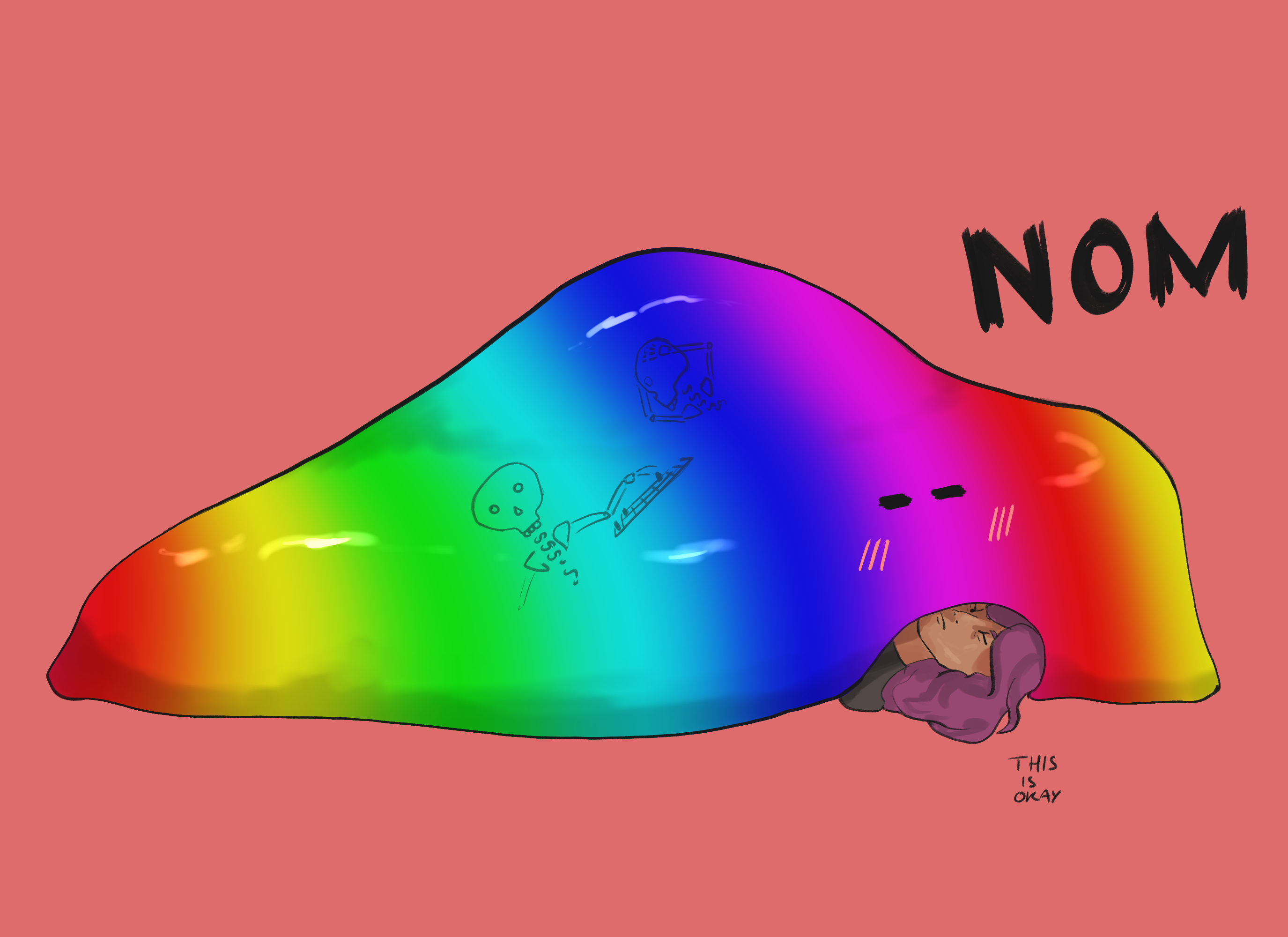
(The above fanart is titled “On Wings of Hope,” by Melsa Hvarei! I am once again incredibly flattered and delighted to include this here, thank you so much!)

Cannibalistic death and unexpected new life; anything is possible, down in the sodden ashes of the end.

Wow! Well! We are indeed going to part 3 of this interlude. Thirteen Arcadia continues her solo journey toward the edge of the upper world, preparing for a dive down into the dark. And Elpida? Well. She took that harder than I expected, but I didn’t want to shy away from it, I didn’t want to avoid the implications of what survival means in this system of meat and machines. This one’ll leave a scar.

If you want more Necroepilogos right away, or you would like to support the story, please consider subscribing to the Patreon:

Patreon link! Right here!

Right now this only offers a single chapter ahead, about 5k words. Behind the scenes I am still very much trying to build up some kind of a backlog of chapters, and when I do, I’ll be sharing more chapters ahead with patrons!

There’s also a TopWebFiction entry! Voting makes the story go up in the rankings, which helps more people see it! This only takes a couple of seconds, and it really helps! Thank you!

And as always, thank you for reading! Thank you for being here on this long journey into the ash and dust, dear readers. I still have such sights to show you, I feel like we’ve barely begun! And, also as always, I could not be doing this without all of you! Thank you so much! Seeya next chapter!

Interlude: Thirteen Arcadia, Part One

Content Warnings

Body horror, the usual


Previous Chapter Next Chapter


Two weeks out from Pheiri, in the shadow of a burnt and broken mountain range, the third of central’s monsters caught up with Thirteen Arcadia.

This was not like the first ‘physical asset’ — the golden diamond which had descended from the skies, to slay Thirteen as she had lain helpless upon the barren soil, before Elpida had rescued her, before her reconciliation with herself, before the Change had changed everything.

Nor was this third monster akin to the second asset, the one she had fought two weeks ago.

The arrival of that second infernal machine had prompted Thirteen’s departure from Elpida’s new cadre; the resulting battle had proven to Thirteen that it was high time for her to leave.

Central — The Enemy, The Unknown, The Blind Mad Idiot God — was hunting her, personally. This was what she had decided.

That second ‘physical asset’, two weeks prior, had been smaller than the golden diamond, but much quicker, considerably smarter, and infinitely more aggressive. The golden diamond, the airship, was a sledgehammer of blunt force applied against an anomaly, an attempt to blot out all evidence that a Telokopolan combat frame had fallen from orbit. The second asset was a red-hot scalpel come to cut her out and burn her to ash. Central had apparently abandoned the plan of suppressing her mere existence, falling back on the old reliable — simple extermination.

The thing had surprised Thirteen and Pheiri by approaching while cloaked. It had projected light through the surface of its body to achieve invisibility, but it had also masked its own heat signature, radar returns, nanomachine-load, and gravitic wave disturbance pattern. The machine had used its own gravitic engine to wrap itself in a veil of confusion.

The first sign of the asset’s approach was the worm-guard massing at the edge of the graveworm safe zone — first a dozen, then fifty, then over a hundred. The worm-guard had formed a phalanx of writhing, coiling, protoplasmic masses, clad in armour so dense it refused to yield to even Thirteen’s sensors. The worm-guard had kept pace with Thirteen and Pheiri’s position for over an hour, growing in number every few minutes. Elpida and the other revenants had flown into near panic; they were concerned that this was it, this was the moment they’d been fearing for the last eight days, the moment the worm-guard decided that Pheiri counted as a threat to the graveworm.

<<Iriko’s already fled,>> Elpida had told her over the comms uplink. <<She’s terrified of those machines, but I think she’s got the right idea. We need to peel off. I don’t want to provoke the worm-guard. They outnumber us a hundred to one.>>

Thirteen agreed, despite her strength.

The Change had made her powerful beyond any prior imagination; she felt exceptionally safe and confident inside her new body. The flesh she had once been was now protected by a dozen layers of nano-composite bone armour, wrapped in several thousand tons of crimson muscle, tendon, sinew, and gristle, and cradled inside a spacious sphere of milky-warm amniotic fluid. She was not that flesh anymore, of course, though she could grasp it and stretch it and look through its eyes and give it teeth with which to bite. She could extrude herself from a sphincter on her own underside to speak through lips she reformed from memory, and gesture with more hands than she’d ever had before. But she was all this flesh now, all this bone, every cell of this infinite potential for regrowth and adjustment.

She did not feel like her name should be ‘Thirteen’ anymore; that felt disrespectful and dismissive toward half her soul. She remembered her childhood, raised as a thing with two legs and two arms and a head, but now she also remembered being a combat frame, being pieced together from machine-meat, being piloted and ridden and joined with — by herself, as herself, inside herself. Her memories were paradoxical; she clearly recalled climbing inside her own body, being entered by herself, as both halves of a single being — the being she was now, after the Change. She recalled the loneliness and betrayal and rage of abandonment in orbit, in perfect clarity, burning with shame and self-recrimination. She forgave herself, but knew she still must atone. She had to treat herself with respect.

In private she experimented with new names. ‘Arcadia’s Rampart’ did not feel right, because she was not just the combat frame, she was also still Thirteen. ‘Arcadia’s Thirteen’ was worse; that implied ownership of half herself by the other half of herself. It was nonsense.

In the end she settled on ‘Thirteen Arcadia’. For now. Provisional. Until she reunited with Twelve Fifty Five.

But even a Changed combat frame could not fight infinite worm-guard. If the graveworm itself truly was a nanomachine forge the size of a mountain range, then it could drown Thirteen in ten thousand worm-guard, or a hundred thousand, or a million. Her potency and durability would count for nothing against such numbers.

So, she and Pheiri and Elpida had all agreed — they had veered away from the distant line of the graveworm, further and further out from the edge of the safe zone. They had hoped this would calm the worm’s autoimmune response. But the worm-guard had continued to gather. In the sixty seconds before the physical asset struck, Thirteen had counted five hundred and thirty seven worm-guard, with more arriving every moment. All the nearby revenants had fled. The city ruins for nearly a mile around contained nothing but herself and Pheiri. Iriko had squeezed herself into the ground somewhere nearby, hiding, invisible.

The worm-guard weren’t there for Thirteen and Pheiri, of course. They could see the monster drawing close.

The second ‘physical asset’ had burst from between the buildings of the rotten city and dropped its cloaking the moment it attacked.

A perfect sphere of mirrored metal, half a mile across.

The thing had assaulted Thirteen with earth-shattering sonic weaponry, wide-spectrum sensory static, and blinding white light — laser beams generated across every inch of the machine’s liquid skin. The suite of weapon systems was designed and selected to overwhelm Thirteen’s sensors, foul her targeting, and confuse her defences.

Once she was blinded and reeling, the main body of the asset had disgorged thousands of flying worms of living mercury, corkscrewing through the air like a cloud of falling seeds.

The flying worms were corrosive. They slipped through her shields, vibrating at the exact frequencies to pass through her seven layers of energy-weave and air-block. They fell upon her like burning rain, melting through armour and corroding her flesh.

That machine had been designed to kill her specifically, to blind and deafen Thirteen while her divine transformation was reduced to so much metallic sludge.

Good try, but not nearly close enough.

Thirteen had led the mirrored sphere on a high-speed dance through the wilds, sprinting at over sixty miles an hour to stay ahead of the corrosive rain. She had spent forty nine hours plinking at the thing with long-range weaponry, pounding at gravitic shielding until it buckled, then hammering on the perfect sphere until it was covered in divots and dents. Such a relentless pace was easy for Thirteen now; she did not need to sleep or rest anymore, not unless she chose to indulge. The new reactors deep within her flesh would keep her awake and operational through anything; she needed no external maintenance, never again, not with her own on-board nanomachine forges feeding every cell of her flesh with fresh grey sludge.

She had delivered the coup de grâce to the mirrored sphere indirectly, by leading it back toward the graveworm. She had grown curious about what might happen if central’s asset came into contact with the massed worm-guard; Elpida had also requested this course of action, during one of their regular check-in broadcasts during the fight. The Commander wanted to know if central and the worms would wage open war upon each other.

Thirteen owed everything to Elpida and Howl. She owed the Commander her eternal allegiance. Not to mention how she wanted to protect Pheiri, her brave little brother, who had been through so much.

She was going to betray them all, of course — with her inevitable departure — so she did everything she could to help. She led the mirrored sphere back toward the worm, for the sake of the experiment.

The worm-guard had dismembered and dismantled the sphere, like ants swarming over a wounded mammal. Several hundred had died in the process, but they were quickly engulfed and consumed by their kin. Thirteen had watched the whole process, then sent the footage back to Pheiri, for Elpida and the others to analyse.

She failed to secure any worm-guard flesh. Not one scrap. The survivors were meticulous in their cannibalistic recycling.

That failure stung. Elpida and the revenants were growing hungry.

Defeating the mirrored sphere had cost Thirteen almost nothing. A few burns on her flesh, a few chips off her armour, it mattered not. Her own nanomachine forges could now repair almost any level of damage. Her body — her new body, a giant of flesh and bone and blossom — could have been bisected in two, and she could have healed herself by pressing the halves together.

But Pheiri and the zombies could not do that.

The revenants could not fight for forty nine hours without a minute’s respite. Pheiri could not jump-charge his shields from a bottomless well of self-replicating nanomachine forges, nor cross the rooftops at a dead run of sixty miles an hour. He was confined to the slow healing process of a true machine, confined to the ground, to the streets, and to the extant shape of his metal and plastic.

Pheiri would not have lasted fifteen minutes against the mirrored sphere.

He would have put up a grand fight, of course! Oh yes, Thirteen had not the slightest doubt in her little brother’s courage and determination. With his particle beam emitter and his stout heart and the love he carried in his belly, he would have fought. He would have fought well, and he would have died swiftly, along with all his crew.

Central was hunting Thirteen, not Pheiri. Without the burning beacon of her presence, Pheiri could hide beneath notice once again, and the zombies could go on without being seen by The Enemy — the real enemy, the blind idiot god behind the mask of the world.

The zombies pretended otherwise. They pored over the footage. They asked Thirteen questions about the asset’s behaviour, as if they might find a way to counter the next one. They made plans and contingencies. They discussed emergency evacuation procedures.

One of them even nicknamed the thing. Mirror, the grumpy one, one of the two who had fought inside Arcadia’s Rampart to save Thirteen from the Necromancer.

<<Disco ball,>> Mirror had called it, over the comms uplink between Pheiri and Thirteen. Pheiri translated the languages for Thirteen’s benefit. <<With built-in speakers. Noise and light as primary weapons. Tacky, blinding, ultimately very stupid, beloved by fools and people with too much entactogens in their bloodstreams. Hence, disco ball.>>

<<We’re not calling it ‘disco ball’,>> another revenant had said. That was Victory, the one who had thrown her empty gun at the Necromancer for Thirteen’s sake. Thirteen Arcadia felt a special attachment and gratitude to Victory. An unadorned human who had stood up to a monster, for her, before the Change, before she had grown strong. <<Come on, Kaga, that’s absurd.>>

<<You don’t even know what a disco ball is, Victoria,>> Mirror had snorted. <<You were born almost two centuries too late for disco.>>

<<I know what a disco ball is! I didn’t live in a mud hut.>>

<<We’re calling it disco ball. Light and sound. Lasers and sonics. Disco. You have a problem with that, take it up with the Commander.>>

A sigh. That had made Thirteen giggle. <<You know Elpi’s not gonna have the faintest idea what ‘disco’ is, right?>>

<<On the contrary. I’m certain Telokopolis had some sort of orgy-disco combination activity, which she’ll be delighted to tell you all about. In detail. With demonstrations.>>

Another sigh. <<Kaga, for fuck’s sake. I’m not screwing—>>

<<We’re calling it disco ball. That’s final.>>

A long pause followed. Perhaps the conversation was over, but Thirteen had not disconnected. She liked to listen to the others speak. Eventually Victory had asked: <<Why? Kaga, this isn’t like you. You’re being … playful.>>

<<Because it disarms the terror, Victoria. Because it makes the thing less terrifying. Silly names help.>>

Thirteen had held on as long as she could.

She knew full well that without her, Pheiri and Elpida and Howl and all the others would be that much more vulnerable to the highly developed revenants which lurked beyond the graveworm line. But Pheiri had spent most of his life out there, enduring conditions much worse than the relative calm of the edge. And if Thirteen stayed, she knew more monsters would come eventually. The next one might be worse — smarter, stronger, less vulnerable to her tricks. Perhaps the next hunter would figure out that she had led the Disco Ball off into the wilds to keep it away from Pheiri and Elpida. Perhaps the next asset would use that against her. Perhaps central’s next strike would slay her little brother, and her Commander, and all the hope they were trying to rekindle.

So, it was time for Thirteen to leave.

She had calculated the shortest route to the edge of the continent, based on observations taken during her descent from orbit — south, through thousands of miles of corpse-city.

There was no reason for a tearful farewell; she would be able to maintain contact with Pheiri and the revenants for weeks or months to come, via long-range comms, tight-beam, even regular old radio. She wanted to feed them as much intel as she could, every last scrap of what she was about to witness out in the wilds. She had no idea what details might matter to Elpida in the long run, what might be useful, what might keep her saviours alive for another few days.

She set off at dawn, heading south.

For two weeks she had walked through the ruins, doubting her decision.

Her eventual departure had always been inevitable, of course; Twelve Fifty Five and the other Changed needed her more than Pheiri and the Commander did. The voice of her beloved, her long-lost missed chance, and all her ‘sisters’ — yes, sisters! The word was a glorious battle cry now — they whispered across the nanomachine ecosystem itself, like a distant echo from beneath too many layers of meat and metal. Her place was down in the ragged rotten remnants of the green, alongside the other Changed. That was the fight for which she had been made, by her mother, by Telokopolis.

On the seventh day she sighted another graveworm, miles and miles to the east, chewing through the city, bearing north. She paused to watch it pass, soaking up measurements and energy readings. That worm was much larger than the one which Pheiri and Elpida were following, easily twice the size.

Could she not have delayed one more day? One more week? Could she not have sheltered her Commander for one more night? She had regurgitated another full load of grey nanomachines for Pheiri’s stores before she’d left, even though the zombies and the robots had protested that their containers were full. But what if they were wrong? What if Pheiri got hurt, and needed her bounty once again, and she wasn’t there? What if she was wrong, and there would be no third ‘physical asset’? What if she had abandoned her new-found siblings for nothing?

The revenants out in the wastes mostly avoided her, despite their own incredible post-human changes. They were few in numbers and far between, compared with the teeming life around the graveworms. Some were still human-like, but many were beyond her comprehension, filling her sensors with information she could not begin to interpret; she catalogued them as best she could, sending the data back to Pheiri at regular intervals.

She was lucky. The most dangerous of the revenants could tell that she was not made of their kind of nanomachines. Her flesh would avail them nothing. She was not edible.

What if she got lonely, out there in the wilds, all by herself? What if she never got to hear something that made her giggle, ever again?

She had walked with Elpida a while not only because the Commander had requested it, but because she wanted to.

But Twelve Fifty Five was waiting for her, fighting a war in the dark beneath the world.

With one part of her mind Thirteen kept up her never-ending broadcast of poetry, singing out into the dark, hoping that Twelve Fifty Five could hear her coming. I’m on my way! I didn’t leave! I’m sorry!

But then the third of central’s monsters caught her in the shadow of the mountains, and Thirteen knew she’d made the right choice.

The third ‘physical asset’ was a gossamer-thin stingray of gravitic disturbance, a mile wide and three feet deep. Its form was generated by a hundred thousand tiny gravitic engines linked together in a mutual web or network, creating a ghostly body, no more than empty air crushed and constrained by a vice of pressure.

The asset came for Thirteen like a blade slicing through the ossified corpse of the city, flying at barely twenty meters off the ground, cutting through concrete and brick like butter before a heated wire. It made no attempt at stealth, not like the Disco Ball; the structures through which it sliced crashed to the ground, toppling over and smashing into other falling buildings like an onrushing wave of felled trees. The asset did not care about going unseen, or it would have approached via the air.

It wanted Thirteen to run.

And so she did, into the shelter of the mountains.

This was the first stretch of bare rock Thirteen had seen, the first large-scale geographical feature not encrusted by the blackened scabs and crumbling bone of the corpse-city. The naked slopes had been scorched by some terrible heat, centuries or millennia prior, leaving runnels and droplets of melted stone as a black crust upon the deeper strength. When she had first spotted the range from several miles away, Thirteen had assumed it was the ridged back of another graveworm, paused in post-partum recovery, after delivering its seed of fresh blue nanomachines to the waiting womb of a resurrection tomb. She had toyed with the idea of plunging in to rescue this fresh clutch of zombies — of carrying out the sort of daring raid that Elpida and the others had debated before Thirteen had left. But as she had drawn closer, the mountains had revealed themselves to be living rock, the bones of the earth, not the hide of an undead worm.

Any soil was long stripped away. No trees or plants or grasses clung to the mountainsides, only the occasional veins of black nanomachine mould, oozing at the bottom of cracks and fissures.

As Thirteen Arcadia fled toward the mountains, she wondered if the rocks themselves were nanomachines now. Where did the slime end and the stone begin? Why did the nanomachines persist in that distinction, if the whole planet was infected and infested? When she stepped onto the naked rock itself, with her four legs splaying to carry her weight, was she standing upon the Earth, or stamping on the body of The Enemy?

Now was not the time for philosophy — nor for poetry.

With great reluctance, Thirteen paused her singing, and turned all her attention toward this third monster from central.

The asset was closing fast, less than half a mile away from the base of the mountains, scything through the buildings in a crashing wave of brick and steel and glass. Masonry dust filled the air in great billows from the fallen towers and collapsed structures. The noise would have been deafening if she hadn’t already closed off her external sound sensors. Any revenants nearby were probably bleeding from the ears, or crushed beneath the rubble, if they were not evolved enough to shrug off the weight of a falling skyscraper.

The leading edge of the asset was razor-sharp, a blade of focused gravitic power barely a few microns wide. Thirteen judged she could hold off that sword with her own gravitics, but it was probably designed to slip around her defences. And it would only need a moment.

Deep inside layer upon layer of bone-armour, wrapped a thousand frills of dense-packed crimson meat, suspended in a warm womb of orange liquid, the memory of Thirteen’s original body stirred with discomfort.

She might survive bisection. She would probably not survive being turned into mincemeat.

Thirteen packaged up all the data she had collected on this third asset, including every second of footage from all ten thousand of her external sensor-clusters. Then she squirted a tight-beam broadcast back to Pheiri, just in case he and Elpida might one day find it useful.

Somebody must have been in Pheiri’s cockpit at that exact moment; a familiar voice crackled over Thirteen’s long distance comm-link, filling her central womb-atrium with real audio.

<<You can do it, little sister!>> shouted Elpida, but with another tone in her throat — Howl! <<Smash that thing up! Come on, it’s a sheet of fucking foil!>>

<<How?>> Thirteen replied. <<It’ll cut me apart.>>

<<Dig, bitch! You’re standing on virgin rock! Fuck it!>>

Thirteen turned toward the mountains, urged her nano-forges into blazing glory, opened a sphincter the size of a building — and vomited forth a torrent of acid upon the rock.

She dug a hole into the mountainside, scooping out the melted stone and hurling it behind her, burrowing into the dark.

Howl’s voice — real audio, over the radio, not a cackling ghost riding along inside Thirteen’s flesh — chanted encouragement for a few moments. But then the signal was suffocated beneath a million tons of mountain.

Seconds later the third asset slammed into the rock behind her. The edge of the blade bit deep, wriggling and pushing, splitting the mountain along a crack kilometres wide. The ground shook and bucked, slamming back and forth like an earthquake. Tucked deep in the dark, digging for her life, with droplets of melted stone hissing off her shields, Thirteen thought the whole mountain was about to open.

But the bones of the earth proved too dense for the asset. It withdrew, sliding from the gap it had created, whirling off into the air beyond Thirteen’s burrow, flying like a manta ray of the skies.

Thirteen did not turn back. She did not poke her head out of the hole. She was not that kind of stupid.

She swept the surfaces with her sensors and discovered the manta ray had left pieces of itself behind; twenty three gravitic generators lay abandoned, crushed within the gap it had been forcing, or fallen upon the floor of Thirteen’s acid-etched tunnel. Each generator was no larger than the palm of a human hand.

The manta was made of a hundred thousand of the tiny generators. Losing a few had not appeared to reduce the monster. Defeating it would require destroying enough to compromise its overall integrity.

Thirteen burrowed deeper into the earth, melting the rock before her, collapsing it behind. Gravel pattered off her shields and her armour.

For five days she played hide-and-seek with the gravitic manta ray. She wormed her way through the mountain range like a gigantic mole, swallowing mouthfuls of rock and turning it to nano-sludge inside her veins, then forging the slime into increased muscle density and thickened armour and spade-like claws for better digging. She strengthened her back legs, adding telescoping joints, and wrapped great knots of muscle around the lower portions of her rearward arms; she was going to need to lift, a lot.

Every day she burst from fresh-dug trapdoors of stone, to find herself beneath the dead blanket of the night sky, or the ruddy cauldron of dawn, or the dying embers of the day — always long enough to pop off a few shots at the manta, lurking above the mountains like a bird of prey riding the thermals. Each time she attacked, the manta swooped down toward her, forming a single gleaming edge of gravitic power; each time she scurried back into the bowels of the planet itself, barely outrunning the cutting edge as it bit into the mountain, scoring yet another deep gash into the tip of this rocky outcrop.

Each day she left another few dozen of the tiny gravitic engines dead upon the mountainside, picked off by point-defence auto-cannons, exploded by HI-EX missiles, fried by bolts of superheated plasma. She fired her main railgun once every day — mostly as a show of force, to keep the manta focused. The railgun was useless against such a distributed target. It was a titan-killer, unsuitable for sweeping aside this airborne swarm-creature.

A dozen or so engines every attack, five or six attacks a day. At this rate Thirteen would defeat the manta in approximately four years.

Thirteen grinned to herself, down in the dark beneath the stone. She extruded an actual face from beneath her body, with eyes and a mouth and nice big sharp teeth, so she could grin in the lightless air of her burrow. She chewed on a chip of stone, melting it with acid saliva. It tasted disgusting.

She was close to victory.

On the morning of the sixth day, Thirteen baited the manta.

She exploded from a new trapdoor in the rock, lower than any previous ambush-hole. She located the current position of the asset — sweeping back and forth over the tips of the mountain range, waiting for her to emerge on time. She deactivated her shields. Her skin and armour steamed in the ruddy aura of Earth’s bleeding dawn.

Thirteen Arcadia stood tall, bellowed a wordless challenge from her external war-horns, and pounded the air with every weapon she had.

She filled the rotten sky with the blossoms of high explosive power and the crack of railgun slugs and the whine of her point-defence cannons. She turned the air into a sea of lead and fire, holding nothing in reserve.

The manta took the bait.

It coiled through the air, forming a razor-sharp wedge, diving for her like the blade of a guillotine.

Thirteen kept firing for as long as possible, making as much noise as she could, giving the asset every reason to believe that she had lost her temper, run out of patience, or taken leave of her senses. This was the final confrontation! She had gone mad down in the dark. Now she would be cut apart, ruined by her own lack of capacity for endurance.

She needed the manta to burrow deep this time. Deep as it could go.

At the last possible second, Thirteen halted her guns, twisted on all four legs, and hurled herself back into the hole from which she had burst.

The manta ray slammed into the rock inches from her rear legs. She scrambled up the curving tube she had dug that previous night, gravitic power nipping at her heels, cutting into the outer layers of her bone armour. She flash-started her shields with a crack of electrical power, but they guttered and flickered against the cramped walls of rock. She lost over a thousand pounds of bone amour and a few hundred pounds of flesh, torn off by the edge of the manta’s blade.

But she wriggled deep. She wormed her way upward, beyond the thing’s reach, for it could not curl within the rock.

She scrambled into the fulcrum chamber she had excavated over the last forty eight hours — nothing more than a few balanced pieces of rock, waiting for the right amount of pressure to be applied to the heart of the mountain.

She had to trust the observations she had made across the five-day fight; the calculations she had assembled, to estimate how long it took the manta to wriggle free from the stone. She counted the seconds, with her actual voice, keeping time with lips and throat in her womb-bath of amniotic fluid.

“One, two, three,” the words gurgled and bubbled from her mouth. “Four. Five. Six. Seven!”

On seven, Thirteen unfurled her own gravitics. Her gravity engines flared to life, uncoiling tentacles and tendrils of invisible power. She applied all the force she had to four separate fulcrum points she had selected within the chamber. She added her muscular strength, the pistons of her legs and arms, and the massive weight of her gigantic body.

She had spent five days turning one particular mountain peak into a honeycomb of rock.

All except the tip.

With a heave of strength only possible for a Changed combat frame, Thirteen hurled a mile-wide slice of mountain down upon her foe.

The sound and fury was beyond anything she had ever experienced. The moment she put the projectile into motion, Thirteen withdrew her gravitic feelers and wrapped them around her body. She curled up into a tight and protective ball, to ride out the sheer destruction of a dislodged mountaintop. The ground beneath her rumbled and shook. A great crashing grew and grew and grew and grew and did not stop, rolling like a wave of world-splitting thunder. Rock dust filled the air, so dense that an unprotected human would have choked to death in seconds. A storm of rock overwhelmed her shields and then plinked off her armour for minutes on end — five, then ten, then fifteen, on and on and on.

Thirteen stretched and swam inside the eternal womb of her own machine-flesh. She grew a dozen arms with which to hug her hidden core, holding herself tight against the storm beyond her skin. She grew plush, soft, pliant layers to embrace and squeeze. She grew lips and kissed herself — kissed Arcadia’s Rampart from the inside. Thirteen Arcadia ‘made out’ with herself, hidden in the dark.

What else was there to do? She was a little bored, waiting for victory.

Eventually the earthquake died away. Chips of rock ceased plinking off Thirteen’s armour. The dust began to settle — or at least did not thicken any further.

Thirteen parted the soupy air with a cautious wave of her gravitic feelers. Sunlight graced her flesh, weak and ruddy-red, bleeding from a skinless sky. She was in the open air.

She’d taken off the whole top of the mountain.

Thirteen descended slowly, wary of rockslides or collapses. She was not invincible, just very durable. The Earth could kill her as surely as it had defeated the manta.

Weak reddish light struggled through the dense clouds of rock dust, flowing down the sides of the mountain range as it settled. Thirteen pushed on through the lethal mist, scanning the way ahead with all her sensors, clambering over the spill of debris.

She found the remains of the manta ray smashed upon the rocks, at the feet of the range. The mile-wide mountain slab had overwhelmed the thin layer of gravitics and destroyed almost all the hundred thousand generators which formed the body of the third asset. The engines were crushed beneath a slurry of boulders and rubble; the rockslide had been halted only by the mass of the dead city itself. The avalanche had slammed into the buildings. A tangle of twisted steel and broken concrete extended in a semi-circle for several miles.

Thirteen spared a thought for any uninvolved revenants, caught in geologic crossfire.

Not all of the asset’s generators had been destroyed. A few handfuls remained active, tied together in miniature webs of gravity, trying to locate their fellows, and reform into larger structures.

Thirteen hunted them down. She crushed them beneath her feet where they were little, when they were no more than a few dozen nodes flickering and jerking on the rubble. Where they were larger, in the hundreds, she deployed her weapons. Half a dozen auto-cannons were more than enough to punch through the feeble gravitics and blast the generators into molten slag.

Once, she found a full thousand — one thousand and ninety two, to be exact — which had survived, located each other, and reformed into something approximating a real shape. It was a jagged mess of angles and spikes of gravitic power, hurling pieces of itself out in every direction when Thirteen approached, as if trying to ward her off.

She watched it for three hours, waiting to see if it would attempt communication, or regain coherency, or try to do anything except kill her.

By the end of those three hours, the worst of the rockslide dust had settled. The ruins of the mountain lay quiet, a truncated peak breaking up the burnt and blackened range, dyed red by high noon — or what passed for noon, beneath the smothering skies.

The remnant never did anything but quiver and jerk. Thirteen put it down with her own gravitics, pulverising the generators into compacted metal.

She lingered among the boulders and scree for a long time, breathing fresh air after five days underground.

Five days down in the dark. Nothing by comparison.

How much worse would it be, down in the rotting memory of the green?

Before she departed to continue her journey, Thirteen re-established long-range comms contact with Pheiri.

They exchanged handshakes; Pheiri was glad to hear from her. He sent her all sorts of data updates — nothing exciting, just refreshes on his current position and condition. All seemed well. Thirteen called him <<Little brother!>> in direct audio, cheering into the amniotic embrace of her inner layers, just because she could.

She gathered up all the combat data and footage and readouts from the last few days and sent them over to Pheiri. She hoped dearly that the Commander would find her experiences of some use.

Six hours later, when she was still picking her way through the ruined buildings, with the mountain range at her back, she received a reply.

<<Thirteen?>>

It was Elpida. Direct audio, from inside Pheiri’s cockpit. Down in her own belly, Thirteen opened her lips and spoke real words.

<<Commander! Hello! Did you like everything I sent? Did you see?!>>

A pause, then a gentle laugh. <<‘Like’ is maybe not the right word, Thirteen. I’m very glad you won. Well done, that was ingenious, a very clever strategy. We were all very worried when you went radio silent after digging into that mountainside. Howl never doubted you for a moment, though. She wants me to make that clear. And for the record, neither did I. Just glad you’re okay. How are you holding up, after that ordeal?>>

<<I sent you all my internal readouts too, Commander. You’ve got it all!>>

<<Yeah,>> Elpida said. <<Sure, I can read the data off the screens here, but I want to hear it from you, sister to sister. How are you holding up?>>

Thirteen smiled, even though Elpida couldn’t see. <<Doing just fine, sister. That was good practice, for what it’s going to be like down in the green. Right?>>

<<Right.>>

Thirteen heard the concern, the worry, the fear. She decided not to mention it. The war beneath the world was not Elpida’s war.

Instead, Thirteen turned the question back on Elpida. <<And how are you all holding up, Commander? How is Pheiri? And Iriko, the angry little blob?>>

Elpida laughed again. The sound made Thirteen feel good, in a way she had so rarely felt before the Change. <<Iriko? She’s … inscrutable, still. Mostly she talks to Pheiri. Sometimes to Serin, when Serin is around. Pheiri himself is doing just great, thank you. You left him with enough nanomachines to repair himself twice over. We’re still skirting the edge of the worm zone for now. No further worm-guard encounters, and nothing like another asset from central, but I’m sure Pheiri already updated you on that.>>

Thirteen noticed a conspicuous absence of reply. <<And what about you and the others, Commander?>>

Elpida paused for a long time. Thirteen could hear her breathing over the direct audio transmission.

<<Sister?>> said Thirteen Arcadia.

Elpida swallowed. <<Howl says I should tell you, so I’m going to tell you, even though this is probably none of your concern, Thirteen.>>

<<You’re my sister and my Commander,>> Thirteen replied. <<No matter how far away I must go, no matter how deep into the dark I dive. Your concerns are my concerns. Telokopolis is forever.>>

<<Telokopolis is forever,>> Elpida echoed. She sounded sad.

<<Elpida?>>

<<Last night,>> Elpida said slowly. <<Last night, we hunted. For the first time. Last night we ate raw meat, for the first time in weeks. We killed and ate other revenants. Other people like us.>>


Previous Chapter Next Chapter


Kaiju fight! Mountain slam! Giant mole girls digging through solid rock! Spooky disco ball machines melting the air with waves of caustic death worms! This chapter has everything. It’s even got more Kagami.

Interlude! Welcome to Thirteen Arcadia’s solo journey deeper into the corpse of the planet. You may notice that this interlude is a little different to previous ones; for a start, it’s the first time an interlude doesn’t introduce a new character outside of our main cast. We’ve met Thirteen Arcadia before, of course. Or … have we? Is this really the same person? Well, we met Arcadia’s Rampart too, so the point still stands.

Secondly, this interlude comes in multiple parts! Three parts, to be exact. Why isn’t it an arc? Well, it wasn’t meant to be this long! Originally this entire chapter was supposed to be two paragraphs at the beginning of a different sequence, but Thirteen has all the energy of a very friendly puppy, so she insisted that we’re doing the kaiju fights on screen. And you know what? She was right! Her journey to the edge of this rotten world deserves a little more breathing room, so I have given her it, and I think that’s the right choice. We we have two more chapters of Thirteen’s wanderings before arc 11! Hope you’re enjoying it!

No Patreon link this week! It’s the last chapter of the month, and I never like the risk of double-charging new patrons. Feel free to wait until the 1st of May if you were on the verge of subscribing!

In the meantime there’s always the TopWebFiction entry! Voting makes the story go up in the rankings, which helps more people see it! This only takes a couple of seconds, and it really helps me! Thank you!

And as always, thank you so much for reading my story! I couldn’t do this without all of you, the readers. I’m delighted how far Necroepilogos has come, and the terrifying horizons opening up before Elpida and her companions, and now others too! So, thank you! Seeya next chapter!

umbra – 10.7

Content Warnings

Extreme jealousy
Sexual jealousy
Discussion/medicalisation of dissociative identity disorder
Chronic pain


Previous Chapter Next Chapter


Kagami woke up on the wrong side of the bed.

What a ridiculous phrase. A superstitious anachronism inherited from one of Luna’s surface-culture ancestors. As if rolling to one’s feet in the incorrect direction could somehow curse one with bad luck. Kagami had not slept in a bed during life, anyway; that would have meant decanting herself every night, an uncomfortable and humiliating process at the best of times, even if she shepherded it herself with remote robotic attendants.

No, Kagami slept like real royalty — in her suspension tank, with her body cocooned and cushioned by the pool of warm bio-gel, while her mind soared through whatever somnambulant simulation she so desired.

She had passed many a night in the apex of magnificent feudal-era castles, looking out across mist-shrouded mountain ranges, snuggled up inside a thick and fluffy futon. She had dozed away the hours in the secret hearts of dripping woodland glades clad in emerald and jade, with alien stars wheeling overhead, her bedside attended by lithe satyr-boys and nubile fawn-girls. She had slept alone in perfect simulated recreations of public campgrounds from the old country, with the distance populated by approximations of fellow campers, with a roaring fire at her feet, and a tent the size of a house at her back. She had passed out in exhaustion at the centre of grand orgies — every other participant simulated, of course — right in the middle of a bed large enough for fifty people, a sole slumbering real human surrounded by dozens of copulating couples. She’d slept in airships, starships, bullet-trains, and cruising cities — fanciful creations from the minds of Luna’s greatest simulation authors, along with a few choice selections from the most enlightened and scientifically advanced of the dirt-eaters down below. She’d slept with imaginary partners three times her height, and with harems of sweet young things who she could sweep up as if she was the tall, strong, dashing, dominant one. She’d slept after banquets and battles, meetings and matings, holidays and horror stories, pre-written romances and wildly unpredictable improv and pure unstructured playtime.

Sometimes she’d slept snuggled up with her AI daughters, when they were young. Kurumi had liked that especially, during the first three years of her incarnation. Kagami had even slept outside sim-space on rare occasions, in the dim light of the naked suspension tank, to the sound of her own biological pulse in her ears.

So how could one possibly wake up on the wrong side of the bed? That was the kind of assumption made by first-timers to sim-space — newbies always assumed that their fleshy body was still flailing about, that they were always about to blunder into a wall. Luddites at best, morons at worst. The simulation would always compensate.

But now Kagami was flesh alone.

She woke up face down on her narrow bunk, eyes gummed shut with sleep crust, cheek stuck to her pillow with a puddle of cold drool. She groaned several times, hoping her irritation might summon a control panel into the darkness behind her eyelids.

In her half-awake state Kagami still harboured a vain hope that the last few weeks were nothing more than an elaborately cruel prank at her expense. Any moment her father would roar with laughter, accompanied by the chorus of his court, and she would find herself standing in the brilliant glittering light of Luna’s parliament, represented in yet another perfect sim-space recreation. Oh certainly, she would be red faced with fury, spitting indignation, and probably attack somebody important. But the humiliation would be worth the salvation.

She would have to find the simulation writer who made all this, of course. She would keep the effort quiet; her father would undoubtedly have predicted her retribution, and probably squirrelled the author away somewhere. But she would dig the little worm out of whatever hole it was burrowed into, and then she would shake it until it screamed.

She wouldn’t have the author killed, though. Oh no. She wanted all these people re-created, from scratch, from their alpha-copy originals: she would give ‘Commander’ Elpida a piece of her mind; she would have Pira shot after a proper court martial; and Victoria, well, Vicky she would invite to join her in—

“Gnnnnhhhh,” Kagami groaned again. These thoughts were nonsense.

Nothing happened, anyway. Deny as she might, this was reality.

Kagami lifted her head from the pillow, eyes still glued shut, and rolled over to get out of bed. She needed to swing these offensively useless bionic legs off the side of the bunk, so she could find the floor with her clumsy feet.

She rolled the wrong way, toward the rear of the bunk, not the opening into the narrow, cramped, dirty little room.

She banged her wounded right shoulder into the metal wall.

Izumi Kagami — Seventeenth Daughter of the Moon, Princess of Tycho City, mother to fourteen AIs, a woman who once had all of Luna’s nuclear arsenal dancing at her fingertips — whined into the thin and lumpy pillow, keening through her teeth, tears running down her cheeks. She clutched at her wounded shoulder, spitting with the indignity of pain.

Yes, her father would never craft such pain. The man was a boor and a clown. He might menace her with cartoonish cannibals and stick ridiculous legs onto her hips, but he was a stranger to agony.

Eventually the sharper torment ebbed away, leaving behind the exposed rocky shore of chronic pain. Kagami finished hissing curses into her pillow, got herself oriented correctly, pulled back the thin blue privacy curtains, and swung the hateful dead weight of her legs over the correct side of the bunk.

She sat, panting in the aftershocks, wiping her eyes on the back of a sleeve.

At least nobody was watching.

The bunk room was a nest of haze and shadows. Tiny, cramped, and full of junk. The air reeked of human sweat — zombie sweat, rather. The sound of soft breathing filled the gloom.

Infinitely preferable to sleeping in the open, of course, or in the rotten guts of some ruined building riddled with holes, so any borged-up predator or bottom-feeding scavenger might creep up on her in the dark. At least she was inside armour now, tucked away behind inches of steel and dozens of guns. It was no sensory suspension tank in the core of Tycho City, protected by an army of robots and drones and seven-point-six million human beings, but Kagami had to admit that Pheiri’s insides brought her a degree of comfort and security. He was a very skilled autonomous machine. She would not mind speaking with him again, sometime.

She would rather be off-planet, no question about that. But if she had to be down here, inside a powerful biomechanoid was an acceptable compromise.

Still, she cursed the fool who’d built this room so small.

Kagami sat on the edge of her bed for several minutes, taking stock of her various sufferings.

She felt as if she had awoken from a full night’s sleep; her head was fuzzy, but that was from the chronic pain and the aftermath of so much adrenaline yesterday. Her bionic legs and her hip joints still ached as if her bones were being pressed in a vice, but she’d almost gotten used to that, like background static. Her right shoulder throbbed with every beat of her heart; she’d been caught by a piece of stray shrapnel on the mad flight from the new-born biomechanoid. A six-inch spike of red-hot metal had slipped precisely through the halves of her coat. So unfair, so bloody stupid, such a tiny chance of happening. Why her?! That sort of bullshit fed her unkind hopes that this was all a simulation aimed at her personally.

The wound had bled like a boar on the end of a spear. Melyn had stitched the flesh shut, slathered Kagami’s skin with ointment and sealants, and then applied thick, soft, clean bandages.

Clean bandages! In this place. A miracle.

Melyn was the real miracle. A medical android, a real physician, not some drooling sawbones revived from the dawn of history. The android had worked with quick, precise, confident movements, not a muscle wasted, not a finger out of place. Beautiful as anything made on Luna. Better, even! That was not something Kagami ever admitted out loud. If something like this had happened on Luna, Kagami would have had Melyn uplifted, uploaded, and designated citizen-AI under her own auspices. If Melyn had been a sim-space fiction, wrought in some sadistic simulation, then Kagami would have hunted down the author, extracted the alpha copy of Melyn’s design, and imprinted her on a brand new AI substrate enclosure.

But she couldn’t do either of those, because she was not on Luna, and this was not a simulation. She sighed and tutted. She had no way to suitably reward Melyn for her service.

Kagami frowned into the murk. She suddenly felt useless. How strange.

But she wasn’t useless now, was she?

Kagami rolled up her left sleeve to examine the changes to her left arm. She had not had a chance to stop and look, let alone think about what she’d done to herself, not with everything since they had first approached the downed biomech.

Circuitry glowed with faint greenish-blue light beneath the natural brown of Kagami’s skin — fingers, palm, wrist, all the way down to her left elbow. When she flexed her fingers or rotated her wrist, she felt metals and polymers moving inside her flesh. An imperfect implant job, certainly, but more than acceptable under the field conditions. The pair of data-uplink cables were currently retracted into her wrist, tucked away for now. She did not relish having to unearth them again; that had hurt like yanking out her own tendons.

Kagami grinned. She couldn’t help herself. Useless? Far from it, she was apex again! Her work inside Arcadia’s Rampart had proven that; she could never have burst that fucking Necromancer bitch without this. A data uplink port, near-field electronic interfaces, and a high-density connection processor, all wired into her brain-stem.

If only it hadn’t hurt so much to grow.

The arm didn’t burn anymore, not since Elpida had turned up inside Arcadia’s Rampart with that bottle of blue. That dose of raw nanomachines had allowed Kagami to stabilise the ad hoc transformation, though she wasn’t exactly sure about the mechanism. She had simply decided that she was finished, that the machines inside her arm were complete, and her body had stopped.

The skin itched like a bad rash, but the pain had ended with the changes.

Kagami’s armoured coat was crammed into a corner of her bunk. She reached out with a flicker of near-field machine-comms — she didn’t even need to move her fingers, but it felt right to wiggle them. She pinged one of the six drones in her coat pockets. The drone acknowledged with a short burst of wake-up code, which scrolled down the inside of Kagami’s left eye.

A flare of pain exploded around her eye socket. She hissed, trimmed the drone’s log-keeping transmission to emergency only, then summoned it to her side.

A silver-grey oblong about the length of her hand wiggled free of her armoured coat and hung in the air before her face.

She snorted out loud. “You’re no domestic robot, but you’ll do. Number … 3, I think I’ll call you.”

Kagami stood up; she could work her bionic legs without falling over now, but she had the drone steady her with a gentle brush of gravitics. Then she used it to drag her armoured coat off the bunk and hold the sleeves for her to insert her arms. A most useful little extension of her body. She left the other five drones in her pockets for now; she was too fuzzy and too tired to keep all six smart drones on-station. Directing the full sextet to pin and crush that Necromancer had almost knocked Kagami unconscious with the effort. Besides, some of the drones had taken a few lumps during that encounter. She needed to examine the outer casings for damage when she was fully awake and clear-headed.

Speaking of being clear-headed, where the hell was Victoria? Kagami’s pet revolutionary was not in her bunk.

Kagami pressed a hand to Vicky’s sheets. They were hours cold. She checked the other bunks, in case Vicky had resorted to a nearby bedmate, but the others were innocent. Atyle was sleeping like the primitive she was, flat on her back with her arms crossed over her chest. Creepy. Amina and Ilyusha were curled up together on one of the top bunks, both of them fast asleep, flaunting their intimacy. Kagami did not like the way Ilyusha’s claws were exposed. Amina was clutching a big notebook to her chest. No sign of Vicky.

No Elpida, and no Victoria.

Kagami felt bile rising up her throat.

She was not jealous. What would she be jealous of? She had kissed the idiot to shut her up and stop her absurd worrying. A kiss meant nothing. Kagami had necked with hundreds of simulated men and women, ninety nine percent of them much more to her tastes than Vicky. She had made out with things with tongues long enough to reach her simulated stomach. She had kissed things for whom kissing was sex, and felt like it too.

But she had kissed Vicky, meat on meat. That was new.

She felt sick. Her cheeks was flushed. She fiddled with the drone’s gravitics to fan her face for a moment, then felt stupid and stopped. She pinched a lock of her long black hair between thumb and forefinger — greasy, unwashed. She felt vile. In a sim she would have cleaned it instantly, and then dyed it a more interesting shade for a few days. What would Vicky think of pink? Or maybe just a nice rich brown, like—

Kagami clenched her teeth. Had that kiss actually meant something to the idiot dirt-eating surface dweller?

Did Kagami need to — what? Take responsibility? Apologise? Explain herself?

Victoria was such an immature little primitive. Kagami had no choice.

She walked over to the bunk room door. She had to clutch the edges of the bunks to compensate for her wobbly legs. She had the drone turn the handle, crack the door, and float through the gap. She didn’t want any nasty surprises from the crew compartment. The drone returned a camera-feed to her left eye, which ignited a sparkle of headache, but Kagami winced her way through the pain. All was quiet and dark out there, bathed in low red night-cycle illumination — another element of Pheiri’s construction that Kagami approved of.

Kagami retrieved the drone, stepped through the hatch, and had the drone shut the door behind her.

The crew compartment was less muffled than the bunk room. Kagami could hear the sound of Pheiri’s tracks against the road outside, and feel the throb of his nuclear engines far beneath her feet.

The androids — Melyn and Hafina — were sleeping in a nest of blankets on the floor. Kagami wrinkled her nose; those sheets must be filthy, even for androids. Still, she was not about to complain, certainly not to either of their faces. Melyn was a real physician, and Hafina was a full-scale combat model. Kagami liked that part. Combat androids were predictable, useful, and very nice to have on one’s side.

The air smelled faintly of rotten wood and meaty fungus. Kagami wrinkled her nose harder. Where was that coming from?

The rear of the crew compartment was drenched in jagged shadows over the doorway to the rear ramp. Kagami squinted into the gloom, then almost jumped out of her skin, heart racing against her ribcage.

Serin was standing right there, in plain view.

Or maybe she was leaning against a wall — or slumped into one of the bench seats? Her ragged shape made it hard to read the position of her torso and limbs. Her hunched back loomed tall, almost brushing the ceiling of the compartment.

Kagami rolled her eyes. She knew Serin’s type all too well. Independent surface agents were awful to deal with — arrogant, jumped-up, paranoid, and fond of showmanship. Serin was clearly lurking in the darkness because she might make somebody jump. Which she had been successful at. Kagami’s face burned.

At least the cyborg troll was sleeping. Or rather, her eyes were closed and—

“Good morning,” Serin rasped from behind her metal mask. She did not bother to open her eyes. “Sleep well?”

Kagami tried not to flinch, even though Serin couldn’t see. Or could she? Serin looked like she was grinning behind that mask.

Kagami replied in a whisper: “Shhh. You’ll wake the androids.”

Serin said, “Mmm? Will I?”

“Shhhhh. Shut up.”

Before Serin could draw her into some infuriating conversational game, Kagami turned away and quickly made for the front of the crew compartment. Her legs felt stiff and awkward. Her heart was beating too fast. She used the drone’s gravitics to help steady her feet.

She peeked into the infirmary, but the cramped room was empty; she paused just long enough to toss a glass of water down her throat. Back in the crew compartment she refused to look at Serin again, because she was not giving that cyborg freak-show the satisfaction of her discomfort.

After a moment’s further consideration, Kagami plunged into the tangle of Pheiri’s central corridor.

She had not yet visited Pheiri’s control cockpit; Elpida had informed her of the general layout, in case of an emergency, but after the fight and her wound and the entire last few days, Kagami had wanted nothing more than to lie down in a dark room for a dozen hours.

But Vicky must be up front. She must be.

The spinal corridor was a jumbled mess of overlapping systems and abandoned components, loose cables hanging from the ceiling and ancient station seats with their stuffing all gone, uneven flooring and threateningly bare metal, tiny side-hatches and mechanical covers which led into the deeper reaches of the fortress-sized biomechanoid. She passed over a massive bulge of super-heavy armour — probably encasing the machine’s AI substrate enclosure — and beneath a ladder which led up into the darkness of a turret.

Kagami had never been anywhere like this before — not outside of a simulation, anyway.

She had to bend and duck and turn sideways over and over again. She had to stop three times, her legs shaking with effort, hip joints throbbing with cold agony. Every footstep sent fists of dull pain radiating upward. She still could not walk properly, not for long enough to get where she was going, not without help.

Damn Victoria and her wanderlust. Kagami needed a hand!

She used the drone to take the edge off, easing some of her weight onto a flat field of gravitic power. She considered using the thing to float herself, like her father on his throne of office back on Luna. But the gravitics on these smart drones were not delicate enough to avoid smashing her knees and elbows against the metal walls. The smart drones were combat models, not suited for the most delicate work of transporting her spongy, tender, vulnerable flesh.

Eventually Kagami emerged into the control cockpit.

The room was nice and large, not cramped like the corridor, but it was an even worse jumble, full of screens and control panels in every direction she looked, with consoles and readouts filling every available surface but the floor. Seats clustered before the cacophony of systems, serenaded by a low orchestra of clicking and buzzing, the hissing of screens and the ticking of internal machinery.

Pheiri’s control room looked like the bridge of a ramshackle space vessel, the kind of human-crewed shit that everyone on Luna found so amusing and perplexing. Sending humans into space in anything but the most guarded and armoured automated protection was a kind of barbarism that went beyond mere objection and into absurdity. Kagami had seen the insides of plenty of those, captured via drone-camera — most of them full of frozen corpses.

At least Pheiri had a window. High up on the right was a narrow strip of steel-glass, a little viewing port, creeping along as Pheiri ground forward through the city outside.

Dawn had arrived in ruddy waves of dull red behind the black clouds, like blood soaking into coal soot. Rotten fingers of corpse-city clutched at the bounty of wet and bleeding meat.

The cockpit was occupied by the Commander’s all-too-rapidly ‘reformed’ fascists, Ooni and Pira.

They were both awake. Kagami paused in the doorway. She felt a swallow coming on; she controlled her throat. She straightened up and raised her chin. She looked down her nose.

Snakes.

Ooni was sitting sideways in one of the seats, ignoring the screens at her elbow, bleary-eyed and exhausted, long black hair all messy from sleep. She did not look as if she had gotten a full night’s rest — which was good, because she did not deserve that. She had been staring at Pira, but now she blinked in confusion at Kagami. She hadn’t met Kagami before, but Kagami had seen her through the exterior sensors back on Arcadia’s Rampart.

Pira was up on her feet. She’d been stretching her back muscles, or trying to. Pira was still covered in wounds, a mass of bandages and dressings beneath the armoured coat draped over her shoulders, bright red hair swept back over her skull. She still listed to one side even when standing. Her eyes were sunken with inner ruin.

Guilt and shame, Kagami hoped. Traitor.

Ooni stared like a startled rodent. Pira met Kagami’s eyes, unreadably blank.

Neither of them were armed, a small mercy. Kagami moved her drone in front and threw up a tentative wall of gravitics anyway, just in case. She forced herself not to swallow.

“Where’s the Commander?” she said.

Ooni answered first: “Don’t know. I don’t know! Sorry … um, hello.”

Kagami snorted. She didn’t even bother to look at Ooni.

Pira shrugged, slow and lopsided. “I haven’t seen the Commander since last night. We both just woke up.”

“Both, huh?” Kagami said.

Ooni swallowed. Pira said nothing.

Rampant bitches, all of them. These two had clearly spent the night fucking — or worse, doing something deeply weird. All of them were the same. Ilyusha and Amina, curled up in bed together. Melyn and Hafina, snuggled down all comfy. And now Elpida and Victoria, missing! How could anybody go missing in these tight confines? Victoria just couldn’t resist her muscle-dyke Commander, could she? Revolutionary? Ha! Vicky took orders like a professional submissive. Next thing she’d be wearing a collar and barking on command. She was probably squeezed into a cupboard somewhere right now, dripping juices onto the floor, with Elpida wrist-deep in—

“Tch!” Kagami hissed through clenched teeth. Ooni flinched.

Pira spoke, slowly and carefully. Her voice was a raw croak. “Kagami. I know you never liked me. You never trusted me. You were right to suspect me. I’m—”

“If it was up to me,” Kagami snapped, “both of you would have been shot.”

Pira stopped. She stared in silence.

Ooni said: “Um … we don’t have to fight. I don’t want to. I don’t care about—”

“Don’t bother,” Kagami said. “Don’t even speak. If you’re rehabilitated then I’m a Martian. Shut your mouth.”

Ooni shut her mouth.

Pira croaked: “Good thing for us you’re not in charge, then.”

Kagami jabbed a finger at her floating drone. She had to steady herself against the wall with her other hand. “You know what this is?”

“Yes,” said Pira.

“I seriously doubt that,” Kagami said. “It’s a smart drone, with on-board gravitics. And it’s mine, along with five sisters. Slaved to my on-board control. Understand? See this?” She waved her left hand, showing off her new circuitry.

“Crystal clear,” Pira said.

“If I get one hint, one errant whiff of another betrayal from you, I will turn you into meat paste.” Kagami smiled; this felt good. Fuck these two and their public rutting. “The moment I think you’re not obeying the Commander, you’re red slurry. Both of you.”

“Mmhmm,” Pira grunted. She seemed unconcerned. At least Ooni was wide-eyed and sweating. Maybe Kagami could have a good shout at her if she caught Ooni alone.

Pira’s defiance made Kagami want to spit at her feet.

She resisted that urge — Pheiri was not that dissimilar to Arcadia’s Rampart, and she had no idea how he would feel about her spitting on his inner decking. She had negative respect for these two, but a healthy regard for the tank-shaped biomechanoid.

Kagami said, “You truly have no idea where the Commander is?”

Pira shook her head. Ooni shrugged, opened her mouth, then thought better of speaking, and closed it again.

Kagami stared at Pira for a moment longer, hoping Pira might turn away or back down. She willed the treacherous little mud-sucker to look at the floor.

But Pira didn’t. Dull as a milk cow, big bovine eyes, she just stared and stared.

Kagami snorted, turned away, and stalked back into the spinal corridor.

She was fuming, with plenty of justification. The least Victoria could have done was wait for her to wake up! Victoria hadn’t even done as she was told, she had not gone back to bed. So much for ‘oh my Moon Princess!’ Instead she had slithered off to beg for Elpida’s praise again. An unwelcome image floated to the surface of Kagami’s mind as she stomped and banged her way back down the corridor: Victoria sitting at Elpida’s feet, listening to a bedtime story about Telokopolis, all big eyes and receptive ears. Oh yes, Commander, tell me more about your shining city! Tell me more about how you fucked all day long! Tell me how big and strong you are, he-he-fucking-he.

Kagami got so angry that she had to stop, just below the turret ladder. She heaved through her nose, huffing and puffing. She raked at her own scalp, sending waves of greasy black hair everywhere. She considered summoning the other drones from her pockets, just so she could scream into a suffocating pillow of gravitics, or—

A voice spoke from nearby, muffled behind layers of metal.

“—not sure if she’ll stay for long, though. Serin has an agenda of her own. And I don’t think she likes to share.”

It was the Commander. Elpida.

“True that,” said another voice, just as muffled — Vicky?

Kagami looked up and down the corridor, but there was nowhere to hide, unless both Elpida and Victoria were crouched behind an old seat or wedged into an inch-wide gap between metal plates. She concentrated on her hearing, but the conversation had either stopped, or the participants had turned away. Or Elpida was filling Vicky’s mouth with her tongue.

Kagami plugged her drone’s external microphones into her brain-stem. A wave of nausea and disorientation passed over her, punctuated by a clicking pain in the side of her skull. She endured, clenching her jaw so hard that her teeth creaked.

There, to her right, ten paces ahead. Sound waves indicated two people breathing amid the soft murmurs of further conversation.

The hatch was easy to find when she knew that one must be present. A low door of thin metal was set into the wall of Pheiri’s spinal corridor, half-obscured by a set of dead screens and a fan of hanging cables. The sound of conversation was muffled by more than a single layer of metal, so Kagami used her drone to ease the hatch aside, as silently as possible. The hatch slid sideways into its housing, revealing a much sturdier layer behind, with a strong-looking steel handle. The door had once boasted a chunky exterior locking mechanism, but the lock was ruined now — part of it had been crowbarred open and ripped off, and not recently. The damage looked just as ancient as everything else inside Pheiri.

It made sense that Pheiri contained additional compartments. He was very wide, after all.

Kagami had to crouch if she wanted to pass through the hatch. Her hips screamed as she lowered herself. She swallowed a grunt.

Before she could grab the handle, the conversation inside regained clarity, though still muffled behind the metal.

“Wait, wait,” Vicky was saying. “You think Serin was lying to us?”

A sigh from Elpida. “Yes and no.”

Vicky snorted. “Is that why you wanted me here to check out this … this … whatever this is? So we could gossip behind her back?”

“Again, yes and no.” Elpida replied. She sounded amused. “I do genuinely want your opinion on this compartment. We could use it. The … Melyn called them ‘charging cradles’, I think they’re for the Artificial Humans. We could seal them up. Maybe some of us could sleep in here.”

“Pffft.” Vicky sounded unimpressed. “Nah, this place is already giving me the creeps. No thanks.”

“Fair enough,” Elpida replied. “As for Serin, I don’t think she would be offended if we called her a liar.”

“Eh? To her face?”

“Yes, seriously. I think there were things she didn’t want to tell us, and nothing could convince her to do so. I think she would respect the guts to say that to her face. But we don’t need to.”

“Like what?” Vicky asked. “What was she lying about?”

A pause. Kagami swallowed. Had they heard her sneaking about outside the door? She dared not move a muscle.

But then Elpida answered: “The stuff about her benefactor, Veerle. And about Necromancers. And the gravitic weapon. None of it adds up properly. I think she was holding things back, because she has an agenda of her own. But — and I want to make this very clear, Vicky — I don’t think she was lying to us about the basics. All the stuff she said about food, about survival, about the crescent-and-line symbol. I suspect all that was basically true.”

Another moment of silence. Kagami wanted to swallow again, but she was afraid they would hear.

Vicky said: “Do you think she lied to Amina, when they were alone?”

“No.”

“Why not? Ami’s bound to be more impressionable than us, right?”

“Amina came out of the infirmary with renewed hope. You could see it in her eyes. I don’t think Serin was lying to her.” A short pause. “And Amina is smarter than you’re giving her credit. She’s learned, fast. That counts for a lot.”

“Huh,” Vicky grunted. “Can we trust Serin or not, then? Like, she’s inside Pheiri, inside his armour. What if she turns on us?”

A clatter of feet made Kagami flinch. She jerked backward in sudden fear of discovery. One of the two had stood up, or perhaps sat down?

Elpida said, “If she wanted to hurt us, she would have done so already. I’m pretty confident she could take us all out one by one, while we sleep, if she wanted. Except maybe Hafina, and Ilyusha. And I never can tell with Atyle.”

“Huh, true that, as well,” Vicky muttered.

“But no,” Elpida continued. “I don’t think Serin is a threat to us, at least not physically. I think her aims and agenda are parallel to our own, not orthogonal. She … ” Another pause. Kagami held her breath. “I’m not sure I should say this, Vicky. But I feel I need to get the idea off my chest, share it with you, with the others. I think Serin is very pessimistic. She’s afraid we’re going to be very short lived. But part of her wants us to be successful, despite her doubts. She’s standoffish because she’s afraid of investing her hopes in us.”

“Ha,” Vicky snorted. “Yeah. We’re just a bunch of dumbass zombies to her, right.”

“Something like that,” Elpida muttered. She said something else, but it was so soft that Kagami couldn’t hear. She put her ear against the metal door.

There was a long, long, long pause. Were they necking, making out, sucking face? No, it couldn’t be. Kagami would hear the sounds, the slurping and—

“Elpi,” Vicky said eventually — and there it was! The emotional hitch in her voice, the tentative, nervous fumbling. Kagami’s lips peeled back from her teeth with rage. She grabbed the door handle and prepared to shove the hatch open with her own strength. She had kissed Victoria first, not Elpida! Victoria couldn’t do this now, she couldn’t! This wasn’t allowed! It wasn’t right!

“What’s wrong?” Elpida said.

“Can I ask you something personal?” That quiver again, that disgusting preening! Kagami could hear it clear as a siren!

Kagami wound back her other fist to punch the door. Her face was flushed, her teeth clenched, her eyes hot. Her wounded shoulder throbbed with every heartbeat.

“Of course,” Elpida said. “Go ahead. You have a perfect right to ask me anything, if I expect you to follow my orders.”

Any moment now they would—

“Are you … are you alright, Elpida?” Vicky said, slow and awkward. “I only mean, well, you were kind of fucked up back there. When we were all talking to Serin. No offence. And uh, you didn’t make any decisions I disagreed with, that’s not what I mean, nothing like that. But you were kinda … aggressive. Needlessly so. You kept trying to shut me down. First time for that, not had you do that before. So, uh, I guess I’m directing the question back at you. What’s wrong?”

Kagami went cold. Her anger drained away. She flushed with embarrassment instead, disgusted at herself. Why was she so worked up?

Elpida sighed so heavily that Kagami heard it through the hatch. “I’m sorry about that, Vicky.”

Vicky said, “Hey, I’m not looking for an apology here.”

“You deserve one regardless. I’m … I’m not used to commanding without a certain level of push back. That’s what it was like, with the cadre, with my sisters. They only followed my orders because they believed those orders made sense, that I had their best interests as my first priority, and that we were all on the same side, no matter what. Some of them — Howl especially — did constantly question my orders, force me to justify myself, that kind of thing. It’s what I’m used to.”

“Howl. She’s … ” Vicky sounded nervous. “She’s the one in your head now, right?”

A third voice spoke, one Kagami had not heard before — Elpida’s voice, but in a new tone, one the Commander never used, as if her voice was gripped by a new will. The Commander had done the same thing inside Arcadia’s Rampart.

‘Howl’ said: “Heyyyyy. I’m right here, you know?”

Vicky replied, stiff and formal. “Hello. Um. Yes. You. Sorry, I didn’t mean to be rude.”

“S’cool,” said Howl.

Elpida spoke, herself again: “Yes. Howl is in my head now. Long story, I’ll explain later.”

This idea was not alien to Kagami. Neurological partitioning and its medicalised forebears had been well understood on Luna, and in some of the less primitive surface cultures, whether purely biological or with cybernetic enhancement; some of Luna’s best logicians induced the condition on purpose. Kagami’s most skilled counterpart down in NorAm — a rival logician she had known in life only as ‘Dolphin’ — was notorious for intentional self-fragmentation.

But Kagami was not certain that Elpida was practising neuro-partitioning. This was some nanomachine zombie bullshit, wasn’t it? ‘Howl’ was something external, burrowed into Elpida’s head.

Kagami hoped that this entity really was Elpida’s sister, willingly invited. The alternatives were disgusting.

Vicky forced a laugh. “Not any weirder than anything else we’ve seen so far.”

Elpida said, “Vicky, the bottom line is this: you can always push back against me. Please do. Push back, question my decisions, call me a cunt if I don’t listen.”

Vicky spluttered. “Wha— Elpi, come on, you—”

“No, I’m serious. Sometimes I need a good kicking. You’re authorised to do that.”

Victoria said something, but it was too faint for Kagami to make out. Elpida laughed softly.

After a moment, Vicky spoke again: “So, if I’m allowed to say that your decisions are shit, have you made the biggest one yet?”

“Biggest one?” Elpida echoed. “What’s that?”

“Where are we gonna go?” Vicky asked. “With the worm, or out into the wilds? Ha, worm or wilds. Has a nice ring to it, right?”

“We’ll take a vote,” Elpida said. “After everyone has been fully informed of all the implications. After we see Thirteen off, wherever she’s going. After we’re ready.”

Kagami rolled her eyes. Voting! At squad level? A recipe for disaster! The Commander was somehow both the most qualified that Kagami had ever known, and also a blithering moron. Who had the vote, in this miniature democracy? Did Pheiri get one? What about that blob-monster outside, ‘Iriko’? And Serin, was she one of them, or not? What about Elpida’s pet fascists? Perish the thought. Or Elpida’s new neurological passenger?

Vicky asked another question. “What about food? We still haven’t made a choice, Elpi, and I don’t know if I can. If we vote … I don’t know if I can abide by the result. I’m sorry, but this shit is eating at me. Uh, fuck, pun not intended.”

“There may be other ways, just like you want to explore with Pheiri’s food manufacturing systems,” Elpida said. “But first, we have a visitor.”

Kagami frowned — and then flinched as the handle of the hatch was yanked downward.

She tumbled through and into the room beyond, arms wind-milling, losing control, about to fall flat on her face. She yelped in surprise, trying to catch herself with her drone’s gravitics.

Strong hands caught her under the armpits and hoisted her up.

Elpida’s face filled Kagami’s vision, purple eyes framed between a frown and a smile. Vicky shot to her feet behind Elpida, peering over Elpida’s shoulder. A long, cramped, tight space was crammed with person-sized upright cubicles, some kind of android self-repair and recharge stations, like shiny chrome sarcophagi.

Vicky spluttered: “Kaga?! You were eavesdropping?!”

“It’s fine,” Elpida said with an infuriatingly indulgent smile. She gently lowered Kagami onto her feet. Kagami was blushing, her dignity in shreds. She grunted as her weight returned to her hips, scowling and blushing, wishing she could thump Elpida in the stomach.

“I was about to join you!” she snapped. “You could at least have invited me in rather than risk breaking my fucking nose!”

“I didn’t know it was you,” Elpida said gently. She even put a hand on Kagami’s shoulder, the uninjured one. “I thought it was Serin, sneaking around. I’m sorry. And you weren’t eavesdropping. You have a right to hear all of this as well, Kagami. Every last word. You’re one of my cadre, too.”

Kagami opened and closed her mouth several times. She wanted to tell Elpida where to shove her ‘cadre’. Instead she crossed her arms and said, “Of course I have the right. Thank you. Yes. Good!”

Elpida smiled again. “In fact, I have a job for you, Kagami. Something I suspect only you can do.”

Kagami frowned. She didn’t like the sound of that. “What does that mean?”

“How much do you know about nano-engineering?”

“Some. Why?”

Elpida glanced at Vicky. “Here’s your counterpart. Victoria, you handle the macro-scale, with the machines, either up here, or down inside Pheiri.” Elpida returned her attention to Kagami. “And you — you’re going to reverse engineer our bodies.”

“I … ” Kagami blinked rapidly. “What? Commander, what?”

“You heard me,” Elpida said. “We need to find a way to make zombie meat, or at least the basic inputs for it. Nanomachines. From dirt, air, and sunlight. Kagami, I need you to grow me a plant.”


Previous Chapter Next Chapter


Kagami’s a real stinker, ain’t she? Just awful. She projects so hard the entire crew could use her to watch a movie. And now she’s got to bio-hack herself some botany! Time to garden, Kagami!

So, this was the last chapter of arc 10! Here we are in the dawn once again, no matter how ruddy-red and rotting. The night is done, the planet turns. Onward we go. The next chapter is 99% certain to be an interlude, from perhaps a rather obvious source, but after that we’re onto arc 11 for real, with some … unexpected motions, shall we say. I have some surprises in store!

Ah, but how could I forget! I have more Iriko art to share! Once again by the very talented Melsa Hvarei, we have Iriko when she hears anybody talking about Pheiri, and Iriko when she is pouting! (Why is she pouting? That’s anybody’s guess. Probably something else to do with Pheiri.)

If you want more Necroepilogos right away, or you would like to support the story, please consider subscribing to the Patreon:

Patreon link! Right here!

Right now this only offers a single chapter ahead, about 4.5k words. Behind the scenes I am still very much trying to build up some kind of a backlog of chapters, and when I do, I’ll be sharing more chapters ahead with patrons!

There’s also a TopWebFiction entry! Voting makes the story go up in the rankings, which helps more people see it! This only takes a couple of seconds, and it really helps! Thank you!

And thank you for reading! As always, thank you for being here and following my little story, dear readers. I couldn’t do any of this without all of you. Thank you so much! Seeya next chapter!

umbra – 10.6

Content Warnings

Entomophobia/fear of insects/imagery of insects beneath skin


Previous Chapter Next Chapter


Serin stood in statue-still silence, with one skinny stick-and-skin arm protruding from inside her ragged black robes. She showed off her gruesome tattoos like battle trophies. Crossed-out skulls dripped with imaginary blood in the shadowy red of Pheiri’s strange night-time firelight.

Amina thought the tattoos were beautiful; Amina thought Serin was beautiful.

In life, before death and descent into this hell, Amina would never have imagined anybody wanting to paint skulls on their own body. Her parents would have been horrified. Her sisters would have shrieked, and probably dragged her away to scrub the offending nonsense off her skin. She would have been treated as a mad person — and besides, she would never have done such a thing anyway. The notion would never have occurred to Amina.

But Serin wore her inked skin with pride; the skulls meant she had killed very bad people, torturers and monsters, the servants of evil, the Death’s Heads who had dared to hurt the angel and put a muzzle around Amina’s face. The skulls were beautiful because of what they meant, and because Serin was so very proud of that meaning.

“Alright, Serin,” said the angel — the Commander, Elpida, Amina’s lamp in the dark. She sounded a little unimpressed. “You received the gravitic weapon and the crescent-and-line symbol from the same source. Are you going to tell us who that was?”

Vicky snorted and rolled her eyes. Her dark skin was even darker in the dim red light. “Of course she’s gonna tell us. She just likes drawing things out with dramatic flair. What were you in life, Serin? A theatre kid?”

Serin’s eyes crinkled above her metal mask. Amina liked that very much; she could tell exactly when Serin was smiling, and even take a good guess at the emotional subtleties of the smile. Serin’s emotions were very easy to read, unlike so many other people, despite the mask over her lower face.

Perhaps it was her eyes. Serin had such beautiful eyes, glowing like hot coals against pale wood.

Serin said: “In life? I was a prostitute.”

Amina tried not to react. She could tell that Serin wasn’t joking — but surely that wasn’t the truth?

Vicky hesitated and frowned, then cleared her throat and averted her eyes. She took another bite from the greasy block of pressed food. She looked angry and ashamed at the same time.

The angel sighed. “Serin, are you going to tell us, or not?”

Serin dipped her head; Amina could tell she was being cheeky, teasing her captive audience, enjoying this performance. Amina didn’t mind, but she wished the others were not so quick to anger.

“Yes, coh-mander,” Serin purred. “The one who gave me the gun. Taught me the cause. Was my saviour. A mentor. A friend. How it happened? Mm, a long time ago now. I had been here a while. Maybe a dozen years. Maybe two dozen. Died more times than I had counted. I was becoming mindless. A bottom feeder. An animal. She pulled me from my coffin. Saw there was still light behind my eyes. Took a chance. Because she believed.” Another one of Serin’s thin pale arms snaked out from inside her robes. She tapped the crescent-and-line symbol on her own arm with a long and spidery fingertip. “In this.”

Elpida asked: “What was her name?”

“Doesn’t matter,” Serin purred. “But. Veerle.”

Vicky rallied after her earlier embarrassment. “Where is she now? You’re a lone wolf these days, right? Unless you’ve been hiding a squad out there this whole time.”

“Beyond the graveworm line,” Serin rasped. “Evolved. Ascended. Doing the same work as before. She and I parted, only because I could not follow.”

Amina listened, doing her best to understand.

The others had spoken of matters lofty and horrifying — of meat and murder, of tiny machines inside their bodies, of the great metal house in which they all now lived, of ‘Necromancers’ and devils and monsters. Now they were doing it again. Amina had so many questions, but she swallowed them all, nursing her knife clutched down in her lap, cradling her restless demon deep inside her chest.

She could do little else.

Amina had long since given up on full comprehension, let alone on maintaining a strict system of cosmological classification. Angels, demons, lost souls in hell; the last few days had made a mockery of all her efforts to categorise and clarify her experiences. She was still certain that Elpida was an angel — cast out from heaven by a God who hated all life, raising a banner of true divinity in defiance of her faithless creator. Amina had experienced Elpida’s blessing first-hand, via the ambrosian bounty of Elpida’s own flesh and blood. The circumstances had been horrible, trapped by monsters, chained up in a cell, prepared for torture; but the angel had bidden Amina to smear her crimson life on Amina’s own hands, and then ordered her to lick those same hands clean in a desperate act of love and hunger.

Amina could not explain her bliss in any other way. She had engaged in a kind of communion with the angel, accepted in body and soul. She was cleansed inside and out. She was renewed, even here, down in the pits of hell. She had been blessed.

But if Elpida was an angel, then what was Arcadia’s Rampart? Divine machinery beyond Amina’s wildest dreams? An angel who had cast off God’s chains upon the body as well as the soul? And Pheiri — the moving house of imperishable metal — was apparently Elpida’s brother. Did that mean he was an angel, too?

Amina could not even begin to think about the giant golden sky-diamond. Was that God’s wrath, unanchored from God’s love or God’s will? Was it another kind of angel, come to empty hell of all the lost and the damned, to consign them to true oblivion?

The golden sky-diamond’s blinding light had burned Amina’s right hand with invisible fire. The skin was blistered and peeling, red and cracked, weeping clear fluid beneath the tight bandages. Melyn had been so sweet, wrapping Amina’s burn in dressings and salve. But it still stung and ached whenever Amina flexed her fingers or moved her wrist.

The things she did not comprehend could still kill her.

The others — mostly Ilyusha — had explained to Amina that this was not really hell. It was just very far in the future.

But it was hell, by definition. How could it be otherwise? God was clearly absent. Perhaps he had abandoned his creation. Or maybe God was dead.

All this was too much for Amina. Her categories were fraying and breaking.

She wanted to pray. But to what?

Ilyusha — or rather, Ilyusha’s more talkative and articulate demon, a secret from all the others except Elpida — had tried to explain many things to Amina, as they had lain in bed together, whispering to each other beneath the thin blue covers. She had taught Amina all sorts of new terminology this time: airship, nanomachine control locus, atomic fusion, nuclear explosion, area denial, thinking machine, artificial intelligence, ecosystem, armoured fighting vehicle — and on and on and on, until Amina’s head had felt fit to burst.

Amina was not stupid; she understood the words in isolation, and she could even see how they might fit together. For example, Pheiri was a thinking machine. He was like a person, but in the shape of a ‘tank’. A tank was a kind of armoured fighting vehicle, which was like a big wheeled cart covered in metal, with cannons mounted on the outside for defence. That wasn’t so hard to comprehend. If Amina applied her intellect she could mostly piece together what Ilyusha was trying to tell her.

But she had woken up hours later and been unable to return to sleep. She had stared at the wall on the other side of the bunk room, mind racing with fear, feeling smaller than she ever had in life.

She did not wake Illy, because Illy would just teach her more words, and those did not help. The words would allow her to name things, but they would not help her to understand.

Pheiri was a tank, a thinking machine, an armoured fighting vehicle. These were real words that meant real things.

They meant nothing to Amina.

Pheiri was an angel, like Elpida and Thirteen. That was easier. That made sense. She was protected and safe, in the belly of an angel.

In hell.

Amina was very happy to be included in the conversation, in the soft dim red shadows of the crew compartment, as Elpida questioned Serin, but she kept most of her thoughts to herself. Elpida had been both clear and kind — if Amina did not understand something, then it was okay to ask questions, even stupid questions. Amina had never been treated this way before. In life, in Qarya, her parents had not been unkind: her father had doted on all his daughters; Amina had never been struck or beaten; she had been taught to read, and how to do arithmetic. Two of her elder sisters had even begun to help their father with the sales from his olive groves. But she and her sisters had always been expected to listen first, to learn through instruction and obedience. Questions were for later, after lessons had been absorbed from one’s elders.

Apparently Elpida did not think like that.

But Amina knew that if she asked every question she had, they would all get very tired of her. There were simply so many things she did not understand, not in the way the others seemed to. Even Melyn and Hafina — who was still naked, which Amina kept trying not to stare at, despite Haf’s many-coloured, shifting skin — seemed to comprehend matters on a level Amina could not approach.

Ilyusha had attempted to explain nanomachines, but the idea made Amina deeply uncomfortable. She could not accept the notion that her body was made of billions upon billions of tiny clockwork mechanisms. That made her think of bugs crawling beneath her skin, bursting out from under her fingernails and exploding from her mouth. If she cut herself, would her blood swarm like maggots? If she sneezed, would spiders drip from her nose?

But she had bled ordinary blood. So had the others. Ilyusha had explained that the machines were too tiny to see. Amina didn’t like that any better. It made her want to scratch at her skin.

She had decided to focus on what she could understand. The debate about meat made perfect sense to her. The only source of food was other people, but nobody really wanted to kill other people, unless they attacked first, and being inside Pheiri meant nobody would want to attack them. Amina understood this instinctively. Her demon murmured treacherous suggestions about making bait of herself for the sake of the others, about sinking a knife into soft and yielding flesh.

But the demon’s heart wasn’t really in it. Murdering random people was of zero interest. Amina’s demon had been quiet and sated for days now, ever since the angel’s guts and the angel’s blood had blessed Amina’s pitiful soul.

Right now, she was more interested in Serin.

Serin was telling a story, and Amina could tell that Serin was enjoying the telling. Her voice purred from behind her metal mask, filling the gloom inside the crew compartment. Amina paid close attention, snuggling down inside her blankets, gazing up at Serin’s face.

“Veerle was one of six,” Serin was saying. “A group. Coherent and strong. Heavily modified. On the cusp of leaving the graveworm safe zone forever. They shared portions of their thoughts with each other. Near-field nanomachine transmission technology. ‘Hacked’, she told me. From the corpse of a Necromancer they had slain. A dozen or so years earlier. By judicious application of gravity.”

Vicky snorted softly through her nose, shaking her head. “Does that mean they pushed one off the top of a building? ‘Cos Kaga hit our Necro with gravity. All it did was pin the thing in place, not kill it.”

Serin said, “Veerle did not lie.”

Vicky snorted again. “Says you.”

Elpida gestured for Vicky to calm down. “Please, Serin, continue.”

“Mmm,” Serin purred. “They shared thoughts. Those six. Lost portions of themselves to each other, gained something greater in the process. All of them were called Veerle. By then. Funny. Thought it was funny.”

Vicky muttered, “Yeah, real laugh riot.”

Serin ignored her. “They raided a tomb. My tomb. One of their last gestures of goodwill. Before they committed to life beyond the graveworm line. Tried to save the girls inside. Wanted to show us there were other ways. Leave some hope behind. Before they left.” Serin shook her head. “All the others fought. Did not see it. Did not understand. They thought Veerle was there to kill and eat them, like all the rest. I fought too. Naked. With claws. Nothing else. But Veerle got lucky. Shot me through the legs. I was last out of the coffins. So they could save me. They cauterised my stumps. Took me with them. Fed me. Raised me again. Treated me like one of them. I was proof.”

“Proof?” Elpida echoed.

“Proof that any bottom feeder is still human,” Serin purred. “Proof that no matter how far fallen, we can all be lifted back to our feet.” She tapped the crescent-and-line symbol again. “By this.”

Serin fell silent, waiting for a response.

Amina swallowed. The sound was so loud in the crew compartment.

Vicky popped another chunk of food-stick into her mouth, and spoke while she chewed. “So, a bunch of good Samaritans screwed up a ‘humanitarian intervention’ into a tomb opening. You’re the only survivor. They take you and look after you, and tell you they did it all because of, what? A symbol?”

Serin turned crinkled eyes upon Vicky. “Yes.”

Vicky laughed once. She did not sound amused. But Amina could tell that Vicky had softened. She wasn’t angry anymore.

Vicky said: “People don’t do things because of symbols. They do things because of what the symbols represent. Yours represents shooting fascists and pulling girls out of tombs to look after them, even when you’ve screwed up and shot them in the legs. Sounds alright to me. I don’t see why you have to be so damn secretive about it.”

Serin smiled wider. She was enjoying this.

Amina swallowed very hard, opened her mouth, and said: “Serin? W-what does it mean? Please? Just tell us what it means.”

Serin looked down at Amina. She suddenly looked very sad.

Amina could tell that Serin liked her.

Serin’s affection was not like Ilyusha’s affection, carnal and physical, nor was it akin to the affection that Amina felt for Elpida — a dangerous blinding white-hot fire low in her belly. Serin’s affection was almost like having a big sister. Serin was some kind of terrible demon, wrought from aeons of severance from God, but she was nice to Amina.

Serin was also very beautiful. Amina was having trouble with that.

The angel — Elpida — was beautiful too, of course. But Elpida was beautiful in ways that Amina could never approach. Amina could not imagine herself ever looking anything like Elpida. The idea made her shake with shame and disgust.

But Serin was beautiful in a different way, a new way. She was tall and strong and confident — and afraid of nothing. She had slept out on Pheiri’s hide, in the dark, in the open! Amina could barely raise her head out there. Serin’s red eyes glittered in the dark, like flesh made of fire. Her skin was pale — not really skin at all, but like a plant suited to grow in dark places, down in the undergrowth, hidden by shade and feeding on secret blood. She smelled of mushrooms and rotten wood.

Amina wanted to be like that. She wanted to thrive in the dark.

Amina’s demon was fascinated by Serin too. Amina’s demon preened and curled in front of Serin, aching to be acknowledged.

“Please?” Amina repeated.

Serin spoke, voice soft with melancholy: “It is a dream. A paradox and an aspiration. A utopia. Always out of reach. A belief that there is a better way than this. It is solidarity. Do you know what solidarity means, little one?”

Amina shook her head. She felt a pang of disappointment. More technical terms, more words that meant so much to everyone else, but so little to her. She braced herself for a lecture. Her demon closed its eyes and lapsed into slumber.

But Serin said: “It means you and I are on the same side.”

Amina’s eyes went wide. Her demon reared up inside her chest, maw open, eyes burning.

“We … we are?” she whispered.

“Mmhmm.” Serin nodded. “You and I. The coh-mander here. The tank. Iriko. The lowest bottom-feeder. The most developed cyborg. All of us, little one. Even the death cult. Though they don’t know it. Or they refuse it. All of us. We are all on the same side. All against Necromancers. Against the great hand behind them. Against the hunger. All of us.”

Serin trailed off. Amina’s heart was racing. She was almost panting. Sweat was soaking into the edge of the dressings on her right hand, stinging her burn wound.

Vicky snorted. “Now who’s changing their tune? Didn’t you call Elpi naive, earlier?”

Elpida said: “Vicky, it’s alright.”

Serin looked around at Vicky. She smiled again, sadness forgotten. “Ideology does not survive practical application intact. The death cult have made their choice. I make mine. I change the world. One bullet at a time.”

Elpida held up a hand. “Serin, I agree with the principle of solidarity, but I am asking for practical intel. Does the symbol represent a coherent group, of which Veerle was one component? Is it a network? A loose confederation of allies? I need to know if we have potential allies out there. Please.”

Serin shook her head. “No, coh-mander.”

“So, it’s more like the Death’s Heads? A statement of allegiance to an ideal?”

Serin lost her smile. She growled behind her mask. “There is no comparison.”

“I didn’t mean to imply—”

“You were hoping for a secret army,” Serin said. “Weren’t you. Coh-mander? You were hoping for your own Telokopolan truth, to be already self-evident. Already thriving. But you have no soldiers. Not even me.”

Elpida nodded as if giving ground. “Then where does the symbol come from? Why still wear it? Where did your mentors get it from?”

Serin rolled her shoulders — a strange motion which looked like it should have produced a clattering sound, but instead made only silence. “There are times when enough zombies can stop fighting. Stop eating each other. Face a worm. Try to wreck all this. That is where the symbol came from. Longer ago than any zombie knows.” Serin shook her head. “But it never lasts. Hunger erodes solidarity. Or Necromancers and their fools stamp it out and murder the best. It is a cycle. Like resurrection. Wear the symbol if you want, coh-mander. Some will flock to it, in knowledge, in hope, in solidarity. Others will try to destroy it. Few will understand.”

Elpida said: “Thank you, Serin. I think I do understand.”

Serin laughed — low and scratchy, metal scraping on the inside of her mask. “Do you?”

Elpida nodded. “Solidarity. All of us, all on the same side. Even those who don’t know it yet. That’s Telokopolis, that’s what the city was for.”

Serin laughed a second time. Unimpressed and scornful. Amina wasn’t sure if she liked that. She wished that Serin and Elpida would be friends.

Vicky said: “Why all the secrecy? You’ve barely told us anything. There’s a symbol we can use to indicate, what? That we’re not assholes? Why’s that worth keeping secret?”

“Same as meat,” Serin rasped.

Vicky squinted. “Eh?”

Amina wanted to be useful — and for the first time in a while, she felt like she understood something that the others did not.

She spoke quickly, before anybody else could answer: “Because it’s bad for us to know.”

Vicky blinked at her. Serin tilted her head. Elpida nodded, and said, “Thank you, Amina. Good point.”

“Eh?” Vicky repeated. “Sorry, Ami, what do you mean?”

Everyone was looking at her — even Melyn, half asleep in Haf’s arms. Amina blushed, but her demon surged to the surface. She forced an answer from her lips, letting her demon take the reins: “Because it’s such a nice idea, so we might use it, without knowing what it really means. It sounds so nice, really nice. Make friends with everyone. What could be bad about that? But … that’s not what it really means. In practice. I think. I t-think it’s … harder to understand. Serin … Serin kills people, though she believes in ‘solidarity’. It … seems like it should be a contradiction. But it’s not. It’s not.”

Amina could not keep her eyes up as she spoke. She lowered her gaze to avoid the others, staring at the floor.

Vicky took a deep breath and let out a long sigh. “Good point, Ami. Fair enough.”

Serin rasped: “A fragile truth.”

Amina could tell that Serin was still lying, whether by omission or otherwise, but she had told them the part that really mattered. The symbol inked on Serin’s skin — the same symbol as on Ilyusha’s t-shirt — was not in itself salvation. It was a tiny, fragile, battered thing, held beneath cupped hands like a candle flame in a storm, hidden from the monsters, from the ‘Necromancers’, from the powers of hell. To wear it proudly on one’s chest was to draw hatred from the servants of evil, to make oneself into a target for the slings and arrows of everyone who still tried to please an absent God. Wearing it would change one to be more like Serin, a killer in service of ‘solidarity’.

Beneath her blankets, Amina moved the tip of her sheathed knife against her thigh, tracing the crescent-and-line on her flesh.

If she cut the symbol into her skin, would she end up like Serin? Could she be strong and fearless?

Elpida did not seem comfortable with this answer. She was frowning at Serin. Amina could tell something was wrong with the angel, but she could not tell what. Elpida seemed too tense, too snappish, too aggressive, which was different to how she was normally. She had almost openly argued with Vicky earlier, which had shocked Amina quite badly.

The angel said: “Thank you, Serin. Now, Vicky, let’s tell Serin about the Necromancer inside Arcadia’s Rampart. I think we owe her the intel, in return.”

Vicky seemed grumpy about this, but she sat back down and related all the things which had happened inside the giant machine. She told Serin about the things the Necromancer had said, about how she and Kagami had pinned it with gravity, and how it had been knocked unconscious. Amina could not make any more sense of this than she could of nanomachines or Arcadia’s Rampart. She had not seen the Necromancer herself — a shape-shifting horror able to wear other faces, imitate voices, and pretend to be whoever it wanted to be — but she could imagine it, and it made her shiver inside.

Why were the Necromancers their enemies? Serin had refused to answer why she hunted them. But when Amina thought about that for a while, she realised that Serin had answered the question in a circuitous fashion.

Necromancers were opposed to ‘solidarity’. Serin wore the symbol. So Serin hunted them.

She changed the world, one bullet at a time.

Perhaps Serin was a kind of angel, too.

Amina allowed her eyes to drift shut. Her demon was quiet in her chest, satisfied by the stiffness of her knife in one fist. The others talked on and on about Necromancers and Arcadia’s Rampart and what direction they might take next, but Amina could not think of anything she needed to say, and her mind felt very tired. Hafina was already sleeping, dozing with her eyes closed while sitting upright. Melyn was well on the way too; she had contributed almost nothing to the ongoing discussion. The ‘artificial humans’ had very little to add. They weren’t zombies.

Amina didn’t feel much like a zombie, either. She did not feel dead.

She considered getting up and returning to the bunk room. Why not snuggle back down in Ilyusha’s arms? She wasn’t made for this. She wasn’t smart and swift and sharp like Elpida, or clever and cunning and kind like Vicky. She would never be like Serin, either. Serin was cleverer than anybody else, and Amina was a fool from a tiny village, with weak arms and a weaker mind, reliant on the protection of others, unable to even grasp the true meaning of this new word, this ‘solidarity’, this—

“I would like to talk with the little one,” Serin purred. “The two of us. Alone.”

Amina’s eyes snapped open. Her demon surged with skin-searing passion. She looked up at Serin, stunned. Amina’s heart beat so fast she thought it might burst from her chest.

“W-why? What for?” she stammered.

Serin regarded her with burning red eyes. “You deserve answers. Did you not want them?”

Elpida and Vicky shared a look. Vicky shrugged.

Elpida nodded, then said: “Amina, are you comfortable with that? Do you want to talk with Serin?”

Amina could not believe what she was hearing. She panted and swallowed, trying to get her breathing under control. She nodded several times. “Yes. Y-yes, yes!”

Elpida smiled, but Amina could tell she was faking. Elpida was uncomfortable and conflicted. About Amina? Amina could not tell. But she needed this.

Elpida said: “Serin, are you going to be staying with us any longer? I would like to talk further. And, once again, you are welcome to stay inside Pheiri for as long as you like. You are welcome to the safety and security.”

“Mm,” Serin grunted. “For the little one. Perhaps.” Serin held out one spindly hand. “Do you have paper? Writing instruments? I can provide my own. But I would rather not.”

Melyn was roused from slumber to provide Serin with one of her notebooks — an empty one, the pages blank except for little blue lines where the words were meant to go — and a single black pen.

Amina stood up from her blankets as the others moved around, as Melyn yawned and grumbled, as Elpida and Vicky looked on. She was shaking so hard that she could barely feel her feet or hands. Was she shaking with excitement? Or with fear? She could not tell the difference. Her heartbeat made her bandaged right hand throb with pain.

Serin drifted into the infirmary without a word, expecting Amina to follow.

Elpida nodded to her. “It’s alright, Amina. We’ll be right here, in the crew compartment. None of us are going anywhere.”

Vicky said, “Yeah. If she does anything weird, you scream for us, okay?”

Amina’s chest swelled with offended pride. “She— she won’t!”

Vicky blinked with surprise. Elpida smiled, but her eyes were full of suspicion and doubt; perhaps she could smell Serin’s half-truths as clearly as her fungal scent.

Amina turned away and stepped into the infirmary.

Serin towered in the middle of the cramped and narrow room, standing over one of the slab-beds. The floor was still covered in dried blood and medical detritus. Melyn’s empty notebook was open on the bed before Serin. The air was filled with the scent of mushrooms and rotten wood.

“Shut the door,” Serin rasped.

Amina did as she was told. She closed the infirmary door until it met the frame with a soft click. Suddenly she was alone with a very different kind of angel.

Her heart was in her throat. Her knife was in her fist. She was shaking from head to toe. Her right hand burned and itched inside the dressings.

Serin said: “I won’t hurt you. I am keeping a promise. Come here and see.”

Amina nodded and padded over to the slab-bed. She could barely stay on her feet, her knees felt so weak. Serin was twice her height, a giant of ragged black robes, reeking of the deep woods, of rotten trees and their fungal ruin. Amina felt drool fill her mouth. She did not understand why.

Serin stared down at her, two points of crimson light burning in the red-lit gloom.

“Do you want to know?” Serin purred.

“Know what?” Amina whispered. Her voice cracked.

“How far you can go.”

“I … I t-think I do?”

Serin extended two hands from beneath her veil of black, both spindly and thin, pale and soft, smelling faintly of fungus. One hand braced the pages of the notebook. The other held the pen.

Serin drew a little circle at the far end of one page, shaded it with delicate strokes of the pen, then labelled it ‘Earth’.

“Us,” she said. “Here. This rock. Understand?”

Amina shook her head.

“The earth is a ball of rock floating in an empty void. Accept it. Move on.”

Nobody had ever spoken to Amina like this before. Her head whirled. She did as she was told. She accepted. She nodded.

Serin drew more circles, shading and labelling them as she went. “Venus. Mercury. Also balls of rock.” Then she added a massive semi-circle on one end of the page. “The sun. A vast ball of fire.”

Amina stared, trying to take all this in.

“That’s sunward. Now, the other way.” Serin went on with more circles, in the opposite direction. “Mars. Asteroid belt — lots of small rocks. Jupiter. That one is gas, mostly. Many moons. Io, Europa, Ganymede. Saturn, more gas. Some liquid, rocky core. Many more moons. All of these are worlds. Uranus. Neptune. Ice giants. Pluto and Charon. The little ones.”

The circles went on and on, spiralling outward into the black. All of these were worlds? Amina accepted, but she could not comprehend.

Serin drew one final circle, far beyond all the others, at the other end of the page. Her pale, spindly hand paused. She added dots around the final circle, then the labels.

“Furthest,” Serin said. “In the Oort Cloud. A hidden place. That is where I came from. In life. Do you understand?”

“No,” Amina admitted. “I’m— I’m so sorry.”

“Don’t be.” Serin’s eyes crinkled with real amusement. “Few did, even when I lived. It was a cold and dark place. It still is, likely enough. Jovians and Belt-Born pretended they were outsiders, but they were nothing. We came from the end of creation. The edge of the void. Beyond us, nothing but echoes and dead cylinders full of frozen corpses.”

Amina tried to imagine. She could not. “I’m really sorry, b-but I don’t … I don’t understand.”

Serin’s expression did not soften. “All you need to understand is that I am like you. We all are. No matter where we came from.”

Amina cast about for a handhold. “Did you … did you really used to be a prostitute?”

Serin nodded.

“Was that difficult?”

Serin grinned behind her mask. “No. I enjoyed it.”

“O-oh … ” Amina did not know what to say to that.

Serin turned to the next page of the notebook, leaving the terrifying void-circles behind. She touched pen to paper again, hand moving quickly.

Serin drew a picture.

Amina gasped as the drawing took shape. Serin was an artist!

Serin drew a young woman — the kind of young woman that Amina could never hope to match. She was beautiful, with a bright and shining smile, long legs and wide hips, heavy curves and a tiny waist beneath thin clothing, and luxuriously long hair all the way down to her backside. Serin could not provide any colours for the illustration, but Amina projected her imagination onto the picture. She gave the young woman Serin’s mushroom-pale skin and white-blonde hair.

Serin finished. She withdrew the pen.

Amina couldn’t find any words. She said: “This was … you?”

“Mm. In life. Close enough.”

“You were … ” Amina’s voice cracked. Tears prickled in her eyes. She looked up at Serin — a scarecrow wrapped in black rags, taller than even Elpida. Lank hair clinging to a pale skull, arms like albino twigs, eyes red as fire-lit blood. There was no resemblance with what she had once been, if this was the truth. “Don’t you want to be like that any more?”

Serin said: “Then, yes. Now, no. I am different now. As are we all.”

Amina’s throat was bone dry. “I think you’re beautiful.”

“Then, or now?”

“Both,” Amina whispered. “I-I-I’m sorry, I—”

“You can be either, little one.” Serin closed the notebook, picked it up, and offered it to Amina, along with the pen. “All your choices are your own. Eat or die. Or live and change. Up to you, how far you go. Even to the furthest. Dark and cold as it may be.”


Previous Chapter Next Chapter


(Iriko having a nice little snack! By the very talented Melsa Hvarei, re-shared here with permission! Thank you so much!)

Ahh, little Amina. If only you knew how far you could go. Serin can chart for you the very limits of space, out in the dark and the cold. But only you can choose your destination.

Well! This chapter certainly answered some questions, but it ended up raising many more. Elpida and the others are going to have a lot to chew on, matters to discuss, decisions to make. In the meantime, Amina can curl up by herself and dream of growing nuclear reactors in her belly. Gotta admit, I didn’t expect this chapter to be so intense! But it was fun visiting Amina again. I’m sure we’ll see more of her soon. Up next is … probably the last chapter of arc 10! I think! I won’t know until it hits. We might be dealing with a very volatile POV, so!

If you want more Necroepilogos right away, there is a tier for it on my patreon:

Patreon link! Right here!

Right now this only offers a single chapter ahead, about 4.5k words.  Feel free to wait until there’s more story! I’m focused on trying to push this ahead for now, trying to make more time in my writing schedule to get an extra chapter or two out. I’ll keep trying! I promise!

There’s also a TopWebFiction entry! Voting makes the story go up in the rankings, which helps more people see it! This only takes a couple of seconds, and it really helps! Thank you!

And thank you! As always, dear readers, thank you so much for reading my little story! I cannot emphasize enough that I can’t do it without all of you, the readers. We’re close to arc 11 now, to a new jumping off point, a ‘book two’ after this long and sleepy recovery, sort of. Things are only going to get more intense from here, burrowing deeper into the corpse of the world. Seeya next chapter!

umbra – 10.5

Content Warnings

Detailed discussion of cannibalism
Discussion of realistic starvation


Previous Chapter Next Chapter


Serin’s voice purred behind the painted black teeth of her metal mask, seeping into the dim red twilight of the crew compartment.

“Meat,” she said, “is the medium and measure of all strength and growth. Muscle and fat will suffice, for metabolic maintenance. Gristle, tendon, cartilage. Those are enough for mere survival, scraps for the bottom feeders. Organs are better. Fresh and hot and dripping with blood. The lowest of suitable fuels for accelerated healing, nanomachine accumulation, self modification. Bone marrow is superior. Higher nanomachine density. Tastes good, too. Even cold. Buttery. Rich. Congeals on the tongue. Sticks to the roof of the mouth. Goes down smooth. Even the weakest scavenger can lift a rock to crack open a femur. But brains — brains are best. One mouthful of pink and grey neurons is equal to all the bone marrow in a body. All the muscles in five or six corpses. Enough gristle to fill this room. A whole brain is a prize worth contesting. Or killing for.”

Serin paused. Her crimson eyes burned against the bloodless skin of her face, a bionic glow to match the ruddy night-cycle gloom of Pheiri’s internal illumination. Her shapeless black robes hung as if from a bundle of sticks, revealing nothing of the form beneath. She was framed by the scuffed metal of the infirmary door.

Elpida chose not to interrupt; she guessed that Serin was pausing for effect, or to allow for displays of disgust. Nobody else in the crew compartment reacted.

Amina was listening with rapt attention, staring up at Serin from the nearest seat, at the end of the bench. She looked very comfy, wrapped up in her blankets. Elpida had considered a quiet intervention, to relocate Amina into a seat further away from Serin, in case something went wrong; but Serin would recognise the obvious gesture of distrust, especially after Serin had spoken so kindly to Amina up on Pheiri’s hull. Elpida allowed Amina’s new infatuation to pass without comment, despite Howl’s grumbled objections.

Vicky was sat on the bench seat opposite Amina, as close to Elpida as possible, still dressed in the clothes in which she had slept, all tomb-grey in the low red light. She’d fetched a drink of water to help her wake up, and was now holding the empty cannister in tight hands. She was frowning at the floor, looking queasy.

Melyn appeared to be listening, but Elpida wasn’t certain — the artificial human had not asked a single question since she had snuggled down in Hafina’s lap, enveloped inside Hafina’s six arms. And Hafina herself was half-asleep; she stifled several massive yawns as Serin spoke. Her big black eyes kept drifting shut. Her colour-shifting skin had faded to a dusken grey, blending with the red shadows among the blankets on the floor.

Elpida was standing at the head of the compartment, as if blocking the way into Pheiri’s spinal corridor. She still wore her armoured coat and her boots, submachine gun still strapped over one shoulder. She maintained the position on purpose — authority and protection, implied but not aloof.

The air smelled faintly of Serin’s unique odour, like rotten wood and fungal blooms.

With no objections, Serin continued.

“Meat needs meat,” she said. “Nothing else will satisfy the hunger. Bellies may be filled. Intestines packed with shit. Minds tricked. Bodies diverted. But growth will halt. Slime and rocks are like eating grass and bark. Low energy, high investment. The nanomachines are too used to being things other than meat. Too solid, too slow, too still. Chew on concrete and you will become as concrete, dull and cold and grey. Suck down slime and you will turn soft and pliant, bovine, dependent. Eat meat and you will live as a person. Steal the seat of your prey’s soul, and you will thrive. Eat, or cease. Eat, or end. Eat, or be eaten.”

Serin trailed off, watching her audience. Vicky swallowed loudly. Amina sniffed, breaking the silence.

Elpida said: “I think that’s the longest single statement I’ve heard you make, Serin.”

Vicky muttered, “Yeah, very poetic.”

Serin’s eyes crinkled above her mask, the tell-tale sign of a hidden grin. “Have I offended your gentle principles, coh-mander?”

“No,” Elpida said, telling the truth. “Far from it. That was intended as a compliment, not as sarcasm. Thank you for going into so much detail. Those kinds of details matter a lot for the sorts of decisions we have to make.”

Vicky snorted, still staring at the deck. “Yeah, lessons on cannibalism. Tell us something we don’t know.”

“Mmm,” Serin grunted at Vicky. “Changed your mind fast. Didn’t you?”

Vicky finally looked up with a frown for Serin. “What are you implying?”

“Mood swings,” Serin rasped. “Irritation. Next comes difficulty with focus. Can’t think about anything else. Then the gnawing. Chewing on anything you can fit into your mouth. Then … ahhhhh. Then friends become food.”

“Hunger,” Elpida said, cutting through Serin’s poetic meandering. “You’re talking about hunger, yes. We all know.”

Vicky snorted with sarcasm. “What, like in an old cartoon? I’m gonna look at my comrades here and see chicken drumsticks running around with little legs? Is that part of being a zombie? Am I gonna hallucinate Elpi into a loaf of bread?” Vicky cleared her throat. “No offence, Commander. Just an example.”

“None taken,” Elpida said. “In fact, that’s a very good question.”

Vicky looked taken aback. “Eh? What?”

Elpida addressed Serin again: “Answer the question, please, Serin. As revenants, does hunger become unbearable? Can we lose control of ourselves?”

Serin stared at Elpida for a long time, red eyes burning in her pale face. “Were you ever hungry in life, coh-mander?”

“Of course I know what hunger is like. I know—”

“How long did you ever go without food? Days? Weeks? Did you ever eat waste? Mouldy bread? Rotten meat? Have you ever caught a rat with your bare hands and squeezed the life out of it just to tear the scraps of raw meat off with your teeth? Have you ever eaten worms, or flies, or a favourite pet? Have you ever made soup from lichen and moss? How empty has your belly ever been, coh-mander? Have you ever lived without food long enough for your body to start digesting your own bone marrow? Have you ever starved?”

Elpida dipped her head, giving way to Serin’s point. “I’ve never been that hungry, no. I never experienced such things. My apologies.”

Vicky sighed. “I have. I remember what it was like, when I was a kid. Get hungry enough and you’ll do anything.”

“Mm,” Serin purred. “Hunger. Breaks you down, fast. Disgust fades. Anything to fill the belly. Anything to feed the soft machine. Zombies? Nothing to do with it. Alive, we were all the same. Hunger is our inheritance. Human beings will kill and eat each other before they starve to death.”

Vicky straightened up and gestured with the empty cannister. “Serin’s got a point, sure. Hunger is a terrible motivator. But I’m not irritable because I’m hungry, thank you. In fact, I’m not really hungry at all, not yet. How about you, Commander? Amina? How do you both feel?”

Elpida let the use of ‘Commander’ go without further comment, at least until she could get Vicky in private; she didn’t want to correct Vicky again in front of Serin. She knew what Vicky was doing, though she didn’t know for sure if the behaviour was intentional or subconscious. Serin was an outsider, an other, standing apart from the group, not subject to whatever ad hoc command structure and interpersonal dynamics they had built thus far. And now she was saying things that nobody wanted to hear. Vicky was asserting her own place in that same structure, asserting Elpida’s authority, and asserting her refusal of this information.

Which was not what Elpida needed. This was a bad sign.

Elpida shook her head. “Not yet, no. I could eat, I think, but I don’t feel any particular urge. Amina?”

Amina shook her head as well, then spoke in a quavering voice. “T-the blue stuff … ”

Elpida nodded. “That’s correct, Amina. Good memory. We all drank from the raw blue nanos before the fight, even if just a little bit. And we ate those brains, up in the penthouse, before we descended toward Arcadia’s Rampart. And, Serin? Thank you again for the meat you gave us. We might not have survived without it.”

Serin dipped her head. Her neck and shoulders moved across strange angles beneath her ragged black robes.

“So,” Elpida said. “You’re right, Vicky. We’re still topped up on fuel.”

“For now,” Serin rasped, then chuckled behind her mask — a nasty, grating, metallic sound.

Vicky raised a hand and gestured at Serin. “Yeah, that? That sentiment, that’s what’s making me irritated. You’re telling us there’s no alternative. There’s no way to survive but to eat people. I don’t know if I can do that, even if it’s our only choice. Pira had a good point. Participation is predicated on carrying on all this murder and cannibalism.”

Serin shrugged, robes rising and falling. “Eat and live. Or lie down and die. Choice is yours, zombie.”

Vicky shook her head and looked at Elpida with a helpless shrug. “What are we going to do? Seriously, are we gonna … what, go out hunting?”

Elpida raised one hand — her bandaged right hand. “I’m not saying that. We haven’t come to any kind of decision yet.”

Amina squeaked: “What if—” She flinched when everyone looked at her.

Elpida said, “It’s okay, Amina, your suggestions are welcome too.”

“Yeah,” Vicky said, forcing a difficult smile. “It’s alright, Ami. I’m not mad at you or anything.”

Amina swallowed, eyes darting back and forth. “What if … what if we only eat bad people?”

Elpida smiled sadly. Vicky cleared her throat.

Amina’s eyes went wide; she was much smarter than she sometimes seemed. She must have understood exactly what that reaction meant. “I-I-I mean— I mean people who attack us first! M-monsters and— and— people who want to eat us! I’m sorry. Sorry. Sorry!”

Elpida said, “It’s okay, Amina. We understand what you mean.”

“Sorry!”

“It’s alright. I promise.”

Vicky sighed a big sigh, raised one hand, and rapped a single knuckle against the metal wall of the crew compartment. “Who’s gonna attack us inside Pheiri?”

Amina bit her bottom lip. “Oh … ”

“Yeah,” Vicky said. “We’d have to go out there and act like bait. Nobody’s gonna assault this tank. We may as well have Pheiri mow down a crowd with his guns and then slink out to stuff our faces with the fucking burning meat. Great. That’s a great solution.”

Vicky resumed staring at the floor. Amina shrank down inside her blankets. Serin watched the exchange with unreadable interest. Melyn and Hafina were totally detached, the only two who didn’t need to worry about meat.

Elpida was losing control.

She did not like Serin’s conclusion — it was materially identical to Pira’s position on the nanomachine ecosystem, varying only in the resultant attitude. Survival meant participation in a system of predation. There was no other choice, no other way to live, no alternative food source. Before Vicky had emerged from the bunk room, Serin had said much the same thing. She had outlined three possible options for Elpida’s group: one, as ‘big game hunters’ bringing down heavily modified zombies with vast reserves of nanomachines packed into their bodies; two, as opportunistic predators picking off the weak, the loners, the abandoned, and any others unable to defend themselves; and finally, three, as scavengers, picking over the cold and stringy remains of better kills. Pheiri’s excellent protection, mobility, and armament opened all three possibilities. The third option would mean the least participation in the nanomachine ecosystem of killing and cannibalism — but according to Serin, it also meant slow and grinding starvation.

Elpida and her comrades had been faced with this basic material fact on the previous occasion they had run into Serin, when she had gifted them a grisly harvest of beheaded brains. Events since then had postponed confrontation with the needs of their new bodies, but now it was only a matter of time. Sooner or later, hunger would gnaw at their undead bellies once again.

Three cannisters of raw blue nanomachines remained, stored in Ilyusha’s backpack. Elpida wanted to retain those for emergencies.

Elpida did her best not to show her indecision. She did not have a solution to this problem. She had dealt with this same rejection in Pira, by accepting personal responsibility for Pira’s nanomachine load — feeding her mouthfuls of fresh blood. But in the long run, other zombies would still have to die to feed Elpida, if Pira was to drink Elpida’s blood in turn.

All she’d done was move the problem around.

In the back of Elpida’s mind, Howl was growling and grumbling, grinding her teeth, grumpy as all hell.

Howl? Elpida prompted. You got something to say?

Howl made a frustrated noise. Unnnh! Elps, shhhh! She might hear me.

Elpida resisted a sigh. I think if she was going to see you running about inside my skull, she would have done so by now. Howl, you don’t have to come out of hiding, but if you have something to say, I would like to hear it. I’m … stuck. I don’t see a way out of this, and maybe there isn’t one. If not, then we need to convince the others, especially Vicky. Do you think Serin is telling the truth? Is she right, is there really no other—

Howl took control of Elpida’s vocal cords.

“S’not what you said up top,” she growled at Serin, through Elpida’s mouth.

Crimson eyes flickered back to Elpida. “Coh-mander?”

Howl smiled with Elpida’s lips. “You think I wasn’t paying attention? Think you could slip that trick past me? Nah, I don’t think so, you’re not stupid. You were testing. On purpose. And I’ve already passed.”

Howl, Elpida said. What are you doing?

Shhh! Elps, lemme work her! I think I’m onto something.

You’re doing a very poor job of imitating my tone, if that’s your intention. Let me take over. You can feed me the lines.

Howl hissed: You won’t get it! You didn’t pick up on what she really said. You’re so hung up on all this bodies and meat shit that you didn’t even notice.

Notice what?

Howl didn’t answer.

Serin dipped her head to examine Elpida’s face in more detail, red eyes burning in an expanse of mushroom-pale skin. The smell of damp wood and fungal growth intensified. “Oh?”

Vicky looked up too. “Yeah, what are you talking about?”

Amina murmured: “Live and change.”

Howl broke into a grin and pointed at Amina with Elpida’s bandaged hand. “Give that girl a biscuit! Same wavelength, tyke bomb! Ha!”

Amina blinked at Elpida in surprise, eyes wide, dark lashes fluttering. Vicky raised an eyebrow too. Melyn and Hafina didn’t seem to care. Serin tilted her head to one side, peering closer at Elpida.

Howl, that was nothing like me, Elpida said. What is this? Have you changed your mind now, are you trying to provoke her on purpose?

Howl used Elpida’s lips to say: “That’s what you said, Serin. Up top, out on Pheiri’s back. You said ‘eat or die, or live and change.’ Eat or die,” Howl echoed again. “Or live and change. Bitches like you pick your words real carefully. So, yeah. We’re smart enough to read that shit.”

Serin straightened up again. She wasn’t smiling behind her mask. “You have a passenger, coh-mander.”

It wasn’t a question.

Elpida was still dressed for combat, in her armoured coat, carrying her weapon. None of the others were armed. Vicky was wearing the clothes she’d been sleeping in. Amina was within reach of Serin’s arms, let alone her weapons. Melyn and Hafina didn’t seem to feel the tension in the air; Haf was sleeping, sitting upright with her eyes closed.

Elpida moved her left hand closer to her weapon’s grip, under the guise of adjusting her armoured coat; the ruse would fool the others, but Serin would understand what she meant.

“I do,” Elpida said. “Do we have a problem?”

Come on, you cunt! Howl screeched inside Elpida’s mind. Fucking swing at me, you lying sack of shit! Do it! Take a shot!

Howl. Stop. Right now. What are you attempting?

Calling her bluff! This is the only way, Elps! She keeps fucking lying, about everything! We can’t trust her!

Howl—

“No problem, coh-mander,” Serin purred. “I know you are no Necromancer. You’ve already been tested. Found wanting. Your passengers are your own business.”

“Thank you,” Elpida said. “I appreciate the respect.”

“Mm,” Serin grunted. “Same.”

Bullshit! Howl snapped. Bullshit! Bullshit! Bullshit! She’s bullshitting us! Come on, shoot me, you fuck! I showed you my face, right there! I am a Necromancer! I’m exactly the sort of shit you say you’re looking for! Fuck you! Fuck you! Fuck youuuuuu—

Elpida sighed out loud. “She also doesn’t like you or trust you. She believes you’re lying to us about certain things, mostly about Necromancers and the reasons you’re hunting them. For the record, so do I — or at least I believe that you’ve been misled, and are passing those mistakes onto us. Here, Vicky.” Elpida pulled the strap of her submachine gun off her shoulder and handed it off to Vicky. “Can you put this on the seat for me, please? It’s getting a little heavy.”

“Uh, sure, yeah.” Vicky accepted the gun, checked the safety, and placed it on the seat next to her.

Elps, what the fuck are you doing? Howl snapped.

Making sure you don’t dynamite this meeting, Elpida replied.

I wasn’t gonna shoot her! Howl screeched. I want her to tell the truth!

Serin watched the performance with the gun in silence. Elpida could not tell if Serin found herself in check, or if she was simply continuing her stubborn refusal to tell the whole truth.

“Eat or die,” Elpida echoed. “Or live and change. Is my ‘passenger’ correct about the wordplay?”

“Rephrase the question,” Serin rasped.

Elpida nodded. “There’s no other source of nutrition available to revenants, just each other, or the occasional raw blue from a tomb opening. So, is there a way of eliminating a revenant’s metabolic burden?”

“No,” Serin said. Too fast. Too certain.

“Alright,” Elpida said. “Is there a way to reduce a revenant’s metabolic burden?”

Serin took a deep breath — or at least appeared to. Her shoulders and chest inflated as a rasping noise came from beneath her mask. When she exhaled, she closed her crimson eyes, and kept them closed.

“There are many ways,” she said. “To do that. More than I know of.”

Bingo, bitch, Howl said.

Vicky frowned. “What? Excuse me? There are other ways? Why didn’t you mention this before? Why the fucking stupid games with us?”

Amina didn’t complain, but she did look at Serin in a new way, chewing on her lower lip.

“Zombies,” Melyn said — but did not elaborate. Hafina blinked open sleepy eyes, then closed them again.

Serin said: “Because you will chase perfection at the cost of survival. Because you must walk before you can run. Because you will lose yourselves in a mirage of purity. Pick your metaphor. Whatever works.”

Elpida said, “Explain. In plain language, please, Serin.”

Serin’s blood-red eyes opened again. She was not smiling behind her mask. She stared at Vicky. “This is not something shared lightly. The knowledge will destroy you, but you’ve already reached the question. Yes, there are ways. To reduce metabolic loads, metabolic needs, metabolic speed. But. The work to reach that point is measured in thousands or tens of thousands of corpses. A mountain of meat and muscle. More brains than I can count. Years or decades of predatory cannibalism. The road to self-sufficiency is more predation, not less. And even in success, small inputs are still necessary. Even the most well-tuned body does not stand alone. We are all meat, little zombie. Every one of us. Nobody is free.”

“Except us,” said Melyn. “Us. Us.”

“Hooraaaaaay,” murmured Hafina, without opening her eyes.

Serin glanced at the pair of artificial humans. Her eyes crinkled with a smile. “Except those who stand outside. Envy them already, don’t you?”

“A little,” Elpida admitted. “How do we do it, then? How do we reduce our reliance on meat?”

Serin shrugged. “As many ways as zombies. Many possible downsides. Compromises. Trade-offs. Vulnerabilities. Grow fusion reactors from meat and gristle. Turn your cells into self-replicators. Feed on ambient radiation. Certain limited wavelengths of photosynthesis. Many more, most beyond my knowledge. Zombies come from their own times. Carrying ideas.” She shook her head. “And too many dead ends.”

“Dead ends?” Vicky asked.

“Mmm,” Serin grunted. “Like our mutual friend out in the road.” She nodded sideways, at the wall.

Vicky frowned. “What? Who?”

“I think she means Iriko,” Elpida said. “Serin, what do you mean by ‘dead ends’?”

“Iriko, yes,” Serin replied. “She made a metabolic choice. A long time ago. Probably seemed like a good idea at the time. Growth and flexibility. Made her a good hunter. Surface area increased to harvest the mould and concrete. But she locked herself into a niche. And now she is always hungry, always needing to eat. Can’t get out. Can’t think. Any choice to grow and develop can turn into a dead end. Tread with care.”

Amina wet her lips. A question was poised on the tip of her tongue. Elpida caught Amina’s eyes and nodded. “Amina, go ahead, please. You’re allowed to ask questions, too.”

Amina nodded, swallowed, and said: “Have you … Serin, have you done that, too? Do you eat … differently?”

Serin looked down. Amina didn’t flinch. Elpida decided that was a good sign.

Serin said: “Yes.”

“How?” Amina asked. “I-if that’s okay to ask … ”

Serin paused for a long moment, then said: “It is upsetting to hear, little one. Are you sure?”

Amina swallowed again, wide-eyed, her breath coming in little gasps. She nodded.

Serin said, “I rot. Rot becomes a bed for fresh meat. In time, rot becomes meat. I recycle my own flesh. It is not a perfect system, but I require less meat, less input, with less regularity. It means I can stay in one place, very quietly, for a very long time. Like a crocodile. Do you know about crocodiles?”

Amina stared at Serin in awe. “I don’t know,” she breathed.

Vicky muttered: “Explains the smell.” Then she spoke louder. “But you still need meat?”

Serin nodded.

Vicky shrugged and shook her head. “And where do you get that?”

“I hunt. I eat.”

Vicky hissed between her teeth. “And how do you justify that? How do you justify eating other people, even zombies, even when they come back to life or whatever? Aren’t you supposed to be against those fash we fought back there, the Death’s Heads? How do you justify acting like them?”

“I do not.” Serin grinned behind her mask. “Can’t hunt the death cult if you don’t eat. Can’t do anything if you don’t eat. Can’t fight without strength.”

Elpida nodded along. She saw the logic, even if she didn’t like where it was going. “Nothing is achievable if we don’t participate. This is the same conversation I had with Pira, just on a larger scale.”

Vicky looked up at her, face twisted by a pained frown. “Elpi, there’s gotta be another way.”

If what Serin said was true, then no one zombie could achieve internal self-sufficiency, and no group could be a closed system.

Even Telokopolis itself was not a true closed system. The city’s population had relied on the bounty of the buried fields, which produced more than enough to feed every mouth in Spire and Skirts combined. But the soil of the fields had to be replenished and regenerated by the city’s waste products, by water pumped upward from the deep aquifers miles beneath the city, and by the unseen alchemical processes of the city’s own nanomachine circulatory system. Fresh intakes of nanomachines had to be fed into the body of the city, manufactured by sucking dust and grit and particulate from the air, filtering it of any taint from the green before rendering it down into atomic components. Elpida had not understood the process — that was the purview of the bone-speakers and the many functions of their sprawling guild. Telokopolan nanomachine technology was nothing like the raw blue nanos that made up her revenant body now; it was closer to the chunky grey vomit that Thirteen had supplied for Pheiri. Elpida was not sure if Thirteen’s fluids were descended from the technology she had known, but it made a kind of sense.

Elpida understood enough to know that Telokopolis had guzzled oceans of water and devoured mountains of dirt, turning it to metal and plastic, to food and clothes, to machinery and computers and everything else the population needed.

And to flesh and bone — the body of the city itself.

As long as Elpida was up on her feet, Telokopolis also stood. And she would do anything to protect her comrades, her new cadre, the human core protected by Telokopolis the body and Telokopolis the set of principles. And this little slice of Telokopolis also had to feed.

“Vicky,” Elpida said gently, “if there’s no other way, then we need to find a source of meat. If we can modify ourselves, given time, then we can try to minimise those needs. But for now—”

“What about Iriko?” Vicky said. “Can she grow stuff for us to eat?”

Serin chuckled behind her mask. “You’ll make her hunt for all your mouths, as well as her own? She will be less discerning in her choice of prey.”

“Dammit, fair enough.” Vicky looked away, frowning hard. “What about … cultured meat?”

“Vicky,” Elpida said, gently.

“No, I’m serious,” Vicky replied. “It was only just coming back in, when I was alive. But they used to do it a lot, back in the Old Empire — the country that existed before I was born. They grew meat in vats. Chicken, pork, beef, all of it. They were doing it up in the Chicago arcology right until the end, I think. Okay, yeah, we don’t exactly have access to a clean-room bio-factory or anything.” She gestured with the empty cannister again, indicating Pheiri. “But surely we can figure out a way to grow meat. It’s not like we have to worry about infections or getting sick.”

Serin said, “Meat means nanomachines. Grow it clean, no nanos.”

“So?” Vicky laughed a little, warming to her subject. “You say we can’t eat the mould outdoors — the black gunk everywhere, right? Why? Because it’s low-energy or whatever. It’s like being a cow and eating grass. You’ve got to eat lots and lots of it to extract the energy, so you end up slow-moving and dull in the head. Whatever. Why can’t we take that stuff and concentrate it?”

Serin said nothing, watching Vicky with those burning red eyes. Vicky paused, as if expecting an answer.

Elpida said: “Go on, Vicky. I’m listening.”

“That’s basically what vat-grown meat is, right? Or real meat, too, I guess.” Vicky gestured over her shoulder, toward the bunk room door. “Kaga would probably know more about this than I do. I bet they didn’t raise cattle on the moon. Bet all her meals were synth-meat. Anyway, you get the cells, you feed them sugars, or … or whatever, I don’t actually know how it works. And they concentrate the energy you give them, into protein, into meat. Why can’t we do the same thing with the black mould?”

“Why indeed,” Serin purred.

Vicky sighed, staring at Serin. “What’s that supposed to mean?”

Serin shrugged. “Somebody has probably tried it before. The world remains the same.”

Vicky snorted, rolling her eyes. “So what? We shouldn’t try to change anything? We shouldn’t try to make the world a better place, even just for us, because things might have been tried before, and failed? I kinda expected better theory from a person who defines herself by shooting fascists. Fuck’s sake.”

“Change is stamped out,” Serin said. “By Necromancers.”

“Not the one we met,” Vicky said. “From the sounds of it, she wanted to blow up her boss. Sort of.”

Serin went very still.

Before Serin had a chance to speak, Vicky set down the empty cannister and stood up. “Fuck this,” she said. “Hey, Melyn? Excuse me, sorry, I know you’re sleepy.” Melyn blinked at her, not sleepy at all, while Haf’s eyes remained closed above Melyn’s head. Vicky pointed at the machine set into one wall, the dispenser that Melyn had used to produce food sticks. “How does your nutrient paste thing work? How do I get it to give me a stick?”

“Vicky,” Elpida said gently. “It’s not going to work, not for us.”

Vicky gestured impatiently. “Commander, just— just let me work. Melyn? What buttons do I press?”

Elpida opened her mouth again, but Howl stilled her lips. Let her cook. I wanna see where this goes.

Melyn answered in a rattling staccato: “Left top. Twice. Twice. Then middle row for size. Small medium large. Press the bottom row to adjust the taste. The taste. I like it all the way over to the left. On the left. The left. Tastes like chocolate.”

Vicky walked over to the food stick dispenser and jabbed at the controls. The machine disgorged a greasy-looking, dark brown rectangle. Vicky picked it up and sniffed the result. Serin looked on with amusement crinkled in the corners of her eyes.

“Thanks, Melyn,” Vicky said. She broke off a corner of the food stick, popped it into her mouth, and chewed slowly. “Mm. Not bad. Does taste a bit like chocolate, I suppose. Melyn, I need to see this thing’s guts, if that’s possible. I need to know how it works.”

Melyn looked up at the ceiling, and said: “Thank you, Pheiri!”

Vicky nodded, chewing another piece of greasy protein block. “Oh, yeah, yeah. Thanks, Pheiri.”

Elpida said: “Vicky, our bodies can’t draw any nourishment from that. I know you don’t want to—”

“Hey, hey, Commander. Elpi. I know! I’m not stupid.” Vicky waved the food stick. “Pheiri makes these from scratch. If I can understand whatever system he’s using to pull resources together, maybe I can improve it. Maybe he can manufacture nanomachines. Who knows? We won’t know unless we try. I’m not grasping at straws here. I’m not drinking seawater while dying of thirst. I’m just trying to work with what we’ve got.”

Heeeeeeeeey, I like this girl, Howl snorted. Elps, you’re wound too tight. She’s on fire. And standing up to your bullshit.

Elpida paused, then nodded to Vicky, accepting her error; she’d been so focused on stopping Victoria from mounting an effective anti-participation argument that she hadn’t seen what her own comrade was trying to do. She’d been on the verge of a very bad leadership mistake. She hadn’t been listening.

Maybe hunger was more of a threat than she expected.

“Thank you, Vicky,” said Elpida. “That’s a brilliant idea. I would not have thought of that. And I’m sorry for interrupting you. Well done.”

Vicky laughed awkwardly. “Yeah, whatever. I’m just an old grease head in the end. Get me in the engines and I’ll see if I can tighten them up, that’s all.”

Melyn spoke up: “Might have trouble getting down there. Trouble getting down there. Too tight for zombies. For zombies.”

Vicky popped another crumb of food stick in her mouth. “I’m sure we can figure something out. I can take some panels off or something. I’ll be gentle with Pheiri, I promise.”

Serin said to Vicky: “Tell me about the Necromancer.”

“Uh-uh,” Vicky said, chewing slowly. “You tell us first. You’ve been insufferable so far. Give up some goods.”

Elpida almost laughed. Howl cackled inside Elpida’s head. Victoria’s real sharp on the uptake sometimes, huh? Gotta get this bitch laid, she’ll be running your crew like I did.

You never ran the cadre, Howl.

Did too.

Elpida spoke out loud: “Yes, Serin, I’m with Vicky on this. We’ll keep our end of the deal, of course. We will tell you about everything the Necromancer did and said, until she left Arcadia’s Rampart and left us behind. But I want to hear the truth from you first. About why you hunt Necromancers. About where you got that gravitic weapon.”

“Hnnnnnh,” Serin grunted. A wordless refusal.

Elpida backed up the conversation and tried a different angle of attack, before the others could foul her moves. “Alright then, let’s start with something less sensitive, but no less essential. What about you, Serin? Can we know about you? If you’re going to join us — and again, I’m not saying you have to — it would be nice to know a bit more about you. Where are you from? Or when are you from? I told you about Telokopolis, but I don’t know anything about you.”

“Beyond your comprehension,” Serin said, but she said it with an amused smile in her eyes.

“Try us,” Vicky said. “Kaga’s from the moon.” She gestured at Melyn and Hafina. “These two are androids. Gynoids. Whatever. You can’t be much weirder than that.”

“Yes, try us,” Elpida echoed. “Even if we don’t understand.”

Amina said, in a tiny voice, “I … I want to know, too … Serin.”

Serin said: “Furthest.”

Elpida and Vicky shared a look. Vicky shrugged. Elpida shook her head. “Serin?”

Serin said: “Furthest. The dark giant. The secret wife. No? All these are proper names.” Serin chuckled, a low metallic rasping behind her mask. “As I said. Beyond your comprehension. In life I hailed from somewhere very strange.”

Howl muttered in the back of Elpida’s head: Cryptic bitch.

Amina said, “I— I want to know! Please!”

Serin looked down at Amina, then ducked slightly, so she wasn’t towering quite so much over the smaller girl. “It was a dark place, and very far away. I will tell you more, between just you and I. But I fear you will not understand.”

Amina frowned with determination. “I’ll try!”

“Mm. You will.”

Elpida shared another look with Vicky — a silent prompt to follow Elpida’s lead. Vicky raised her eyebrows in acknowledgement.

Elpida said: “Serin, we need to start somewhere with sharing more intel. Can’t you at least tell us about the gravitic weapon you’re carrying? If we’re being hounded by Necromancers, then we need to understand how to stop them, disrupt them, or kill them. Why does that weapon work on them?”

Howl snorted. Yeah, that’s the right question, Elps. Push that angle.

Serin straightened back up to her full height. “The gun works because I trust the one who told me it works.”

Elpida said, “And who told you?”

“The one who gave it to me.”

Vicky laughed, shaking her head. “Do we have to play this game all night? Just answer, or say you’re not going to. Damn, I may as well go back to bed at this rate.”

Serin slowly extended a spindly arm from beneath her black robes, sliding the bony limb between rustling layers of ragged fabric. The mushroom-pale flesh was dyed red in Pheiri’s night-cycle illumination.

A row of crossed-out skulls glinted black and glossy, terminated by the now-familiar symbol — the crescent-and-line.

“The weapon was a gift,” Serin said. “From the same one who taught me this.”


Previous Chapter Next Chapter


Meat. Rich red and dripping raw. But is that really the whole tale? What about mushrooms, Serin? What about that fungus stench?

So yeah, Serin’s a mushroom girl. Vicky wants to tinker with Pheiri’s food-production systems. Elpida is sliding toward some worrying leadership errors (why’s that? What’s got you so riled up, Elps?) Melyn and Hafina would quite like to return to sleep, thank you very much. And Amina has a crush. Sort of.

This one carried on a lot longer than I was expecting! I was predicting the entire conversation was gonna be in one chapter, but then the girls really wanted to get into that debate about food, so I let them do it. But! There’s surprises coming up next chapter, and the the one after. In fact, I think 10.7 miiiight be the end of the arc? We might go to 10.8, but I’m not certain just yet! Gotta let these zombies herd themselves in the right direction, after all.

If you want more Necroepilogos right away, there is a tier for it on my patreon:

Patreon link! Right here!

Right now this only offers a single chapter ahead, about 4.5k words.  Feel free to wait until there’s more story! I’m focused on trying to push this ahead for now, trying to make more time in my writing schedule to get an extra chapter or two out. I’ll keep trying! I promise!

There’s also a TopWebFiction entry! Voting makes the story go up in the rankings, which helps more people see it! This only takes a couple of seconds, and it really helps! Thank you!

And thank you, dear readers! Thank you for reading my little story about zombie girls and nanomachines after the end of the world. Even now, I still feel like we’ve barely scratched the surface. And I couldn’t do it without all of you! Thank you so much! Seeya next chapter!

umbra – 10.4

Content Warnings

Discussion of realistic brain damage
Discussion of disability/albeism
References to transphobia (kind of???)
Rape metaphor (it’s like a single sentence, that’s all)


Previous Chapter Next Chapter


Try as she might, Victoria could not sleep.

Consciousness clung to her mind with subtle claws, digging deep whenever her eyelids creaked shut, jolting her awake in little snorts and starts. She was greeted again and again by the peeling cream-white paint of the bunk room wall, or by the jumble of thin blue sheets and tiered beds on the other side of the narrow room, or by the sound of soft breathing from within warm shadows.

The first time that happened, Vicky had no idea where she was.

For several racing heartbeats she thought she was back in a tent or a pre-fab, deep in the heart of an artillery park, somewhere in the staging grounds south of the Chicago Arcology. If she rolled to one side and hopped to her feet, she would see her comrades, the regiment’s other engineers and gunners, spread out in cheap steel bunks, or wrapped up in sleeping bags on the floor, or just dozing on their packs whenever they’d dropped. No matter the arrangements, Cirilo and Petir would both be snoring their heads off; Andrew might be drunk, unless Elmer and Christman had gone with him on one of his night-time wanderings. Gale and Sonia would be tucked up in their own corner, probably still awake, probably playing some card game Vicky had never heard of. She could always join them, no matter how awkward she felt. They appreciated her company. All the younger soldiers did. She’d been around longer than most, and spoke more sense than some.

The Colonel would still be awake, of course, poring over maps or fire plans sent down from divisional headquarters — there was simply so much to do these last few days. Vic should get up and help, she’d had enough sleep; this would be a good time to check the regimental fuel reserves and make sure the shells were stowed properly. She didn’t want another cook-off incident like those poor bastards over in the 14th. Everyone was getting sloppy during this lull in the fighting, ever since the Arcology’s Euro-trash mercenaries had turned tail and fled. Nothing stood between the GLR lines and the Arcology’s automated defences now — but those defences were nasty. Old Empire robotics, mostly. Some of those things would shrug off hi-ex shells like water balloons.

The child-eating monsters up in the Arcology were quiet for now. Their Old Empire jets were wary of the foreign AA missile systems guarding the GLR staging grounds. But after more than twenty years of war, they could smell their end coming. They could hear it in the camp songs on the wind, see it with their long-range telescopes from the tip of their glittering spire, taste it in the brackish water reserves; the GLR had blown the main supply pipeline sucking Lake Michigan dry, two weeks back. The Arcology would get desperate soon; everyone was lucky they didn’t have any nukes left, not after the big raid three years ago. Soon they would throw their aircraft into the teeth of the guns, just for one last roll of the dice. And Vic did not want any stray rounds landing on an unsecured pallet of 155mm.

For a split-second Vicky was back inside the military machine of the Great Lakes Republic, held like a sharpened sword to the throat of her lifelong foe, poised on the eve of a battle she had worked toward for her whole life. The second battle of Chicago. The revolution had come full circle, come back to where it had started, come back to finish the job.

Then Vicky’s heartbeat made the rear of her skull throb with pain, and she remembered where she was.

Two hundred and fifty million years in the future, curled up inside the belly of an armoured vehicle the size of a barn, surrounded by nanomachine zombies.

The Chicago Arcology was long dead. So was the GLR, or whatever it had become.

And so was Vicky.

“Yuuup,” she grumbled to herself, the first time that happened. “You’re dead too, dumbass. Mmhmm.”

At least her bunk was comfortable enough — scratchy sheets and a lumpy old pillow were luxurious by her standards, infinitely preferable to the hard insides of the combat frame’s control room, or the freezing mud of a shallow foxhole — but she could not toss and turn.

The back of her skull was still a spider-web of half-healed fractures. Even the fanciest feather pillow or the most expensive memory foam could not have cradled her cracked cranium softly enough to avert the nausea, the disorientation, and the headache spikes, whenever she put pressure on the rear of her head.

Melyn had examined Vicky’s skull earlier, but the sweet little med-bot hadn’t been able to do much except wash off most of the dried blood. Vicky’s only choice was to let the raw blue nanomachines work their magic, fuelling her undead biology, sealing skin and knitting bone — and hopefully regrowing a few damaged neurons.

She knew she was lucky; in life a wound like this would have killed her, or left her with permanent brain damage. Recovery alone would have taken months or years. She would have needed surgeries to remove blood clots, then replace or reinforce the shattered bone with metal plates or pins. She’d be on anticonvulsants, barbiturates, and opiate painkillers, perhaps for the rest of her life. She might lose some memories, or her entire personality. She might never taste or see or hear again. She might have been a bed-bound vegetable. She’d seen other soldiers end up that way, people she’d been close to, people she’d fought beside. Waadey had been too close to the blast-wave of an air strike outside Charleston — he’d lived while a dozen others had died, but his brains had been shaken inside his skull; he’d been discharged on full pension, a drooling mess of quivering and shaking, shitting into his pants every couple of hours. Walter Keogh had been one of Vicky’s older comrades, from back in the early days just after the first battle of Chicago; he’d somehow survived a dart of shrapnel directly through his right eye, with the tip lodged in the front of his brain. He’d never been the same again, mean and cynical when he wasn’t distant and dazed.

But lucky Victoria was a zombie now. All she had to do was wait and rest. Resurrection would handle the mess.

Undead biology retained other indignities, among the silver linings — like insomnia.

Vicky had tried everything. She’d lain on her right side, facing into the darkness of the bunk room, watching the shadows between the tiers. Then she’d tried her left, staring at the old paint and cold metal of the wall. She’d snuggled down beneath the sheets, spread out on her front, head pointing one way, then the other. She’d tried curling up into a ball, chin tucked tight to her knees, but that just made her cough, which in turn made her skull ache.

She ended up splayed out wide, one arm dangling off the side of the bunk, trying not to think.

She hadn’t expected insomnia.

She’d assumed she would fall into easy unconsciousness the moment she lay down, lulled to sleep by the deep rumble of Pheiri’s engines down below the decks, soothed by the knowledge that she was finally tucked away somewhere safe. She felt like she could sleep on the bare floor, or on her feet, or under fire. She was exhausted in both body and mind — by post-combat adrenaline crash, yes, but also by the sheer amount of mind-boggling information she’d tried to absorb. She didn’t even know how to process half of what she’d seen — the golden diamond airship thing, the biological miracle of Arcadia’s Rampart, and even the lesser surprises like Iriko and Serin, or whatever was going on with Elpida’s head, or the Necromancers.

Perhaps that was the paradox. Too many things to think about, too many things she could not process, too exhausted to sleep.

After what felt like hours of fruitless inaction, Vicky gave up and got out of bed.

She was careful not to make any noise as she swung her legs over the side of the bunk and lowered herself to the floor. She didn’t want to wake the others; everyone needed rest for their own wounds and stress, they didn’t need to hear about her problems. When she stood up, waves of slow pain throbbed through the back of her skull. She had to squeeze her eyes shut and take deep breaths. She gripped the bunk for support.

The pain passed, leaving behind an echo of fractured bone.

Vicky glanced around the cramped confines of the bunk room and suddenly felt very silly. She asked herself what she was doing — how would she have dealt with this kind of insomnia in life?

The answer was not useful. She would have gotten up and tended to her duties. She would have spent the lonely hours of the night stripping down and oiling up an engine, or checking on the maintenance schedules on the tubes, or even just walking a perimeter to look for holes in a fence. She’d probably go pester the Colonel. Make some coffee. Grumble.

But here? Could she go bother Elpida? Probably; Elpi wouldn’t mind, though what could they grumble about together? They had almost nothing in common, despite both being soldiers.

Could she make herself useful? That was another matter entirely. Probably not, Vicky guessed.

On her feet and fully dressed; Vicky was still wearing her tomb-grey clothes, t-shirt and trousers and thick socks, swapped out for fresh ones after the journey through the muddy crater. But with nowhere to go.

Inside this armoured vehicle which was so far beyond Vicky’s technical skills, she had nothing to do.

“Not yet,” she whispered to herself. She reached out and tapped the side of the bunk — tapped Pheiri. “Wanna get to know you, thinking machine. You got user serviceable parts? Mm. Must do.”

Her new comrades were all asleep, deep in the grey haze of the bunk room. Kagami was curled up tight on her side, on the bunk below Vicky’s, almost completely concealed by the privacy curtains. Vicky smiled and shook her head. Who cared about privacy in this place? In these bodies? They’d started this afterlife naked and covered in slime.

Or should she care more? Should she feel skittish and furtive? Was that the right thing to do?

Maybe Kagami was more authentic than her.

Vicky was suddenly thankful for being fully dressed. She wished she had a mirror. She’d spent a while examining herself in the reflective surface of one of those space blankets from the tomb, but that wasn’t the same. She needed to stare into her own eyes again — her eyes, set in a face twenty years younger than the one in which she had died, with the sharp edges rounded off, the wrinkles smoothed out, the forehead uncreased.

She took a deep breath and gently chastised herself; it was very hard to maintain that this was not the time for personal matters. They were all safe inside Pheiri now, right?

Atyle was also sleeping soundly, flat on her back, hands crossed over her chest like an Egyptian Mummy from a silly cartoon. Vicky wondered if Atyle was in her original body as well. The pre-modern woman was by far the most taciturn of the group; perhaps she had secrets too. Vicky peered into the top bunks, then realised somebody was missing. She went up on tiptoes to confirm. Ilyusha was sleeping alone, clutching a pillow to her front, black-and-red bionic claws sticking out of the blankets.

Vicky checked the other bunks to see if Amina had moved in the night, but there was no sign of the girl.

Worry suddenly gnawed at Vicky’s guts. Amina was by far the most vulnerable and inexperienced of her new comrades.

Several items were missing from the equipment on the lower bunks, among the weapons, body armour, extra coats, Kagami’s auspex visor, and the coilgun; Elpida’s submachine gun was gone, along with her coat and several other clothes.

And the bunk room hatch was shut, flush with the door frame.

Vicky hadn’t heard Amina climb out of bed, nor close the door. She certainly hadn’t noticed Elpida entering the room and arming up.

Must have slept after all, she told herself. Weird.

She held her breath and concentrated, but she couldn’t hear anything except the low rumble of Pheiri’s engines, the muffled grinding of his tracks against the ground outside, and the slow, stately, steady throb of his nuclear reactor, far beneath her feet.

Nothing out of the ordinary. No clattering bones or spooky whispers. Vicky doubted that a Necromancer had ghosted into the room, stolen Elpida’s gear, kidnapped Amina, and then shut the door. If that was the case, Vicky couldn’t do anything about it anyway. Amina was probably just talking with Elpida. Perhaps Elpi was teaching Amina how to use a gun. That would be good. The kid deserved some confidence, poor thing, despite her fancy knife work.

Vicky looked over the equipment and supplies again. Perhaps she could make herself useful, after all. She could take all the regular guns out into the crew compartment and do an inventory of ammunition and spare parts, strip and clean all the firearms, make sure everyone was provisioned and prepared. Maybe if she tired herself out with work, she could sleep. Maybe if—

A groggy mumble came from behind Kagami’s privacy curtains: “Go back to fucking bed, Victoria.”

Kagami sounded like her throat was full of sand.

Vicky almost laughed. She had to put a hand over her mouth. She knelt so she didn’t have to crouch, then gently parted the privacy curtains over Kagami’s bunk.

Kagami was curled on her side, facing the wall, making a bulwark with her upper back. The thin blue blankets were falling away from her raised shoulder. Vicky couldn’t see Kagami’s face, but she could imagine the curled lip, the grumpy sneer, the narrowed and scornful eyes.

Vicky whispered: “Hey Moon Princess. How did you know it was me?”

Kagami didn’t answer. Vicky assumed she’d gone back to sleep. Seconds ticked by. Vicky swallowed, suddenly self-conscious. She was invading Kagami’s personal space, no matter how silly the privacy curtains seemed in these cramped quarters. A faint scent entered Vicky’s nose, drifting out of the shadows — soft cool sweat and warm skin. Was that Kagami’s bodily odour? Vicky started to withdraw.

Kagami muttered: “Distinctive tread.”

Vicky froze. Her heart fell. She tried to pull a smile, but it hurt. “Heavy footfalls, right?” she whispered. “Great clomping—”

“Mmm, no,” Kagami grumbled. “Tread like you’re sneaking. Not actually. Don’t know how to sneak. Do you?”

Vicky smiled for real. She reached down and pulled the sheets up over Kagami’s shoulder.

Kagami flinched and rolled onto her back. Her soft brown face squinted up at Vicky from within the warm grey shadows, framed by a halo of black hair, floating as if detached from the body beneath the covers.

“Fuck—” Kagami snorted to clear her throat. “Fuck are you doing?”

“Sorry,” Vicky whispered. “I was tucking you in. You were slipping out of your bedsheets.”

Kagami blinked slowly, twice. “Go back to sleep. You still have a head wound. Lie the fuck down.”

Vicky smiled and nodded. “Good night, Kaga.”

She moved to withdraw again — but Kagami suddenly lashed out with a hand from beneath the covers and grabbed one of Vicky’s wrists. Kagami scowled, groggy and heavy-eyed.

“Kaga,” Vicky said gently. “You’ve got a wound on that arm, haven’t you? Look, you shouldn’t strain—”

“That’s a liar’s face. A lying face,” Kagami grumbled, smacking her lips, still half asleep.

“Kaga? What are you talking about?”

Kagami took a deep breath, trying to rouse herself. She hissed: “You’re not going back to sleep at all. You just smiled and nodded because that’s what you think I want to hear. I got very skilled at sniffing out that sort of bullshit. My father’s attendants, doing lip-service to me while fulfilling his orders. Oh yeah, I’m real good at that, Victoria. Don’t you treat me the same. Don’t you dare.”

Vicky almost sighed. “Kaga—”

“You’re no butt monkey for taking orders,” Kagami slurred. Her eyes wavered shut again. “Your own woman. Far as I can tell. All you. Mm.”

Kagami fell silent, voice trailing off. She drew in a lazy half-snore. Her eyelids fluttered, then ceased to move.

Vicky gently peeled Kagami’s hand from around her wrist, then tucked her back beneath the covers, careful not to press against the dressings around Kagami’s upper arm.

Vicky paused for a moment, then whispered, barely more than a breath: “Not even sure I’m that.”

Kagami’s eyes flicked open. “Not sure you’re what?”

Vicky sighed and rolled her eyes. “Why are you so hair-trigger? I know you weren’t faking, you haven’t got it in you, but—”

“Answer the question,” Kagami croaked.

Vicky stared into Kagami’s dark eyes. Suddenly her heart was pounding, sending pulses of pain through the back of her skull. She felt sick. Her face was hot. Her stomach churned, with hunger and worse.

Kagami was objectively awful, Vicky was under no illusions about that. Grumpy, fussy, arrogant, and demanding; secretive, bitter, vengeful, and bigoted — at least against those she saw as ‘primitive’, which seemed to include basically everybody who wasn’t grown in a vat on the Moon. Her background was horrifying to Vicky’s most dearly-held values — a linchpin of imperial domination, the central command point of a remote-controlled military, installed on the actual Moon like an untouchable godlike being in the skies, subjecting the surface to unanswerable violence committed by brain-wiped cyborg slaves. If Vicky had understood Kagami’s position correctly, her duties and powers had also included a vast nuclear arsenal, pointed down, like a boot on the neck of the whole world.

Vicky had made it a joke, back in the combat frame. But now it didn’t seem like anything to laugh about.

So why did she trust Kagami?

“My own woman,” Vicky echoed in a whisper.

Kagami squinted hard. She snorted, then muttered: “You don’t have to take Elpida’s every whim like gospel if you don’t want to. Haven’t you figured that out yet? She’s a pushover if you say the right words. If you disagree with her, you better bloody well speak up, Victoria. Stop serving in silence, stop scraping and bowing and—”

Vicky sighed. “Kaga, that’s not what I meant. And you’re wrong about Elpi.”

“Oh?” Kagami snorted again. “Am I really?”

“She leads from the front. She risks herself. She’s for real. And she’s not a pushover, not about the things which matter.”

Kagami rolled her eyes.

Vicky hissed: “And she came for us! She pulled us out. She didn’t leave us behind. She could have, very easily! And then she … I don’t know, fought a giant flying god machine for us? Kaga, what the hell is your problem with her? Don’t you feel grateful? At all?”

Kagami turned sullen and sulky. “Rescuing people is easy. I should know. I did it plenty of times—”

“Stop deflecting. She’s doing a good job. She’s kept us alive.”

Kagami sighed. “So she has. Fine, alright, whatever. And I’m following her, yes, because she’s keeping us alive and feeding us brains and recruiting fascists.”

Vicky winced. “I don’t think she had a lot of choice about that. And anyway, Ooni seems … damaged.”

Kagami glared. “Yes, fash generally are — in the fucking head.”

Vicky hardened her expression. “You can talk, Kaga. Didn’t you spend your entire life sat on the moon with a clutch of nukes pointed at the surface? What do you call that, huh?”

Kagami’s face went cold. “Really?”

Vicky’s stomach lurched. “I mean—”

“You’re equating me with race-war obsessed primitives? The kind of people who run death camps and do genetic testing on foetuses? Really?”

“I— Kaga, I just—”

“I expected a pre-NorAm revolutionary brat to know better,” Kagami hissed between clenched teeth. “I suppose I shouldn’t, seeing as your future countrymen spaced me rather than cut a deal! Didn’t want some moon-cunt in their famous little orgies!”

“Kaga, wait—”

“I am not a fascist, Victoria! I am many things, all of which I am well aware of, thank you very much. And you know what? You were right first time — I should have been elected, Queen of Luna! Should have joined in the little game and had my father poisoned when I was twelve. Do I really need to walk a committed revolutionary soldier through the basic differences in political economy between feudalism and fucking heads-on-spikes fasc—”

“Okay!” Vicky hissed, hands raised. “Okay, fine, okay. You’re gonna wake the others up, geeze. Fine.”

Kagami glared, mouth set, eyes fully awake now. “I expect an apology, if our friendship is to continue.”

“ … we’re friends?”

Kagami snorted and turned her head to face the wall.

“Are you sulking? Kaga?”

“Apologise or go fuck yourself.”

“Alright, alright,” Vicky hissed. “You’re not a fascist. I’m sorry I said that.”

Kagami muttered, “And why did you say it?”

“I was … jumping at rhetorical shadows,” Vicky whispered. “Though you’re definitely an imperialist—”

“None of us are anything, anymore,” Kagami grunted. “We’re all zombies now. Who cares what you or I were? Why does it matter? Why do you give a single solitary dried-out turd what I was in life? I’m right here, aren’t I?”

Vicky made a placating gesture with both hands again, though Kagami was still glaring at the wall. “Fair point, okay.”

“Huh,” Kagami grunted. “So you believe the little rat can be rehabilitated, but I can’t? Is that it? I stand by your fucking side and neutralise a Necromancer and that doesn’t count for anything, but some shit-painted skull-measuring primitive comes in with a sob story about ‘just following orders’ and you’re ready to have her gnosh down on your fucking lap?”

“No, I—” Vicky lost her temper. “For fuck’s sake, Kaga, that is not what I meant. Stop it.”

“Uh huh.”

Vicky took hold of her patience; Kagami was being impossible. “I don’t believe that Elpida made the wrong decision by letting Ooni live. I think people like her can be reformed and rehabilitated. Maybe not all of them, okay. But, Ooni? You only have to look at her. That’s why I changed my mind. I think Elpi is right. And I’m sorry I called you a fascist. Whatever my opinion would have been of you in life, we’re … we’re not alive now. We’re all dead. All zombies here.”

Kagami snorted softly.

Vicky said: “Can we be friends again, Moon Princess?”

“If you stop calling me that.”

“No way,” Vicky said with a laugh in her whisper. “Make up your mind. You’re my little Moon … ”

Vicky trailed off, suddenly uncomfortable. Without the emotional blur of brain damage, this felt rude and weird and wrong somehow. Was it right for her to treat Kagami like this, with pet names and gentle teasing — with flirting? Or was it intrusive and unwanted? Was she a freak, acting like this?

Kagami finally twisted her head back around to look up at Vicky. She frowned with irritation. “What? What is it now?”

“N-nothing,” Vicky said. “Just that I agree with Elpi’s judgement, and I wish you would too.”

Kagami sighed, sharp and hard. “And here we are, talking about her again. Our Commander is unavoidable, hm?”

Vicky rolled her eyes. “You’re the one who brought her up, talking about how I’m a good little yappy dog for her or whatever.”

“Tch!” Kagami pushed her sheets down with her right hand, revealing her slender chest wrapped in a tomb-grey t-shirt, then levering herself up on her elbows. Her head almost brushed against the underside of the next bunk. “I’m trying to give you confidence, Victoria. You are your own woman, you don’t need to follow every last—”

“Kaga, that’s not what I—”

“—order and copy every last piece of her inner motivation just to be—”

“Kaga!” Vicky grabbed Kagami’s face, squeezing her cheeks. Kagami flinched and went silent, eyes wide. “Dammit, I’m trying to tell you something. Something I … I couldn’t tell Elpi.”

Vicky let go of Kagami’s face. She braced for a slap or a screech; she shouldn’t have handled Kagami like that.

But Kagami stopped scowling. She went still and focused. She whispered, barely moving her lips, “And what would that be?”

Vicky took a deep breath. Her heart was racing again, making her skull creak with pain. Her palms were sweaty. Her chest was tight.

“I’m not sure that I am my own woman,” she whispered.

“And what does that mean?”

“This body, it’s … it’s not mine.” Vicky gestured weakly at herself, hands shaking. “I-I mean I do look like me, it’s still my face, my hair, my build, mostly. And I have all my old scars, too. Got the big one on my upper left thigh where I got hit by a piece of shrapnel up in Appalachia. And the two dots on my shoulder from the incendiary in upper New York. That one burned like a bitch, but they’re only the size of my little fingernail, which is crazy. And I’ve still got the surgical marks from getting my appendix removed, and the one missing wisdom tooth, and—”

“Victoria,” Kagami hissed through her teeth.

Vicky swallowed. Her throat felt dry. “This body is twenty years younger than when I died. Maybe more, I can’t tell. I was forty one years old when I died, Kaga. I was a lifelong career soldier. I feel fake.”

Kagami’s face unfroze. She frowned and squinted at the same time. “We’re zombies.”

“Yes?”

“The undead,” Kagami went on. “Nanomachine abominations. Our minds have been mathematically rotated out of the quantum foam, or dredged up from hell, or something I can’t even figure out. We have been resurrected past the end of all recognisable human civilization, surrounded by blob monsters and borged up cannibals who want to fuck us dead and eat us at the same time. Giant worm machines. That bio-tech wet dream out there. This living tank, in which we are currently sleeping — or not sleeping, at this exact moment. I’ve modified my left hand and arm into a data input-output device by drinking blue nano-slop. You had your arm glued back on. Are you following me here, yes?”

“Uh, Kaga, where are you going with this?”

“Yes. Or. No.”

“Yes.” Vicky shrugged. “But I don’t see what that has to do—”

Kagami raised her right hand and snapped her fingers and thumb shut in a be-quiet gesture, face scrunching with irritation. “But the part you’re struggling with is a bit of de-aging? The graveworm saving you the trouble of old person knees and a weak bladder? Really? That’s the part which is keeping you awake?”

“Well—”

“You are a moron, Victoria.”

Vicky’s throat was bone dry. She almost couldn’t say the words. Kagami’s mockery did not help. “It’s not just that.”

“Then what!?” Kagami hissed, eyes bulging in her face. “Just say it! By all of Luna’s silver soil, my heart is going to explode!”

“W-what?”

“Just say it!”

“I-I— it— my … my body … it’s the wrong … or the right, I don’t know … ” Vicky screwed up her eyes. “Sex.”

Silence.

Vicky opened her eyes, heart racing, skin gone cold. Kagami was staring at her, expression unchanged but waiting, frozen halfway to horror.

“Kaga?”

Kagami whispered: “So you’re not a Necromancer?”

“What? No, I’m not a Necromancer. I’m trying to tell you I’m—”

“Not being a Necromancer is infinitely more important and relevant than whatever weird gender stuff you had going on in life, or whatever other pre-NorAm bullshit you’re so caught up on. Fucking hell, Victoria!” Kagami’s eyes blazed. Her face shook. “I thought you were doing the big reveal on me! I thought you were about to tell me that you’re been hiding in plain sight all this time, and invite me off to … to … Luna knows what! Recruit me into the next layer of this death-fuck game! Do not terrify me like that, you absolute dirt-sucking, womb-born, shit-mating—”

“Kaga, isn’t this important?!” Vicky boggled at Kagami’s response. “The— the graveworm, the resurrections, the fact that there’s no men here? Isn’t this important somehow?”

“I doubt it. You really think that much of yourself?” Kagami snorted. “You think one little gender swap matters to whatever is going on here?”

“I … well, no, but—”

“You were a trans woman in life, then? Is that really it? That’s what you’re freaking out about?”

“Yes. I mean, no. I … ” Vicky’s stomach clenched up hard; she had to let out a slow breath. “I was, yes, but I never went through with anything much. I always told myself I would, after the war. Told myself I’d get seen by a shrink. A proper one, back out east. The GLR was good about that.” Vicky shook her head, putting into words things she had previously been unable to express — and asking herself why on earth she was unburdening herself to Kagami, of all people. “And I could have. I’d served for twenty years formally, more than that in the Irregulars. I was an old hand. I could have retired on a full pension, gone to live on the coast in one of the big cities, far from the war. But I … I kept telling myself ‘after the war’. After the war. But the war went on and on. And I really believed in it. I still do, I still believe in the GLR, even here, even now we’re all dead, or zombies, or whatever. So I never did. Always after the war.”

Kagami waited, looking very uninterested and unimpressed. When Victoria finished, Kagami shrugged. “Well, good for you? I suppose? Stars above, you’re stupid.”

Vicky’s hands were shaking. She wasn’t sure what response she’d expected, but this was not it. “Kaga,” she hissed. “Kaga, I didn’t earn this or—”

Kagami’s right hand shot out and mirrored Vicky’s earlier gesture — she grabbed Vicky by the chin. She leaned forward on the bunk, so her eyes were inches away from Vicky’s.

“You think I earned these legs?” she hissed. “You’re a zombie! We’re all zombies!”

“Kaga—”

“I do not give a shit, Victoria! I don’t care what fucked up dirt-eater bathtub-biohack nonsense you had going on down there in the dark ages! On Luna, you would be exceedingly unremarkable.”

Vicky opened her mouth again, about to protest — what? Her own innocence? Innocence of what? That Kagami should be mad with her for some other reason?

But then Kagami jerked her head forward and mashed her lips against Victoria’s mouth.

Vicky did not have much to compare with — a few fumblings in her early twenties — but even she could tell that this was an exceptionally bad kiss. It was mostly just uncomfortable. She could feel Kaga’s teeth through her lips.

Kagami pulled away, still scowling, then wiped her mouth on the back of her modified hand.

“Now, do as your Moon Princess says,” Kagami whispered. “Go back to sleep.”

Kagami let go of Vicky’s face, flopped back onto her bed, and yanked the privacy curtains shut.

Vicky stood up and stumbled back, the rear of her skull pounding in time with her frantic pulse. She stared at Kagami’s shoulder through the narrow gap in the privacy curtains for a moment, then let out a slow breath and shook her head. She shot a guilty glance at the other occupants of the bunk room, but Atyle and Ilyusha were both still fast asleep.

She would have to disobey her Moon Princess. She needed some fresh air.

Vicky stepped away from the bunks and walked over to the door. Her hands were still shaking as she gripped the handle. She paused and made a fist, then flexed it open again. What was she panicking about? Kagami was the one who’d initiated—

She heard voices on the other side of the door. No more than murmurs.

Pheiri’s internal structure was so thick and sturdy that she couldn’t make out the actual words, even when she pressed her ear to the door and closed her eyes. But she could tell there was more than one speaker. One of the voices sounded like Elpida.

Vicky turned the handle and cracked the door open, desperate for somebody to take her mind off everything.

The voices ceased as soon as she broke the seal on the bunk room door. Dark red light flooded through the widening gap — night-cycle illumination, designed not to wake the uninterested sleepers. She slipped through the door and out into the crew compartment.

Five faces turned to meet her, among the blankets and benches and bulkheads.

Elpida stood by the entrance to Pheiri’s spinal corridor, wearing her armoured coat, submachine gun at her side, boots on her feet; her arms were crossed, chin raised in wordless command, white hair fanned out down her back, purple eyes alert and awake. Amina was sitting curled up on one of the long benches, the seat straps unsecured, half-swaddled in blankets from the floor. Hafina was awake, a huge mass of muscle and naked colour-shifting skin, sitting up in her makeshift floor bed; she looked bleary-eyed, barely awake, not really listening. Melyn was snuggled in Haf’s lap, tiny by comparison, her grey-white skin dyed dark in the red light.

Serin was standing by the infirmary door, halfway between Elpida and the rest.

Or was she sitting? Or reclining against the wall? Vicky couldn’t tell. The posture wasn’t quite human.

Serin was a scarecrow of black robes, topped by a grinning metal half-mask and a pair of burning red eyes. Stringy blonde hair was raked back from a mushroom-pale forehead. A faint scent of rotten wood and fungal growth lingered in the crew compartment.

Elpida nodded a greeting to Vicky, then mouthed: ‘Shut the door.’

Vicky closed the bunk room door, so as not to wake the others. She made sure it was flush with the frame once more.

“It’s shut,” she confirmed, speaking softly. “The others are all sleeping.”

Serin made a raspy noise behind her mask. “Hnnnh. Another voter.”

“Sorry, what’s this?” Vicky asked. “Are we having a meeting?”

Elpida said: “An informal discussion. You’re very welcome to join us, Vicky, but you won’t miss anything if you choose not to. Everyone else will be informed later. And … ” Elpida gave Serin a meaningful look. “Serin will answer any questions.”

“Hnnh,” Serin grunted.

Amina suddenly said: “She will! I think she will.”

Amina was sitting close enough to reach out and touch Serin, though her hands were hidden inside the blanket. Vicky gave her a smile. Amina smiled back, a little hesitant.

“Mm,” Serin grunted again.

Vicky felt relieved. This was safer ground than talking about the past with Kagami. “I couldn’t sleep. Need to do something, feel useful, all that kind of stuff. What are we discussing?”

Serin’s gaze caught her. She couldn’t see the smile beneath the mask, but she saw the crinkles at the corners of those glowing red eyes.

“Meat,” said Serin.

“Food,” Elpida elaborated. “Food, predation, nutrition. Our options for survival. There’s other topics to discuss too — Necromancers, allies, maybe more. We could be here all night, well into the morning. This is difficult stuff, Vicky.” Elpida reached over and put a hand on Vicky’s shoulder, squeezing gently. “You sure you want to join in? If you just want to stretch your legs and head back to bed, you’re perfectly entitled to do that instead.”

Vicky felt strength and certainty flow from Elpida’s touch. She filled her lungs and nodded.

“I’d like to be here for this, sure. Thank you, Commander.”

Elpida smiled. “You don’t have to call me that all the time, Vicky.”

“Well, sometimes I want to.” Vicky cleared her throat and nodded to Serin. “Sorry for interrupting. Please carry on. So, what about meat?”


Previous Chapter Next Chapter


A moment of levity amid the metal and meat. Just a couple of zombie girls, whispering in the night. Kaga’s got a point, though, Vicky. Is this really important, right now?

Hoooooo, well. You wanna know how this worked out behind the scenes? These two were not meant to have this conversation yet! This entire sequence was meant to be 500-1000 words, just an intro before the meat of the chapter, talking to Serin about … well, meat. But then Vicky and Kaga just went right at each other, and I was powerless to stop them. I didn’t want to cut them short or interrupt them once they got going! As I’ve said before, often it feels like I’m not the one really charge of the story. The characters are. And I don’t think I’d win an argument with Kagami. Still, arc 10 continues as a nice little tone breather, sandwiched between darker stretches of the night.

No Patreon link this week, as this is the last chapter of the month! I never like the risk of double-charging any new patrons. So, if you were just about to subscribe, feel free to wait until the 1st. 

In the meantime I want to shout out something kinda weird and different. Some of you may be aware that Necroepilogos is heavily inspired by the manga Blame! (yeah, the exclamation mark is part of the title, it’s a mistranslation of the sound of a gunshot), among many other inspirations. A couple of weeks back a reader made me aware that there’s an indie pen and paper RPG also inspired by Blame! called DEATHGRIND!!MEGASTRUCTURE (yup, it’s in all caps, amazing, right?) I haven’t had a chance to play it myself, just to flick through the rules, but it’s just way too relevant not to mention, if you’re into some of the more extreme post-human themes in Necroepilogos so far. I don’t know the author or anything, but here’s a link to the itch.io page if you wanna see what I mean! Just thought I’d share!

As always, there’s still a TopWebFiction entry for Necroepilogos! Voting makes the story go up in the rankings, which helps more people see it! This only takes a couple of seconds, and it really helps me!

And thank you all, dear readers, for enjoying my little story! I know I say this every week, but I really could not do this without all of you. Thank you for being here! Necroepilogos continues onward, toward the inevitable terrors of the next arc. Until next chapter! Seeya then!

umbra – 10.3

Content Warnings

None this chapter.


Previous Chapter Next Chapter


Elpida stepped through Pheiri’s top hatch, onto the carbon bone-mesh of his exterior deck, out into the night.

Darkness stretched away in every direction — a tarry soup congealed in the streets and alleyways, clotting the torn arteries of the corpse-city. Elpida’s revenant night vision could barely penetrate into the lightless gaps between the buildings. The sky was a smothering blanket of absolute black, empty of stars, flat and featureless in the night’s quiet grip. The pitiful excuse for sunrise was still several hours away, the horizon unblemished by blood-red bruise. Noises carried far in the night air — muffled shouts, the crack of occasional weapons discharge, the scurry of claws on brick. The graveworm was a line of writhing motion towering over distant rooftops, easily mistaken for churning clouds. Arcadia’s Rampart strode closer to hand, climbing across the buildings ahead; the combat frame’s silhouette was lost against the blackened skies. Down in the streets, Iriko was completely invisible to Elpida’s eyes.

Far to the south-east — past Pheiri’s rear, back the way he’d travelled for the last twelve hours — a corner of the sky glowed with a faint aura of toxic golden light. The last remnant of central’s downed airship, entombed within the ossified guts of the dead city.

Pheiri ran dark. A handful of exterior lights broke the dirty white of his hull, casting a dim red glow at the skirts of his armour. Warning lights, to ward off the attention or curiosity of unwise predators. The deep crimson bloom extended only a few feet into the road. Pheiri’s tracks chewed through crumbly asphalt and churned up broken concrete. He was moving no faster than a walking pace, just enough to keep level with the distant graveworm.

Every minute put Elpida and her comrades further away from central’s physical asset.

Elpida wasn’t certain how to feel about that: on one hand, if the airship achieved self-repair, every inch of distance would buy Pheiri more time to evade or hide; on the other hand, every mile meant less chance of ever returning to extract intel from the wounded machine.

Howl hissed inside Elpida’s mind, How would we even do that, Elps? It took everything we had just to survive that fight. Focus on your shit! Deal with this zombie bitch first.

The top of Pheiri’s hull was a forest of shadows. Beyond the relatively flat area of the exterior deck, curls and horns and knots of nano-composite armour grew wild in frozen waves, supporting and cupping the turrets and sponsons and rack-mounts of his weapons, sprouting upward in crazed fractals of tumorous bone. Pheiri’s turret loomed behind Elpida, a great hill of shade in the night. The main gun was in the rest position, aimed forward, away from the rear area and the exterior deck.

Serin was nowhere to be seen.

Elpida murmured: “We may be too late. She may have already left.”

Amina said: “O-or maybe she’s hiding?”

Elpida looked over her shoulder, down into the shelter of the open hatch. Amina and Melyn were huddled together on the top steps, peering around the sides of Elpida’s boots. Amina was clutching her sheathed knife in one hand, her eyes barely rising above the level of Pheiri’s armour. Melyn was shivering a little, pressed into Amina’s side like a cat seeking body heat. Her massive black eyeballs reflected nothing from the night beyond the hatch; her white-grey skin was dull in the darkness.

Love how that little sprog thinks, Howl purred. She’s smart, you know that?

Elpida nodded. “Good point, Amina,” she whispered. “Serin might be sleeping somewhere nearby. You two stay here, I’ll go check. If anything happens, if anything approaches the hatch, or if you hear any unfamiliar sounds, shut the hatch right away and go wake the others. I’ll be fine by myself.”

Melyn clicked her tongue. “Not by yourself. Not by yourself.”

“Melyn?”

Melyn raised one tiny, delicate-fingered hand. She gestured across the hull. “Pheiri.”

“Ah,” Elpida said. “Of course. We’re never alone, not with Pheiri. Thank you for the reminder, Melyn. You two wait here. I’ll be right back.”

Elpida pulled up her armoured hood, wrapped her left hand around the grip of her submachine gun, and stepped away from the hatch.

She walked to the edge of the exterior deck, where the flat surface gave way to the gnarled and knotted bone armour. Outcrops of soot-stained white climbed level with Elpida’s chest, or spread wide in striated coils of curled bone, or formed pits and dry abscesses in Pheiri’s hide. Shadows pooled in hollows and gathered in the lee of encrusted stalagmites. Elpida stepped into that miniature forest of shadow and bone, then slowly worked her way clockwise, skirting the edge of the exterior deck. She peered around dark corners and into gaping holes, penetrating the shadows with her revenant night vision. She paused to look upward and examine Pheiri’s weapons as she passed beneath them, admiring the clean precision of his autocannons and missile pods, sleeping soundly as they were slowly re-armed from deep within his belly. She wove her way through jutting spears and humped masses of nano-composite bone. She brushed her fingertips over patches of pitted and gnawed material, already slowly re-filling with fresh white bone, where this thick and hoary armour had turned away titanic weaponry. Her breath misted in the air, forming little plumes; the night was cold, much colder than it felt to her undead flesh. No sunlight, no warmth, not even during the dim and dusken hours of ‘daylight’. No wonder the nights were freezing. She stayed close to the edge of the upper deck, never straying more than half a dozen paces deeper than necessary; she kept the open hatch in view as much as possible.

It would be so easy for a small and stealthy revenant to hide up there on Pheiri’s back.

Good thing he’s got great eyes, huh? Howl whispered. Little brother watches himself just as much as he watches the tree line.

Tree line?

Howl tutted. Green metaphor. You know what I mean.

This isn’t the green, Howl. Though perhaps it works the same way, sometimes.

Elpida agreed with the principle; the last thing she wanted was to run into something unknown, out here in the dark.

Three quarters into her circuit of the exterior deck, Elpida found something new — when she peered into a shallow abscess of bone armour, the shadows looked ragged and rough around the edges. She waited, but her night vision did not resolve the dark into the familiar surface of dirty white bone-mesh. She adjusted her position, inching to one side. A strip of mushroom-pale flesh floated out of the darkness.

Serin — curled up inside an abscess in Pheiri’s armour.

Serin’s closed eyelids were framed between layers of black rags and the naked metal of her mask. The face mask covered her mouth and nose and chin, still painted with jagged black teeth. The rest of her was one with the shadows. Elpida couldn’t see any hands, nor any hint of Serin’s long blonde hair, and no sign of a weapon.

Shit! Howl hissed. Would’a missed her for a turd in a cesspit in all this dark. Sneaky little cunt.

She’s out here, alone, Elpida replied. Hiding is only rational. I would do the same.

Tch. Or it’s a ruse. I don’t like this. Tread lightly, Elps.

Will do.

Elpida backed up a couple of paces, keeping Serin’s exposed eyes in view. She did not want to make Serin jump or flinch; this revenant was very well-armed beneath her robes. Elpida opened her mouth and—

A metallic rasp rose from within the shadowy pit: “I know you’re there, Commander.”

Serin pronounced the final word as ‘coh-mander’, emphasising the first syllable.

Inside Elpida’s head, Howl flinched.

Elpida said, “Hello, Serin. I thought I’d caught you napping.”

“Smarter eyes than yours do not see me. Unless I wish.” Serin stayed absolutely still as she spoke. “All your clomping about. Woke me up.”

“Stealth was never my specialisation,” Elpida replied. “Besides, I didn’t want to surprise you.”

“Mmm,” Serin grunted. “Could have put a round through your face from a dozen paces away. All that noise and talking. You would make a poor ambush predator.”

“Good thing I’m not trying to be one, then.”

“No? Were you not?”

Howl tutted, and said: Don’t get drawn into this shit, Elps! She’s playing with you. Just move on quick. Don’t get pinned down.

I know, Howl. Relax. Serin is cryptic and standoffish, but I know this game very well. I played it with enough of the cadre, back in the day, when we were all younger. What’s got you so wound up?

Howl just hissed, then fell silent.

Elpida opened with her strongest volley: “Serin, you wouldn’t have to worry about being ambushed in your sleep if you came down inside Pheiri, with the rest of us. There’s plenty of room. If you need privacy, there’s plenty of cubby holes and secret spaces inside, too. You can hide just as well, inside his armour.”

“Mmmm,” Serin purred. “‘Us’.”

Serin saturated that word with amused scorn.

“It’s an open invitation,” Elpida said. “That’s all. You fought alongside us, you helped me escape the Death’s Heads, and I think I understand that without your mediation, Iriko wouldn’t have been in position to assist Pheiri, either. You have a place inside Pheiri’s security, with the rest of us, if you want it.”

Red eyes opened down in the darkness. High-grade bionics, glowing with inner light. Serin stared up at Elpida.

“Perhaps I was trying to avoid you, coh-mander,” she said.

“Ah?” Elpida raised her eyebrows, miming surprise. “Why might that be? Still don’t trust me?”

“Perhaps. Perhaps I was avoiding this little chat.”

Elpida smiled knowingly, trying to include Serin in the rueful conclusion. “Spooked you with that, did I? ‘You and I need to talk’? It’s not a big deal. I just need intel.”

Serin shifted and coiled within her abscess, fabric rustling against armour, shadows curling down in the dark. Her distinctive scent floated upward, like rotten wood and meaty fungus. Her red bionic eyes turned away and back again. “I see your two little scuttlings. Over in the open hatch. Is this an ambush, coh-mander?”

Elpida sharpened her smile. “If I wanted to ambush you, I’d probably get Pheiri in on the plan. Lure you out into the open, and then have him turn you into red mist with a burst from an autocannon. In fact, if you believe I’m going to betray you, you’re stuck in that dark hole forever. What do you think, Serin?”

The pale skin around Serin’s eyes crinkled with amusement. “I think you can be goaded. Too easily.”

“Perhaps I can,” Elpida admitted. “But that’s not what I’m here for.”

“No.”

“I’ve come to find you because I want to talk to you, yes.”

“No,” Serin repeated.

“No?”

“You want me to talk,” Serin said. “To you. Not the other way around.”

Elpida nodded. That was a fair point. Inside her head, Howl tutted with derision.

Elpida said to Howl: Something to add?

Shhhh! Howl hissed.

Sorry? Howl?

I’m hiding! Shhhh! Don’t talk to me so much, not with her eyes on us.

Elpida almost laughed, but she controlled herself in front of Serin, for Howl’s sake. Howl, I don’t think her eyes are like Atyle. If she could see you, she would have said something by now.

No, she wouldn’t! She’s all secrets and bullshit! And shhh, stop talking to me! She might go spare on us if she thinks I really am a Necromancer hiding inside your head.

Serin’s burning red eyes bored into Elpida.

“Fair point,” Elpida said out loud. “I do want you to talk, Serin. I want your help and your advice, because I suspect you have more experience with survival out here than anyone else in our group. Except possibly Pheiri, but his terms of survival are a little different to ours. We, me and my comrades, whether that includes you or not, we have decisions to make, so I need intel.” She gestured toward the exterior deck and the open hatch. “The two over there, that’s Amina and Melyn. They’re here because they’re my crew, my cadre, my comrades, and it’s not up to me to make decisions or assess intelligence by myself. They’re here because they want to listen as well. Will you come talk to us, Serin?”

Serin’s eyes went dark, then red again — a blink. “Is this an interrogation, coh-mander?”

Fucking bitch, dammit, Howl hissed. Just fucking talk to us! Fuck, you—

Elpida used her broadside again, before Howl could lose her temper. She said to Serin: “Seriously, why don’t you come down inside Pheiri? I’m not going to be offended if you don’t trust us, I’d just like to know why.”

Serin said, “You cannot make me do anything, coh-mander.”

Fuck—

“Hmmm,” Elpida said, clicking her tongue against her teeth. “I seem to recall me and Ilyusha getting the better of you, back when we first met. In fact, I think I countered your sniping techniques, avoided your explosive drones, and then Ilyusha surprised you and knocked you down. If it wasn’t for that symbol on your arm, Illy would have taken your head off with her shotgun.”

Serin chuckled, low and raspy behind her metal mask. “Only because you confused me, not-a-Necromancer. Thought I had you scrambled. Guessed wrong.”

“A draw, then,” Elpida said. “But we’re not on opposing sides now, either by mistake or design. Is that right?”

Serin blinked again. Two red pools closed, then opened, down in the dark. She did not answer.

Elpida said: “Serin, will you help us, or not? If not, I want to get Amina and Melyn back below, just in case.”

Serin said nothing for a few seconds — then climbed out of the abscess and stood up, like a bundle of sticks pulled on a string.

Nine feet of ragged black robes towered over Elpida, topped by a narrow strip of mushroom-pale flesh around two glowing red eyes. Raw meat mushroom reek rolled off Serin’s body. Lumpy shapes adjusted beneath her robes.

“Lead on, coh-mander,” she said.

Elpida turned away and led Serin toward the flat area of the exterior deck. Serin followed in silence, without even a whisper of cloth against the carbon bone-mesh armour. Howl hissed and growled inside Elpida’s head the whole way, muttering dark insinuations about the risk of turning one’s back on Serin.

Elpida reached the hatch, then nodded down to Melyn and Amina; the smaller girls were both staring at Serin’s approach. The massive revenant swayed gently as she crossed the outer deck. She stopped six feet clear of the hatch, haloed from behind by the toxic golden glow in the south-east.

Amina shrank back. Melyn stared openly, shivering in the cold, her massive black eyes reflecting Serin’s glowing red bionics.

Serin said: “Boo.”

Amina smothered a squeak. Melyn didn’t react.

Elpida cleared her throat. She gestured at the hatch. “We could speak inside, Serin. There’s places to sit, or lie down. There would be inches of armour between us and the night. Once we’re done, if you’re not comfortable, you’re free to leave again.”

Serin’s eyes crinkled with crow’s feet at the corners — a smile hidden behind her black-toothed mask. “Too convenient.”

Melyn snapped: “What does that mean? What does that mean? Answer.”

Serin regarded the pixie-like artificial human with mild surprise, red eyes boring into grey flesh. “Oh?”

Elpida said: “Yes, what does that mean, Serin? Don’t leave my comrades in the dark, please.”

Serin did not stop smiling. She said, “You are too convenient, coh-mander. All of you. All of this. Your survival from fresh meat to power player. In less than one life. This tank.” She unfolded one spindly pale arm from inside her robes. Long fingers uncurled and gestured past Elpida, to point at Arcadia’s Rampart. “That mech. The golden mystery back there. And you come away, yet again. Too convenient.”

Elpida nodded slowly. “That’s a fair point, too. We seem to be breaking a lot of norms and expectations. You’ve already tested me, to make sure I’m not a Necromancer.”

“Mmmmmm,” Serin purred, rough and metallic behind her mask.

“Is that not enough?”

“Mmmmm.”

Elpida smiled. “Will you not be satisfied until you test the rest of my comrades?”

Serin made a harsh rasping sound behind her mask. A laugh.

Three spindly pale arms burst from inside Serin’s robes, faster than Elpida could react. She pointed a smooth, boxy, grey oblong down at the open hatch, at Amina and Melyn. A long finger worked a trigger mechanism in silence — once, twice, three times.

Melyn flinched. Amina yelped and put a hand over her mouth. Inside Elpida’s mind, Howl scrambled into a corner, hissing and spitting.

Elpida jerked her submachine gun out of her armoured coat and aimed it at Serin, resting the forward grip on her bandaged right hand.

Nothing happened.

Howl?! Elpida snapped. Howl, are you okay? Did that hurt you? Are you—

I’m fine! Howl spat. Deal with this bitch!

Serin was staring down at Amina and Melyn, ignoring Elpida’s submachine gun. Both of the girls were unhurt, though Amina was panting, flushed in the face. Serin grunted: “Hmm.”

Melyn snapped: “What is this? What is this? This? This gun?”

Elpida spoke quickly. “It’s her anti-Necromancer weapon. Hold steady, both of you. Just hold, you’re perfectly safe. The gun can’t hurt you. Amina, relax. She can’t hurt you.” Elpida took a deep breath, then played a trump card: “In fact, I don’t think the gun does anything at all. I think it’s either a placebo, a show-piece, or Serin is mistaken.”

Serin pulled the gravitic weapon back beneath the black waves of her robes. She was still smiling with her eyes, mouth hidden behind metal. “Then why point your gun at me, coh-mander?”

Elpida lowered her weapon as a gesture of good faith, but kept it ready, mostly to make a point. “Because you shot at my crew. My comrades. I don’t care why, and I don’t care that it doesn’t work. If you want to line everyone up and test them with your gun — sure. You can even cross-reference it with Pheiri’s Necromancer detection systems.” Serin’s eyebrows crinkled at that; Elpida left it unexplained, dangling as bait. “But we organise it first, you understand? Don’t surprise us with a gun. If you do that again with the others I can’t promise that nobody will shoot you.”

Serin chuckled, rough and raw. “The point is surprise. Necromancers play games with us. Hide in plain sight.”

Elpida said: “I know. We’re pieces in a game.”

Serin’s laugh cut off. She stared at Elpida, two red points burning against the night, beneath the distant golden halo.

Elpida went on. “It’s a logical conclusion to draw from what I’ve witnessed so far. You’re right, Serin, all this is too convenient. My working theory right now is that my own resurrection was the catalyst for some kind of plan or scheme, or perhaps just a very small cog in a larger machine. By who, or to what ends? I don’t know. We could be the unwitting pawns of a Necromancer, certainly. Or maybe we’re being puppeted and guided by something else.” Elpida considered how far to push this, then said: “I have reason to hope that my city — Telokopolis — has somehow survived into this afterlife, perhaps as some kind of echo or ghost, perhaps within the nanomachine ecosystem—”

Serin scoffed. Elpida pointed at Arcadia’s Rampart.

Serin ceased her laughter. “Hnnuh. Point to you, coh-mander.”

Elpida smiled. “Yeah. Hard to deny a combat frame, right? I do have other reasons to believe that Telokopolis may have survived, somehow, but … ”

Serin raised her eyebrows.

Elpida turned those reasons over in her head quickly, but found them too raw, too tender, and too tentative to relate to Serin. The city itself may be dead and gone; perhaps Howl’s experiences were nothing but a mirage in the underworld. But while Elpida lived on, Telokopolis stood, whatever unseen phantoms held true to her cause. Right now, Elpida and her comrades were Telokopolis, sheltered within the nano-composite bone armour of Pheiri’s hull.

Elpida continued: “But, even if that is the case, it’s likely that other powers are very interested in either destroying me or using me — or Pheiri, or Arcadia’s Rampart. I don’t know what’s going on. I don’t know the rules of this game. I can’t see the board, or the players. But I do know one thing.” Elpida raised her bandaged right hand and gestured past Serin, over her shoulder, to the south-east — to the faint toxic golden glow on the horizon.

Serin glanced over her shoulder, then back again. “Mm?”

“Whatever forces set us in motion or guide us now, if they are inimical to us, then I don’t think they expected us to wound that golden diamond. I don’t think they predicted a combat frame. Only one force could have called me to Arcadia’s Rampart, and that’s Telokopolis.”

“Your living city,” said Serin.

“Yes. And from what little I’ve seen so far, I don’t think there’s any other force which would want us free and loose upon the world. If we were meant to be yoked to some purpose not our own, we’ve broken those fetters by now.”

“Hrrrrnh,” Serin rasped. “Lofty words.”

“Perhaps. But I have practical goals. Serin, if we are loose and unconstrained, or if Telokopolis set us in motion, or if none of this is true and I’m just making it up as we go, then I still need intel. I need as much as I can get, to form a picture of this game board, or at least to survive well enough so we can make our own choices. And—”

Elps! Howl snapped. Don’t—

“I think you know more than you’re letting on,” Elpida said. She felt Howl wince. “Some of the things you said earlier don’t quite add up. If you don’t trust us, well.” Elpida waved her bandaged hand to indicate the bone armour on which they both stood. “We won’t be able to make informed decisions about what we should do. Follow the worm, or plunge into the wilderness? But we’ll do one of those things anyway. This is your chance to exert some control over that.” Elpida shrugged. “Or you can keep your silence, and leave us to our own decisions.”

Serin smiled behind her mask, eyes crinkling. “The price of a place is all my secrets?”

“No,” Elpida said.

Serin frowned — Elpida couldn’t see her forehead, but the skin between Serin’s eyes bunched up.

Elpida said: “You can stay and keep your secrets all you like. The price of staying here is nothing. Just don’t be a Death’s Head, I suppose, but I don’t think I have to worry about that with you.”

Serin rasped with laughter behind her mask, harsh and metallic. “Coh-mander. You make it seem too easy. What about—”

“I’ll trade you,” Elpida said, thinking fast. “Your advice and intel, in return for everything the Necromancer said to us. Everything she said while inside Arcadia’s Rampart. Everything she said to me, to Vicky, to Kagami, to Hafina. All of it. Everything she did. Everything we know about her.”

Serin stared at Elpida, eyes burning like twin fires against the dark backdrop of the night. She wasn’t smiling anymore.

Guess that can’t do any harm, Howl grunted. Got her hooked with that. Fuuuuck, this bitch got a one-track mind.

Serin said: “What do you wish to know, coh-mander?”

Elpida smiled. “I want three things from you. Plus.” She gestured down at Melyn and Amina, huddled in the shelter of the open hatch. Melyn was snuggled against Amina’s front now, soaking up warmth. “You answer any questions these two have, in simple enough terms that they can understand it.” Serin glanced at the smaller pair again. Elpida went on: “One, I need to know everything you do about food and predation. We’re on the cusp of running out of raw blue nanomachines. I know we’re going to have to feed, sooner or later, and I don’t have a solution except hunting for meat.”

“Mm,” Serin grunted. “Eat or die. Or live and change. There are no other choices.”

Elpida ignored that for now. She needed to reel Serin in. “Two, I want to know everything you know about Necromancers, because I need to smooth out the inconsistencies. You claimed that you targeted me because my phenotype and my neural lace matches a Necromancer you’d seen before. But that means either you saw a pilot, or a Necromancer imitating a pilot. I need to know why. I need to know what that Necromancer looked like. And I need to know why you hunt them.”

Serin rasped behind her mask. Not a laugh. Something darker. A refusal.

Elpida pushed on before that could turn into an argument. “And third, the symbol. The crescent and line tattooed on your arm. If anything, I think that is more important than the first two questions. If I have potential allies out there, against people like the Death’s Heads, then I need to know about them.”

“Ahhhhhhhhhh,” Serin purred. “Ahhh. Yes. The cause.”

Serin slowly extended another mushroom-pale arm from beneath her black robes. She presented the naked flesh to Elpida, at an angle so Melyn and Amina could also see. Serin’s tattoos glistened black in the night: nine crossed-out skulls indicating nine kills, with the crescent-and-line symbol at the head of the row.

“The cause?” Elpida echoed.

“Ask your Ilyusha,” Serin said.

Elpida sighed. “She can’t — or won’t — explain it, not really. I don’t think she’s capable of it. And I want to hear it from you, Serin. I want you to—”

Amina said: “Why only nine?”

Serin looked down into the hatch, eyes burning. Amina stared back up at her, throat bobbing with a gulp.

Elpida murmured: “Serin, please answer her.”

“Rephrase,” said Serin. “The question.”

Amina frowned in thought, then said: “If you hunt … the … D-death’s Heads, and you’ve been doing it for a long time, why only nine skulls? There were so many of them. Haven’t you killed more?”

Serin grinned behind her mask. “I only mark kills that matter. Not the followers. The foot soldiers. If I counted those, I would be coated in black. But these?” She extended another arm and caressed her tattoos with a hand of long and spindly fingers. “All of these were true fights. Death cultists true. Better off reduced. Better off for humankind that they stay dead.”

“Humankind,” Amina murmured, frowning harder.

Elpida realised Serin had not added to her kills since the first time she’d seen the tattoos. Elpida said: “Didn’t get Yola, then?”

Serin grunted. “The leader? No. Slippery. Lucky. She would not count as one of these. Anyway.”

Elpida opened her mouth to once again request an explanation from Serin — but Amina spoke up a second time.

“How do you do it?” Amina whispered. “How do you … ”

Serin tapped her tattoos. “With great care. And—”

“No!” Amina squeaked. Serin blinked, red eyes going out and black, then back again. “How do you stay so … so strong? And … and … ” Amina panted softly. “I want to be like you.”

Serin stared for a moment, then said: “I will not say it here. Not for the coh-mander. But if you and I are ever alone, maybe I will draw you a picture. Of how I used to look. And then you will know, how far you can go.”

Amina swallowed, loud in the dark. She sniffed, nodded, and glanced at Elpida.

Elpida said: “Well said, Amina. Serin, I would appreciate it if you would do that for her.”

“No promises, coh-mander,” said Serin.

Elpida nodded. “Fair enough. Now, the symbol, the crescent and line. Please, if you—”

Serin interrupted: “Better question. What do you believe? Coh-mander? Telokopolitan?”

“Telokopolan,” Elpida corrected gently.

Howl hissed: She’s fucking bluffing! She made that up on the spot to mess with us!

Maybe. Maybe not. I think she’s being genuine.

“Telokopolis,” Serin rasped behind her mask. She sounded unimpressed. “I have heard of living cities before. All before this. Before the endless corpse of this city.”

“You have?”

“Mm,” Serin grunted. “Zombies tell stories about their own times. Living cities, common enough. Cantor. Yorksend. Irentograd. Hoijing.” Serin shrugged. “Nothing special. Seen demagogues before too. Like you. Capable leaders come and go. But this.” She twitched her tattooed arm. “This is the only eternality. The immortal principle.”

“Telokopolis is forever,” Elpida said.

“Hmmm,” Serin purred. “Maybe. But what do you believe in, Telokopolan?”

Elpida took a deep breath and looked out into the dark and clotted night beyond Pheiri’s hull. Alley mouths rolled past, each one filled with the shades of the dead.

She decided to tell the truth.

Elpida said: “I have a Death’s Head down inside Pheiri. An ex Death’s Head, now. Ooni.”

“Mm,” Serin grunted. “Saw her. Worthless follower.”

“No,” Elpida murmured.

“No?”

Elpida looked at Serin again. The halo behind her seemed faded, dying in the dark. “Ooni is one of us now. Or she will be, given time and support and comradeship. She was something else, something wretched and exploited, turned toward evil ends. But now she’s in my hands, and that is not her purpose anymore. Now she’s within Telokopolis.”

Serin waited, eyes burning red.

Elpida went on: “If I could, I would go out there into the dark, and gather up every lost soul I can find. I would lead them all to Telokopolis. None would be rejected, none left behind, none sacrificed. Not even the Death’s Heads, if they could be contained, made to change, made to see otherwise. Not even the Necromancers—” Serin snorted behind her mask, but Elpida kept going “—if they could be communicated with.” She nodded at Serin’s tattoos. “I will fight as hard as you, when I have to. You’ve seen that up-close, Serin. But I will fight in the spirit of Telokopolis, be the city alive or dead or a memory or something else. None will be rejected, not unless they choose so themselves.”

Serin waited, to be sure Elpida was done. Then she gestured out at the night, down into the street. “What about her?”

“Her?” Elpida followed the gesture, but saw nothing. “You mean Iriko? I can’t see well in this darkness.”

“Iriko. Yes. What about her? A very hungry mouth to feed.”

Elpida laughed. “Didn’t you hear me, Serin? None would be rejected, not even her. None. That was what Telokopolis was for, no matter what the people inside made of it. The city, the only city, for everything and all. You included.”

On a hopeful whim, Elpida extended a hand toward Serin — her bandaged right, vulnerable beneath the dressings.

Serin raised her eyebrows.

Elpida said: “Come down inside Pheiri. Let’s you and I talk. If you don’t want to stay after that, then don’t. If you don’t want to come down inside, then we can talk right here. If you don’t want to talk, then you’re welcome to stay up here, in the cold, in the dark, as long as you like. You want to leave? You’re welcome back any time.”

Serin rasped a metal laugh. “You are too naive, coh-mander. I thought otherwise. Thought you had learned.”

“Learned what? To abandon Telokopolis?”

“The undead will eat you alive.”

“Too late,” Elpida said. “I’m already dead, in case you hadn’t noticed. We all are. You too, zombie. Now, are you coming inside, or not?”


Previous Chapter Next Chapter


Come on in from the cold, Serin. Isn’t it lonely out there? Maybe this grizzled old zombie has her reasons. Maybe trust is a treacherous coin, when the only food is each other.

This chapter kind of went in a couple of directions I didn’t expect! Or at least it revealed certain things I hadn’t thought would happen so soon. Amina and Serin making a little personal connection. Elpida being forced to better articulate where she’s going with her new ‘Telokopolan’ philosophy, and where it might lead, given time and fed with flesh and blood. Ahem. Anyway! I hope you’re enjoying this slightly more relaxed arc, dear readers; the girls really need this decompression time, before they face the horrors on the horizon. I think we’re just about hitting the midpoint of the arc, but I can’t tell for sure, there’s other POVs still waiting in the wings for a turn.

If you want more Necroepilogos right away, there is a tier for it on my patreon:

Patreon link! Right here!

Right now this only offers a single chapter ahead, about 4.5k words.  Feel free to wait until there’s more story! I’m focused on trying to push this ahead for now, trying to make more time in my writing schedule to get an extra chapter or two out. I’ll keep trying! I promise!

There’s also a TopWebFiction entry! Voting makes the story go up in the rankings, which helps more people see it! This only takes a couple of seconds, and it really helps! Thank you!

And thank you! Thanks for being here and reading my little story! Thank you so much for all your support, and thanks for enjoying what I’m doing here. It means the world to me. Couldn’t do it without all of you! Onward we plunge, into the corpse-littered night of this festering city. Seeya next chapter!

umbra – 10.2

Content Warnings

Claustrophobia


Previous Chapter Next Chapter


Melyn climbed out of Pheiri’s innards, tired and sore and sated.

She wriggled up through the narrow aperture of the engine access hatch, emerging into the soft shadows and open space of Pheiri’s spinal corridor. Dead screens, threadbare seats, and scuffed bulkheads greeted her return.

She perched on the edge of the open hatch, dangling her naked legs and bare feet through the slit which led down into Pheiri’s guts. She gripped a rung of the ladder with her toes, stretching her aching calf muscles. She sucked on her fingertips, digging beneath each fingernail with the edge of a tooth, to clean away the final morsels of grey goo.

She sat in satisfied silence for a long and solitary moment. All the others — zombies and otherwise — were sleeping, as far as Melyn knew. All but Pheiri himself. She listened to the purring of his body, to the click and buzz and hum of his nervous system and bloodstream and muscles, and to the steady, deep, powerful beat of his nuclear heart.

The screen of Melyn’s mind told her this was good.

It also reminded her that this was not her function; she ignored that part, dismissed it with a flicker of thought, and locked it out so it could not repeat.

Melyn had spent most of the night down in Pheiri’s engine decks — six hours, nineteen minutes, and three seconds.

First she had stowed the grey goo for later use; the zombies had handled collection, up on Pheiri’s outer deck. Melyn and Hafina had scurried around inside Pheiri to provide the zombies with every possible container they could find, from hand-sized drinking vessels to ancient plastic buckets. Melyn had not dared venture up onto the outer deck herself — not with so many dangerous things nearby, and with how the sight of Arcadia’s Rampart affected the screen of her mind. Instead she had focused on what she could achieve within the safety of Pheiri’s hull.

The sheer amount of grey goo did not all fit into Pheiri’s ‘secret room’, deep down in his guts, where his original stash of grey goo was kept. Melyn had poured as much as she could into the big tank which was plugged directly into Pheiri’s internal machinery, until the fluid reached the brim. She and Haf had eaten great messy handfuls of the stuff; Haf had gorged herself into unconsciousness, but even that had barely reduced the available quantity. Melyn had resorted to cramming the extra containers into new nooks and crannies down inside Pheiri’s engine decks, in places she had never needed to use as storage before. The zombies couldn’t get down there, but they didn’t need to; the zombies couldn’t eat it, not like Melyn and Hafina.

This was all for Pheiri.

Arcadia’s Rampart and Thirteen had done Pheiri a generosity that Melyn could not comprehend. She wished she could think clearly about their godlike benefactors, but she could barely picture the vast machine in her mind without almost blacking out.

After securing and storing the priceless bounty, Melyn had begun the long and painstaking task of smearing the grey goo all over Pheiri’s viscera.

She had squeezed through narrow passages of throbbing red light to wipe greasy grey gunk on machines she only dimly recalled, following fragmentary instructions from the screen of her mind, slathering sticky sludge on copper wires and optical cables and blinking panels and pulsing plastic mucosa. She had revisited the steel ring of Pheiri’s nuclear heart, to add an extra layer of fresh goo to all the joints and seams and plates; thankfully the chamber was no longer flooded with the invisible power which had blinded her and scrambled her mind, so she took the opportunity to lie against the warm metal of Pheiri’s most secret engine, wrapping her arms around the machine that kept him alive and moving. She had whispered a thank you, and a love poem she could not recall composing, before she had moved on.

She had opened hatches marked with yellow warning symbols and wriggled into the periphery of Pheiri’s thumping, grinding, clacking manufactory systems, to dump bottles full of goop directly into the machinery, snatching back her fingers before she could lose a digit to the metal teeth. She had smeared the gloopy, chunky, glistening mess over what she thought was probably Pheiri’s water processing and nutrient-growth machines. She had teased open wet red sphincters deep in Pheiri’s nervous system, then reached through to massage grey goo directly onto the hot and quivering meat of his most delicate membranes.

She had sustained bruises and bumps, grazes and cuts, and even a couple of dislocated joints as she had contorted herself to squeeze through the narrow passages of Pheiri’s body; Melyn had smeared small quantities of grey goo on each wound, and fed herself by licking the warm slime off her own hands. That was more than enough to accelerate her own healing process. By the time she’d finished and climbed back up the ladder, her cuts were scabs and her bruises were dark purple blotches, rapidly turning yellow and green beneath her pale skin.

Melyn sat on the lip of Pheiri’s guts, completely exhausted.

Nobody else had helped her. Nobody else could. Nobody else was small enough and flexible enough for the job — not even the smallest of the zombies, Amina and Ilyusha. Melyn suspected those two might just be able to descend the ladder, past the bulge of Pheiri’s brain. But no deeper.

She wanted to crawl into bed next to Haf and not move for twelve hours. She wanted to eat her own body weight in nutrient blocks. She wanted to curl up in the storage racks with a familiar book and read it from cover to cover six times.

The screen of her mind reiterated praise, but Melyn did not need the reminder to feel satisfied.

Pheiri was on the mend; that mattered more than anything else.

Melyn was exhausted for more than physical reasons, but those reasons were impossible for her to articulate. The last few days of her life had changed everything. She had finally recovered from the mind-scrambling side-effects of fixing the fatal defect in Pheiri’s heart, but now she was overwhelmed. She was still numb from the fight against the golden diamond in the sky, from Elpida piloting Pheiri, from the activation of Pheiri’s main gun, not to even mention ‘Iriko’, or the additional zombies she had to deal with, or Arcadia’s Rampart, or— or— or—

Melyn clicked her tongue. Thinking clearly was very difficult.

The screen of her mind was obsessed with Arcadia’s Rampart and Thirteen, but not in a way that was of any use to Melyn. The smallest stray thought was enough to summon a cacophony of clashing information, inscrutable terminology, and incompatible instructions. The physical sight of Arcadia’s Rampart triggered an explosion of overlapping nonsense inside Melyn’s head: ‘priority warning XK class nanomechanical replication threat’, ‘disengage and retreat, report to superior officer immediately’, ‘Telokopolan artefact recovery all other orders rescinded’, ‘I am the way and the truth and the future of all your generations’, ‘cease contact initiate EM-shutdown firewall procedure return to charging cradle’. Her eyeballs had tried to block out the sight of Arcadia’s Rampart several times, blooming with patches of white rot before she had dismissed the interruption.

The metal smell and salty taste of the grey goo itself was even worse — the screen of her mind had locked up several times, paralysing her until she had taken control and wiped her thoughts clean. When she’d watched Thirteen vomit the stuff onto Pheiri’s hull, she had physically passed out for three seconds.

Melyn had ended up manually locking away every single response to Arcadia’s Rampart, but the screen of her mind summoned fresh nonsense every time she thought about or approached the machine, as if there was an endless well within herself. She couldn’t function with all that input.

And it didn’t help. It didn’t tell her what was going on, or how her world was changing, or what she should do.

Her home was full of zombies. She had witnessed a battle she could not comprehend, fought by beings which had no place in her model of the world. Her own mind was conspiring to paralyse and confuse her. And nobody — not even Haf — seemed to be even half as lost.

Melyn had never before felt so small.

But six hours down in Pheiri’s guts had made the world right again.

Pheiri was home. Pheiri was life, and love, and safety, even if he was a bit more crowded now. As long as Melyn cared for Pheiri, and Pheiri cared for her and Hafina, everything else beyond this hull did not matter.

Melyn smiled as she finished sucking grey goo from beneath her fingertips. She knew her purpose.

“Thank you, Pheiri,” she whispered.

From the shadows down the spinal corridor, something whispered back:

“—sure about that part, Howl? I’m not so certain we can go without—”

Melyn raised her head and peered down the spinal corridor, past the jumble of Pheiri’s ancient systems and overlapping parts. She spotted the hem of a dark coat and a hint of snowy white hair, vanishing around an internal corner.

Elpida (zombie) (‘Commander’ provisional).

Elpida hadn’t replied to Melyn, she’d been whispering to herself. She was heading away from Melyn, making her way toward the crew compartment.

Melyn wasn’t the only one still awake in the night.

Melyn stood up and closed the engine access hatch, careful not to pinch her fingers between the hatch and the hole. Her clothes were folded in a neat pile nearby; she had stripped almost naked to squeeze down inside Pheiri’s innards. She quickly pulled her socks back on, followed by her pajama bottoms and her large baggy jumper. She tied her hair back with a twist. Then she set off after Elpida.

Catching up to the ‘Commander’ took only a few moments. Melyn spotted Elpida’s distinctive white hair and tall physique just ahead, ducking beneath an overhang of dead screens; Elpida stepped out of the spinal corridor and into the crew compartment, straightening up and rolling her shoulders. She let out a quiet sigh and ran a hand through her hair.

Melyn hung back, watching.

Elpida glanced around the crew compartment, then went left — into the infirmary, beyond Melyn’s line of sight. Melyn waited, tucked behind a twist of ancient machinery inside the corridor. Elpida reappeared a few moments later, crossed the crew compartment, and vanished to the right, presumably into the bunk room.

Melyn slipped out of the corridor and into the crew compartment.

All was quiet and dim, with the main lights extinguished. Soft red shadows coated the walls and pooled on the floor, vibrating in time with Pheiri’s distant heartbeat and the nearly imperceptible motion of his tracks. Hafina was asleep in her usual spot, snuggled up beneath a nest of blankets on the floor, between the benches. Haf was very large and soft beneath the covers, blonde hair fanned wide in a big untidy wave. She was on her side, three arms flung outward.

That was Melyn’s spot, on those arms. Melyn’s Haf. Melyn’s place.

Melyn said a silent apology. Sleep and closeness would have to wait.

But why? Why did she feel the need to follow the ‘Commander’? Did she think Elpida was up to no good? Of course not, no. Elpida had proven that she loved Pheiri too, and Pheiri was her brother, and that was good enough for Melyn.

Melyn’s curiosity was unmoored from reason, from the screen of her mind. She followed it anyway. She needed something she could not articulate, even to herself.

She crept up to the open doorway of the bunk room and peered inside.

Elpida was standing in the narrow gap between the bunks, framed by scratchy blue sheets and cream-white metal, all drenched in deep shadows with the lights out. Elpida was so tall and so large that she barely fit into that space, especially while wearing her long coat. Elpida was simply too big. All the zombies were too big, crowding Pheiri’s limited internal capacity. Haf and Melyn still had the crew compartment to themselves for now, but what about the future? What about the two zombies currently sleeping in the cockpit — Pira and Ooni? Wouldn’t they need somewhere more permanent? What about the zombie up on the roof, Serin? What if the bunk room got too cramped? It was already half-full of equipment, armour, guns, and other assorted zombie detritus. Melyn could wriggle down into Pheiri’s guts for some improvised privacy, and there were many other nooks and crannies hidden inside Pheiri’s superstructure, but she didn’t want to do that. She didn’t want to sleep in a gunner’s compartment or venture into the terrifying darkness of the charging cradle.

She didn’t like the thought of these zombies being so big and getting in everywhere, even if they were under Pheiri’s protection. They needed to stop being so untidy.

Elpida was checking on the others. Melyn watched.

The two smallest zombies — Amina and Ilyusha — were sleeping together in one of the topmost bunks, cuddled up with Amina in front and Ilyusha behind. Elpida reached up and touched one of them, perhaps making sure they were both tucked in properly.

The other three zombies were all sleeping alone, in separate bunks. The dark-skinned zombie with the one green eye was on her back, serene and peaceful, with a little smile on her lips. That was ‘Atyle’. Her face and neck and hands were wrapped in bandages, compressing medical gauze and thick greenish salve into her burn wounds. Melyn had not relished applying those dressings. Atyle had stared at Melyn the entire time. Atyle was spooky.

The second dark-skinned zombie was sprawled on her belly, with one arm hanging off the side of her bunk. That was ‘Victoria’, or Vicky for short. Her dangling hand seemed to be reaching for the zombie on the bunk below her — ‘Kagami’. Kagami was the only zombie who had drawn the thin blue privacy curtains over her bunk. Kagami had also required considerable medical attention, lots of gauze, and a few stitches. She’d submitted with grim determination.

Melyn was doing her best to remember all the names. They were not easy.

Elpida stared at Atyle for a long time, standing motionless. Melyn bristled inside; was the ‘Commander’ judging her work on the dressings, evaluating her treatment of Atyle’s burn wounds? She had no right, no right to pass judgement! These zombies kept getting beaten up and cut open and burned. Melyn felt as if she could barely keep up.

Elpida moved over to Vicky and smiled down at her, shaking her head at the sight of Vicky’s dangling arm. Elpida twitched open Kagami’s privacy curtains, but Kagami was curled on her side, facing the wall, breathing softly.

Melyn recalled that Elpida had done this before; when Elpida had woken up from the surgery on her gut wound, her first priority had been to check on the others.

Melyn relaxed inside. The ‘Commander’ was only fulfilling her purpose, just like Melyn had done, down inside Pheiri.

Maybe Melyn should go sleep with Haf. She was very tired. There were no answers here.

But then Elpida stepped over to the equipment and weapons spread out across the lower bunks. She moved quickly and quietly, tugging on her trousers, stepping into her boots. She squatted down and did something to the controls of the very big gun, the one with the backpack and the magnetic rings.

Melyn watched.

The screen of Melyn’s mind suggested that she should make her presence known to her Commander. She made that suggestion go away.

After a little while, Elpida stood up again. She strapped her submachine gun beneath her coat, then mimed raising it with her left hand a few times. Her right hand and wrist were still wrapped in bandages — Melyn’s own work, some of the best she had done these last few hectic days. Elpida had asked Melyn to leave her fingers free, and Melyn had carried out the instruction. Was her best not good enough for Elpida’s dexterity?

Eventually Elpida turned around to leave the bunk room. Melyn slipped away from the door, hurried over to Hafina, and slid inside the nest of blankets. She did not snuggle into Haf’s arms, but stayed out of reach, peering over the edge of the covers.

Elpida emerged from the bunk room doorway. She paused to tuck her long white hair down the back of her coat, then pulled her hood up over her head. She turned to her left and mounted the narrow staircase which led to the top hatch. She vanished into the darkness.

Melyn waited.

Was Elpida going up to the outer deck? Why? It was the middle of the night! Pitch darkness and freezing cold waited up there. Anything might be watching from the edge of the ruins, beyond Pheiri’s hull. And Pheiri was tired, still recovering. His guns could protect Elpida, of course, but he needed to rest!

What was the Commander doing?

Melyn crept back out of bed and tiptoed over to the narrow metal staircase. She peered around the corner, up into the dark. She hadn’t heard the hatch open. Perhaps Elpida was making certain the hatch was closed and locked. But then why had Elpida taken her gun? Why—

A small pale face appeared around the edge of the bunk room door.

“Ah!”

Melyn flinched.

The face flinched as well, letting out a strangled squeak. Hands fluttered to cover a mouth.

Melyn stared. The zombie stared back, shocked to be discovered creeping around at night.

Amina, the littlest of the zombies.

Amina took her hands away from her mouth, panting softly, red in the face. She bobbed her head, eyes wide and dark.

“S-sorry!” Amina whispered. “Sorry. I-I saw Elpida. Going up there. Sorry, sorry. I’m very sorry.”

Amina was almost as small as Melyn, but much chunkier beneath her baggy grey clothes. She was brown and soft and mousey. Her left hand was wrapped in bandages and gauze, pressing creamy salve into burn wounds, the same as Atyle’s dressings. Melyn had applied those bandages too; Amina had bitten her own tongue and lips to stop from whimpering as Melyn had tended to her, screwing her eyes up tight and panting through her nose.

But Melyn understood that Amina was just as dangerous as any other zombie. Amina’s danger was concealed.

That’s why Amina didn’t straighten her right arm all the way. She pressed it awkwardly across her stomach, with her elbow bent.

Amina hesitated, then raised her bandaged left hand, and whispered: “Um … t-thank you. M-Melyn? Is that how your name is pronounced? For this, I mean, thank you, for this. For earlier. I didn’t get a chance to … say … ” She trailed off. Her throat bobbed. “Do you … do you speak?”

“Yes,” Melyn whispered back. “Yes. I speak.”

Amina dipped her head again. “S-sorry for interrupting you. Following Elpida, I mean.”

“You move very quietly. Very quietly. Made me jump.”

Amina winced as if terribly ashamed. She averted her eyes. “I’m sorry, I’m sorry, I … I … ” Amina sniffed, paused, then sniffed again, smelling the air. Her eyes travelled back up to Melyn. She sniffed the air a third time. “Is that smell … is that the … the sick?”

“The sick? Sick?”

“The grey stuff. The mud. You … you smell of it … ” Amina trailed off. Her eyes were huge and wide in the dark red shadows. She looked Melyn up and down, then eased back from her as if afraid. “I’m sorry. I’m sorry. Sorry. I’m just worried about Elpida. Do you think she’s doing something without telling the rest of us?”

Melyn considered this question. The screen of her mind offered suggestions about the Commander’s prerogative for independent action and the lack of responsibility for informing subordinates. Melyn cancelled that suggestion and tutted. Amina flinched. Melyn frowned at her.

Amina hissed: “S-sorry … just … your stare is very intense.”

“You’re correct,” Melyn whispered. “Correct. Correct.”

Amina blinked several times. “Ah?”

“Elpida shouldn’t be doing things without informing the rest of us. Informing the rest of us.” Melyn wasn’t certain about ‘the rest of us’, but the screen of her mind provided no better phrase. She wasn’t about to start calling the zombies Pheiri’s crew. “Pheiri doesn’t do things without informing us. It’s not right. Not right.”

Amina stared for a moment longer, then nodded. “Nobody has to be alone!” she hissed. “Ever again!”

Melyn wasn’t sure about that part, but she was glad Amina agreed with the basic principle. She stared up into the dark passageway which led to the hatch.

“Let’s go,” Melyn hissed. “Go. Go. Go get her back. Her back.”

Amina whispered: “W-what? Sorry? Us? Now?”

“Yes,” Melyn said. “Us. Now, now.”

Melyn mounted the steps. Her socks cushioned her tread on the bare metal. A few paces onward she stopped, turned around, and stared at Amina. The zombie hadn’t moved.

“Come on. On. On,” Melyn said. Her temper and patience were both fraying. Amina was a zombie. What did she have to be afraid of?

Amina glanced back over her shoulder, toward Haf’s huge lumpy form, asleep beneath her blankets on the floor of the crew compartment. “Don’t you want to wake … Haf— Hafina?”

Melyn shook her head. “Haf needs sleep. Haf did lots of fighting today. We didn’t. You didn’t.” She stuck out her hand. “Come on. Come on. On.”

Amina’s face went pale and waxy. She glanced into the open door of the bunk room.

Melyn hissed: “Why are you afraid?”

Amina cringed, screwing her eyes shut and shying away.

Melyn said, “I wasn’t insulting you. Insulting you. I don’t understand. Understand. We’re inside Pheiri. The hatch didn’t open. Why are you afraid?”

Amina blinked up at Melyn. The small zombie was framed at the foot of the stairs, drenched in red shadows. Her delicate forehead creased with a frown.

“How are you not afraid?” Amina whispered. “All of you? How are you not? Everything — everything! It’s terrifying! I … I can’t … ”

Amina lowered her eyes and stared at nothing, gaze darting back and forth over invisible memories. The screen of Melyn’s mind provided rapid diagnoses, warned of an oncoming panic attack, and suggested she render aid. She decided not to. She waited and listened.

Amina went on: “I felt stronger for a while. After certain … certain things. After I … did what I was supposed to. But then today all the fear came back again. And how could it not?” Her eyes jerked back up and caught Melyn, wide and wild. “I don’t understand anything, anything I saw today. Anything that happened. Did we fight a demon? Did we fight God? Was that God? Or an angel, or—” Amina stopped and shook her head, eyes full of suspended tears. “Illy tried to explain, but the words don’t make sense. The others keep trying to tell me it’s okay now. But I saw. I saw! What … what did I see? And what are we following now? Arcadia’s Rampart, what is that? What was that?” Amina’s eyes bulged from her face. She was panting now, rough and ragged. Any louder and she might wake the others. “I don’t even understand what you are. You ate that thing’s vomit. You. What are you?”

“I’m Melyn.”

Amina smothered a sob. She bit her bottom lip and crushed her right arm against her own belly. She panted through her teeth. “I don’t understand.”

The screen of Melyn’s mind flashed with a lot of words she didn’t care to read — ‘anxiety attack’, ‘psycho-reflexive breakdown’, ‘trauma response.’ She dismissed them all and walked back down the stairs.

Amina flinched away.

Melyn whispered: “Same.”

Amina blinked several times. “S-sorry?”

“Me too. Same. I don’t understand. I don’t understand most of what’s happening.”

Amina’s tears stopped. She stared with huge dark eyes. “You … but you’re … you’re one of … you ate the … ”

“The only thing I understand is Pheiri,” Melyn whispered. “And maybe Haf. I don’t even understand myself. Understand myself. But I’m not afraid, because I know my purpose.”

Amina swallowed, sniffed down her tears, and gently wiped her own eyes on the back of her bandaged hand.

Melyn added: “But I should really be afraid of you.”

Amina stared. “S-sorry?”

“You’re a zombie. A zombie. You can’t be killed easily. You might eat me, or Haf, or something. Something. You’re stronger than you look. I know you have a knife up your right sleeve. That’s why I can’t see your hand, why you keep it in your sleeve. In your sleeve.”

Amina froze.

Melyn sighed. “It’s not a bad thing. You can take it out if you want. If you want. Holding it makes you stronger.”

Amina boggled at her, wide eyed with amazement, tears drying on her cheeks. “How do you know?” she whispered.

Melyn shook her head. It was too much effort to explain how the screen of her mind had informed her that Amina was carrying a blade, held at an awkward angle up her right sleeve; that’s why her right arm was pressed to her belly, to stop the knife from slipping downward.

Amina straightened her arm and fumbled the knife into her right hand, cradling and sheltering it as if Melyn was going to spring at her and take it away. The knife was nothing special — a black combat knife in a plain sheath. Amina stared, blinking, confused.

Melyn said: “Take it out, if you want. If you want. If it makes you feel better.”

Amina’s jaw hung open. Her voice quivered. “Are you sure?”

Melyn shrugged. “Will you use it to stab me?”

“No!” Amina hissed. “No, no! Not you, not— not you or even the angel, not anymore. I’m … I’m more useful now. I’m not … not for that. So, no.”

Melyn shrugged again. “Follow me or don’t. Up to you.”

Melyn turned and mounted the short, cramped flight of metal steps. A moment later, soft feet scurried up behind her. A bandaged hand bumped against her own. Amina wriggled up alongside Melyn, with her sheathed blade held in her other fist.

Amina smiled, tight and nervous. Melyn nodded back. The knife did not frighten her.

The diagonal passageway up to the top hatch turned only once, to the right, at a ninety-degree angle; Melyn knew this was to prevent the unlikely event of an aerial attack breaching the hatch while it was open, and penetrating straight into the crew compartment. Any attack would be fouled by the single turn. The area at the top, just below the hatch, was very small and very cramped. Melyn and Amina turned the corner together.

Elpida was sitting at the top, beneath the hatch.

Her long armoured coat was spread under her backside. Her submachine gun lay across her knees. She had her chin in one hand and her hood pulled down around her neck. She seemed much too large for the limited space. Bright purple eyes burned in the darkness. She looked at Melyn and Amina with a distinct lack of surprise.

“Hello, you two. Melyn, Amina,” Elpida murmured softly. “Didn’t wake you up, did I?”

“N-no!” Amina squeaked. “No, no, not at all, not at all, not at all … ”

Melyn stopped two steps short of Elpida’s boots. She had to look upward to meet Elpida’s eyes. “What are you doing? What are you doing?”

Elpida took a deep breath, let it out slowly, and said: “I was heading up to the deck, to talk with Serin. Or, more accurately, I’m hoping Serin is still there, hoping that she hasn’t moved on. But then I realised I needed to consider my strategy, so I sat down to think. I also happened to hear two girls whispering at the bottom of the stairs, so I thought I might wait to see if they were going to join me.”

Amina turned bright red in the face. She opened and closed her mouth several times.

Elpida smiled. “I’m not teasing you, Amina,” she said. “And it’s okay. Everything is going to be—”

“Liar,” said Melyn.

Elpida looked at Melyn. “I’m sorry?”

“Liar liar. You’re lying, Elpida. You’re lying to us.”

Amina blinked several times. “She— she is? I don’t—”

“Lying,” Melyn repeated.

Elpida frowned gently. “What am I lying about, Melyn?”

Melyn sighed. Where could she even begin? Elpida was not sitting down to think — she was sitting down because she was exhausted. The screen of Melyn’s mind provided a rough catalogue of wounds: Elpida’s right hand was still bandaged tight, the deep cut not yet healed; the remains of her gut wound still formed a dangerous breach across her stomach, closed with stitches and wrapped in gauze, far from ready to stand unaided; deeper still, Elpida’s heartbeat whispered of lingering tissue damage from terrible trauma, from shredded muscle re-knitted with the dark miracle of undead biology. And those were only the wounds Melyn knew about. The ‘Commander’ (provisional) sported countless bruises and scrapes, grazes and cuts, not to even mention the sleepless exhaustion hanging like lead weights on every muscle of her body.

Melyn understood that Elpida — like any zombie — had imbibed vast quantities of raw nanomachines to heal her wounds. But even undeath had limits.

“Lying by omission,” Melyn said eventually. “You need rest.”

Elpida sighed and chuckled at the same time. But she nodded. “You’re right, Melyn. We all need rest. But all I’m going to do is have a little chat with Serin.”

“Then why are you carrying your gun?” Melyn asked. “Pheiri will protect you.”

Elpida tapped the submachine gun across her knees. “Security. In case I need it. I don’t expect to. Serin is on our side, after all.”

Melyn frowned. She didn’t like Serin.

All the other zombies had come down inside Pheiri, happy to be included, protected, sheltered within his hull. They’d all spoken to Melyn, even if only a few words — Kagami had mostly complained and screamed, but at least that was communication. Victoria had made sure to pronounce Melyn’s name properly. Even Ooni had bobbed her head and muttered a bit.

But Serin wasn’t like the other zombies, Elpida’s zombies, the ones who called Elpida Commander. Melyn hadn’t even gotten a good look at Serin yet. She had smelled Serin through the open hatch when the others had been collecting the grey goo — mushrooms and rotten wood, earthy and loamy. None of the other zombies smelled like that.

Melyn decided that Elpida was right to go armed. And this meant she wasn’t right to go at all. She should stay inside Pheiri.

When Melyn didn’t speak, Elpida said: “Melyn, have you finished Pheiri’s maintenance? Finished with the grey goo?”

Melyn shrugged. “For now.”

“Thank you,” Elpida said. “I know it’s a lot of work. Without you, we wouldn’t be able to do any maintenance at all. Nobody else is small enough to go down inside Pheiri. I know he needs more, much more than we can achieve with the resources we have. We need to stop somewhere secure, somehow, to give him time, open up his insides, and … ” She trailed off, sighed, and smiled. “If there’s anything we can do for Pheiri, anything at all to provide better maintenance, I want you to let me know, Melyn. Please.”

Melyn nodded. She didn’t trust herself to answer. If she said anything she might stop being angry.

Elpida went on: “That goes for you as well. You’re our medic now, Melyn. You’ve treated almost all of us, with expertise the rest of us do not possess. Thank you. If there’s anything I can do to make your life easier, please let me know.”

Melyn nodded again.

“One more thing,” Elpida said. “I have a favour to ask you, Melyn. I know Pheiri has a lot more internal space than we’ve explored — me and the other revenants, I mean, not you and Hafina. You’ve known him for so much longer. I know he’s got gun compartments and little storage areas all along that main corridor, and there’s a bigger compartment on his left side that I can’t access. If and when you feel ready, would you please show me as much of Pheiri’s internals as you can? I need to understand how we’re going to manage space, privacy, storage, and such, if we’re going to be living inside Pheiri for the foreseeable future. I want to maximize our available space, without disrupting Pheiri’s current operations, while minimizing our impact on the spaces we’re already using.”

Melyn tutted softly. Elpida raised her eyebrows.

“Yes,” Melyn huffed. “Yes, Elpida. Yes. Fine. Thank you. You.”

“Thank you,” Elpida said. She smiled again. “Now, you’re probably right. I should probably be sleeping, or at least resting. But I can’t sleep, and I need to confront Serin about some difficult questions, and I don’t know when she might decide to up and leave. But I also shouldn’t do this alone — not because I think I might need physical backup, but because I cannot make decisions for the whole group by myself. We’re a collective now. A … ” Elpida paused. Her lips twisted with amused satisfaction, like something else was speaking through her. “A cadre!” she growled. “Yeah. Good shit, eh? Haha.” She sniffed and blinked. “A cadre”, she repeated, normal again. “Which means any long term decisions belong to all of us. That includes both of you, Amina, Melyn, no matter how unqualified you feel. So.” She thumbed at the hatch just above her head. “Do you two want to come with me, to question Serin?”

Melyn and Amina shared a look. Amina was wide-eyed with surprise. Melyn considered going to wake Hafina.

“This isn’t an order,” Elpida added. “You are under no obligation to accompany me. You are welcome to leave, or stay and listen from the shelter of the hatch. You probably won’t understand what Serin and I are going to talk about, but that’s okay. You don’t have to understand the words to judge her character, her intent, or where her allegiance may lie. If you want, I can do my best to explain to you as we talk.”

“Or—” Amina squeaked, then recoiled under Elpida’s attention. Elpida waited. Amina chewed her bottom lip, then carried on: “Or make Serin explain to us. Make her do it.”

Elpida smiled with surprise. “That’s a very good idea, Amina. Very clever. Very sneaky. I like it. Thank you.”

Amina beamed with pride, taking a sudden deep breath.

“Melyn,” Elpida said. “Do you understand why I like Amina’s suggestion?”

Melyn nodded. “Intrigue. Subterfuge. Not my preference. Preference. But I can watch. Not stepping beyond the hatch. Not beyond the hatch.”

Elpida nodded, suddenly very serious. “You two can be my audience. Use your own judgement on what to say and when to speak up, just be honest. You have complete permission — no, complete encouragement — to press Serin for explanations on any point. I’ll back both of you up, no matter what you ask. But if you don’t smell a rat, you don’t have to interject, there’s no pressure. If you get uncomfortable, just walk down the steps and leave. I won’t think less of either of you if you need to do that. How does that sound?”

Melyn had no idea what ‘smell a rat’ meant, but the screen of her mind provided the context. She nodded. Amina nodded too, shaking a little with over-excitement. Her sheathed knife creaked in her fist.

“Good,” Elpida said. “Let’s get this started.”

She rose into an awkward crouch in the cramped stairway, turned around, and grasped the release handle for the top hatch.

“You two ready?” she asked.

“Ready!” Amina squeaked.

“Ready,” Melyn said, then added: “Commander Elpida.”


Previous Chapter Next Chapter


What goes bump in the night, down inside Pheiri’s guts? Melyn, wriggling through blood-red passages, healing her home and friend with handfuls of nutritionally super-dense slime, apparently.

This one was a bit of a surprise, even to me! It was meant to be a lot shorter, and I didn’t expect Amina’s emotional state to be quite so … fragile. But this was inevitable, I suppose! Elpida’s crew and Pheiri’s “maids” need to get talking and get to know each other, especially if they’re going to be deciding on a future goal together, if nothing gets in the way first. Elpida needs to keep these girls together, but she can’t do it alone. Good job, Melyn. And now we step out, into the dark and the cold, to address the one girl who won’t come down in to the warm.

If you want more Necroepilogos right away, there is a tier for it on my patreon:

Patreon link! Right here!

Right now this only offers a single chapter ahead, about 4.5k words.  Feel free to wait until there’s more story! I’m focused on trying to push this ahead for now, trying to make more time in my writing schedule to get an extra chapter or two out. I’ll keep trying! I promise!

There’s also a TopWebFiction entry! Voting makes the story go up in the rankings, which helps more people see it! This only takes a couple of seconds, and it really helps! Thank you!

And, as always, thank you!!! Thank you so much for reading my little story. It means the world to me that so many people are enjoying Necroepilogos. I know I say this every chapter, but I really mean it, I couldn’t do any of this without you, the readers. Thank you! Seeya next chapter!

umbra – 10.1

Content Warnings

None this chapter.


Previous Chapter Next Chapter


You want the whole story, Elps?

Yes ma’am, yes Commander. Sure thing, sister. Not like I don’t owe it to you, anyway. Guess I may as well start at the beginning — or at my end! Ha!

Get it? No? Come on, Elps. Don’t make me draw you a diagram.

Fine.

I went out the same way you did. One bullet to the back of the head. Blam.

Actually, nah, that’s kind of a lie. It was more like four to the body, then one to the head. That’s right, yeah, it took five bullets to put me down. I always was a stubborn little bitch, wasn’t I?

The Covenanters did me, Asp, and Fii all together. That’s not how you remember it, I know. They led us away from that spire room one by one, hours apart from each other. But they didn’t kill us right away, at least not me. They stuck me in a room alone for like, what, twelve hours? Then Asp turned up on the next day, then Fii on the following night. Fii was blindfolded, don’t know why they did that. We thought maybe they were trying to fake us out, or let us stew before — what, interrogating us? What intel could we possibly have? We came to the obvious conclusion, eventually.

You wanna know my theory? Well, fuck, you’re gonna hear it anyway. I think the Covenanters had internal strife. Disagreements about what to do with us, all of us, the pilots, the cadre. Or maybe they were negotiating with whatever was left of the Civitas. Maybe they were gonna spare us, use us as bargaining chips. I dunno. Not like it mattered for shit in the end.

Next morning after Fii joined us — I think it was the morning, anyway — three Covenanter fucks walked into that room to execute us. Guns in hand. Greensuit hoods on. You know, too chicken-shit to show their faces. Same thing they did to you. Same thing they did to everybody else.

But they’d left me, Asp, and Fii alone together, in a room, for hours, pretty certain we were about to get domed.

Asp got loose and bit one of the Covenanters to death. Went straight through his jugular. Fii distracted the others. I almost strangled a second, was bouncing his head off the floor so it went crack crack crack!

But hey, they had guns and we didn’t. Still, one dead bastard and one brain injury is better than three-nil, right?

We went down fighting. I think we all did. You too. Knew you’d be proud of us, Elps.

Don’t … don’t fucking cry. Fuck! I’ll cry too! Just, stop. Don’t get me stuck on this, this is just the start.

Anyway. That was the last thing I knew, just like you did. I died, just like you did. Then I woke up again, just like you did.

Yuuuup, in a metal box full of blue slime.

Resurrected.

I had a body, a real body, my body. I could feel it and touch it and everything. Didn’t know the blue gunk was nanomachines, didn’t know where I was, didn’t know what was happening. Thought some of the same shit you did, that the Covenanters had buried me somehow, or stuffed me in a med-pod, but that didn’t make sense.

Nah, I don’t think it was a ‘resurrection coffin’, not like how you and the girl squad and all the other zombies woke up. I was upright, floating, naked. No windows or buttons, nothing like that. Couldn’t hear anything from outside the box. And there was no lid, no way out, just a metal tin full of Howl soup.

Yeah, of course I fucking panicked! But then I figured out I didn’t need to breathe. Thought maybe that was the afterlife or something. Trapped in a metal box, alone forever, drowned in glowing gunk. That stuff was inside my lungs, packed into my sinuses, up my fucking arse hole and cunt and all. Didn’t figure out that I was literally made of it, not until much later. Makes more sense now.

Floated there for seven hours, thirty eight minutes, and three seconds, give or take a bit before I got my bearings and started keeping count.

Then I died, again. Faded out. Dissolved.

Nah, it didn’t hurt. Felt my skin start to melt, but it was like somebody was lulling me to sleep. Getting recycled. Much better than being shot four times, ha!

Here’s where shit gets real weird. Bear with me, okay?

And … and you have to promise to believe me. Promise me, Elpida.

Okay. Yeah, shit, you don’t have to get all sappy. Just promise me.

Cool. We’re cool. Alright. Hold on.

After I melted, I woke up in hell.

Like an actual afterlife, you know? But I can’t describe the place. One moment it was one thing, then the next it was another. My memories don’t make sense, like I wasn’t wired for it right, or the place was giving me the wrong inputs.

Yeah! Yeah, I know, it sounds like crap. I know, okay?

Nah, I haven’t grown religion all of a sudden, Elps. It wasn’t literally hell, or heaven, or anything else. It was a software spirit-realm. The world with the graphical user interface stripped away. A nanomachine noosphere.

But fuck me, it didn’t feel that way at the time.

Sometimes it was a big black void, all cold and dark, and I couldn’t see shit no matter how wide I opened my eyes. But there were things moving around in that dark, things much bigger than me — titans, and I was an ant. And I had to avoid them or they would notice me and … and then I would stop being myself. I’d lose myself, if I got spotted.

Other times it was endless mist and cloud, so dense I couldn’t see my hand at the end of my arm. The floor was frozen marble, my feet were black and bleeding with frostbite. And those titans were still out there, churning the mist with even the smallest of their movements. Sometimes it was a jungle of rusted metal, or a pulsing mat of endless meat, or a dozen other things I don’t wanna think about. Occasionally it was even the green — yeah, weird, right? Like I was down on the forest floor, naked and unarmed, all my flesh getting itchy and raw from pathogen exposure, and I had to keep ducking behind the tree trunks to avoid those … those—

Nah, no Silico, not even when it was like the green.

Giants. Titans. Gods? I dunno, fuck gods.

They felt like gods.

All I knew for sure is that I was not supposed to be there. Somebody or something had smuggled me in. If I was challenged, then I wouldn’t have the right credentials, the right authorizations. I wasn’t even the right shape! All those giant gods in the dark — if they noticed me, I was fucked. I’d be removed, or I’d stop being myself. I’d stop being free.

Nah, I have no shit fuck idea how I knew any of that. Still don’t. I just knew it, okay?

Okay.

Anyway.

There was a trail. Sometimes it was a scent, sometimes it was a damp string on the ground, or a path through the undergrowth, or a blinking light across a marsh, or a dozen other things. But mostly it was a scent. That’s how it made sense to me. You know why?

‘Cos it smelled like one of us. Your smell, my smell. One of the cadre. One of us.

Following the smell wasn’t easy. Time — time wasn’t relevant there. Fuck, I don’t know if this all took a split-second on some processor somewhere or if I crawled along for a thousand years. But I crawled and crawled and crawled. I got bloody hands and sliced up knees and grit in my wounds and shit all over my face, but I followed the scent. I followed it all the way.

To her.

No, not one of us.

She was …

Look, shit, I can’t describe her any better than I can describe this stupid afterlife, this noosphere nanomachine bullshit. If I try to picture her in my mind right now it’s all just shadow and static. Sometimes she looked like one of us, pilot phenotype — brown skin, purple eyes, white hair, all that, just much, much older than any of us ever got, like she got to grow all the way up. But I knew she wasn’t one of us, not really! But somehow she had the right to wear that face, the right to be one of us. Other times she was white and red and bleeding all over. Sometimes she was just bone. Or white metal. Or mist.

But she was warm.

She was … a-always warm.

She was the one who’d smuggled me into that place. She’d laid the trail for me to follow. And then, when I found her, she … she …

She held me.

Yeah, no shit this is hard, Elps. Gimme a sec. Fuck! Yeah, I’m crying!

Nah, it’s just …

I was warm there. I was safe. I was loved.

Yeah, I know. Love you too. That’s what I mean. You get it? It was like being back with the cadre.

No. No, that’s not right, scratch that.

It was like having a mother.

A real one. I know, we had Old Lady Nunnus, she gave a shit about all of us, she really did. But did she ever hug any of us? Tell us a bedtime story? Kiss our boo-boos and make them better? Nah, we had to do that for each other. We had to do everything for each other, we learned from nothing. But this … this god, whatever she was, she was a mother. To me, to you, to all of us. Fuck. Fuck, Elps, I can’t—

Okay. Okay. Gimme … gimme a sec. You go handle your zombies for a bit. Get that grey goop stowed, whatever.

Yeah, hey. I’m good, I’m good to go.

So, the god.

I stayed with her for a long time. She hid me in her skirts, where it was safe from the other things in that software space.

How long? No idea! Like I said, time didn’t mean anything there. That’s what it’s like to be dead, I guess. But it felt like years. Hundreds of years? I dunno. I didn’t learn or grow or change, I was just kept safe. She had a couple of others there alongside me, but they weren’t cadre, weren’t pilots, not one of us. We didn’t talk or anything. There was nothing to talk about. We were just snuggled up shoulder-to-shoulder. Safe and sound. Waiting. Sleeping? I dunno.

Names? Nah, I don’t remember. We didn’t have names there. If I met either of them again now, though, I think I’d know them. I think we’d know each other.

But all good things end, right? Eventually the god said she needed me to do something for her, and it had to be then, right then, because the other gods had gotten wind of what she was hiding. She apologised, but she said it was the only way to stop me from being found. She kissed me on the forehead and — pow!

Here I was.

Nah, not inside your fucking head, Elps! I wish it had been that quick! Nah, I mean here, out here, in the physical world. With the zombies and the rot and the nanomachines.

But I didn’t have a body. I was just floating around, like a loose fart.

Couldn’t think. No brain, see? And I hadn’t learned how to imprint myself on a neural network of distributed nanos, let alone pull them together, command them to take a shape. I think that’s how Necromancers do it — they turn themselves into webs, spread out over miles and miles, linked together with quantum comms. But me? Pffft, I was sludge. Struggled just to remember who and what I was. Stuff from that period is hard to remember, bits and pieces of it come and go.

If you’re a zombie, what am I?

Come on, it’s not hard. What do you call a revenant without a body?

A ghost.

Ha! No, I’m serious. It fits. I’m a software ghost, Elps. That’s why ‘Necromancer’ is such a dumb-arse word. Necromancers are just software entities with enough control to give themselves bodies. We should be calling them liches. Or poltergeists!

On second thought, maybe I’m a poltergeist.

Wraith? Haha. Yeah, cool, I like that. Tell your new girlies that you’ve got a wraith in your head, that’ll go down a treat.

Anyway, we’re getting lost in semantics.

When I was a ghost, I learned by watching other ghosts — Necromancers. Didn’t see them very often, only a handful of times ever, but whenever I did I paid real close attention. Watched how they flowed and swam through the noosphere, how they manipulated nanomachines, how they called up and put down other, lesser spirits. I learned how to anchor myself to objects and fiddle around with the edge of control systems. I didn’t even know I could hijack the worm-guard until I tried. Fuck knows where I learned that, I just kinda knew I could. Like you know how to walk, yeah? Or breathe. Or throw a punch.

Then, one day, there was a … a current. Like in water. Pulling on me, pulling me toward a graveworm.

I’d never seen a graveworm up close before. Instinct had kept me away. Big thing like that might notice me, suck me up, eat me. But the current pulled me in, then down into a tomb.

And there you were, Elps. Naked and shivering, rounding up those other girls, getting everyone moving.

Yup, I’ve been watching you since the start. Saw it all! Haha! Embarrassed yet?

Nah, I wasn’t really conscious, not really thinking. Not like now. I just sort of floated along.

When that crazy cunt, Pira — no offence to her, by the way, she’s fucking mental, love that bitch — when she shot you in the gut, and the Death’s Heads tied you up, and you were stretched out on that metal table, you were right on the verge of giving in. You were so close. Right on the edge. You were gonna choose death.

Becoming a ghost. Like me.

Nah, I don’t know the technical details. I don’t know how any of this shit works. All I did was reach out and touch you, touch your dreams, all those memories in your head about Telokopolis. And suddenly I was just there, inside you, all myself. I could think!

You know what I’m doing to you, right? I’m probably hijacking part of your brain, running like software on your hardware. Borrowing your meat. Couldn’t think before ‘cos I was just a signal. But neurons let me self-organise. Got myself sorted out.

I was a ghost, just a memory. You made me Howl again.

And that’s it. That’s all there is. You know the rest. Everything since then, we’ve done together. Ha, sure, yeah, except when I left to go boot Thirteen in the arse to get her moving, and hijack those worm-guard for us. And I didn’t do anything else in that window of time, promise. Swear on the soul of Telokopolis, Commander, I didn’t do anything else. If I did, I would tell you.

Ha! What do I know? Good fucking question! Shit, not much more than you, Elps. I don’t know what’s in the graveworms. Don’t know what’s going on here. Don’t know why we’re here or what for. Don’t know what other Necromancers are up to, not really.

Your chess metaphor? Yeah, I like it, it’s good. But I’m not a player. I’m not looking down at the board from above. Never was. I’m just a different kind of piece.

But … but hey, you know what I think?

The goddess, the one who hid me in her skirts.

I think she was our mother, literally. I think she was the city. I think she was Telokopolis.

Yeah, yeah I’m fucking crying. No shame.

Fuck, I gotta take a breather. Not like there’s anything more to say. Gimme a few, okay?

Love you too.

* * *

Pheiri’s control cockpit was quiet and dark.

Systems and consoles hummed and hissed, buzzing and purring in a chorus of soft static. A soporific rumble vibrated upward through the decks and bulkheads — Pheiri’s internal manufactories, shunting fresh ammunition toward the exhausted muscles of his guns. Deep down in Pheiri’s belly, his nuclear heartbeat kept time in a slow, steady, stately throb. The occasional crunch and crack of material beneath his tracks was barely audible through the armour of his exterior hull.

Internal lights were dimmed to embers amid metal shadows. The gloom was interrupted here and there by brief LED-flickers and the scrolling of muted green text on drowsy screens. Most displays and readouts lay blank and empty; the few screens still awake had their back-lights turned low, shadows dancing across their surfaces.

The tiny steel-glass observation window — far up in the top right of the cockpit — was once again unarmoured. The window showed the night sky, a blanket of ruptured black, pierced from below by the skeletal fingers of the corpse-city.

Elpida was sitting in one of the cockpit seats, tucked away toward the rear.

She was stripped down to her t-shirt and underwear. Her right hand lay in her lap, palm and wrist now properly stitched up and wrapped in bandages; Melyn had insisted on doing a proper job the second time, so the bandages were clean, not stained with blood. Elpida had her bare feet up on a console. She’d asked Pheiri permission to do that. He hadn’t minded.

She’d been sitting there for four hours. She couldn’t sleep.

Pira was asleep in another seat, at the front of the cockpit. She was in the same seat she’d occupied all day; she was too exhausted to drag herself back to the infirmary. She slept beneath a tomb-grown coat pressed into service as a blanket, pale eyelids still, lips slack, fire-bright hair framed by the faded headrest. Ooni was asleep in the neighbouring chair, turned on her side so she could face her beloved Leuca, curled up tight beneath a scratchy blanket taken from the bunk room.

One of Ooni’s hands was exposed, dangling in the empty space between her and Pira, alone.

Their twinned breathing was barely audible above the background hum of Pheiri’s body.

Elpida realised she’d been staring at Ooni’s lonely hand for more than thirty minutes — thirty three minutes and twenty one seconds. She admonished herself for needless melancholy, and turned her attention elsewhere.

Three of Pheiri’s dimly lit screens showed exterior views, tracking three different subjects beyond his hull.

The first showed Iriko — the strange iridescent slug zombie who had assisted Pheiri in the final moments of the battle with central’s physical asset. Iriko crept along in the lee of Pheiri’s bulk, sliding across the debris and ruin like a living mass of molten metal. She was partially camouflaged beneath an ever-shifting layer of glossy armoured scales, almost invisible to the naked eye in bright light, and completely unseen in the darkness, even to Elpida’s revenant night-vision. Pheiri’s sensors highlighted her in yellows and oranges and greens — but never red; apparently Iriko was not that sort of threat anymore. Various warning labels were appended to her, instructing Pheiri’s crew not to approach Iriko on foot, not to attempt wireless communication, and generally to just let Pheiri himself handle her presence, for now.

The second screen showed Arcadia’s Rampart — or perhaps Thirteen, since the line between pilot and frame was now so blurred. The combat frame strode diagonally ahead of Pheiri, a giant in charred bone and glistening garnet meat, framed against the blank canvas of the night sky. She stepped over or on top of most of the buildings, only diverting her route for true skyscrapers or unexpected geographical features. Pheiri kept a running log of her omni-broadcast poetry on one darkened screen, scrolling upward in dim green text.

Elpida read a few lines, then winced; Thirteen had not developed into a better poet over the last twelve hours.

She considered turning up the brightness on the screen showing Arcadia’s Rampart; the combat frame was so very beautiful. Watching it in motion made Elpida’s heart ache with nostalgia and admiration. The way the limbs unfolded and reached forward was so much like the combat frames she had known in life. But Elpida did not wish to wake Ooni or Pira. Everyone needed to rest.

The third and final exterior view showed the graveworm, though there was little to see.

A dark grey line of mountainous peaks was slowly turning on its side, grinding into the material of the corpse-city as the worm spiralled forward, using a corkscrew motion to pull itself through rotten world-flesh.

Elpida could not hear the sound of the worm, not through Pheiri’s hull.

She’d puzzled over that question several times in the last twelve hours; true, Pheiri’s current position was distant from the worm itself — but the sound of such a giant in motion should have ripped through the ground and air with a earth-shattering noise of smashing concrete and pulverising brick. How did the graveworm move in such relative quiet?

Elpida almost sighed at herself. The question was academic. She should focus on practical problems.

Pheiri, Iriko, and Arca travelled at the very limit of the graveworm’s safe-zone, in the grey area beyond true security, where the worm-guard would not venture out to deal with undead threats. They moved no faster than a zombie’s walking pace. One of Pheiri’s screens of dim green text was keeping a log of long-range sensor encounters — predators moving into the spaces behind and beside, as the safe zone itself receded, rapidly filled in by the wilds beyond the worm.

Elpida leaned forward to check that screen, but all the sensor readings were distant and furtive — nothing close enough to warrant visual confirmation. The undead from beyond the graveworm safe zone were staying well clear of Arcadia’s Rampart; or perhaps they were wary of Pheiri himself. He had survived out there for a very long time, after all.

Elpida settled back into her seat and smothered a sigh.

She spoke into her own mind: Howl? Howl, are you awake?

Howl replied in a sleepy grumble. Yuuuup. Can’t sleep, huh? I napped already.

Good. You need rest too, the same as everyone else.

Right back at you, Elps. Not sleeping, huh, Commander?

Too much on my mind, without any avenues for action. You know what that does to me.

Howl snorted, then said: You need a good hard railing so you can sleep right.

Perhaps, Elpida admitted. But that’s not available right now. Are you feeling up to going over the facts one last time? From the top?

Howl snorted again. She sounded more awake when she replied. What, with me getting shot in the head? You already know everything I do, Elps. I’ve told you literally everything. You tryin’ to get me to slip up? Looking for cracks in my story?

Elpida smiled into the gloom, staring at the screen of Arcadia’s Rampart. No. You know that, come on.

It’s what I’d do. Howl laughed. I’m a ghost. A ghost living in your head, possessing your grey meat. How do you even know I’m real, huh?

You’re software. You said it yourself. And you’re welcome to a place in my meat, Howl.

More like malware! I’m a mobile virus buried in your think-meat, Elps. You sure you don’t wanna dig me out and—

Howl, Elpida said gently. Stop that.

Howl fell silent for a moment. Elpida felt Howl roll her eyes.

Yeah? Howl said eventually. Why should I?

Because I believe your story. I believe you’re telling me the truth.

Why? Elps, come on, I could be exactly what you’re afraid of. I could be some Necromancer infiltrator trying to gain your trust and turn you away from a goal. I could be—

Even if you weren’t the real Howl, I would still trust you right now. You got me up and got me on my feet, when I was about to give up. You set me straight and got me to protect the others when I doubted my purpose. You put yourself at risk to protect Thirteen. And then you came back. Howl grumbled under her breath. Elpida smiled. Howl or not, you’re on my side. You gave me hope.

I … I did? Howl asked.

“Telokopolis,” Elpida whispered out loud.

Toward the front of the cockpit, Ooni shifted beneath her scratchy blanket. One eye snapped open, looked at Pira, then found Elpida — and stopped as if frozen.

Elpida mouthed: “Sorry. Go back to sleep.”

Ooni just stared.

Elpida whispered: “Go back to sleep, Ooni. You’re perfectly safe. Nothing is wrong. Sleep. That’s an order, from your Commander.”

Ooni glanced at Pira again, then back at Elpida, then closed her eye. Her breathing deepened and slowed. Within a minute or two she had returned to slumber. Pira hadn’t reacted at all, fast asleep beneath her coat.

Howl tutted. Real twitchy, isn’t she?

Elpida nodded. If I’ve understood her position in the Death’s Heads correctly, she was at the bottom of their hierarchy, or near the bottom. Years of conditioning for sudden violence, from people she called her comrades. Light sleeper.

One of us, now, Howl said.

She may take years to adjust, to unlearn old habits. Elpida sighed. I’m not entirely sure what to do with her, Howl.

Howl snorted. Years to adjust? Do we have years?

Elpida sat up a little in her chair. Maybe. I don’t know. But you’ve given me hope for something more than just survival.

Howl fell silent.

Elpida closed her eyes and pictured Howl as she had known her in life — petite and wiry, copper-brown skin and purple eyes and a mop of white hair, always with a grin of some kind, always ready to show her teeth. She tried to sense Howl inside her own head, tried to feel out the position of Howl’s hypothetical body, the pose of her limbs, the expression on her face.

Blushing. Teeth gritted. Eyes sideways, narrowed and cynical.

Elpida smiled. That was her Howl.

Elpida said: There’s one question I didn’t ask you earlier.

Eh? Yeah? What?

Elpida braced herself for inevitable disappointment. She opened her eyes and stared at Pira and Ooni again — at Ooni’s hand, halfway exposed, waiting for Pira’s touch.

Can you make yourself a body? Elpida asked. Like the other Necromancer did?

Howl didn’t reply for a long moment. Eventually she said: Nah. Tried like a dozen times. Just can’t. Locked out. Or maybe I’m not the right shape or some shit.

Elpida swallowed and nodded. The disappointment hurt. She tried to hold herself back, but the words slipped out as a raw whisper.

“I wish I could hold you.”

Howl growled. Shut up! You’re gonna make me fucking cry again!

Elpida said nothing. She wrapped her left arm around her own ribcage, squeezing herself tightly. Pheiri’s cockpit buzzed and purred. Shadows flickered across the ceiling.

Hey, Howl said after a moment. You know what I can do, though?

What’s that?

Howl took control of Elpida’s left arm. She held up two fingers. I can fuck your brains out stupid-style, with your own hand. I still know how to make you squeal, Commander. Being a ghost doesn’t mean I can’t get all up in your cunt.

Elpida almost laughed. We need somewhere a bit more private for that. This isn’t the cadre.

Tch! Howl relinquished control of Elpida’s arm. Yeah, no kidding, Elps. Pheiri’s great and all, but your girls are crammed in here like canned meat. If we’re gonna fuck sick nasty then doing it when everybody’s sleeping is probably our best bet!

Elpida contained a sigh; Howl had more of a point than Howl realised, but there wasn’t much that Elpida could do about that issue, not yet.

For all Pheiri’s security and safety, he did not have a lot of internal space, not for eleven people. All the others were currently sleeping — some in the bunk room, some in the crew compartment, along with Pira and Ooni up front in the cockpit — all except for Melyn, who was still down inside Pheiri’s guts, smearing handfuls of grey goo on his innards. Everyone was exhausted after the battle, the flight, and the frantic efforts to scoop up Thirteen’s bounty of nanomachine vomit into containers and bottles.

With all eleven revenants and artificial humans awake and active, Pheiri’s insides would quickly feel cramped.

Elpida was all too familiar with the risk of internal conflict inside tightly knit groups confined to small spaces; but unlike the cadre, these zombies were unlikely to deal with it by having sex.

Another problem on the pile. Elpida could not tackle this right now. She needed to sleep, like all the rest.

Howl grumbled, then said: So, Elps, you believe me about Telokopolis? Really?

Elpida considered her reply carefully. I believe that you believe, Howl. I believe you met something, inside the ‘noosphere’, that was aligned with Telokopolis. I don’t know more than that. I have no data to go on, no intel other than your impressions. But … yes, I’ve been thinking about it for hours. That’s why I can’t sleep. Regardless of whatever entity helped you or put you here with me, Telokopolis exists regardless. As long as one of us is up and active, the city still stands.

Fucking right, Howl purred.

If Telokopolis — the city itself, somehow — exists inside a software noosphere, then good. But right now that has very little to do with our practical circumstances. All I know is that I have a group of women, my comrades, my … cadre, inside this mobile armoured vehicle, who is also our brother. I have a command responsibility. I have people to take care of.

Elpida felt Howl grin — with Elpida’s own mouth.

That’s my Commander, Howl purred.

It’s the only thing I know how to be.

Elpida and Howl both lapsed into silence. Pheiri’s insides ticked and whirred. Pira and Ooni’s breathing filled the cockpit. On one of the dimly lit screens, Iriko flowed over a sharp spike of corroded rebar and dissolved it into sludge.

So, Howl grunted. What now? What’s the plan?

Elpida stared into the shadows. I don’t know, not yet. We still need more intel. I still don’t know the shape of the game board, or the state of play, or what sort of piece we’re meant to be. Or even who’s playing. I don’t even know what ‘central’ is, or if Thirteen is right about other pilots and other combat frames still existing, still fighting, out there beyond the drop-off. And it’s been a long day, Howl. A hell of a long day. We all need rest and recovery.

But—

Howl, I know what you’re going to say.

Howl snorted. Oh yeah?

You’re going to ask several questions. What about my plans for Thirteen’s departure? What about my plans to follow the graveworm or plunge into the wilds, in search of the towers Pira mentioned? What about the plan to capture Yola and force her to talk about Necromancers? I haven’t forgotten that one, though it seems like a long shot now, after the fight, with the graveworm moving. What about the physical asset we left behind? What about Pira and Ooni? What about Iriko? What about Serin? What about Kagami’s self-modification with nanomachines? There are many issues to consider, many things I must decide on. I know.

Howl hissed through her teeth: You’ve gotten better at this.

I’ve had to be.

Howl said, You’ve forgotten something, though.

I’m sure I have. That’s why I have you, Howl. Go ahead.

Howl lowered her voice into a nasty growl: What are you gonna do about meat? You’ve not got much of the raw blue left, right? You’ve all gotta feed, sooner or later. We gonna hunt, Elps? We gonna be predators?

Elpida said: I haven’t forgotten about that at all.

Ah? Could’a fooled me.

That question is bound up with the decision about where to go — follow the graveworm until it cracks open a new tomb, or dive into the wilds, heading for a tower. That decision changes everything about our access to nanomachines, to nutrients, to food. And it’s not a decision I can make alone.

Howl spluttered with laughter. You gonna put it to a vote?

Elpida nodded. She sat up and stretched, abandoning all hope of sleep. Yes. But an informed vote. We have one source of intel on predation and food — and also on Necromancers — who I have not yet properly debriefed.

Howl hissed with sudden hostility: Serin.

Elpida stood up and rolled her neck from side to side. She grabbed her coat off the back of her chair and dragged it over her shoulders. She didn’t need the warmth now, but the coat reinforced her authority. You don’t like Serin?

Don’t tease, Howl growled.

I’m not, said Elpida. Howl, I trust your gut more than I trust my own judgement. Why don’t you like Serin?

She doesn’t like Necromancers, Howl growled. But she never explained why. She claims to know the pilot phenotype, but how? Fucking bullshit. And that gun she has, the gravitic weapon, to disrupt Necros? More bullshit! She’s lying. I’m software. How would gravity disrupt me?

Elpida considered that. Perhaps the gun disrupts the mechanism Necromancers use to make bodies?

Tch. Whatever. Still don’t like her. Don’t trust her, Elps. Where is she, anyway? She’s not sleeping with the others, right?

Elpida glanced down at one of Pheiri’s screens. She could easily ask him to display everyone’s current location within his hull, but some things were better done in person, for the sake of intimacy and comradeship.

Let’s go find out, said Elpida. I’ll do the rounds, check on everyone, make sure nobody else is struggling with insomnia. Then we can have an informal chat with Serin, if she’s awake.

Bitch is probably on the fucking roof, Howl snorted.

Elpida stepped toward the corridor, leaving the cockpit, leaving Ooni and Pira behind.

Elps, Howl growled again. Elps, I’m serious.

About Serin? Howl, I believe you, but I have to talk to her sooner or later. Not just about meat and Necromancers, but about that symbol as well, the crescent-and-line symbol, and what it means. If we have potential allies out there, I need to know about them.

Yeah yeah, not that part. Howl tutted. Just be careful, Elps. Be careful around her. And maybe don’t let on what I am, okay? Don’t tell her you’ve got a wraith in your head. Don’t tell her I’m a Necromancer.

Elpida reached out and touched the doorway rim, staring into the gloom of Pheiri’s connecting corridor; her comrades slumbered in those guts, little twists of undead flesh tucked away behind layers of cold metal.

I won’t let Serin hurt you, Howl, she promised. Besides, I think she and I are on the same side.

Elpida stepped into the connecting corridor.

Howl growled, low and raw: We don’t even know what the fucking sides are, Elps. Be careful. She’s not one of us. Not yet.


Previous Chapter Next Chapter


Howl speaks. The veil draws back, revealing the rocky shores of an unwanted afterlife. But what lurks in the tidal pools? We may not want to find out.

Arc 10! Here we are at last, dear readers, as our zombie girls pick up the pieces after the explosive changes of arc 9. This arc is likely to be a fair bit shorter than arc 9 was, and probably a little less action-packed. Things scuttling around Pheiri’s insides in the night. Elpida and Howl making plans. And … well, we’ll see!

I also have some art to share this week! There’s several new things over on the fanart page, including a pair of animations, one of central’s physical asset, and one of Pheiri and Iriko throwing a rave. Unfortunately due to how wordpress animation uploads work, I can’t link those directly, so you’ll have to click through to see them. They’re near the bottom of the page! But we also have this illustration of post-Change Arcadia’s Rampart (by DreamLupus), and this picture of Iriko eating a piece of rebar, from this very chapter!!! (by Melsa Hvarei). Thank you again to everyone who’s ever made fanart, it’s all incredible to see!

If you want more Necroepilogos right away, there is a tier for it on my patreon:

Patreon link! Right here!

Right now this only offers a single chapter ahead, about 4.5k words.  Feel free to wait until there’s more story! I’m focusing on trying to push this ahead for now, seeing if I can make more time in my writing schedule to get an extra chapter or two out. I’ll keep doing my best!

There’s also a TopWebFiction entry! Voting makes the story go up in the rankings, which helps more people see it! This only takes a couple of seconds, and it really helps! Thank you!

And thank you reading my little story! Thank you for being here and enjoying Necroepilogos. I almost can’t believe we’ve come so far already, but we’ve still barely broken the skin. Until next week, dear readers!