utero – 14.3

Content Warnings

Gore (lots!)


Previous Chapter Next Chapter


Automatic gunfire ripped and roared through the bone-speakers’ cavernous chamber. Caseless rounds ricocheted from naked steel and thudded into the massive armoured dome in the centre of the room. Stray bullets went wide, pinging off the floor of living metal, caught in the tangle of walkways and staircases, filling the air with flying lead. Booted footfalls rang out from above as the squad of Covenanters spread wide. The girl — Misane — screamed like a wounded goat, eyes wide with fresh terror, crammed into the junction where a bank of computer consoles met the floor.

Elpida was pinned down.

“—there, there! She’s gone behind the cogitator bank—”

“—Bassa, go left, go left—”

“You go left, I’ve already got an angle!”

“Fuck you, I can’t see her!”

“—bitch was armed, keep frosty, go slow—”

“Screw slow!”

“Wasn’t there another one?! I saw another person! I think there’s another person down there with—”

“Fire that fucking weapon, Pranav! Don’t just stand there! Pull the trigger”

“Who’s got the launcher? Did we lose the launcher?”

“Tersi had it! Tersi, get up here, splat that fucker—”

“I can’t see her!”

“Go left!”

The Covenanters were all shouting over each other. No leader, no clear orders, no chain of command. If Elpida had met this undisciplined rabble on level ground, she might have stood a chance. She could have shattered their morale by inflicting one or two quick, decisive, brutal casualties. But the Covenanters had entered the chamber high up, with perfect angles to suppress anything down on the lower floors, and very good sightlines on all the available cover. Their lack of cohesion and competent command was little impediment when they held the high ground, and Elpida had no way to dislodge them. In a few moments the Covenanter militia would flank her position. She would be wide open.

Elpida shoved her heavy pistol back into her ballistic vest; she needed weight of fire, not miniature shaped charges. She drew the lightweight machine pistol, yanked the suppressor off the end of the barrel under her opposite armpit, then looped the weapon back into the makeshift harness around her left shoulder and forearm. The motion left her open to Misane, still pinned beneath her, but the girl was too shocked and confused to take the opportunity.

Elpida stuck the machine pistol over the top of her cover, aiming up and to the right — to the Covenanters’ left. She pumped the trigger for three short bursts.

The machine pistol shivered and twitched — brrrrt-brrrrt-brrrt — spitting a cloud of low-velocity reaction-mass shavings to chew at the underside of the walkways.

Two Covenanters shouted. One swore. Somebody hit the deck with a clatter of gear, but no scream of pain.

“—bitch fucking winged me—”

“You’re fine, you’re fine, get up—”

“Push on, left! I’ve got her pinned! Come on, before she shifts it! Left, go left!”

The gunfire intensified, pouring down on Elpida’s narrow wedge of cover. The steel plates of the computer housing shuddered and shook with the impacts. She’d bought herself several seconds, nothing more.

Elpida had two choices. One — use Misane as a human shield. She could shout that she had one of the Covenanters’ own down here, a child, unarmed, alive. Then she could drag Misane to her feet and put the pistol to the girl’s head. Could she back all the way across the room without Misane trying to escape, or one of the Covenanters deciding to be a hero? Doubtful. Even if Elpida had been willing to bluff that hard, the plan was a non-starter. The Covenanters had opened fire with Misane standing right there in the first place; Elpida had no guarantee they wouldn’t shoot through the girl just to kill a pilot. Some of them probably saw it as a necessary sacrifice.

Which left only option two. Elpida had no time to weigh the implications.

“Lykke!” she shouted. “Cover me!”

Elpida had been certain that the Necromancer was standing out in the open, several feet away, giggling and gaping, ignoring the bullets — but suddenly Lykke’s voice was right next to Elpida’s ear.

“Oh, zombie,” she purred — a soft, slippery, sibilant whisper, somehow clearer than the storm of gunfire, the pounding of Elpida’s own heart, and the birdlike screaming of Misane pinned beneath her. “I thought you’d never ask!”

A vortex of bladed bone and bleeding meat erupted upward in Elpida’s peripheral vision, crashing into the underside of a walkway, seeping through the tiny holes in the mesh like blood-frothed mist.

The Covenanters started to scream.

“The fuck?! Where’d that come from?! Where’d that come—”

“Artturi, Artturi, down! Down! Get back from it, get—”

“City’s end, what is that?!”

“Back up, back up!”

Lykke cackled, shrieking with joy. “Stand still, little puppets, so I can pluck your flowers raw!”

Gunfire went wide, chewing into the meat of the walls with wet slapping sounds, bouncing off the ancient yellowed bone.

Elpida’s position was no longer under fire.

Misane was still screaming, hands clutching her own face, eyes wide white pools in blood-stained skin. Elpida hit her across the cheek with the machine pistol — just a tap, not hard enough to leave a bruise, only to shock her out of the screaming. Elpida didn’t have any other options; even if she’d not been working with her right forearm missing, she could not have gotten the girl up and on her feet and dragged her clear. Besides, there was no point.

“Stay here and stay down!” Elpida screamed in Misane’s face. “When it’s over, shout that you’re one of them, shout for them not to shoot!”

She couldn’t spare a moment to see if Misane understood.

Elpida scrambled off the girl, bolted out of cover, and sprinted across the floor of the chamber, back the way she’d come. She had to gain height, as quick as she could. Lykke was an excellent distraction, but if one of those Covenanters realised their prey was getting away, Elpida might draw opportunistic fire.

She hit the nearest set of stairs at a dead run, then vaulted them five at a time, her long legs carrying her to the top in a few bounds. Her shoulder blades itched as she scrambled along the walkway, but she didn’t look back — a pointless temptation at this moment in a firefight. Automatic gunfire spat and screeched on the other side of the chamber, splitting Lykke’s cackling laughter with staccato interruption.

“—get it off me, get it off me! Get it off—”

“Down, down, I can’t get an angle!”

“What the fuck is this?! What is the fuck is that!? Where’s the launcher!? Give me that—”

“Little piggies, little piggies!” Lykke crooned — voice cracking and hoarse. “I’m going to eat the crispy skin off your slow cooked corpses! Now come here and let me flay you! Come! Here!”

Elpida hit the end of the walkway and vaulted up another set of stairs, almost level with the Covenanters now. The blast door she’d entered through wasn’t far, one more level upward. When she got there she could drop prone and crawl, well out of sight—

Bullets suddenly rained down onto the metal around Elpida, rebounding and ricocheting from the naked steel. Somebody held down a trigger, filling the air with full-auto fire, mag-dumping at her back.

“She’s getting away! The pilot, she’s getting away!”

Elpida ducked and dived, through the railing on the side of the stairs. She landed hard, winded for a moment, behind a row of baroque machines wired into the living flesh of the city, a tangle of sweeping steel curves and massive cables. Bullets chewed into polymer housing and bounced off reinforced metals. A delicate crystal disk two arm-spans across shattered overhead, scattering broken fragments down onto Elpida’s hair. Gunfire broke a complex articulated arm, sending the mechanism crashing to the floor. Flecks of Telokopolan bone exploded from bullet impacts several feet up.

Elpida quickly checked herself for wounds, but she’d gotten lucky. Her back felt bruised, up by the left shoulder; the ballistic vest must have stopped a low-powered round.

She was pinned down again.

Elpida stuck her machine pistol through a gap in her cover and pulled the trigger three times — brrrt-brrrt-brrrrrrrrt. Incoming fire lessened for a moment. She scrambled six feet to her right and peered around a corner of machine housing.

The dozen Covenanters were regrouping; Lykke couldn’t even touch them.

The Necromancer seemed to be experiencing the same simulated impotence she had suffered against the lone Covenanter, back in the memory of the cadre’s quarters. She could menace them with hooked claws of serrated bone and loom over them as a crashing wave of roiling meat; she could dance between them like burning red sunlight made of viscera and gleaming teeth; she could draw their fire and frustrate their aim and ruin what little semblance of unit cohesion they had. But she couldn’t touch them. It was as if her body was surrounded by a magnetic repellent, always allowing the Covenanter gunmen to scramble out of the way at the last second. Bullets passed harmlessly through her warped body, bouncing off the walkways and walls behind; the Covenanters screamed and panicked, their sorry excuse for a formation badly disrupted. But the lack of actual contact had left several of them free to ignore their comrades and advance toward Elpida.

And Elpida was still a level short of the blast doors.

“Lykke!” she shouted. “Lykke, keep them off me! Lykke!”

But the Necromancer wasn’t listening. Lykke had grown visibly frustrated; the vortex of meat and bone was shrinking and collapsing into itself, folding back to reveal Lykke’s slender limbs and stained white dress, her blossoming bruises and a little pout on her lips. She stamped her feet and clenched her fists as bullets ripped through her, pale flesh reforming and reknitting over and over.

“This isn’t fair!” she screamed at the Covenanters, red in the face. “You’re supposed to die! You aren’t even real! You’re simulations and you’re humiliating me in front of the one zombie who matters! I hate you I hate you I hate youuuuuu!”

Lykke’s tantrum did not impress.

The handful of advancing Covenanters opened fire again, popping out of cover and darting forward along the walkways and gantries.

Elpida ducked back behind cover and sprayed with her machine pistol twice more, left then right. Covenanters grunted and shouted and hit the deck, finding their own cover — but then they opened up again, forcing Elpida to keep her head down as bullets pounded the steel at her back.

“Keep her there, keep her covered! I’m almost on the right!”

“What about the fucking thing back there?!”

“Silico trick! Bullshit! Not even doing anything! She brought it here, take her out and it’ll leave!”

“Get up on that gantry! Mazuo, Maz! Get up there, you dozy bastard! You’ll have an angle on—”

Elpida pointed her pistol and unloaded on a ladder which led to a gantry on her right. She heard somebody crash to the floor, swearing and shouting. But bullets were still landing all around her, whizzing over her head, keeping her pinned. She had perhaps ten or fifteen seconds until the Covenanter militia had her flanked.

She eyed the top of the open blast door, one level up. If she vaulted the barriers at the edge of this level of walkways, she might just make it up there. She would take a few bullets in the process, likely in her back and legs. The ballistic vest would protect her vitals. She had no choice.

She gave the Covenanters a last chance.

Elpida shouted: “None of this is real! We’re in a simulation! Cease fire, cease fire now!”

No reply but bullets.

She braced herself to leap from cover and haul herself up to the blast door. She stuck her pistol over the top of the machine housing one more time, pumping the trigger to make the Covenanters duck — brrrt-brrrrrt. She leapt upright as she fired, twisting side-on to minimize her profile; she glanced back once, to fix in her mind the position and number of the nearest Covenanters — two on her left, three on her right, faces hidden behind greensuit hoods, bodies barely protected in scraps of armour, all of them jerking from cover, levelling rifles to open fire.

Elpida was going to take more than one or two bullets getting out of this chamber. She started to turn, to twist, to bunch her muscles for the leap, to brace herself for the slam of bullets against the back of her ballistic vest—

A shimmer of misplaced light dropped from the high ceiling; it landed behind the Covenanter trio on her right.

The impact buckled the walkway with a deafening screech of tortured metal. The gantry bowed but did not break. The three gunmen were thrown off their feet.

All gunfire ceased. All eyes turned to the glinting of refracted light, the negative space which had bent steel beneath massive weight. Even Lykke paused her little tantrum. Elpida froze.

An occluded shape unfurled — ten thousand facets of translucent ruby, catching and warping the blood-red inner light of Telokopolis. Twelve feet of shimmer and glisten, bristling and rippling with unseen power, wrapped in refracted glimmer.

Optical camouflage.

“It’s here!” one of the Covenanters screamed.

The screaming spread. Weapons swung round, muzzles spat fire. Bullets pattered like hailstones on invisible armour.

The three Covenanters who had been knocked prone died first. The one nearest the Silico seemed to burst as if detonated from within — clothes and flesh and bone and organs torn apart in an instant, hurled outward in a sphere of gore; flecks of blood landed on Elpida’s face. The second gunman hauled himself halfway to his feet, greensuit hood lost, eyes bulging, teeth clenched tight — then he was swept up and smashed down against the walkway, skull shattered, brains forced through the mesh. The third man was scrambling backward on his arse and elbows, trying to get distance. He raised his weapon and jerked his finger on the trigger — then the front half of the rifle was gone, cut away in a flash of ruby-red mirror. A split-second later the gun was bisected again, along with the man’s hands and forearms. Metal and meat clattered to the floor and slopped into his lap. He had a moment to stare at the spurting stumps of his limbs — then his head left his body, neatly decapitated.

The Silico killing machine launched itself into the air before the man’s head hit the floor, flashing across the chamber, a storm of blood-dyed glass.

It landed on the opposite walkway, next to the other two Covenanters who had been advancing on Elpida. They died before they could even turn their guns on it — pulled apart and torn up and emptied out. Steaming chunks of meat collapsed in a mess of blood and guts, slithering over the edge of the walkway in loops of voided intestine.

Elpida drew the heavy pistol from inside her ballistic vest.

The Silico turned — toward her, or the other way? Elpida couldn’t tell. She couldn’t draw a bead on the thing with the active optical camo; it was like trying to aim at a flail made of wine-soaked crystal. She would only get one shot — two if she was fast — and she had to hit the main housing, had to disrupt a critical process, or the thing would charge right on through the shaped explosive tips.

It was looking at her.

Elpida was certain, it was looking right at her.

Thonk!

The Covenanters had found their grenade launcher — or at least figured out how to fire it without blowing themselves up. A grenade round arced through the air toward the shimmering carmine ghost of the Silico, right on target. At least somebody over there knew how to range a launcher properly.

The Silico twisted like a wind chime in a hurricane. The grenade round shot straight upward, sailing toward the ceiling, deflected by a limb. The round burst a moment later, pulsing the chamber with a concussive thump. Elpida dived back into cover; shrapnel pattered against steel.

A fragmentation grenade. Elpida almost wanted to laugh. The Silico needn’t have flinched.

The seven surviving Covenanters tried their best to put up a real fight; they were no longer distracted by Lykke, since the Necromancer was just standing there with her mouth open, green eyes gone wide as she tracked the Silico’s every motion. But the Covenanter militia lacked everything they needed to neutralise this target — training, courage, weapons, leadership. A Legion kill-team would have stood a decent chance, armoured in hardsuits and armed with real weapon systems, drilled to within an inch of their lives on how to respond, trusting in each other’s skills and morale. But the Covenanters bunched up instead of spreading out, taking refuge in proximity; Elpida screamed for them to scatter. Too late — the Silico sprinted into their midst, an invisible knife parting one of them down the middle. Two halves of a person fell to the floor, spilling guts and gore in a fountain of blood. The others screamed and scrambled clear. The cough and splutter of small arms did nothing against the Silico’s armour; their only real chance was to get distance and blanket it with rapid fire from the grenade launcher, if only to slow it down long enough for them to flee. But the Covenanter with the grenade launcher was reluctant to fire so close to her comrades; Elpida shouted for her to do it anyway, just point and pull the trigger, or they’re all dead. But the Silico caught the woman by her head and hoisted her into the air. She had enough time for a single scream and a twitch of her index finger.

The fragmentation grenade in the chamber exploded point-blank. Knocked two other Covenanters off their feet. The Silico didn’t flinch.

Nobody took command or gave orders; there were barely twenty seconds in which to do so. The Silico tore the remaining Covenanters to pieces, smashing them to pulp against the floors, pulling off a head, mincing flesh, ripping off limbs. A final survivor lasted a few more seconds by pure luck — slipping on blood and sprawling on his front. He tried to scramble toward the rear blast door.

The Silico paused — then reached forward with a cluster of invisible limbs. It impaled the man through his ribcage and belly, pinning him to the floor.

It waited while the man screamed and bled and died. Didn’t take long.

Elpida still couldn’t draw a proper bead on the thing.

“Drop the cloaking, drop the cloaking, drop the cloaking. Come on, come on, come on,” she whispered through clenched teeth. She needed a clear shot.

The Silico tossed the final corpse aside. The body hit the wall, leaving a bloody splotch on the machine-meat of Telokopolis.

A mass of fragmented glass and broken rubies and blood-slick surfaces turned to face Elpida.

She emptied her lungs. Steadied the pistol. Now or never—

“Well hello there, big boy,” Lykke purred. “Now where oh where did you come from? Crawled out of the circus, did we? Why don’t you do another round of tricks, just for little old me?”

The Silico turned again — to look at the Necromancer?

Lykke’s human visage was fully restored, a petite woman all bruised and bloodied and wearing a tiny white dress, golden hair awash with the blood-light of the city. Her emerald eyes sparkled with dark delight. Her lips curled into a crimson bow of cruel amusement.

“Lykke!” Elpida shouted. “You can’t fight it! You can’t—”

“Hush, zombie.” Lykke raised one white finger, but didn’t take her eyes off the cloaked Silico. “I have been stymied and humiliated enough. Enough! I am no fumbling virgin now, I am no cuckold to be forced aside. I am what I am, and I will not be ignored!”

The Silico twisted part of its cloaked body, as if considering Lykke from a new angle.

“This dance is mine,” Lykke said with a little giggle.

The Necromancer exploded forward in a surging wave of liquid flesh; pale skin and satin dress and golden hair dissolved into a mass of teeth and claws, diamond-tipped tendrils, gnashing maws filled with acid, stingers dripping corrosive fluids, and a dozen more biological weapons Elpida had never witnessed before.

She slammed into the glimmering translucence of the Silico like a wave breaking against a diamond boulder. Her weapons flashed and stabbed; teeth closed on invisible metal; stingers bounced off armour; hissing fluids sluiced to the floor.

Lykke’s body suddenly blurred, flying apart as if thrown into the blades of a blender — but reforming just as quickly, Necromancer nanomachine control sucking her back into shape faster than the Silico could dismantle her.

“Haaaaaaaahahahaha!” Lykke squealed with delight, a clotted voice howling from a dozen bloody mouths. “This one I can fight, zombie! I told you! This one I can fight! I—”

The Silico hurled Lykke away from itself with a convulsive shove. A whirlwind of flesh flew through the air; a petite woman in a white dress landed in a tumble of flailing limbs.

Lykke sprang back to her feet, panting, flushed, face ripped by a grin. Her eyes were wide and burning like green flames. She raised her hands and clapped slowly.

“Bravo, bravo! But not enough, little puppy dog! Try again! Try and try and try again, but I’m going to shove your snout into your own guts!”

The Silico dropped its optical camouflage.

Like a sheet of bloodstained rainwater sliding down clean steel, the refracted light fell away.

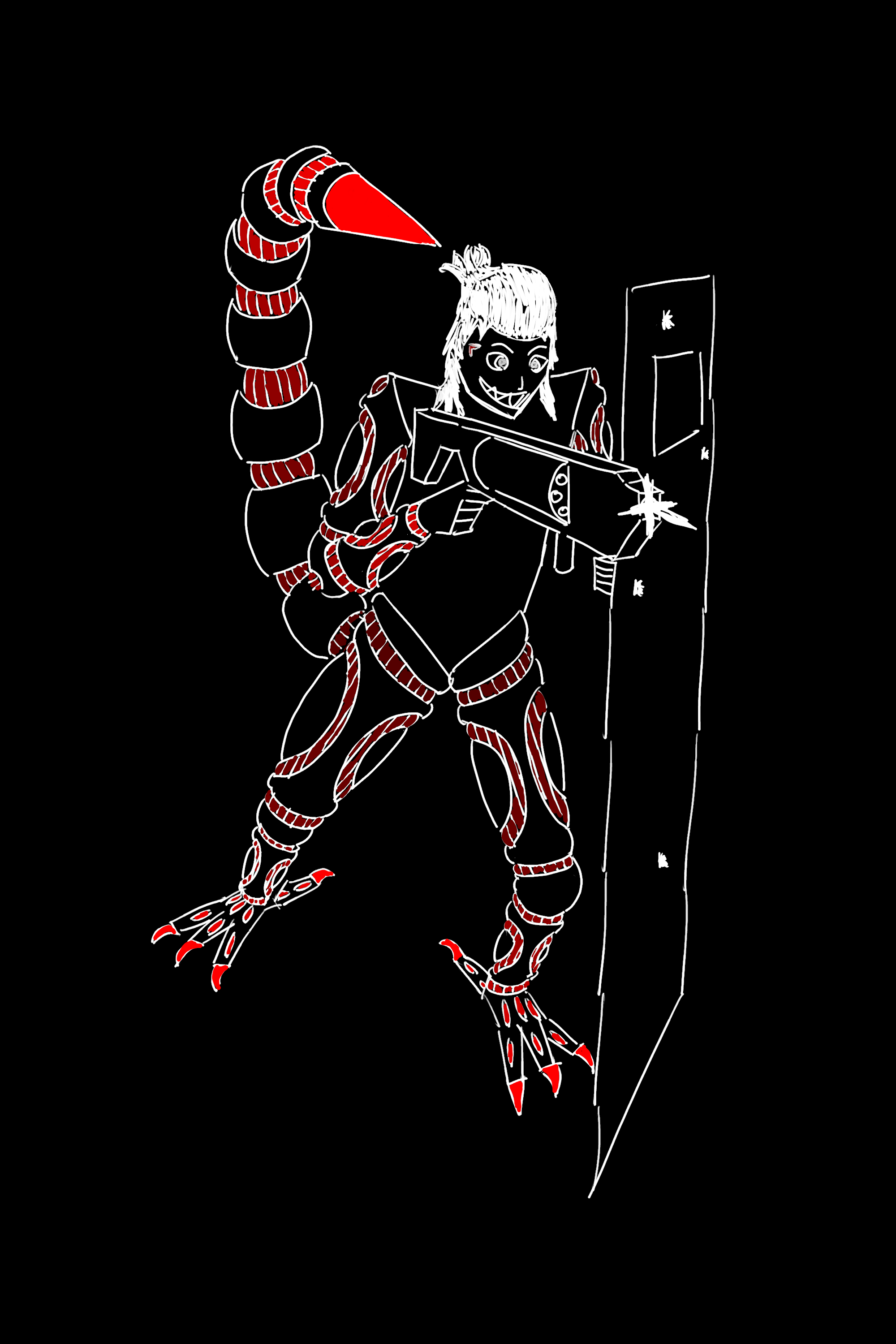
Twelve feet of Silico killing machine rippled and flexed beneath the crimson glow of Telokopolis. A sweeping upward curve of metal stood on six jagged legs, each limb with so many joints that they seemed to blur together into a twitching mass of rainbow-hued skin and shivering black muscle. The metal skin slid like oil on water beneath a hidden breeze, the subtle shimmer of an ancient rainstorm flowing across the surface of the Silico’s body; that skin was inches thick, and not true steel, but a semi-translucent material that Telokopolan science had never managed to comprehend, let alone replicate, both impossibly hard and strangely flexible at the same time, as if a different order of evolution had acted on iron and fire instead of meat and bone, to forge a new kind of tissue out in the green. Beneath that armoured hide, bundles of black muscle flowed back and forth, pulsing and throbbing along the limbs and inside the torso like blood-fattened leeches, their greasy coal-dark masses relocating and readjusting, seemingly independent of the Silico’s outward motion.

Six arms curved forward from the torso, like fingers curled into claws from the flayed bones of a narrow hand — eight feet long, many-jointed, omni-directional, with tapered points hanging in the air in front of the main body. Blade limbs, for close combat, each one lined with eight cutting edges; the blades hurt Elpida’s eyes, so sharp they looked unreal, the edges maintained by constant nanomolecular repair. Two dozen more limbs were folded into recesses on the Silico’s torso, tipped with strange metal organs, hooked and barbed and wired and holed, intended for a dozen different purposes, combat and otherwise.

The Silico’s body was haloed by three semi-visible rotating rings of shining metal. The rings seemed to pass in and out of view, as if not wholly material. Their passage blurred Elpida’s sight.

The front of the Silico’s body — the front of the upward curve — housed the sensory equipment-organs. It had no head, just that long vertical strip of optics and sensors and apertures down the middle of the curved torso. A hundred winking lenses stared at Lykke with red and green and sickly purple — some mechanical, others slick and black with Silico biology.

An imitation of a human face stood in the middle of the upward curve, wrought in Silico metal, white as chalk. The face was upside down, eyes closed in cherubic sleep. It looked like a child.

Elpida had seen that kind of thing a million times before; the kind of detail which got edited out of records and logs, the kind of inexplicable imitation that the public never knew about.

She ignored it, as best she could.

This Silico was a close-combat model — no true ranged weaponry, but plenty of options for CQC.

In a combat frame, Elpida could have destroyed a thousand of these things with a secondary weapon system alone. Up close, on the ground, inside the city, she stood little chance.

Neither did the Necromancer.

“Lykke!” she screamed again. “You can’t fight it! It’s goading—”

“Ugly puppy!” Lykke shrieked with girlish laughter, wrinkled her nose in disgust, and launched herself at the Silico again.

Lykke slammed into her opponent as a tidal wave of flesh and bone, infinitely plastic, infinitely regenerative. The Silico exploded upon her in return, the six blade-limbs blurring into a tempest of knives, slicing Lykke to pieces every split-second. The Necromancer ignored the rending of her flesh, flowing over the Silico, shrieking and cackling and whooping.

“Lykke, get off it!” Elpida shouted. “Get—”

The semi-visible rotating rings which haloed the Silico’s form suddenly accelerated, filling the air with a deafening whine. Pieces of Lykke’s body flew in every direction, cut apart by invisible force — but Lykke giggled, so loud that she drowned out the screaming sound of the Silico’s close-in defence systems.

“Tickle-tickle-tickle, puppy!” she howled. “My turn!”

Lykke’s flowing flesh somehow gripped one of the Silico’s blade-limbs, immobilising the arm. Lykke pulled and yanked and ripped until the limb tore free, exploding from the socket in a welter of black blood and living muscle. Masses of leech-like flesh slopped from both ends of the wound — then seemed to suck back within the edges of the rupture, wriggling away from the open air.

Elpida hesitated.

Could Lykke actually do this?

If the Necromancer could fight, then she needed Elpida’s help. And the girl from earlier — Misane — she was still crammed against a bank of computers down on the floor, still alive. If the Silico won and Elpida fled, the girl would die shortly after.

Everything in Elpida’s experience told her that Lykke didn’t stand a chance. And she was a Necromancer; Elpida should have been glad to spend her against the Silico, just for a chance to get away. The girl down on the floor of the chamber was a Covenanter, and probably a simulation anyway. Howl was missing, Howl was all that mattered. Elpida knew she should turn and run.

She broke from cover, heavy pistol in her left hand, and sprinted — toward the duel.

If she could get close, she wouldn’t even need to aim, just unload the whole magazine into the Silico’s guts.

Lykke was waving the Silico’s severed limb in the air, cackling and giggling and hooting. The Silico was unfolding extra arms, shooting Lykke’s protoplasmic flesh with close-range weaponry, unloading contact viruses, dousing her with electroshock fields, cutting her to pieces. And none of it worked. Perhaps the same would never have happened in reality, but maybe it would. But at least here, in the simulation, inside the network, Necromancer control was winning, and—

The Silico’s whole body pulsed. The air around it blurred and thickened.

Elpida skidded to a halt as the shock wave passed over her. She winced and hissed, her guts trying to punch upward through her throat. Her mouth suddenly tasted of blood. Her vision swarm, eyeballs throbbing. She locked her knees and forced herself to stay standing.

Lykke — a mass of whirling flesh and bone — slopped to the floor like cold offal.

The Silico picked up its severed limb and pressed the stump to the voided joint; black leeches reached out from either side of the wound and sucked the limb back into place with a wet slurp.

“Lykke,” Elpida said. “Lykke? Lykke! Get up. Get up, now! Lykke!”

Whatever was left of Lykke wasn’t moving anymore.

The Silico turned toward Elpida. The upside down face in the front of its body was still asleep, eyes closed in childlike innocence.

It took a step toward Elpida, then another, then another, all six legs carrying it forward.

Elpida levelled the hand cannon.

The Silico stopped.

Elpida froze, finger on the trigger, with the Silico perhaps a dozen feet away. With all its attention on her, she knew it could read her muscles. It would see the moment she tried to fire before her finger could squeeze. It would leap aside, or into the air, before the bullet could land. Elpida presented almost no serious threat to the Silico now, not without a good distraction, not unless she could make the shot against Silico speed and precision — and then only if she got very lucky and hit something that mattered.

But the Silico didn’t move.

Elpida didn’t breathe.

She held the gun.

The Silico.

Waited.


Previous Chapter Next Chapter


Face to face with the ancient foe, pared down to nothing but muscle and a gun. But this is all a simulation – right?

Let’s hope Elpida has a steady hand.

Anyway! Here we go, arc 14 gets deeper and rougher and weirder with every step. Behind the scenes, things are still looking good, this arc is remaining pretty tightly wound at a predicted 7 chapters, but we’ll see where that goes! Not everybody is under my control here – least of all Elpida, as always – but there’s only one direction to go, even if it leads through a Silico. 

Meanwhile, if you want more Necroepilogos right away, or you would like to support the story, please consider subscribing to the Patreon:

Patreon link! It’s here!

Right now this only offers a single chapter ahead, about 5k words. Behind the scenes I’m plugging away, and hope to offer more chapters ahead in the future!

There’s also a TopWebFiction entry! Voting makes the story go up in the rankings, which helps more people see it! This only takes a couple of seconds, and it really helps!

And thank you all, dear readers! Thank you for reading Necroepilogos; I couldn’t do any of this without all of you, the audience. These zombie girls (and others?) would be stumbling around in the dark, without anybody to see them. Onward we go, deeper into the tomb, into the network, into whatever waits behind all these playing pieces in the foreground. Until next chapter! Seeya then!

utero – 14.2

Content Warnings

Grief
Grieving children
Gore (again! Honestly I should probably stop warning for this.)


Previous Chapter Next Chapter


Elpida examined the bloody footprints which led away from the massacre — sharp angular wedges flanked by wide flat pads.

They told her that this particular Silico was perhaps quite heavy, but little else.

Silico were wrought in innumerable variety. Some could be classified into broadly applicable strains or breeds, but these designations were invented by Telokopolan academics and Legion strategists, meaningless to the Silico themselves. Two ostensibly similar individuals might display totally different purposes, combat roles, durability, armament, and more. Judging by the way this one had torn through a squad of armed Covenanters, it probably wasn’t a simple corpse-drone. This Silico construct was a true killing machine.

With no additional clues as to where Howl had been taken, Elpida left the dismembered corpses behind, and followed the trail of footprints

She wished she had time to double back for her hardshell suit and heavier weapons. But the Covenanters already had a head start; they could be taking Howl further away with every passing minute.

The Silico’s footprints led deeper into the tunnel of red-glowing flesh, punctuated by ancient, yellowed, arching bone, twisting away to the left in a slowly widening arc. This passageway was much narrower than the great vault which had led to the wound-junction, with room for maybe three people shoulder-to-shoulder. The bone-ridged ceiling was only a few feet above Elpida’s head. The walls offered far fewer protruding ribs to serve as cover.

Elpida moved slowly and silently, taking care with each footstep in her soft-soled shoes, breathing through her mouth to minimize sound. She kept the heavy pistol steady on the centre of the unfolding corridor. She had tucked away the lighter machine pistol inside her ballistic vest, detached from the webbing harness around her left shoulder and forearm; she couldn’t risk a loose weapon knocking or clicking against any surfaces.

After about two hundred feet the footprints ran out.

Elpida stopped and held position for ninety seconds. First she stared at the space above the final, faded footprints, until she was certain it was nothing but empty air. Then she ran her gaze down the curve of corridor, watching for any errant shimmer of warped light. She unfocused her eyes, tilted her head back and forth, stared at random points on the walls and floor — all the old-school Legion tricks, the ones Nunnus had taught her. Such techniques weren’t much use out in the green, but they would save lives if there was ever another Incursion.

Had there ever been another Incursion into the city? Elpida realised she didn’t know; the reality of this simulated time and place was millions of years gone.

Lykke hissed over her shoulder: “Zombie? Hellooooo? Have you fallen asleep with your eyes open?”

Elpida winced. Lykke had managed to maintain silence until that moment. At least she’d whispered.

Elpida whispered back. “The Silico was using optical camouflage. It was standing in the mouth of the corridor, in plain sight, before we found the massacre. Watching us, I don’t know why. I’m making sure it’s not standing in front of us right now.”

Lykke let out a petite sigh. “These bogeymen of yours are so tiresome. Is this what all you people were like? Sneaking about, never having any fun?”

“Out in the green they use this to blend in with the plants. It’s very effective. Less so up on the plateau. Standard issue Legion hardshells come with built in infra-red, night vision, and terahertz sensors. I have to use my eyes. Shut up and wait.”

Lykke sighed again.

Elpida was satisfied after another sixty seconds; the corridor was empty. The cold trail of Silico footprints pointed onward.

The narrow passageway coiled leftward for about another hundred feet, then abruptly passed through an open membrane of trembling flesh, into a short stretch of naked bone and exposed metal. The flensed corridor was lined with bright warning signs, printed in Upper-Spire, Mid-Spire, Down-End, and two other varieties of Skirts dialect, as well as Braille and tactile pictograms. Every warning sign was stamped in one corner with the symbol of the bone-speakers’ guild — a pair of sinuously interlocked semi-circles, one in machine-meat red, the other in yellowed bone.

The passageway ended in a large, armoured, blast-proof door; the lintel bore a larger version of the bone-speakers’ symbol. The blast door should have been closed and sealed, even when the room beyond was in use. Six fully armed Legionaries should have been on guard at all times, with a permanent comms uplink to an on-duty commanding officer. They should have been stationed behind a series of air-gapped pressure walls, scanner booths, and emergency lock-down remote force-restraints.

The blast door was wide open and unguarded. The security systems were all offline. The massive hinges were bent back.

Even in a simulation made from memories, Elpida hesitated at this threshold. She glanced back at Lykke; if this had been reality, she would have died fighting rather than lead Lykke into the room beyond. She would have given her life to keep the Necromancer out.

Lykke just stared up at her, one eye socket still puffy with bruises, golden hair dyed dark red by the blood-light of Telokopolis, innocently curious.

“Zombie?” she whispered, then batted her eyelashes. “Looking for some motivation in my face?”

“Follow my lead. Go where I go. Keep low, stay down, absolute silence.”

“Yes ma’am,” Lykke purred.

Elpida turned back to the blast door and stepped through. She crouched as low as she could, minimizing visibility as she hurried for the nearest cover, behind a bank of computer consoles, heavy steel plates humming softly over their powered innards.

Lykke scurried in Elpida’s wake and went down on her knees at Elpida’s side, her stained white dress bunched up around her pale thighs. A smirk played over her lips.

Elpida eased one eye out of cover.

She recognised this manner of chamber, if not this specific one — a massive vault about a hundred feet square, floored in living metal, crisscrossed by dozens of walkways and gantries, stuffed with computing equipment, MMI uplink chairs, cables as thick as the limbs of a combat frame, and all manner of devices, most of which Elpida had only the roughest understanding. Walls of semi-transparent machine-meat glowed with rich red light between upright ribs of sturdy bone; behind the flesh hung bundles of gigantic ganglia, wide webs of flickering nerve-tissue, thickly pulsing organs the size of armoured vehicles, and layer upon layer of fluttering meat which seemed to recede into infinite distance, deeper and deeper into the body of the city. Much of the machinery was interfaced with the machine-meat — plugged into extruded orifices, reading the beat of massive organs with traceries of delicate metal, or pointing powerful lenses and imaging devices at the walls, to read the motions of unreachable internal structures.

Down on the floor of the room was a low metal dome, ringed with warning signs, additional computing machinery, and several safety barriers — one of the dozens of stoma into which raw nanomachines might be fed into the city’s body.

Elpida’s gut unknotted slightly when she saw the dome was sealed and bolted. She had to remind herself this was a simulation.

This chamber belonged to the bone-speakers’ guild. Elpida had been allowed to visit similar places a couple of times; most Telokopolans would never see anything like this outside of vid-records, and even those were rather limited. There were many like it in Telokopolis, deep within the core of the city’s body. This was one of the places where the guild attempted to interpret the needs and will and mind of the city.

Elpida had always liked the bone-speakers, even if the experienced ones were very eccentric. They were responsible for monitoring and adjusting and managing all the processes the city itself seemed not to — though if you ever got into an extended conversation with a bone-speaker, they would always insist they were mere catalysts. It was the bone-speakers’ guild who had originally made the Civitas aware of the possibility of the pilot project; they had dredged the data for the combat frames and the pilot’s genome modifications from the incomprehensible thoughts of the city herself, though many in the Civitas and the public preferred to attribute that to human sources. Elpida had never managed to strike up much of a professional relationship with any bone-speakers — they kept to themselves, spending most of their lives ‘listening’ to the city via mundane means. The few who attempted direct communion via MMI uplink tended toward extreme detachment and dissociation, their thoughts always elsewhere, though they rarely seemed upset about it; those who dove too often sometimes lost the power of speech, or seemed concerned with matters impossible to communicate. Elpida had once met one of the bone-speakers who had personally contributed to the extraction and translation of the pilot-project data, who had done seven MMI dives in his youth; he had been a very old man by that point, well over a hundred, totally non-verbal, his eyes locked on motes of dust, one hand recording their motions in great mathematical detail on a writing pad.

As far as Elpida knew, no bone-speaker had ever joined the Covenanters.

She was glad there were none in this chamber, simulated or not.

The gantries and walkways and platforms were littered with corpses — Covenanters, torn apart, bisected, crushed, left to bleed out, slumped over their weapons, crumpled inside their greensuit hoods, smeared across the floors in bloody streaks of mashed gore. Elpida counted seventeen visible casualties from her current position, and partial corpses of seven more. A small group had made a last stand on one of the highest points in the room, in front of the matching blast door on the opposite side, which was also wide open. They hadn’t fared any better.

Elpida held her position, watching for any flicker of refracted light, listening for the sound of clawed feet clicking on metal, trying to pick out the scent of Silico flesh and metal beneath the iron-and-shit reek of so many voided bodies.

The illumination in there was easier on the eyes but harder to read; the crimson and scarlet blood-glow was muted and mixed with the regular lighting from much of the bone-speakers’ equipment. The chamber was far from silent; the air was filled with the great subsonic throbbing of the city itself, the low clicking and humming and whirring of all the computer equipment, and the slow, steady drip — drip — drip of blood falling from one high gantry onto another.

No sign of Silico, no hidden movement.

Which meant it could be anywhere.

Elpida weighed her chances.

If something like this had happened in reality, during Elpida’s life, it would have been a near-unimaginable emergency. Elpida’s duty — which she would have accepted without question — would be to stand up and shout and draw attention to herself, to get the Silico out of this chamber by any means, to draw it away from any places the city might be truly vulnerable.

Silico had breached Telokopolis five times in the city’s history. The First and Second Incursions had happened within a century or two of the city’s founding — at least according to the ancient, incomplete, confusing records of that time. There was a lively academic debate as to whether those incursions had actually happened, or if they were just mythical, or perhaps references to much smaller events. Telokopolan historians had little physical evidence to go on; archaeology on the plateau always turned up such a jumble of human and Silico corpses, the fruit of seven thousand years of unbroken siege.

The Third Incursion had really happened, about three thousand years before Elpida’s life. Nobody disputed that, except perhaps the infinitesimally small number of people who thought everything in the public museums was fake. The Third Incursion had been preceded by a period of about twenty years where Silico numbers had seemed to dwindle. Probing attacks and skirmishes had trailed off, then stopped entirely. Expeditions into the green had gone almost unchallenged, except by random stragglers. The Civitas of that period had embarked on a cautious program of forcing the green itself further back, clearing land beyond the plateau.

Historians disagreed about why the Silico had eventually returned — was it a reaction to the burning back of the green, or had the Silico been busy with some ineffable task, somewhere else on the planet’s surface? Whatever the true reason, the Silico had crashed back into the atrophied defences of the city in gigantic numbers, without even forward scouts to probe for weakness, giving the Legion barely six hours of advance warning. They had swept aside the plateau defences in two days, punched into the Skirts on the third day, and had only been driven back by fourteen months of fighting. A sudden sharp shock to Telokopolis. A reminder to never again relax her eternal vigilance.

All that had happened so long ago, though.

The Fourth Incursion was recorded in the same languages that Elpida had spoken in life.

In post-founding year 6332, the city’s most sensitive long-range equipment had detected distant echoes from a series of ground tremors. The source was far beyond the plateau, far away to the extreme east, perhaps at the edge of the drop-off itself, where the green fell away to infinite benighted depths.

Several weeks later half a dozen vast Silico leviathans had shouldered their way through the green, shredding billions of trees as they advanced, scooping up undergrowth like filter-feeders, and even devouring the smaller Silico forms they encountered. Nobody had ever seen Silico constructs of that size or kind. Legion archives were opened, bone-speakers communed with the city, and the matrosses’ guild woke engines in the Skirts that had not been fired in thousands of years. The populace had panicked; though each individual leviathan was no more than a tick when compared with Telokopolis, the notion that something could wound the body of the city was unthinkable, no matter how small the wound.

In the end the Legion had fought the six leviathans at the edge of the plateau. The matrosses’ guild had struck the killing blows with energies that were still being studied in Elpida’s time. But as each of the vast creatures had died, they had disgorged millions of small-scale Silico constructs — along with equal numbers of what would later be called corpse-puppets, which was the first time anybody had seen their like. Plateau defences had been overwhelmed. The Skirts had been breached and constructs had swarmed halfway up the spire. The distinction between civilian and Legion had melted away; anyone who could do anything did it, because there was nowhere to run. Repulsing the attack and retaking the plateau had taken four years.

Telokopolis had not been scarred by the Fourth Incursion — the Silico had never reached her inner places — but the people had. The Civitas of that time had instituted the official policies of isolation, the end of pushes out into the green, and the massive re-fortification of the plateau.

The Fifth Incursion had happened about a century before Elpida’s birth. Old Lady Nunnus had been a young woman, a Legionnaire on the plateau, already showing promise in the constant churn of small-scale contact.

The Fifth Incursion had not breached as deeply as the Fourth, nor been as surprising as the Third, and had not found Telokopolis unguarded — but it had shown intellect, adaptation, and strategic planning, which had seeded a new kind of fear. The Silico had gathered in massive numbers on a very narrow frontage, then cut through the plateau in a sharp wedge. They had ignored the Legion, retreated from open engagement, and bypassed fortifications by choking them with Silico bodies. Then they had lunged for the Skirts, like a lance rammed through the city’s armour, uncaring of the counter-blow.

Seventeen million civilians had died; two million Legionaries. The fighting had lasted just under two years. A whole city block down in the Skirts was dedicated to a memorial. Nunnus had taken the cadre there, when they’d been quite small, just old enough to understand their intended purpose.

The experiences of the Fifth Incursion formed the basis of all modern Legion doctrine. The political and social aftermath had seen the birth of the expeditionist faction in the Civitas — an acknowledgement that the city could not close itself off from the green and pretend the Silico would throw themselves into the teeth of the Legion’s guns forever. That, in turn, had led to the pilot program, and Elpida’s own birth.

No Silico had ever gotten this deep inside the city. This breach was unthinkable.

Elpida reminded herself that this wasn’t real. This was a simulation.

But to whom did this memory belong?

The bone-speakers’ chamber had multiple exits — three different sets of blast doors, all lying open. Elpida decided the highest was the most obvious route, the one the Covenanters had tried to defend.

She slipped back behind cover. Lykke was smirking at her, like they were playing hide and seek.

Elpida whispered, “We need to cross this room, to the doors on the other side, but the sightlines are terrible. We’ll be exposed the whole way, and the Silico could be hiding anywhere. We need to move fast, keep low, and stay silent. If you make a sound on purpose I will consider that a betrayal. Do you understand?”

Lykke’s smirk dissolved into a pout. She crossed her arms over her bloodstained chest.

“If you make a sound it could bring the Silico down on us,” Elpida whispered. “If you’re going to undermine the rescue, then I may as well shoot you now and—”

“Yes, yes, fine,” Lykke hissed. “But don’t you think I could dance with this unwanted suitor in your place? If it wants to steal you, it has to go through me.”

“These are no longer my memories. I don’t know what it means if either of us gets hurt or killed now.”

Lykke grinned. “But I could still swat this fly for you.”

“No,” Elpida hissed. “You couldn’t.”

Lykke rolled her eyes.

“Promise me you’ll be silent,” Elpida whispered.

Lykke rolled her eyes harder. “Cross my iccle bitty heart and hope to die. Or not. Because I can’t die. Hee-hee-hee.”

Elpida stared at the Necromancer, then accepted she had no choice but to trust her.

She pulled the stolen greensuit hood out from inside her ballistic vest; she might not have time to don the disguise if they blundered into survivors on the other side of that blast door. She tugged the hood down over her head, got the internal supports snug against her skull, and tucked her hair up inside. The visor lenses gave her a good field of view, but this was a civilian model, without any electronics.

Then she tapped Lykke on the knee, rose to her feet, and crept out from behind cover.

Elpida picked the safest, most well-concealed route, even if it took a little longer. She went right, crouching low, past the banks of computers and stacks of machinery, then crept down a set of metal stairs, her soles silent on the textured grip of each step. She ghosted along a walkway, moving quickly and carefully; she glanced back to make sure Lykke was following. The Necromancer was doing her best to crouch and shuffle, a playful smile twitching on her lips, craning her neck to peer at everything. That would have to do.

Down a final set of steps; Elpida hit the floor of the chamber with a whisper of fabric. Down here she was level with the sealed metal dome. Even through the greensuit hood, the air stank of blood and offal.

She held position for thirty seconds, eyes scanning for fresh motion, for the glimmer of misshapen light, for the air to assume an incorrect angle.

Nothing. Total stillness. No Silico, not that she could see.

Elpida hurried onward, past the dome, heading for the stairways and gantries which led back up to the blast doors on the opposite side of the chamber. She kept her heavy pistol aimed at every blind corner and hidden nook, in case the Silico killing machine was—

“Hsssst!”

Elpida froze.

“ … hssst! H-hey! Hey … here. Here!”

The terrified whisper came from Elpida’s left — from within a sheltered alcove formed by the supports of three different overhead walkways. The light had made it seem like a blank wall.

A small, pale, blood-smeared face was peering out from within — young, female, framed by dark hair, eyes bulging and bloodshot.

It was a young woman, drenched from head to toe in fresh gore. She was clutching a submachine gun with both hands, knuckles so tight that her arms were shaking. She wore baggy work overalls and practical boots.

The chest of her overalls was painted with the triple-triangle symbol of the Covenanters, white lines blurred and marred by crimson splatters.

Elpida nearly turned away and walked on. But she had no choice.

She altered her route and stepped into the sheltered alcove, towering above the survivor. A small pile of bodies was tangled in the mouth of the narrow space, cut into pieces, guts voided, lying in a pool of blood and viscera. This young woman must have fallen beneath the corpses, passed over by the Silico killing machine.

The woman was shaking uncontrollably, eyes mere wide white rims in a crimson mask. Beneath the blood her skin was grey with shock. Her hair should have been bright bronze — a fashion trend Elpida vaguely remembered — but the matted blood made it look black. She had the beginnings of a tattoo down her right cheek and the side of her neck — the stylised flowing wave of a guild Elpida didn’t know.

The tattoo was only just begun; Elpida realised this was not a young woman — this was a teenage girl, a child, no older than sixteen or seventeen.

The girl hissed: “Shhh shhh! D-don’t say anything, don’t— don’t make a sound, it might come back, it might come back. T-there’s Silico, inside the c-city, w-we have to g-get—”

Elpida put the muzzle of her pistol beneath the girl’s chin.

“Put the gun on the floor,” she whispered.

The girl froze. Her jaw hung open.

“Put the gun on the floor,” Elpida repeated. “Or I’ll pull this trigger.”

The girl tried to nod, but the pistol was in the way. Elpida eased back just far enough to give her room to obey. The girl bent over and placed the gun on the floor; by the way she handled it, she’d probably never touched a weapon before. She let go of the gun and spread her hands. Elpida put a foot on the submachine gun and scooted it back, beyond the girl’s reach.

This lone survivor was too shocked to take advantage of a moment’s lapse, and Elpida had only one hand. She had to use the hand holding her pistol to take off her greensuit hood. Her long white hair fell from the hood and down her back.

The girl’s face collapsed further — eyes bulging with fresh fear, mouth curling with a need to sob, her whole body cringing away from Elpida.

“Oh … n-no,” the girl half-sobbed, trying desperately to stay quiet. “It’s— it’s you, the— the leader! No— no no no, don’t— don’t—”

Elpida frowned. “You know me?”

“W-what?” The girl boggled at her. “I— I know you from the news! You’re the head pilot, a-aren’t you?” A shudder went through the girl; she started to pant as she spoke. “Y-you let that thing in here! Didn’t you?! You let it in, to kill us! You let in!”

“I did not let the Silico into the city. Stop. Breathe. You’re going to make too much sound and draw it down on us.”

The girl seemed about to hiss another panicked accusation, but then her eyes flickered to Elpida’s shoulder. “W-who are you?”

Lykke smiled, toothy and bruised, leaning around Elpida’s side. “Hiiii,” she whispered. “Oh, this one is shaking like a leaf. What fun! Can we keep—”

“Just a civilian,” Elpida said to the girl. “Ignore her.”

Lykke tutted. The girl didn’t seem to know where to look, then stared at the pistol. “Are you going to … kill me?”

“If I wanted to shoot you, I would have done it already,” Elpida said. “But I will, if—”

Lykke interrupted: “She will! You best believe her, sweet little thing. She’s a terror, this one, a real heart-breaker, a—”

“Lykke, shut up.”

Lykke shut up.

The girl was staring, panting for breath, eyes wide and white. Elpida continued, “I’m going to ask you questions. You’re going to answer them. Refuse, and I’ll shoot you. Lie, and I’ll shoot you. Try to mislead me — what happens?”

The girl swallowed. “Y-you’ll shoot me.”

“Good.”

Elpida was bluffing. She was not sure she could shoot an unarmed teenager, even a Covenanter — though this was a simulation. This girl had not been old enough to understand what she was committing to. She’d not even been old enough to have any responsibility in a guild. She was a child, led astray by others who should have known better.

“Your comrades brought a captive through here,” Elpida whispered. “Yes or no?”

The girl nodded. “Yes, yes!”

“Who?”

The girl’s eyes widened. “I-I don’t know! I don’t know, really, I don’t. It was just a person bundled up in a float-plate stretcher. That’s all I saw.”

“Which exit did they take?”

“The big one, up— up there.” The girl pointed a shaking finger at the blast doors where the Covenanters had mounted a last stand.

“Where were they taking her?”

“Her?” The girl blinked. “Um— I-I don’t know! I don’t. We don’t— I wasn’t part of—” Her face started to crumple. Fresh tears gathered in her eyes. “I was o-only meant to be here with— with my dad, and then—”

“Concentrate,” Elpida said.

It took an effort of will for Elpida to keep her face neutral. This girl — simulation or memory or not — was on the verge of a breakdown, pumped full of adrenaline, in shock. Her gaze started to drift backward, to the bodies right behind her. Was one of them her father? Was this the daughter of a committed Covenanter, just along to make her father proud? And now she was splattered with his blood, alone among the corpses, and her only hope was one of the people her father had sworn to exterminate.

“My— my— my d-dad, he’s right there. Dad … dad—”

Elpida reached out with the pistol and tapped the front of the girl’s chest. “Concentrate.”

The girl swallowed and nodded. She didn’t look at her father’s corpse.

Elpida whispered: “How many guards with the captive? How many Covenanters?”

“S-six,” the girl murmured. “No, uh, seven. Sorry. Seven. I-I think.”

“How were they armed?”

The girl blinked, blank for a moment. “Uh … with … guns? I-I-I don’t know much about … guns. I’m— I’m really sorry. I’m sorry. I’m sorry.” Tears started to fall down the girl’s cheeks, cutting tracks into the blood. She raised an arm to wipe her face, but her sleeve was covered with blood as well; she stared at the sticky gore, frozen for a moment.

Elpida stared down at her, trying to sort through her memories. “I don’t recognise you,” she murmured.

The girl looked up, wide-eyed. Lykke let out a soft sigh and muttered, “This again, zombie?”

Elpida asked, “What’s your name?”

“Uh … uh … Misane. Misane … Peruce.”

A Skirts name. “Misane,” Elpida said. “What’s the last thing you remember doing?”

Misane blinked several times. “W-what?”

“Before this. Before you were here, in this chamber. What were you doing, before this?”

Misane shook her head. “Talking with … m-my dad and—”

“No, before that. Think hard, Misane. What is the last thing you remember?”

Misane’s breathing slowed. She frowned, growing more confused than afraid. “I was … in bed? In … bed, but I was … I wasn’t … ”

“That’s enough,” Elpida whispered.

Elpida didn’t know what this girl was — what any of these Covenanters were. Was this really just a reconstruction from a memory, whether hers or somebody else’s? Or was this a real person? Was this another form of resurrection, dragged out of the soup of history and pressed into service inside this simulation?

Was this just another zombie?

Elpida took a gamble.

“None of this is real,” she whispered to Misane. “This is a simulation, based on a memory. Do you understand?”

Lykke let out a soft little ‘ugh’. Misane just stared, wide-eyed. Even if this girl did comprehend, Elpida was the enemy she had been taught to hate and fear, and Elpida was holding her at gunpoint.

“Lykke,” Elpida hissed. “Pick up that submachine gun for me, please.”

Lykke tutted. She picked up the girl’s gun with one hand, dangling it by the butt, as if it was a bag full of excrement.

Elpida waved the pistol at Misane, gesturing her out of the alcove. She whispered, “The blast door on the opposite side of the room, it’s open, that’s where I just came from. There’s another pile of corpses down there, but nothing else. If you move quietly and slowly, the Silico won’t hear you.” She paused. “Go. Get out of here.”

Misane looked from Elpida to the gun, then back again. “But— but if it— if it’s there, I’ll— I-I need the—”

“I’m not putting a gun in your hands,” Elpida whispered. “Because you’ll probably use it to shoot me in the back. Go.”

Misane cringed . “What if there’s more Silico? I-I don’t want to die, please … ”

“None of these weapons would put a hole in a Silico killing machine. You need something heavier, like this.” She gestured with the pistol again. “Out.”

Misane stumbled out of the alcove, back onto the main floor of the chamber. Elpida followed, moving silently. Lykke sighed and padded after them.

Elpida pointed the pistol at Misane again. “Go.”

Misane hesitated. “Are you going to shoot the Silico?”

“If I can. Now—”

“Take me with you!” Misane hissed. “Please! If this is the Sixth Incursion, they’ll be everywhere. Please, please, I’m sorry, take me with—”

A clamour of heavy boots on metal floors rang out from far above.

Elpida twisted just in time to see a dozen armed figures emerge from the blast door which she had intended to use as her exit. Rifles in hands, scraps of body armour on their frames, white triangles painted on greensuit hoods and jacket shoulders and cast-off Legion chest-pieces. A dozen Covenanters advanced into the chamber, with the shaken confidence of those who were not used to seeing the fresh corpses of their friends.

Elpida tried to grab her own greensuit hood from the front of her ballistic vest, but it was too late.

One of the Covenanters stopped and pointed down at her. “It’s one of them!” he cried out. “One of them! She’s right here!”

Misane opened her mouth and raised a hand to her comrades. “Help—”

Elpida tackled her to the floor, behind a bank of computer consoles which ringed the great dome at the centre of the room. Misane flailed and spat, trying to wriggle out from under Elpida, batting at her chest and back with blood-smeared hands. Elpida shoved her down, further into cover. Lykke let out a squeal of delight from somewhere behind, but Elpida couldn’t see where the Necromancer had gone.

“Get off!” Misane screamed. “Get off! Get off me, get off—”

The Covenanters opened fire.


Previous Chapter Next Chapter


Elpida just can’t help herself, can she? Necromancers, ancient foes, simulated versions of the people who exterminated her sisters – she’ll try to save anybody, if there’s any chance for redemption. Is she right, or just too optimistic? 

She’s already committed to shooting back at these Covenanters, though. Too bad.

Meanwhile – behind the scenes! It seems like this arc is going to be a little bit longer than I had expected (go figure, this always happens, right?) Not that much longer. Originally I had planned for 5 chapters, as tight as possible. But Elpida and others have pushed things a bit further, and now I think the arc will be 6-7 chapters. Maybe 8? I’m braced for anything. It’ll all be Elpida, though. We’re staying as focused as we can for this one. Elpida is at the controls; I’m just in the co-pilot seat with the mapping software. Anyway! I hope you enjoyed this one, dear readers. Onward we go.

Meanwhile, if you want more Necroepilogos right away, or you would like to support the story, please consider subscribing to the Patreon:

Patreon link! It’s here!

Right now this only offers a single chapter ahead, about 5k words. Behind the scenes I’m plugging away, and hope to offer more chapters ahead in the future!

There’s also a TopWebFiction entry! Voting makes the story go up in the rankings, which helps more people see it! This only takes a couple of seconds, and it really helps!

And, thank you! Thank you so much for being here and reading my little story about far-future zombie girls and the dead earth beyond the end of biology. None of this would exist without all of you, the readers! Even now I still feel like we’ve barely scratched the surface – though for the first time we’re digging a little deeper, into the soil, into the network, to see what lies beneath. And I will see you all next chapter. Until then!

utero – 14.1

Content Warnings

Gore


Previous Chapter Next Chapter


Visceral flesh fluttered and pulsed on monumental scale, trembling and throbbing in slow, steady, stately rhythms, almost too subtle for human eyes to follow. Disrobed meat smouldered with the crimson glow of molten blood, glistening slick and wet with layers of silken mucus. Hawsers of thickly thrumming tendon and bunched cables of braided sinew sutured and stitched hidden layers of marrow and muscle to the arching spans of soaring bone. Osseous columniation curved toward the vault of the ceiling, joining there like steepled fingers, each rib-like support yellowed as ancient paper, encrusted with long streaks of darker deposit, pitted and worn in swirling patterns by the passing of processes no mortal mind could trace. The lowest and narrowest of the veins melted from flesh to dull silver metal, spreading out to become the floor. Tiny side passages puckered and winked, some of them closed by metal bulkheads marked with the symbol of the bone-speakers guild, others with warnings that the interior was unsafe for unprotected human beings, but a few stood open — membranous voids between the bones, lit by the dappled backwash of dark red light, spiralling upward and downward, deeper into the body of a living god.

Elpida crept onward through the remembered flesh and bone of Telokopolis, though she knew not where this vessel led.

Before she had left the memory of the cadre’s private quarters, Elpida had paused to equip herself from the armoury. She wore a fresh pair of black leggings and a clean back t-shirt, along with elbow and knee pads which the cadre had sometimes used for training. She had also dug out a pair of flexible, soft-soled sparring shoes, muffling her footsteps to near-silence.

A jury-rigged harness was looped around her left shoulder and forearm, made from two rifle slings and some combat webbing, cradling a GXI-115 lightweight submachine gun — little more than a pistol with a stock and some punch. Elpida had added a silencer, bulky and awkward but essential for her strategy. The weapon was designed for non-Legion civilians operating out on the plateau. It drew ammo from a pre-loaded block of reaction mass, produced minimal recoil, and had as few moving parts as possible. No way to jam, no need to reload, nothing that would force Elpida to fumble with the absence of her right hand.

She also wore a simple ballistic protection vest. Her long white hair was stuffed down the back. The front of the vest concealed an additional sidearm — a 117-MCS hand cannon, the same heavy pistol she had used against Lykke, along with two additional magazines, and a long-bladed combat knife.

Elpida had located some white paint deep in the armoury and done what was necessary, even though it had brought bile to the back of her throat.

The ballistic protection vest now sported the Covenanter’s triple-triangle symbol on the chest, daubed in white, by Elpida’s own hand.

Better than stripping the dead woman. Elpida had taken the greensuit hood, despite the blood on the inside; it was stuffed down the front of the ballistic vest, in case she needed to complete the disguise in a hurry. Her hair, skin colour, and height would give her away quickly, but she didn’t plan to pass for a Covenanter for long, just enough to fool a quick glance and slip on by — or to get close enough to open up with her firearm.

She still longed to employ the opposite strategy. Her hardshell suit still stood in the armoury, intact and undamaged, as if she had never tried to use it against Lykke. A missing right forearm wouldn’t matter once inside the suit. She could lock the servos in place, arm up the suit with a heavy machine gun, plasma-casters, and anti-personnel close-proximity fragmentation rounds, and then cut through a hundred Covenanters like a scalpel excising rotten flesh. But she had no idea how many of these memory-ghosts stood between her and Howl. She could not count on a total lack of anti-armour. Worse, the Covenanters could bog her down with sheer numbers in a protracted firefight, while they moved Howl elsewhere, or simply held her hostage, or threatened to kill her.

Elpida had to rely on stealth. Get to Howl, as quickly and quietly as possible.

Lykke walked beside her.

The Necromancer had shed her trembles and her shuffling limp, padding along quite comfortably on bare feet, though she still bore the bruises and welts that Elpida had left all over her skin. One of her eyes was puffy and purple. Blood and vaginal mucus still stained her little white dress, though the stains were muted by the omnipresent crimson light, turning all white to scarlet and maroon, wrapping her shins and ankles in rose-bright ribbons. Her golden blonde hair lay loose, turned dark red. Pain occasionally crossed her face in a suffocated wince.

Elpida didn’t complain about the flexible boundaries of Lykke’s promise of permanency; the Necromancer could lie all she wanted, as long as she helped recover Howl.

Lykke was still pouting, though.

“Truly, I have no idea what happened back there,” she was muttering as she followed Elpida. “That … that scrap of animated meat, that bag of unmodified flesh, that weak little mote of nothing, nothing, nothing! She wasn’t even holding me back, not really. Nothing like that has ever held me back. It’s nonsense, it’s contrary to every principle of good sense. It’s offensive. Yes, offensive, that’s what it is! Those flecks of lead, those bullets, holding me back? Tch! Perish the thought, perish the very notion. I just … I simply couldn’t … couldn’t touch her!” Lykke fell silent for a moment, then sniffed. “You do … you do believe me, don’t you, Elpida?”

Elpida kept her eyes on the main trunk of the passageway ahead, floor and walls and bone-supports all bathed in blood-red light. Each rib of arching bone was a potential ambush, each unfolding metre of curve a possible encounter. Her left hand was dry and cool on the grip of her weapon. Her bruises complained and her groin ached, but she ignored the sensations; the demands of her body faded to nothing.

Lykke whined, “Elpida? Elpida? Zombie? I asked, do you believe—”

“Already told you. Wasn’t your fight.” Elpida replied in a whisper. “She was a Covenanter. My responsibility, my failure.”

“Aren’t your responsibilities mine now, too? Now we’re … as we are?”

Elpida glanced at Lykke. The Necromancer’s pale skin was dyed darkly glistening red. “You said this software space exists inside me. I considered her my responsibility. The symbolism was obvious. I did not want you to kill her. I had to do it. Why are you so surprised?”

Lykke shrugged. “It shouldn’t have happened. It’s never happened to me before. You are … no offence, not after we shared so much, but you are only a zombie, after all … ”

Elpida returned her attention to the passageway. “You do the distracting, I’ll do the shooting. Or we slip by unseen, in disguise. All we need to do is recover Howl. Nothing else matters.”

Lykke sighed, sounding lost.

Elpida pushed onward, down the main trunk of this inner passageway of Telokopolis.

The passageway was very high and very wide, enough for two dozen Legionaries to march abreast, a clear memory of one of the largest and oldest veins in the living core of the city. It curved away to the right in a slow, lazy loop, ribbed with bone, upholstered with cliffs of flesh. The light dyed everything a mottled, dappled blood-red; a deep throbbing hum lay just below human hearing, resonating with the meat-and-fluid engines of the city; the air carried a sweet iron and tangy copper scent, the smell of machine-meat and organic lubricant, occasionally joined by the rich mineral spice of the exposed bones.

Elpida did not recognise the specific location. She had visited the deep innards of the city plenty of times, as much as the bone-speakers guild had allowed, but one meat-and-bone vessel was much the same as any other.

She ignored the open side-passages for now. They were tight and twisty, leading anywhere. If this kidnapping had happened in reality, in the real Telokopolis, in life, then Elpida would have been in a terrible situation; whatever force of Covenanters had overpowered and kidnapped Howl could have taken her down any passageway, into any adjacent vein of the city, into any one of a million hidden abscesses and pockets, or just hurried her to an elevator or transport tube, to whisk her off to another floor.

But this was a simulation, a software recreation made from Elpida’s own memories, running on the local nanomachine network of her own undead body.

So she followed the obvious passageway, toward obvious confrontation.

Lykke huffed again. “Sneaking about in the shadows? Really, zombie? We’ve been having so much fun, you and I. Haven’t we? Not counting my little … issue, back there.” She cleared her throat. “If we’re going to run into more of your dour and disgusting little friends, the least we can do is have some fun with them, can’t we? This is your internal network space, it’s not like getting shot or cut up would make any difference to you. Have some fun, cut loose! Ride that revenge!”

“Stop making suggestions.”

Lykke sighed — then cut off with a little cough. “Oh. Oh, you’re not … you’re not avoiding a dance just to … to spare me further … embarrassment?” Lykke lowered her voice. “Are you?”

“This might not be my doing,” Elpida said. “Keep that in mind.”

“ … eh? I’m sorry, zombie, what?”

Elpida glanced at Lykke again. The Necromancer looked clueless, eyes like pools of mulled red wine, hair the colour of dying roses. “I’ll explain. You listen. Then you tell me anything relevant, about how the network functions, how it interacts with my own internal software space. Understand?”

Lykke blinked three times, then shrugged. “I suppose so?”

Elpida kept her eyes on the curve of the corridor and her left hand on the grip of her machine pistol. She whispered quickly, ears pricked, listening for any sounds from up ahead.

“Option one, I am doing this to myself. The Covenanters are pure software. They’ve kidnapped Howl. My subconscious is doing this, perhaps to punish me, because I feel guilty. Something like that. The positive conclusion I came to earlier wasn’t enough.”

“You mean, after we fucked?”

“Mm.” Elpida shook her head. “But option one is unlikely. I do consider myself responsible for my sisters’ deaths. I may harbour some self-loathing. But I would never harm Howl. I would punish myself, not her. I don’t think I’m doing this to myself.”

“Punished me quite effectively,” Lykke purred. “Maybe Howl isn’t enough of a naughty girl?”

Elpida shot Lykke a sharp look. Lykke smothered a giggle.

“Option two,” Elpida carried on. “I am not doing this to myself. This is the work of an intruder, inside me, inside my local network, however it works. We’ll call this hypothetical intruder ‘hostile one’. Hostile one is using the Covenanters against me, a symbol from my memories, from my life. I am inclined to believe this, since I’ve already confirmed a prior intruder.”

Lykke gasped. “You have?!”

Elpida glanced at the Necromancer. “You.”

Lykke pouted. “You weren’t complaining about my intrusions earlier, zombie. In fact, I seem to recall you making some quite wonderful—”

Elpida halted and held up a hand.

“—noises when my—”

“Quiet,” Elpida snapped. “Now.”

Lykke shut her mouth, then sighed through her nose.

Elpida dropped to one knee and tucked herself half-behind a protruding ridge of bone. She turned her head, cocking one ear toward the passageway.

She wasn’t sure what she had heard.

The sound had been too subtle to identify, drowned out by Lykke’s words, captured and muffled by the meandering organic innards of Telokopolis. A voice, perhaps — a shout? A meaty, liquid — something? As Elpida strained to listen, she heard a brief moment of higher-pitched thumping — or perhaps only imagined she did.

She waited another minute, then two, but the sounds did not reoccur.

“Just Telokopolis?” she murmured.

Lykke sighed, flamboyantly irritated.

Elpida stood up, stepped out of cover, and continued her advance. “Lykke, still listening?”

“Tch! Not as if you’re good for anything else right now, zombie. Yes, yes, do continue … ”

“Good enough. My initial assumption was that ‘hostile one’ was you, but now I think it’s something else. Can you confirm that for me, Lykke? Is there another intruder?”

“How should I know?” Lykke snorted. “I don’t make a habit of slipping into zombies’ private networks. I told you, Elpida. You’re my very first. My first and only. The only one I want, the only one I’ll ever take, I think.”

Elpida ignored that. “Right. Brings me to my point. If hostile one is real, it might intend real harm, toward either myself or Howl. It might be able to do real damage. So, no, I’m not going to indulge anything, let alone a desire for revenge. We do everything we can to reach Howl, stealth or otherwise. Everything and anything. Understand?”

“I would be so much better at the ‘otherwise’.”

Elpida pushed on, each footstep silent, with Lykke trotting along behind her. The curve of the passageway sharpened — first gradually, then more intensely, as if coiling toward some vital organ of the city. Elpida stayed on the outside of the curve, for maximum visibility. She kept her ears pricked for any recurrence of the unexplained noises from earlier. She focused on each fresh arch of rising bone, every new expanse of red-glowing meat. She was waiting for any sign of Covenanters, but secretly for something else.

Elpida was keenly aware that her hopes were impossible. Despite her resolve to stay true to her new comrades, to put to them the question of Telokopolis as their future, she still ached for another glimpse of that white dress — that flutter around a corner, that hint of red flesh, that confirmation.

She wished that Telokopolis herself would show the way.

At Elpida’s shoulder, Lykke suddenly whispered: “What’s it like to have a sister?”

Elpida almost looked back. “What?”

“A sister. Like your … ‘Howl’.” Lykke tutted softly. “Or the others, the names I could read all over, back there in your sisterly love-nest. Orchid, Yeva, Asp? They were all your sisters, yes? But you weren’t spawned from the same womb. You were grown in machines, then decanted. Isn’t that right?

“She was our womb.”

“Eh? Pardon, zombie?”

Elpida nudged the wall with the stump of her right elbow. “Telokopolis. Our womb, our mother. She was the one who bore us, even if human hands helped her do it.”

Lykke fell silent for a long moment. Elpida kept her eyes on the curve ahead as she advanced. Was that another sound, at the edge of her hearing — a long metallic scrape? Or just another echo from the depths of this memory?

Lykke whispered again. “But what’s it like?”

“Lykke.”

“I know, I know!” Lykke hissed. “You’re trying to concentrate! You have to be ready to duck and roll and blast with your stupid little bang—bang splurt gun. But I’m trying to understand you! Your little goblin is horrible, just utterly rancid, I despise her. I would happily see her carried off by whatever bugbears your memory has summoned for you. But here I am, helping with a rescue, and for the love of myself I cannot figure out—”

Lykke rambled on. Elpida filtered it out, because the passageway had led somewhere.

The curve of corridor terminated in a tangled junction — a vast knot of meat and bone soaring far overhead, tied together with twists of naked tendon and strings of exposed sinew. A tracery of crimson spider-webbed toward the apex in a confluence of veins, like the canopy of the green, carrying more than blood in a dozen shades of scarlet flame and sluggish flows of raw red marrow. Wedges of bone rose from the floor, melded with the living metal extruded by the city, great gnarled horns of osseous matter marked with silvery capillaries; they seemed to have grown directly into the garnet flesh of the walls, fringed with hardened ruby nodules. Machine-meat was thickened and roughened in long furrows and wide patches, many of them dozens of meters in size — some of them were browned or blackened, then paled again with incredible age. Huge flaps of loose pink hung from the ceiling, ragged and empty. The floor was uneven, canted and bowed; Elpida had never encountered that before, anywhere in Telokopolis.

The metal of the city had been augmented and assisted by human hands — plates of common steel had been bolted to the bone in dozens of places, support struts riveted into the floor and braced against the arches, pins and disks and cables all clamping and splinting and fortifying this jagged crater. The steel surfaces were stained and discoloured like water on oil, protected against rust but warped by aeons of exposure to the city’s innards.

The abscess echoed with a deep, meaty palpitation, irregular and rough, just below the range of human hearing. It made Elpida’s eyes water.

“—and all I want is to understand,” Lykke was still talking. “I want to understand this thing you have with her, with any of them. This ‘bond’?” She spat the word. “Ugh, that makes me sound so twee, I could just vomit. What does it feel like, to have somebody so … so … ”

Elpida dropped to one knee at the edge of the junction, tucking herself into cover behind metal and bone. She could barely follow standard operating procedure, and had to force herself to concentrate. She scanned the mouths of the tunnels and passageways and arches, each one leading in a different direction. Some were fringed with Telokopolan bone, but others were ragged sections of unprotected machine-meat; a few had been reinforced with the living metal extruded from the veins of the city, as if it had flowed out and coagulated upon the flesh.

“All I am asking,” Lykke was saying, “is what it’s like. What is it like to have a sister, Elpida? Is the question so difficult?”

Elpida saw no motion in any of the exits from the junction. She stood up and stepped forward, out of cover. She let go of her machine pistol; it hung against her side, suspended on the straps and webbing.

She couldn’t help herself.

She reached out with bare fingers and touched the exposed flesh of Telokopolis, as she had a million times in true life. She ran her left hand over one of the thickened, roughened, darkened patches of machine-meat.

“Elpida? Zombie? You’re not paying attention, you’re not even listen—”

“Scar tissue,” Elpida whispered.

“What?” Lykke tutted. “What now?”

Elpida struggled not to lose herself. She focused on the concrete implications. “This is scar tissue. This whole junction. Scars and … and physical repairs, done by hand? By … by people? Look at this steel, it’s ancient. I’ve seen steel objects dated from the time of the city’s founding, and they don’t look like that, these must be … thousands of years older?” She forced herself to take a deep breath. “This was a wound. A very old one.”

Lykke just stared, expression limp. Then she put her hands on her hips. “I knew it. You’re not paying the slightest bit of attention, you—”

Elpida rounded on Lykke; she quickly replayed the Necromancer’s words in her head. “Having sisters is like having parts of my heart outside of my own body at all times. Lykke, pay attention. This is a wound. A wound in Telokopolis.”

Lykke blinked, frowned, and then shrugged. “Your city gets boo-boos, boo-hoo. What does that matter? This is all software, Elpida, it’s not happening right now.”

“I was never here.”

Lykke shrugged again, with more ostentation and fewer words.

Elpida explained. “In reality, in life, I was never here. I know the city can be wounded, in theory. But— but I’d never seen it with my own eyes. And nothing like this. The wound … this steel … it pre-dates—”

Lykke spread her hands. “Then you have a wonderful imagination, well done.”

“No!” Elpida snapped. “I could never have imagined this. I can barely—” Her eyes flickered along the gigantic streaks of scar tissue and missing chunks of bone replaced by metal, up to the ceiling, where the ragged sheets of once-torn flesh hung in pale pink memorial. Elpida tried to visualise what kind of weapon, wielded by what manner of foe, in what form of combat, could possibly have produced this wound. She felt a quiver in her chest. “I can barely process that this is even possible. Telokopolis, the city, her body, it’s not … totally invincible, I-I know, but—”

Lykke waved a hand. “If you want to rescue a sister, you have to accept some wounds.”

“No, Lykke.” Elpida clamped down on her awe, forced herself to focus. “That’s not the point. The point is, these aren’t my memories.”

Lykke’s mouth made a silent o-shape.

Elpida went on. “The cadre’s quarters, those were my memories. The deep places of Telokopolis, the living places, I went to those many times, yes. But I never saw a wound. Never an old scar, not like this. This is somebody else’s memory.”

“ … Howl?”

Elpida frowned, then shook her head. “She would have told us all if she’d seen an ancient wound. This would have changed our world.”

Lykke shrugged.

Elpida pressed: “Lykke. Are we still inside my internal network? Is this somebody else?”

Lykke rolled her eyes. “Yes, of course we are! Zombie, you fucked me upside down and inside out, but I’m not blind and deaf. Yes, we’re still inside you. Tch. It’s probably just your little goblin,” Lykke sighed. “Anyway. Which way do we go now? I thought you were the one in a hurry, and now we’re wasting so much time on this boring old hole.”

Elpida slipped her hand back onto the grip of her machine pistol. She clenched all her muscles to halt any residual quiver. The wound was unthinkable — but it also wasn’t real. This was a simulation. She still had to locate and recover Howl.

Telokopolis could be wounded, perhaps by mortal means; Elpida bottled that up and shoved it deep. This was not the time.

She scanned the junction exits once more, turning slowly on the spot. If Howl had been conscious when she’d been brought this way, she would have done anything she could to leave some kind of sign. But Elpida couldn’t see anything — no droplets of blood, no fresh scratch on a wall, no detritus dropped on the floor, not even a boot print or scuff mark on the metal.

“I don’t know,” Elpida admitted. “We may have to pick at random. Lykke, this is still software, and you’re a Necromancer, I need you to—”

A flicker of motion snagged Elpida’s peripheral vision and spun her round.

Down a passageway — a smaller cylinder-vault of bone-ridged flesh — a fluttering step strode around a distant corner.

White fabric, red flesh, bare ankle, a slip of dress?

Elpida couldn’t tell for sure, not at that distance, not with the crimson innards of Telokopolis painting every surface in glowing scarlet. But her heart leapt.

“There,” she snapped. “There.”

Elpida moved quickly and quietly, her soft-soled shoes silent on the living metal, slipping out of the wound-junction and into the slightly smaller passageway. Her mouth went dry and her fingers tightened on the grip of her weapon. Something familiar buzzed in the back of her brain, a recognition she could not quite put her finger on, not as adrenaline flooded her veins and Telokopolan genetic engineering prepared her for contact.

Contact? With the ghost-memory of Telokopolis herself? But why—

A familiar scent slammed into Elpida’s nostrils.

She reached the corner and flattened herself against the wall. Lykke trotted along to join her, hanging back. Perhaps she smelled the reek as well. Elpida peeked around the corner, weapon first.

Six Covenanters lay dead — strewn across the floor, smeared up the walls, taken apart and emptied out.

Elpida held her position. She counted twenty seconds, then went to sixty. Lykke whispered a complaint, but Elpida wasn’t listening. When the Necromancer tried to step past, Elpida made a hissing noise that stopped Lykke without argument.

Elpida held her position. She watched the shadows, the corners of bone, and the places where something might stand unseen in plain sight. She watched for the tell-tale shimmer, the refraction of light which should have been still. She listened for clicking or humming, for the drip of fluids. She inhaled deeply, trying to pick out sharper scents beneath the iron reek of fresh blood.

Nothing.

Elpida held her position.

After two hundred seconds, Elpida eased out of cover and stepped around the corner.

She didn’t bother to keep the machine pistol levelled. If she was right, then there was no point. The weapon was too small-calibre, lacking the necessary penetration.

She drew the hand cannon instead. One shot might break her elbow, but it would be worth the risk.

A group of Covenanters had been dismantled. The corridor was awash with fresh gore, stinking of blood and bile and voided bowels. No single corpse was in less than four pieces. Intestines had been torn out and smeared up the walls in slopping masses of mashed-up meat. Heads lay smashed apart, brains dashed out, grey and greasy. Limbs had been severed, torn from their sockets, or just pulped into ruined flesh and bone fragments. Clothes were shredded, soaked in blood, hard to recognise. Weapons had been shattered. Elpida spotted one rifle that had been bisected clean in two; the Covenanter had probably been trying to fend off a killing blow. A short combat knife lay on the floor amid a pool of blood; the blade had been snapped.

Elpida struggled to guess the ages or genders of the dead Covenanters. One surviving face on a severed head looked like an older man, perhaps. One arm looped in spilled intestines had the look of a young woman’s hand. A shattered pelvis wore the torn remains of a kilt, but that could have meant anything.

A handful of spent brass was scattered amid the blood and bodies. A few squashed bullets had fallen on the floor. Less than a dozen rounds.

Elpida wished she’d worn the hardshell after all.

Lykke tottered forward, showing her little white teeth in a big grin. She cooed with satisfaction. “This is more like it! Straight through them!”

“They were waiting for us,” Elpida said. “An ambush.”

“Did your little goblin do this? Did she get free and get wild?” Lykke let out a cackle, spinning on the spot, her bare feet pattering in the blood. “Oh my, my, my! Perhaps I misjudged her!” Lykke frowned. “Well … well, I wouldn’t go that far, she’s still horrid, but if this is her idea of a proper response, well, I do approve, I—”

“This wasn’t Howl.”

Lykke stopped turning. Her smile collapsed into confusion. “No?”

“I saw it, right there in the corridor. It must have been watching us, cloaked. I thought it was … ‘her’ again, for a second. Telokopolis. But it wasn’t, that was just in my mind, just what I wanted to see. Why didn’t it attack us? We were wide open. It could have taken us.” Elpida looked down at the heavy pistol in her hand, then at the end of the corridor, where the red light of Telokopolis glinted on angular footprints, blood-prints on the metal floor.

Minutes old. Fresh.

“Zombie, what are you going on about now?”

“These people were killed by a Silico construct,” Elpida said “A murder-machine, from my memories, from my life, my time. From out in the green.”


Previous Chapter Next Chapter


Now how do you suppose that got into this simulation? Unless it really is nothing more than a bad memory. But who’s bad memory?

Welcome to arc 14! I hope you enjoyed the opening of Elpida’s one-woman (plus one-Necromancer???) sneaking mission, as much as I enjoyed writing it! As I mentioned last chapter, arc 14 is likely going to be quite short; 5 chapters is the current plan, but I am braced, as always, for Elpida to rip me off the outline and fling us all further than I expected. Though this arc is planned to be single-POV, which gives us some … forward momentum, let’s say. I hope Elpida treads carefully. This might be a simulation, but she’s got a point – die in the game, die in real life? We’ll see.

Anyway! I have more art from the discord, yet again! Just a couple this week: a mock-up front cover version of last week’s ‘Resurrection’, by samsungsmartfrog (I love how this looks, and I’d love to use it as a volume cover or something!), and then also this wonderfully characterful design for Ilyusha, with shotgun and shield and lots of meaty cybernetics, by spring. I know I say this every time I repost art here, but thank you so much!!! I’m so flattered and amazed by all the fanart. You’re all incredible!

In the meantime, if you want more Necroepilogos right away, or you would like to support the story, please consider subscribing to the Patreon:

Patreon link! It’s here!

Right now this only offers a single chapter ahead, about 5k words. Behind the scenes I’m plugging away, and hope to offer more chapters ahead in the future!

There’s also a TopWebFiction entry! Voting makes the story go up in the rankings, which helps more people see it! This only takes a couple of seconds, and it really helps!

And thank you, dear readers! Thank you for being here and reading Necroepilogos. I might be writing the words, and Elpida is shooting the guns and messing with Necromancers, but you’re the ones who make this all possible every time you read a chapter. Thank you so much! I’ll see you all next time, and we’ll see more of the innards of Telokopolis. Until then!